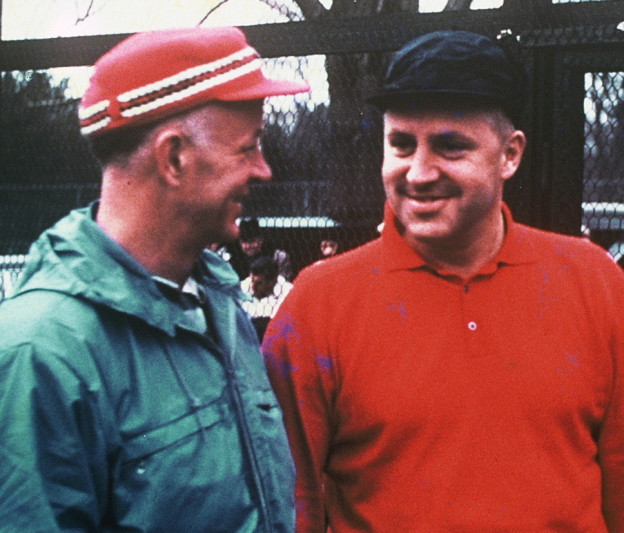
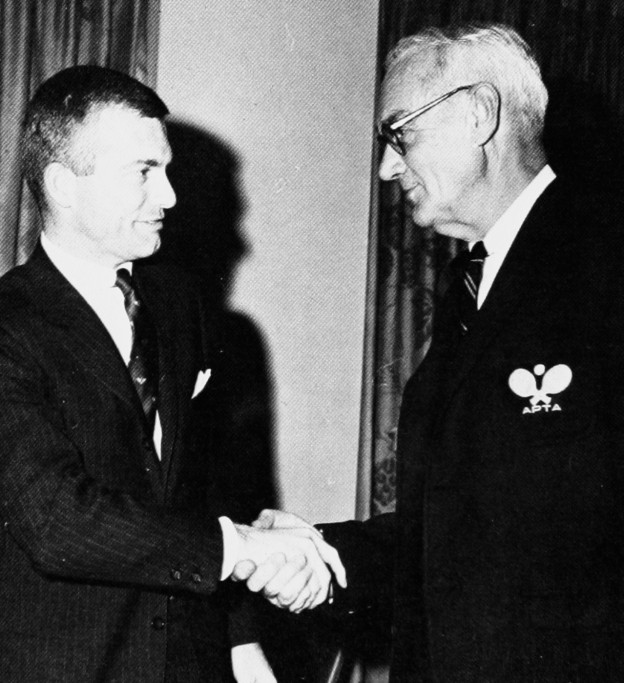
George Harrison (left) and Bill Pardoe

APTA Honor Award: Harrison and Pardoe

George R. Harrison won the Men’s Nationals in 1956 and 1960 and the Men’s 45+ in 1963. He was active in the APTA as chairman of the Rules and Equipment Committee and, during his tenure and through his efforts, the yellow-orange ball that replaced the original white ball was introduced and became the ball standard until the modern yellow ball was adopted. (Fox Meadow Tennis Club).

William E. Pardoe won the Men’s Nationals in 1956 and 1960, the Mixed Nationals in 1965. and the Men’s 50+ three straight times (1966-1968). He had one of the all-time best serves in the game, and brought the American twist service to platform tennis. (Fox Meadow Tennis Club).
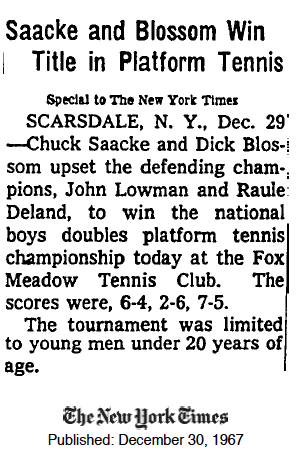
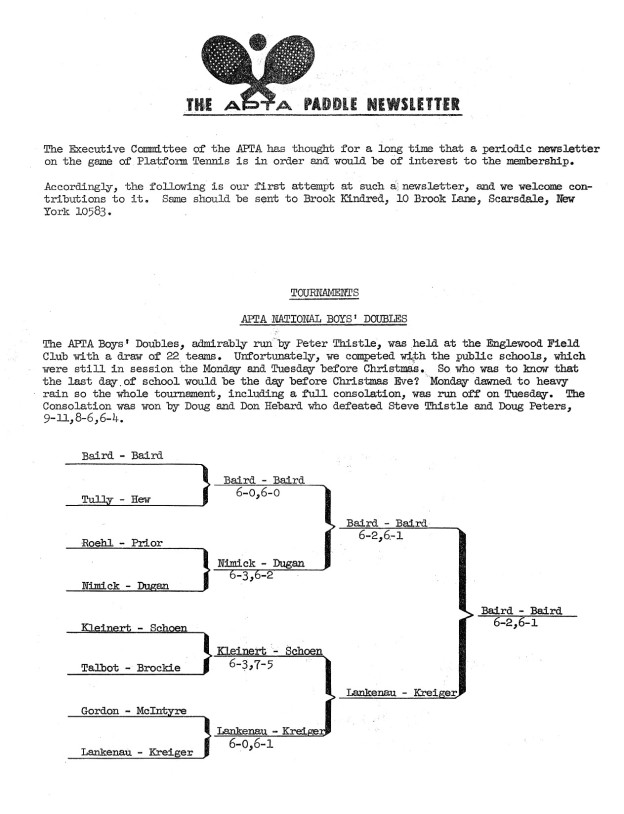
First APTA Newsletter

First APTA newsletter published

The newsletter leads off:

“The Executive Committee of the APTA has thought for a long time that a periodic newsletter on the game of Platform Tennis is in order and would be of interest to the membership. Accordingly, the following is our first attempt at such a newsletter, and we welcome contributions to it. Same should be sent to Brook Kindred, 10 Brook Lane, Scarsdale, New York 10583.”

The newsletter went on to cover the National Boys’ tournament (won by the Baird brothers) and the results of the Cleveland Invitational, Connecticut State Men’s, and Long Island Invitational. It also reprinted an article from the in-flight magazine American Way on paddle tennis.

The newsletter was edited by Fox Meadow member, Brook Kindred for four years

Gordon Gray from Greenwich, Connecticut, was one of the top male players from the late 1960s to the 1970s

National Championships now Include Men’s 60+

1969 - Rev 1

CBS had coverage of the National Mixed Doubles narrated by Heywood Halle Broun, Jr. [See APTA 1969 Annual Meeting Minutes]

Gordon Gray and Jesse Sammis reversed the result of the previous year’s finals and started on a three-year streak. ABC was on hand to film the Men’s Nationals and the APTA obtained two copies that they made available for loan to member clubs of the Association, as well as individual members.

Charlotte Lee and Peggy Stanton won the Women’s again for the third time in a row, and Charlottee Lee got back into the winners circle in the Mixed with Bradley Drowne.

Walter Frese and George Holloway won the inaugural 60+ Senior Men’s.

The Junior Boy’s was won by Charles (Chip) Baird, Jr. and Steve Baird. Chip went on to win five straight titles, twice with his brother Steve, twice with George Krieger and once with James Hartmann.

Source: Oliver H. Durrell, The Official Guide to Platform Tennis, 1967; APTA Platform Paddle Tennis 1963-1973: Rules and Records, 1973

Jesse Sammis won the Men’s Nationals (with Gordon Gray) in 1969, 1970, and 1971

Paul C. Molloy

Paul C. Molloy elected APTA President (1969-1971)

Malloy had been very close to the game for many years but, despite this, in his farewell remarks as President, he said, “….there is no way I can picture where our game will be 10 years from now. The instant appeal of the game is so great that it is impossible to estimate how long the accelerated growth will last and how far it will spread.”

Under his leadership the first newsletter was created to keep players informed of activities throughout the year and much work was done in scheduling and coordinating tournaments and satellite events in recognition of the new areas of growth in the game and their demand for tournament paddle. National rankings had also been established by the end of his term, with Hennessey donating cups to the individual man and woman gaining the most points from ranking tournament play. With the upsurge in women’s play, he was also instrumental in getting the APTA nominating committee to nominate a woman as Co-Tournament Chairman and a member of the APTA Executive Committee to give women the representation on the board that they deserved

Oscar F. Moore

APTA Honor Award: Oscar Moore

Oscar F. Moore served as President of the APTA from 1946-1948, which proved to be important growth years. He was credited with developing the mixed Scrambles or Jamboree, a format that gave the game much of its social overtones and proved to be very popular. Few people gave so much of their time and energy, or were so dedicated to platform tennis. (Fox Meadow Tennis Club).
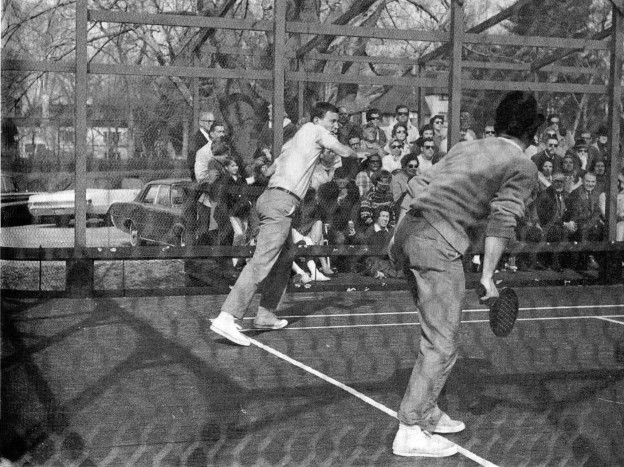
Peggy Stanton (left) and long-time partner Charlotte Lee.

National Championships

1968 - Rev 1

Gordon Gray and Jesse Sammis fell short again and were defeated by Bradley Drowne and William Scarlett.

Charlotte Lee and Peggy Stanton1 repeated in the Women’s, as did Gordon Gray and Anne Symmers in the Mixed, and George Lowman and Bill Pardoe in the Men’s 50+.

Cogswell’s daughter, Do Deland, was a finalist in the Women’s and his grandson, Rawle Deland, Jr., was the Junior Boy’s finalist

Source: Oliver H. Durrell The Official Guide to Platform Tennis, 1967; and APTA Platform Paddle Tennis 1963-1973: Rules and Records, 1973

Note 1: Margaret G. (“Peggy”) Stanton was a major contributor to the advancement of women’s platform tennis and a distinguished player. Besides winning the Women’s Nationals with Lee from 1967 through 1970, she went on to win two Senior Women’s Nationals in 1974 and 1977. She was the first female on the Board of Directors of the APTA

Screen Shot 2013-11-11 at 10.23.08 AM

Kimberly and Jennings defeated Richardson and Swanberg in the finals in four sets

National Championships

1967 - Rev 1

APTA President Ned Swanberg and his partner Tom Richardson lost to the 1964 Champions David Jennings and Oliver Kimberly, Jr. in four sets.

Charlotte Lee and Peggy Stanton won the first of their four straight Women’s titles, defeating two time champions Do Deland (Cogswell’s daughter) and Susan Wasch.

Gordon Gray and Anne Symmers won their second straight Mixed.

George Lowman and Bill Pardoe won their second straight Men’s 50+.

Gogswell’s grandson won the Junior Boy’s with John Lowman; they had been finalists in 1965 and 1966.

Source: Oliver H. Durrell The Official Guide to Platform Tennis, 1967; and APTA Platform Paddle Tennis 1963-1973: Rules and Records, 1973

Women's Nationals 1967: Peggy Stanton and Charlotte Lee
Women’s Nationals 1967: Peggy Stanton and Charlotte Lee

Walter Close (1916-1991) was know as a "doer" at the APTA as well as at Fox Meadow. The retaining wall he built between the club porch and the tennis courts still stands.

APTA Honor Award: Close, Stephenson, Sutter

Walter H. Close, Jr.: Walter Close started his platform tennis career in the early 1950’s and soon became known as a “worker” who gravitated to the important jobs. He teamed with Dick Hebard to win the National Men’s 45+ in 1960 and again in 1961. But, his accomplishments stretched beyond the court. He served as APTA Tournament Chairman from 1958-1959, after which he served as association President from 1960-1961. These were busy and successful years for the game and, during his regime, the APTA membership increased from 24 to 38 membership clubs. (Fox Meadow Tennis Club).

John A. Stephenson: John Stephenson served as Vice President of the APTA from 1941 to 1946, and as its President from 1948-49. An avid player and tough competitor, he won many local tournaments, and was very active in promoting paddle at the Manursing Island Club, and organized some of the first night play under lights. (Manursing Island Club, Rye, NY).

Clifford S. Sutter: Sutter won four National Men’s, two Mixed and one Men’s 45+. He was one of the canniest and most consistent players of the game, a student of placement and control of the ball who was at his best in the return of serve, where he altered both speed and direction. Sutter introduced many tennis skills to the game of platform tennis, and was a master of a prime offensive and defensive tool of the game, the lob. He introduced deeper lobs to the game than was common at that time and they were, in a word, devastating (Field Club of Greenwich).

Click on hyperlinks to go to Hall of Fame biographies

Men's Nationals, 1966: Richard Squires and Edward l. Winpenny, Jr

National Championships

1966 - Rev 1

The previous year’s finalists, Dick Squires and Ted Winnpenny, Jr., prevailed over the new and rising team of Gordon Gray and Jesse Sammis.

Charlotte Lee won her fourth Women’s title with yet another partner, Carolyn Nelson, and Gordon Gray and Anne Symmers won the first of their three straight Mixed titles.

The dominance by Fox Meadow teams had begun to wane.

Cogswell’s grandson, Rawle Deland, Jr., was a finalist in the Junior Boy’s for the second year in a row.

Source: Oliver H. Durrell The Official Guide to Platform Tennis, 1967; and APTA Platform Paddle Tennis 1963-1973: Rules and Records, 1973

Don Evans accepting the Honor Award form Brook Kindred. Evans solved the problem of inconsistent bounces of the wires, an innovation that spurred the growth of the game.

APTA Honor Award: 7 more pioneers honored

James M. Carlisle: Carlisle served as APTA Secretary from 1955-1957, and as President from 1957-1959. A winner in as many different kinds of tournaments as anyone else in the early years of the game, he won the Men’s Nationals in 1955 and 1958 with Richard K. Hebard. He also won the first and second annual National Men’s 45+, in 1957 and 1958, a tournament that he is generally considered to have founded. (Fox Meadow Tennis Club).
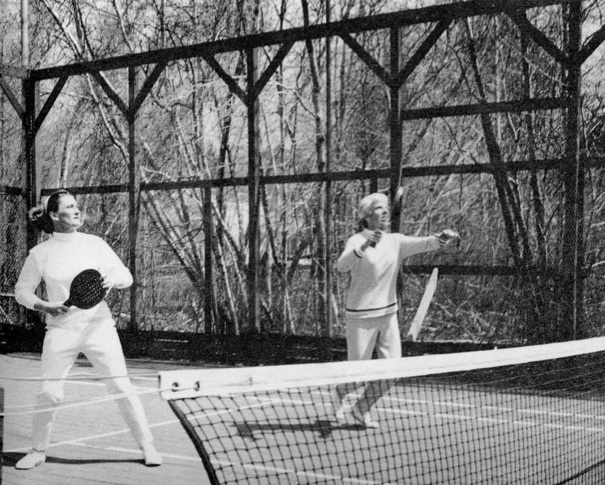
Donald K. Evans: Among his many accomplishments, Donald K. Evans is best known for the backstop that shares his name. In designing and producing the Evan Backstop, he solved the major impediment to the enjoyment and expansion of the game—the inconsistent bounces of the ball off the wires. He designed and built the freestanding taut wiring that is officially used today. The first installation was on Jimmy Cogswell’s court in Scarsdale, NY, during the winter of 1934-1935. (Fox Meadow Tennis Club).
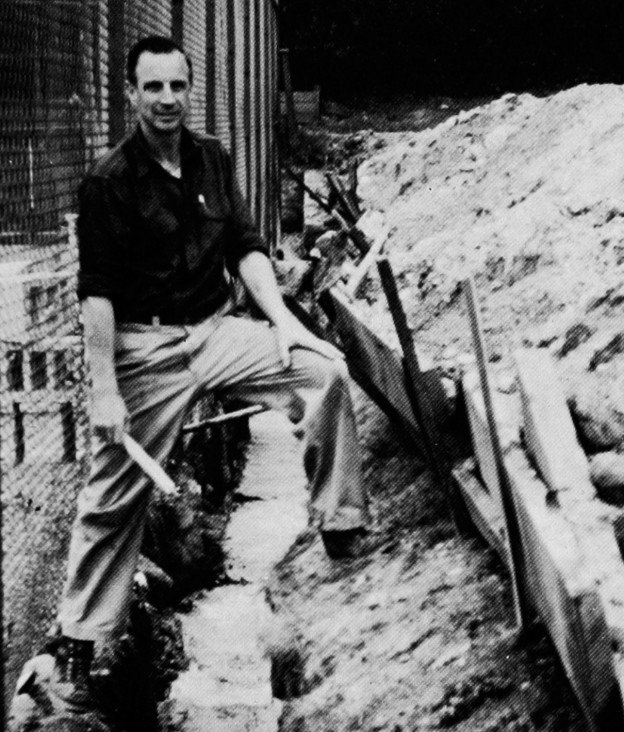
Harold D. Holmes: Harold Holmes was affectionately known as “Mr. Paddle of New Jersey” for his tireless efforts on behalf of the game in that state. A member of the Tremont Place Paddle Tennis Club in Orange, NJ, he also served as APTA’s second President from 1938-1939. (Englewood Field Club, NJ).

Barbara Bixler Koegel: Barbara Koegel was an accomplished tennis player who started playing platform tennis when she was in her mid-thirties in 1955, and won the National Women’s the following year and the National Mixed with A. H. (Zan) Carver, Jr. in 1964. She retired from competitive play in 1965 for health reasons. At her home club, Fox Meadow, she devoted time and talent to developing the skills of new players, which helped raise the level of women’s play. (Fox Meadow Tennis Club).

Charlotte McNeill Lee: Charlotte Lee made a mark in tennis before becoming an outstanding platform tennis champion, despite only starting to play the game in her early forties. Playing with a variety of partners, she won three straight National Mixed (1961-1963), and then again in 1965, and five National Women’s (1961, 1963, 1964, 1966, and 1967). She was a master tactician of the game. (Short Hills Country Club, NJ).

Frederick B. Walker: Frederick Walker served as APTA Secretary-Treasurer from 1948-1950, and as President from 1951-1953. In partnership with Dick Hebard, he won three National Men’s in 1949, 1951, and 1952, and was considered a master of the “drop shot” in his day, with one of the hardest forehands (Fox Meadow Tennis Club). He was the son-in-law of Fessenden Blanchard and his wife, Ruthie, was a very accomplished player in her own right, and a finalist in the National Women’s in 1956 and 1959.(Fox Meadow Tennis Club).
Marie Walker: Walker won five straight Women’s Nationals with Madge Beck from 1938-1942. They likely would have won more but the Women’s Nationals was not played from 1943-1945 because of travel difficulties during World War II and then not reinstated until 1949. (Fox Meadow Tennis Club).