L. Gillespie Erskine, Jr. Photograph taken at FMTC Centennial, 1983

L. Gillespie Erskine, Jr. elected FMTC President (1977-1979)

Louis Gillespie (Gil) Erskine (1921-) was born in New York City and spent his early years in Larchmont, NY, and nearby Scarsdale. Following graduation from Salisbury School, he attended Princeton University. Erskine left after his sophomore year to become a glider pilot in World War II, stationed primarily in Rome. He received the Air Medal for his service.

Following the war, Erskine received a law degree from New York University, which, taking his war experience into account, accepted him as a student despite his not having graduated from college. He was happy to pass the Bar exam on the first try.

The last 25 years of Erskine’s business career were spent as president of Financial Institutions Retirement Fund, located in White Plains, NY. He retired in 1986, having growing the business very successfully.

The Fox Meadow Tennis Club has been an important part of Erskine’s life ever since his family joined when he was a teenager. Until recently, he has been active on both the tennis and paddle tennis courts.

Erskine assumed the presidency of the Club in 1977. During his term Phoebe Creamer became the first woman allowed to serve on the FMTC Board since Hopeton Atterbury’s presidency in the early 1900s. Women were not accepted for full membership in the Club until the prior term of John Ware. Creamer was opposed to women on the Board, but, having been elected herself, she proved to be an outstanding member according to Erskine.

Since Erskine’s retirement from the Board 36 years ago, his interest in sport has continued. He founded The Westchester Triathalon, a recognized sporting event; played tennis at the Club until recently, and now takes frequent energetic walks at the age of 94.

Source: Molly Ware interview with Gil, April 2015

Gil’s brother, W Birks Erskine, was killed in WWII and is on the Clubs Honor Roll for service to their country.

Phoebe Creamer in her favorite spot - the Felix McCrea memorial rock.

A woman returns to the FMTC Board of Governors for the first time since early 1900s

Phoebe Creamer became the first woman to serve on the Board since the early 1900’s: “I think they thought that if they had to have a woman on the board they would take an old-time conservative person who wouldn’t rock the boat too much,” she said.

The club’s constitution had been re-written in 1913 and women were excluded from the governance of the club. Prior th the change Hopeton Atterbury had served as President in 1907 and 1909.

Source: Diana Reisch Fox Meadow Tennis Club – The First Hundred Years, 1983

John P. Ware (1921-1999)

John P. Ware elected FMTC President (1975-1977).Paddle courts changed to all aluminum

John Ware (1921-1999) was born in Chestnut Hill, MA and was a graduate of the Brooks School and Princeton University. He served as a first lieutenant in World War II as well as in the Korean War where he received the Bronze Star.

Before his retirement in 1987, he was director of industrial sales and professional development at John Wiley & Sons, publishers, and served on the national committee of the American Society for Training and Development

The wooded paddle courts were always difficult to maintain and the club began experimenting with an aluminum deck in the early 1970s. After some trial usage, and with the Board anguishing over the cost, the decision was made during Ware’s term to convert all the courts to all-aluminum. The new courts now had heaters under them to melt snow and ice and this extended the available playing time.

Ware served as APTA President from 1961-1963 where he was a great supporter of developing junior players. He was known as the game’s historian and was inducted into the APTA Hall of Fame in 1995

APTA Boy’s Doubles- FMTC juniors make it to the finals but lose to the Baird brothers

No one from Fox Meadow had won the Boys’ Doubles yet, but in 1969 the Club’s Clay Auxford, son of Sally Childress Auxford, and partner Hi Lankenau of Chappaqua made it to the finals. They lost 6-3, 2-6, 6-1 to Chip and Steve Baird, brothers from Chevy Chase, Maryland, who won the Men’s National Championship in 1976. Steve Baird and partner Rich Maier dominated the game in the 1980s and early 1990s

Source: Adapted from Diana Reische, Fox Meadow Tennis Club – The First Hundred Years, 1983

Koegel Award Recipients

Barbara Koegel (1921-1968) and the Koegel Award

Although she won twenty club titles in tennis and paddle, as well as two APTA titles, one in Women’s Doubles and one in Mixed Doubles, and was inducted into The Platform Tennis Hall of Fame in 1966, Barbara Koegel is remembered best at Fox Meadow for the help and encouragement she gave to other players, as opposed to her own play. As coach of the Paddle Pals at FMTC in the 1950s and 1960s, she made it fun to work hard at improving one’s game.

Barbara’s husband, William F. Koegel, served as President of FMTC from 1973-1975.

Source: Adapted from Diana Reische, Fox Meadow Tennis Club – The First Hundred Years, 1983

Several ladies chairmen gave credit for team play in the late 1950s and the 1960s to Koegel. When Barbara coached Paddle Pals, says Delsa Wilson, she instilled a competitive spirit by constantly telling the players, “You have to want the ball to come to you.” Dotsie Erskine added, “It was fun to improve our paddle because our mentor Bobbie Koegel engendered such spirit and sportsmanship and camaraderie.”

During her tenure as ladies chairman, Clare Kingsbury and her committee proposed that the Club create a suitable memorial for Barbara Koegel, who died in 1968. The award reads, “given in memory of a champion who gave her time and talents to develop paddle tennis among women of our Club.” Presented to women Club members for achievement and sportsmanship, the Koegel award winners are listed on a plaque created in the form of a huge paddle by Scott Wood.

Source: Adapted from Diana Reische, Fox Meadow Tennis Club – The First Hundred Years, 1983

Barbara Bixler was born October 11, 1921 in Jersey City, New Jersey. She and her younger sister, Joan, were the only children of Donald and Dora Bixler. At an early age, Barbara and her family moved to Forest Hills, New York, where they joined the West Side Tennis Club, which was then the foremost tennis club in the area and the site of the men’s and women’s National tournaments. She took up tennis as a young girl at her father’s urging, under the tutelage of the club pro, George Agutter. He held the job at West Side for 46 years, was described by Al Laney as “the country’s No. 1 tennis professional,” and was much loved and respected. He developed in his pupils a sweeping style of backhand that was very graceful and very effective, and such a trademark that his pupils could often be identified in later years.

Barbara’s tennis developed very rapidly and she became the club’s women’s singles champion while still in high school. The family moved to Garden City, Long Island, in the late thirties, but kept the West Side membership. In 1940, Barbara played in the Nationals (then on grass) and in the first round defeated the French girl’s champion. According to the newspaper account: “A sunny blonde, enjoying her first attempt in the big tournament, made the home club people very happy – to say nothing of her mother and father who watched joyously as she made a sensational battle out of a losing fight and scored a coveted victory. (0-6, 6-1, 6-1).”

Barbara went on to Smith College, where she graduated in 1943. She was captain of the tennis and squash teams and won the college championships in both sports. After marrying William F. Koegel in 1946, she and her husband lived in Charlottesville VA where he attended University of Virginia Law School. There, she continued to play tennis while she also began to raise a family. She won the Albemarle County (Charlottesville) ladies’ singles championship and played squash, non-competitively.

In 1949 she moved to Hartsdale and in 1952 to Walworth Avenue in Scarsdale. She played at County Tennis Cub until 1955 and was the ladies’ tennis champion. In that year she and her husband joined Fox Meadow Tennis Club and her attachment to paddle tennis began. In ten years, until she gave up competitive play in 1965 for health related reasons, she won twenty club titles in tennis and paddle and won the APTA National Women’s Doubles in 1956 (with Mrs. Peyton [Sally] Auxford) and the National Mixed Doubles title (with Zan Carver) in 1962.

Fessenden Blanchard, in his book Platform Paddle Tennis, had these comments about Barbara Koegel: “Mrs. William F. (Barbara) Koegel is another first-class player, who has come to the top in recent years. She is a sister-in-law of the highly rated Frank Guernsey. In the semi-finals of the national mixed doubles at the Wee Burn Club in February 1959, she played as fine a game as I have ever seen any woman play. Though she and her partner, Herman Schaefer, lost to George Lowman and Sally Auxford in a very close, exciting match, Barbara’s steadiness and poise in returning difficult shots off the wires, her low volleying, her backhands and her all-around play were outstanding. And she continued her fine play in reaching the finals of the 43-team national women’s doubles championship in 1959, with my daughter, Mrs. Frederick B. (Ruthie) Walker, as her partner. As Kitty Fuller put it, she is ‘what the men call a real clutch player’.” And, as one of her partners put it, ‘she’s a spectator’s joy and a partner’s dream’.”

In the late 50’s and early 60’s, she served as captain and coach of the Westchester Junior Wightman Cup team. The Wightman cup was donated by the Queen Mother of tennis, Mrs. Hazel Wightman, who was herself a winner of forty-one national championships. The annual competition was, and still is, between English and American teams. Play would alternate between Wimbledon and Forest Hills. To encourage interest in the younger girls (up to 18), teams were formed from Westchester/Connecticut, Long Island and New Jersey. Barbara, who knew Mrs. Wightman well from Forest Hills days, agreed to captain the Westchester/Connecticut group of about two dozen girls, including several from Fox Meadow. She devoted a great deal of time to the practices and the matches and got great satisfaction from the experience.

Barbara died on October 16, 1968, after a four-year bout with colon cancer, at the age of 47.

Sally Barnes Bondurant

Sally Barnes Bondurant was another of the second-generation paddle players to emerge in winners’ lists in the 1960s. With her mother, Helen Barnes, Bondurant took the Club Women’s Doubles title in 1968.

Paired with Spencer Brent, son of Old Army Athlete Rufus Brent, she collected the Mixed Doubles championship.

Bondurant paired with various partners to win most of the Club’s member and invitational tournaments in 1968.

Bondurant, along with her sister, Lucie Bel, had an impressive tennis career as a junior (see The Barnes Sisters and ended up compiling an even better record on the tennis courts winning the Singles title four times – 1965 and 1967-1969 and the Doubles three times – 1965-1967, the last two with her mother.

Source: Diana Reische, Fox Meadow Tennis Club-The First Hundred Years, 1983

Bob and Clare Kingsbury

Robert R Kingsbury, multiple winner in tennis and paddle and APTA President

Bob Kingsbury, the son of FMTC President Ollie Kingsbury (1965-1966) captured an enviable number of club tennis and platform tennis crowns.

In tennis he won the Singles five times – 1966-1967, 1969-1970 and 1975, and the same number in Doubles – 1962 (with his brother) and 1969-1971 (with Zan Carver). In Mixed Doubles he won six championships all with his wife, Clare – 1968, 1970-1973, and 1975-1976.

Teamed with Zan Carver, Kingsbury won the club Men’s platform tennis title five years running, from 1968 to 1972, and the Mixed Doubles six times, again all with Clare – 1970-1974 and 1976.

In APTA National championships, he and partner John Mangan of Manursing Island Club were Men’s Doubles runners-up in 1970 and 1971 before clinching the title in 1972 at Fox Meadow, and again in 1973 in Cleveland.

Kingsbury served as APTA President from 1978-80 and was inducted into the Platform Tennis Hall of Fame in 2003.

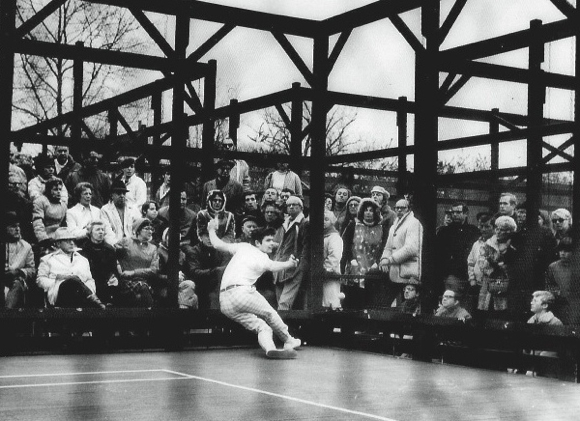
Bob Kingsbury making one of his great "gets" Bob Kingsbury making one of his trade-mark “gets”

Hugh King, Jack-of-all-trades

Hugh King hired as FMTC caretaker

In searching for a new caretaker board members consulted with Felix McCrea, who had retired after almost 20 years at the club on a full-time basis and five more years on part-time. He suggested they talk to the foreman of the Scarsdale Parks and Recreation Department, namely Hugh King.

Hugh admitted that when Jim Carlisle approached him about the job, he was apprehensive. He was, after all, a family man with three young sons. At the Village he had a staff under him, and a pension. “So I sat with Felix,” Hugh said in a voice that still echoes County Galway, “and he told me he was there during the Depression, and that there were days when nobody came into the Club. And Felix said, ‘I never lost a paycheck. You don’t have to worry about security’.”

When Hugh King was hired in 1967, FMTC acquired a man who was to become universally liked and admired. And the feeling was mutual. “I didn’t expect that I’d become part of a big family, but that’s what the Club is.” To the Club, he contributed not just his own devotion, but also the help of his wife, Rose, and that of his three sons. Each has pitched in, whether it was one of the boys shoveling snow or Rose King taking the curtains home for a wash. “Rose is not there as often as Hugh, but when she is, with her marvelous twinkle, it is a definite asset,” said Molly Kindred.

Former President Bob Lee commented that to replace Hugh would take five or six people: “His Irish wit and his unbelievable tact have solved more problems! You wonder who the president is sometimes because he finds a way to solve the problems you’ve been thinking about.”

The 1976 ladies chairman, Donna Henderson, touched on another side of the Club manager’s caring personality. “Who else would think of assisting a robin to repair its nest as I saw him doing on the porch eaves this morning?”

“The overriding characteristic of both Felix and Hugh,” said Brook Kindred, “is that they were more like Club members than employees. Their spirit, their care, their involvement was so much deeper. If I were to leave the Club, certainly I’d miss my friends, but I would miss Hughie King as much as any person I know here.”

When Hugh retired in 1994, his son Kevin took over.

Source: Adapted from Diana Reische, Fox Meadow Tennis Club – The First Hundred Years, 1983

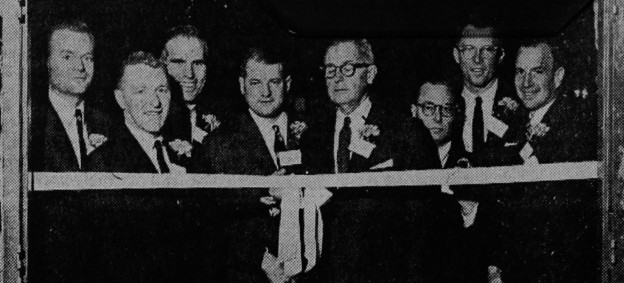
: President Ollie Kingsbury wields the scissors as the new wing is formally opened. Watching are Governors Wilson, Sullivan, Ware, Nagle, Hammer, Tredwell and Close

FMTC opens new wing

It had been a controversial journey but the new wing was now a reality thanks to the efforts of Kingsbury and Close.
Screen Shot 2014-01-07 at 11.15.35 AM
Ollie Kingsbury weilds the scissors as the new wing of the clubhouse is formally opened. Watching are Governors Wilson, Sullivan, Ware, Nagle, H Hammer, Tredwell, and Close.

Fox Meadow members have enjoyed singing together and, on especially happy occasions, can be counted on to have their own lyrics ready. The opening of the much-disputed new wing at the Governors’ Tea in 1967 was such an event.

“Maybe the spirit unique in Fox Meadow can’t be entirely captured in cold type,” muses Ollie Kingsbury, “but a seven verse song and chorus composed for the occasion comes rewardingly close.”

The credits read “Lyrics by John and Ellie Lou Kirk and Bob Kingsbury (with constructive editing by numerous members). Performed to the music of ‘The MTA,’ strummed by Julie Westland and Dotsie Erskine. Directed by Delsa Wilson.” The “Pudge” in the song was Pudge Neidlinger, house and grounds chairman and an architect by training, who gave form and function to the wing. Here is the chorus and first verse:

Under Close control the machine began to roll
As Walter paved the way
Then to Oliver K the reins were passed one day
And the Wing was on its way.

Pudge gave it style—it was lawyered by Carlisle.
Pushed through the neighbors by the Board.
It’s a monument; it’s a testament
And it’s all we members could afford.

Source: Adapted from Diana Reische, Fox Meadow Tennis Club – The First Hundred Years, 1983