



More than 80 juniors from the tri-state area gathered at Fox Meadow Tennis Club to open the 2006-07 Viking Junior Tour. Participants in Viking Junior Tour events earned points toward an end-of-season ranking – but most importantly, they had a great day of platform tennis!

Player Profiles: Brad Kelly and Brett Englesberg
Brad Kelly
Age: 38
Married: Jenny
Children: Lauren (11), Anna (9) and Ben (6)
Born: Charleston, WV
Resides: Pittsburgh, PA
Education: BA Business Marketing WVU (1991)
Occupation: Director of Brokerage Services ECHO Real Estate
Like many of the top platform tennis players, Brad Kelly was a full-scholarship, Division 1 college tennis player. At WVU (Top 20 national college tennis team), Brad captained his team to nine conference championships in singles and doubles. He was one of three Division 1 All-Americans in WVU tennis history and he also earned a USTA National Indoor Doubles Championship title.
Brad moved back to Pittsburgh in 1995. He recalled, “I knew a lot of guys that played platform tennis at The Pittsburgh Field Club and they got me out there to give platform a try.” He added, “At first, I relied on the similarities with tennis – really the basics such as strokes and footwork. Over time, I learned the mental aspects. In tennis you look to finish points and that is the exact opposite of what you need to do in platform tennis.”
For several years, Brad played league matches as a social outlet. He said, “I met Brett through paddle in our league play. One night after we played each other we decided that it might be fun to try a few tournaments together. That was four years ago.” He added, “I think that the biggest help for my game has been to travel and play tournaments. When you play the same people all of the time it can be misleading. There are lots of different styles out there and it makes you better to play different people.”
Brad added, “I like the competition, the challenge, and probably most of all the people within the sport. Brett and I have traveled to several cities to play and the people are always very fun, good people to hang with.”
He concluded, “Brett and I have always set goals with our ranking… they are getting tougher to reach. We have reached our goal every year so far but this year will be the hardest (can’t tell you what it is).”
Brett Englesberg
Age: 33
Married: Melissa
Children: Sophia (5), Isabella (2) and Gabriella (4 mo.)
Born/Resides: Pittsburgh, PA
Education: BA Business Marketing PSU (1996)
Occupation: Senior Planner / Dick’s Sporting Goods
Tennis was always a natural for Brett Englesberg. In high school, he was the Pennsylvania State Champion in 1991 41′ and a finalist in 1990, earning him two all-American awards. In college, Brett played 3 and 4 singles for Penn State and 1992-1996.
“I got interested in platform tennis through local friends who really enjoyed the sport. I then joined my local township paddle team. That was seven years ago.”
He added, “Brad and I have become great friends through paddle. We have improved over the years by learning intricacies of the game and how to play strategically as a team. Playing tournaments has helped us tremendously because you can learn so much from both watching and playing the top teams.”
Comparing the similarities of tennis and platform tennis, Brett said, “Striking the ball is the only similarity. Everything else is different in platform tennis: strategy, effectiveness of spins, playing the screens, volleying closer to the net, softer overheads, driving at the body, importance of good lobs, shorter swings, and faster hands.”
He said, “I like the teamwork, strategy, and fast pace of the game. As we all know, it is also a great way to get exercise during the winter.” He added, ‘Tennis players will be frustrated at first but if they stick with it, they will learn to love platform tennis.”
Brett concluded, “Watch tournament matches and read what you can. The instructional tips in PTM are generally very helpful.”
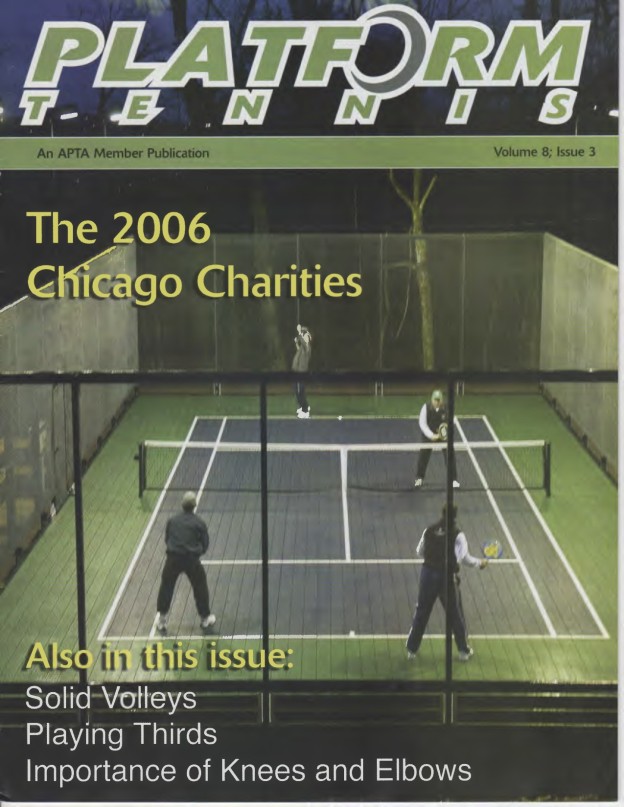
Chicago Charities coverage by Jean Kempner
Jean Kempner reported for PTM:
As the first “major” of the year, the Chicago Charities tournament picked up where last year’s Nationals left off. Story lines were continued, rivalries were resumed and new partnerships featured exciting and fresh dynamics.
The Women’s tournament showcased all of last season’s top teams and, though the pairings hadn’t changed, the results were clearly different. Mary Doten and Susie Keane came in as defending National Champions and made it to the final without dropping a set to stage a rematch of last season’s National final against Kerry Delmonico and Aila Main. Delmonico and Main had a tougher road and won a three-set semi against Cynthia Dardis and Amy Shea 4-6, 6-2, 6-1. Doten and Keane had beaten Sally Cottingham and Chris Sheldon in their semi in a 6-3, 6-3 slugfest. Cottingham and Sheldon had broken through to their first Chicago semi by defeating Bobo Delaney and Tonia Mangan in a three-set quarter ending an “0 for 5” losing streak against the always-tough east coast team.
To say that the women’s final was a great match would be an understatement. The best two teams over the last three seasons squared off and, after some early jitters on both sides, the match settled into a rhythm of great shot-making and subtle momentum changes. Delmonico and Main took the first set 6-3 before Doten and Keane ratcheted up their offense to win the second set, 7-5. Responding to the aggressive attack, Delmonico and Main picked up their volleying and, as is the case in tight matches, they managed to win one or two more key points than their opponents and took the final set and the championship, 6-4.
Aila Main described the match as “the best match Kerry and I have ever played. Doten and Keane are great competitors and the match easily could have gone either way.”
Back-draw winners were: Cooper/Rohrbach (64’s), Blackwell/Yamada (32’s), Frei/Sierks (16’s), and Prop/Schneebeck (quarters).
The Men’s draw was made more interesting by the debuts of some new top teams and the resurgence of Chris Gambino and Dave Ohlmuller. Flashing back to their amazing run of three years ago, Gambino and Ohlmuller won the Championship without losing a set and defeated the winners of the last two Nationals Championships in the process.
The semis featured Gambino and Ohlmuller against the 2006 Nationals winners and top ranked team of Dave Keevins and Brian Uihlein. After being down 2-5 in the first set, the former number one team steamrolled the rest of the way for a 7-6 (4), 6-1 victory. Gambino-Ohlmuller had defeated 2005 Nationals champions Bill Anderson and Mike Stulac in the quarters in dominating fashion 6-1, 6-1.
The other semi was a great clash of a legendary team and a new team of two players who are knocking on the door. Mike Cochrane and Scott Estes, partnered just this season, took down Flip Goodspeed and Scott Mansager, 6-1, 7-5. Cochrane’s all-court play and Estes’ brick wall consistency proved too potent a combination for the veteran Goodspeed-Mansager team. Cochrane and Estes had beaten Bill Fiedler and Mike Marino in three sets in the quarters to avenge their finals loss at this year’s Premier Cup in what was the most entertaining match of the tournament.
With a “we’re back and we’re serious” confidence, Gambino and Ohlmuller showed what made them such a dominant team in the past. Ohlmuller’s unique and spectacular volleying style left the opponents and the crowd shaking their heads, and Gambino’s solid and intelligent all-around play was too much for Cochrane and Estes to overcome. The winners unforced error count was in single digits and they fashioned a methodical 6-3, 6-3 win to take the Charities title.
Back draw winners were: Kepner/Sturges (128’s), Baladad/Martin (64’s), Albrikes/Jonason (32’s), Broderick/Moore (16’s), and Anderson/Stulac (quarters).
The Men’s 95’s event was won for the second year in a row by the father/son team of Scott Estes Sr and Scott Jr. Their victory this year was over Mike Sullivan and Rick Johnston in a hard fought three setter.
All three events fielded a total of 130 teams and made for a great weekend of platform tennis.
The Glen View Club staff did it’s usual first-class job and helped to make the Chicago Charities one of the stellar tournaments of the season.
Source: Platform Tennis Magazine, Vol. 8, Issue 3, January, 2007
Springfield bests Chicago in Platform Tennis innovation
Springfield, IL demonstrated yet again why it is the oasis of right-minded paddlers, opting to join its brethren from the east in embracing Premier Purple courts during resurfacing in September.
Prior to the resurfacing, Premier’s Dave Dodge, with assistance from friend and competitor Bullet Brown, re-welded two of Springfield’s courts. This eliminated dead spots that some locals referred to as a “Clark Spot,” or a “Bean There.”
“Premier and Bulletworks work together on a number of each other’s bigger projects,” said site impresario, Dan Kepner. “It’s nice to see that kind of cooperation amongst rivals in a sport so small that clashing personalities and interests could bring it down.”
The decision to go purple was difficult. Local players were evenly divided between “traditionalists” and “innovators.”………..(cont.)
[enlarge image to read full story]
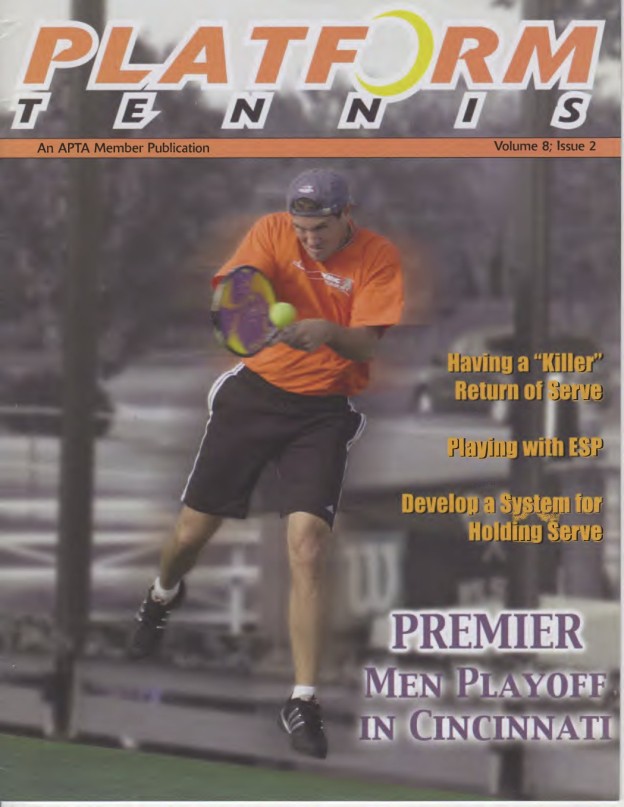
Premier Cup held at Four Bridges CC in Cincinnati, OH
They came to the Four Bridges Country Club in Cincinnati from all over: Chicago, Toledo, Pittsburgh, Philadelphia, New York, New Jersey, Baltimore, Boston and Cincinnati. Sponsored by Premier Platform Tennis, Wilson Sporting Goods and Michelob Ultra, David Dodge (Premier) and promoter Jason Gray invited the top 16 men’s players to compete for a $5,500 purse at the 2006 Premier Cup.
“The best tournament of the year!”
“The highest level of play in the game today”
“I’m here to take home the cash.”
These were a few of the quotes offered by the players. An overwhelmed and enthusiastic Cincinnati audience had similar comments not suitable for printing.
After a Saturday round-robin featuring two four-team brackets, the top two teams in each paired off against the top two in the opposing bracket on Sunday morning semi-final play. Sunday saw David Keevins and Chris Gambino play against Mike Cochrane and Scott Estes in one semi and Mike Marino and Bill Fiedler play against Mike Stulac and Bill Anderson in the other.
With Estes/Cochrane and Marino/Fiedler prevailing in their semi match-ups, the finals demonstrated incredible talent from the game’s top players. In the end, Marino and Fiedler succeeded to take home the trophy, the cash and most importantly, the bragging rights into what is sure to be a very competitive 2006-07 platform tennis season.
Source: Platform Tennis Magazine, Vol.

Viking celebrates production of 25,000th OZ paddle
Viking Athletics announces the manufacture of its 25,000 OZ paddle, the most played with paddle in platform tennis.
To celebrate, Viking is giving away more than $25,000 in product.
Viking will be supplying every paddle manufactured for the upcoming 2006/2007 platform tennis season with a scratch-off ticket that is redeemable for product at the Viking Pro Shop.

Paddle in Atlanta surges
Ansley Golf Club and Piedmont Driving Club played hosts to the 1st Annual Peachtree Invitational Platform Tennis Tournament January 14 & 15. This is a new APTA Region VII PCQ event that follows on the heels of last year’s successful exhibition and clinic that kicked paddle in Atlanta into a higher gear. The two-day event was limited to 16 teams due to court capacity (there are currently just two courts in Atlanta). Nine players traveled in from as far away as New Jersey and Virginia to participate in the event.
Atlantans Jay Bailey and Peter Lauer took the inaugural Peachtree title over brothers John and Nick Gill (from DC & Alabama). Bailey and Lauer also won the Southern Invitational in Winston-Salem, NC, two weeks later over Mark Fischl and Alex Whaling. [enlarge image to read full story]
Summer paddle…why not says Matt Terry
The snow had melted and leaves were starting to appear on the trees. Knees swollen from a winter of pounding on the paddle courts had started to heal. Tennis whites and racquets with strings had been removed from the closet. Then the phone call came. A good friend called and said, “I played tennis last night. It occurred during the match that paddle is much more fun than tennis. Would you be interested in playing paddle during the summer?” Three thoughts came to mind after hearing the proposal. First, that paddle really is more fun than tennis. Second, there was no reason that we couldn’t play during the summer. Last, could we find anyone else crazy enough to play? [enlarge image to read full story]
Player Profiles: David Keevins and Brian Uihlein
It seems that David Keevins must have grown up with a racquet in his hand. At 18, he received a full scholarship to play tennis at the University of Kentucky. By the end of his senior year, he was ranked #37 nationally in singles.
After earning his MBA from the University of Chicago, David was burned out on tennis. He explained, ‘Tennis no longer interested me. Someone suggested platform tennis so my dad and I went to our club (Tennaqua) and played. We both liked it. I was hooked.”
David knew Brian Uihlein from junior tennis. About ten years ago, Brian and John Hough began inviting David to play in their platform tennis practice games. They have been practicing ever since.
Comparing his tennis background to platform tennis, David said, “Paddle is a game of mistakes. Power has less of a premium, just look at the lobbing nature of the game.” He added, “In tennis, sometimes one break is all a person needs to win a set and two breaks almost certainly ensures winning a set – especially if the tennis player has a big serve. Not so in paddle. I have lost my share of sets after being up 5-0 or 5-1.”
Asked why he liked platform tennis, David said, “My three favorite aspects of platform tennis are: First, it is a great cure for cabin fever. There is nothing better than being outside in the winter time. Second is the people. Some of my closest friends I have met through platform. Third is the social nature of the game. Although everyone tries hard and competes well, no one seems to lose sight of having fun and sharing a drink after the game.
Not a natural volleyer, David had to work hard on that aspect of his game. He said, “I knew if I wanted to compete at a higher level there were two parts to my game that needed to really improve. The first was my volley and the second was my lob.” David was lucky to have two practice partners for one-on-one-type drilling – his wife Kristin and his friend and mentor, Craig Wilson.
Before Short Hills and the Nationals, David and Brian played a warm-up tournament – the Illinois States. They were pressed along the way and wound up losing in the semi finals to their good friends Peter Berka and Ed Granger. David recalled, “The next day we talked about the match and one very obvious conclusion was that my lobs were way too short. We never got a good look at a drive because they were always hitting overheads two feet from the net. Brian suggested we take few lunch hours and do some lobbing drills.” He added, “Even in practice I was really struggling. I was focusing on height (trying to hit my lob sky high) as opposed to depth (five feet behind the service line).”
It just so happens that as they were drilling, the pro at Onwentsia Club, Rod Workman, was walking by the courts. Brian said, “Hey Rodney, how do you teach the lob?” Without skipping a beat, Rod fired back, “The lob? That’s easy. Cup of water. Pretend you have a cup of water on the face of the paddle. Get the paddle below the ball, having the paddle face parallel to the ground. If you don’t extend straight up toward the sky, keeping the paddle face parallel to the ground during contact, the cup of water will spill. Cup of water, baby!”
From that moment on, David’s lobs improved. More importantly, he became just as excited about a good, deep lob as he did a big forehand drive. David concluded, “Drilling is key. Craig Wilson can attest we did a lot of lob / drive drills the three weeks leading up to the nationals.”
Asked about the transition from tennis, David feels that tennis players should try as quickly as possible to leave their tennis instincts behind (not their tennis skills, but their approach to the game). He said, “Tennis players need to become comfortable letting the ball go to the screen and lob it back. I see too many new (and even veterans) try and block hard overheads and drives from the baseline, as opposed to letting the ball hit the screen and have an easy lob back.”
Looking back at his stellar year, David said, “Brian and I went 16-1 over three national ranking tournaments with victories at Short Hills and the Nationals. Never in my wildest paddle dreams did I think I would ever be part of a team that could have that sort of a Cinderella season.”
Discussing his health, David said, “After some bad knee injuries over the past seven years, the greatest pleasure for me is just being out on the court.” He added, “In the future I would like to see trying to spread the National Tournament over three days — perhaps play the first round or two late Friday afternoon / evening. I understand the logistics of this are challenging but having to play five matches on Saturday (for many teams) is extremely hard on the body.”
David concluded that he reads PTM religiously – particularly enjoying the features and instructional articles.
Known by his peers as the most offensive player in platform tennis, Brian first started playing platform tennis in his early 20’s after graduating from the University of Minnesota. In college, Brian was an All-american tennis player, ending up ranked #3 in the country senior year!
Brian was intrigued by the strategy of paddle tennis. He said, “There are a lot of different shots and strategies that occur in a match.” He added, “When you are playing well you can anticipate how the point is played out 3-5 shots ahead of time. In tennis the rallies are so short.”
Asked what he enjoys about playing platform tennis he smiled and said, “I like frustrating people with spin overheads, hitting a great deep lob, winning volley exchanges at net, and definitely winning.”
Brian plays twice a week because he feels that if he only played once a week he wouldn’t get used to seeing the ball very well. “1 do drills a couple of times a year especially before a tournament.” He smiled and referred to his friend Peter Berka’s new book and said, “I also try to read Winter Warriors before each tournament.”
Asked how the average player can improve, he said, “For newcomers I would try to play with people that are better than you and ask them their strategies. Some of the best advice I have received has come from Rich Maier, Bill Fielder, etc.
Brian’s spin overheads have dominated the tour for years even though he just earned his first National Title. Looking towards the future, Brian said, “I hope my shoulder doesn’t fall off and that I can continue to play three tournaments per year.” He added, “I think paddle is a great game and would like to see the game continue to grow. It is a very social game that really helps pass the winters by and make some great friends.”
Asked about making improvements to the game, Brian said, “I think the APTA has done a good job of growing the game. I hope they continue to make decisions in the future based on the growth of the game.” He added, “I would like to see the game change to reward aggressive play.” Elaborating further, he said, “I don’t know how you can do it but I don’t think having people being able to hit back 50 lobs is fun for people to watch. I would love to see the ball take spin even more. Obviously I am biased but I remember actually being able to cut some of the old balls in half. It makes it pretty hard to retrieve a ball that ends up in two pieces lying on the ground.”
Brian concluded by talking about shortening the number of rounds played per day in tournaments. He said, “Short hills is a great format for me. Trying to play five matches in one day at the Nationals took a few years off my life.”
Source: Platform Tennis Magazine, Vol7. Issue 5, April, 2006
New England Junior Boy’s Open
On Saturday, December 10th the New England Junior Open was held at The New Canaan Field Club. It was one of the first ranking event of the junior paddle season. Seventy four children participated, representing four states in the general area.
10-and-underWinners:
Peter Simonds and Daniel Adajian both of Southport and Fairfield defeated Reed Schultz & Jack Jeffrey of New Canaan 8-1 in a pro set.
12-and-under
Patrick Newton and Carter Lovejoy from New Canaan, played a tough fought match against CJ Purse of Greenwich and Parker Connolly of Wilton. They were victorious after an exciting three setter (1-6, 6-1, 6-3).
14- and-under
Jason Ottomano and Nick Newhouse from Weston, CT pulled out a third set tie-break beating the Safford brothers from Philadelphia.
18-and-under
Terry Keegan from Fairfield and Liam Bohonnon of Westport, defeated Jay Schwab and Cole Barris of Scarsdale 2-6, 7-5, 6-4.
The juniors received “got paddle?” long sleeve shirts, printed by former national champion Cindy Prendergast.
Mike Gillespie, tournament director said there has been a very impressive increase of juniors playing in the area. He attributes one reason for this growth is that more pros are teaching paddle. The Professional Platform Tennis Association (PPTA) tests and certifies pros and over the past three years, certification has tripled. Gillespie said “People are improving and having more fun in the process”. Gillespie has been running the New England Junior Open for years and in just one year the event has grown by an additional 25 kids competing. Gillespie has a bit of experience himself, having competed and won the 18-andunder Nationals in 79 & 80. He went on to become a finalist in the 92, 94 and 02 Men’s open Nationals.
Source: Platform Tennis Magazine, Vol. 7, Issue 4, February, 2006
 © 2026 Platform Tennis Museum and Hall of Fame Foundation, All Rights Reserved.