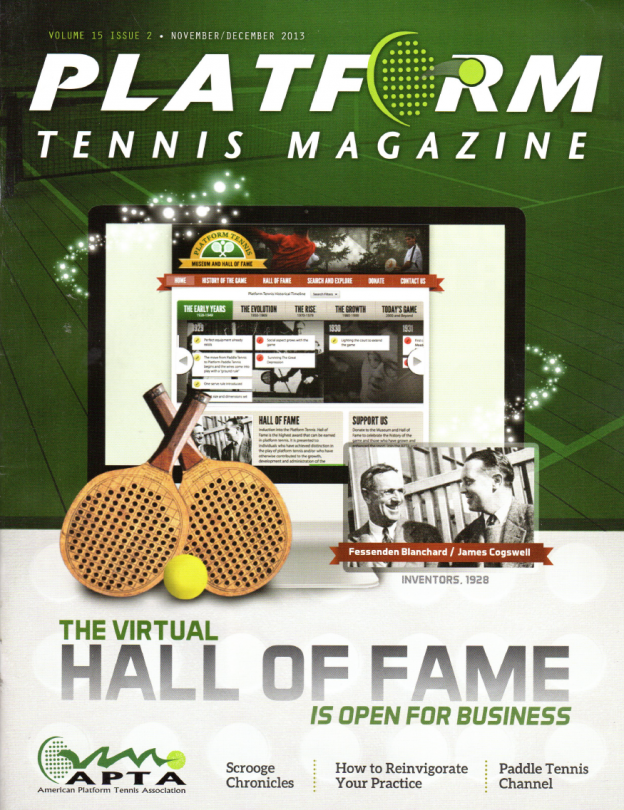
Virtual Museum and Hall of Fame Opens – the mission is to capture the history of the game

Screen Shot 2014-08-05 at 4.43.57 PM

Technology has been wonderful to our under-known sport. With the advent of the computer, communication has become more cohesive and streamlined. Archived photos reappear for the world to see. And the history of the game, previously existing in just a few books and deep memories, has been given a new place to live. The virtual Platform Tennis Museum and Hall of Fame has breathed new life into the dusty chronicles and is now welcoming visitors.

The backstory of The Platform Tennis Museum and Hall of Fame Foundation sits on a few shoulders. Bob Brown and Chuck Vasoll were important cheerleaders for a Hall of Fame museum. In 2002, under the guidance of then APTA President John Horine, The Platform Tennis Museum and Hall of Fame Foundation finally became a registered 501 (c ) (3) non-profit that has the mission of capturing the history and the great camaraderie of the game and celebrating those players and others who have grown and enhanced the sport.

The next thrust was to create a “bricks and mortar” facility, and efforts continue to locate such a site. In 2005, Bob Brown attempted to get space dedicated at the Fox Meadow Tennis Club, the birthplace of platform tennis, without success. In 2008, the Foundation tried again, and the next “almost” building was at Centercourt in Chatham, New Jersey. Once more, the project didn’t stick. In the meantime, it was widely believed that to significantly enhance how to capture the history of the game, employing digital technology, rather than just limiting it to a physical facility, was the way to go. Many traditional museums have moved in this direction as they see opportunities to deliver content in more visually exciting and interactive ways, with the added benefit of attracting “visitors” without the need to physically visit one location.

Thanks to the generosity of supporters, the Platform Tennis Museum and Hall of Fame has made significant progress towards realizing this dream……[click on images to read more]

Source: Platform Tennis Magazine, Vol. 15, Issue 1 Sept./Oct. 2013

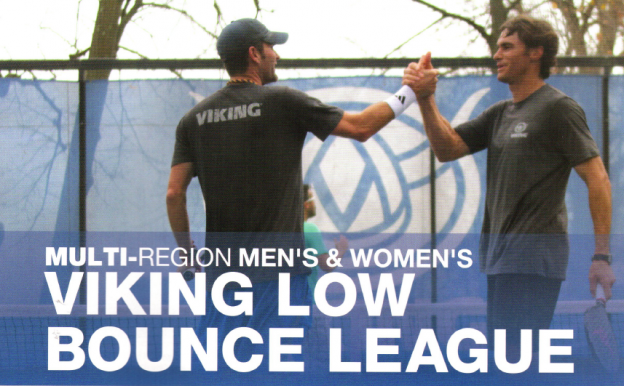
Inauguration of Viking Low Bounce League

It’s mid-March and the last platform ball has hit the aluminum. The platform leagues across the country are crowning their league champions. But for many of us, we experience a sense of withdrawal that kicks in right after the season is done. The desire to compete more and socialize with friends continues to fuel us. To add to that feeling is the plain fact that the weather in mid-April thru the beginning of June has not warmed up—it’s still platform weather. Along with the want for more platform, there is also a sense of wondering among the league champions. A wondering if my teammates and I are the best team in the country at our level….[read more – click on image]

Source: Platform Tennis Magazine, Vol. 15, Issue 4 Feb/March 2014

The Juniors “Spirit of the Game” Award Is Presented to Mary Emma Guldi

One of Radley Run’s future stars shone brightly at the 2014 Junior Nationals

While demonstrating the good sportsmanship, integrity and respect that goes with the “Spirit of the Game” honor, this award is so special because paddle is a game where good sportsmanship is so keenly recognized. Independent but commanders were on the lookout for exemplary behavior during the tournament and, at the end of the day, the tournament committee made their decision.

The winner of this year’s “Spirit of the Game” Award is ten-year-old Mary Emma Guldi. A fifth grader at St. Agnes in West Chester, Mary Emma has played platform tennis at Radley Run for about three years.

Mary Emma lost her partner when the tournament date was changed, due to an ice storm, but still wanted to be part of the event. She created her own rainbow after the storm by signing on as a junior reporter for the APTA. She thought that being a tournament reporter would be fun, so she and her mother traveled from venue to venue, interviewing players and adults alike.

Mary Emma was lucky enough to interview the President of the APTA, Rob Coster, who drove down from Boston; the APTA Junior Tour Chairman, Steve Caccam from Connecticut; Ann Sheedy, the APTA Executive Director from Pittsburgh; and many of the players throughout the day.

She was a true professional, recording conversations, photographing key moments, and getting consent forms signed. Mary Emma then went home, compiled her notes, and sent in her article long before her deadline. She also took great photos, on and off the court. Her professionalism was impressive. “I thought it would be really fun to go and take pictures and interview people,” she explained. “I don’t think it will be my career. But I may do it a few more times.” Her article and photos can be seen on the APTA website.

Mary Emma was chosen from five nominees, each of who showed great integrity. But her unswerving energy toward her job was above and beyond, and she was very good natured about not playing.

“I was very surprised to get the award. Mrs. Hissey came to our house and presented me with it. I didn’t know about the award until this happened,” Mary Emma explained. “I want to thank them for choosing me, even though I wasn’t playing.”

We want to thank Mary Emma for her dedication to the game, for a superb show of sportsmanship, and for preserving the history of the 2014 Junior Nationals.

Congratulations to Mary Emma Guldi.

Source: Platform Tennis Magazine, Vol. 15, Issue 5 April/May, 2014

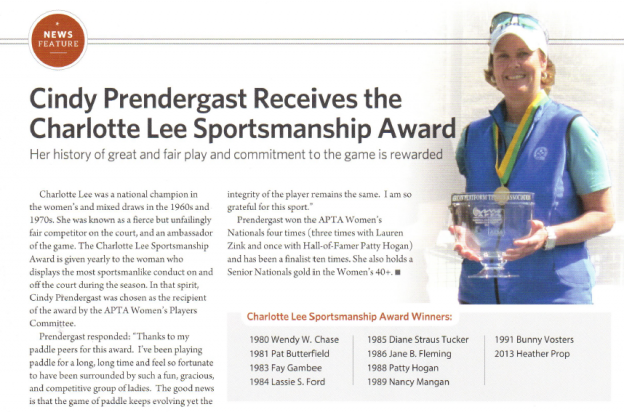
Cindy Prendergast Receives the Charlotte Lee Sportsmanship Award

Charlotte Lee was a national champion in the women’s and mixed draws in the 1960s and 1970s. She was known as a fierce but unfailingly fair competitor on the court, and an ambassador of the game. The Charlotte Lee Sportsmanship Award is given yearly to the woman who displays the most sportsmanlike conduct on and off the court during the season. In that spirit, Cindy Prendergast was chosen as the recipient of the award by the APTA Women’s Players Committee.

Prendergast responded: “Thanks to my paddle peers for this award. I’ve been playing paddle for a long, long time and feel so fortunate to have been surrounded by such a fun, gracious, and competitive group of ladies. The good news is that the game of paddle keeps evolving yet the integrity of the player remains the same. I am so grateful for this sport.”

Prendergast won the APTA Women’s Nationals four times (three times with Lauren Zink and once with Hall-of-Famer Patty Hogan) and has been a finalist ten times. She also holds a Senior Nationals gold in the Women’s 40+.

Charlotte Lee Sportsmanship Award Winners:
1980 Wendy W. Chase
1981 Pat Butterfield
1983 Fay Gambee
1984 Lassie S. Ford
1985 Diane Straus Tucker
1986 Jane B. Fleming
1988 Patty Hogan
1989 Nancy Mangan
1991 Bunny Vosters
2013 Heather Prop

Source: Platform Tennis Magazine, Vol. 15, Issue 5 April/May, 2014

Museum and Hall of Fame Foundation Video – Platform Tennis: A celebration of the game, its camaraderie and those that made it happen

The video is a short history of the game from its start in 1928 through to 2014. It highlights the key events in the game’s development, the leading players, the role of the APTA and the Foundation’s efforts to document the story for the next generations of enthusiasts.

The video was produced by Camille Thoman who produced the indie documentary The Longest Game which was inspired by a group of octogenarians at Dorset Field Club, Dorset, NH who met regularly to play paddle and reminisce.
Screen Shot 2014-08-04 at 1.58.04 PM

Click link to play: Platform Tennis: A celebration of the game, its camaraderie and those that made it happen

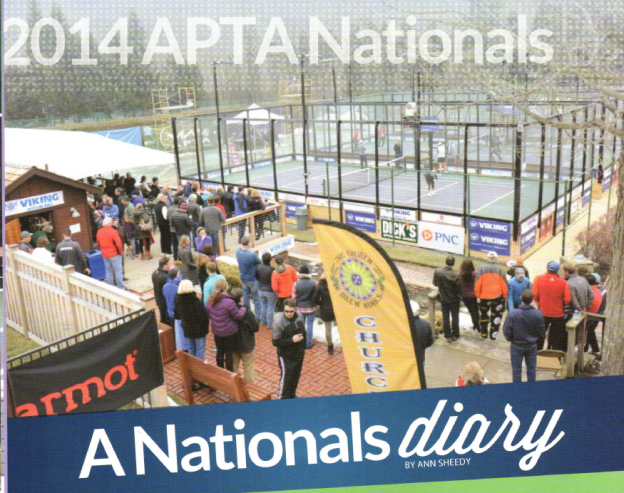
Ann Sheedy’s Nationals Diary – reflections on running a Nationals

Ann Sheedy, the Executive Director of the APTA, was deeply involved in running the Nationals which were held in her home town, Pittsburgh.

She filed a report with PTM on the activities leading up to the event and some thoughts on when all was said and done.

Preparation (March 2013)

The 2014 APTA Nationals are only a year away! We have our Executive Committee and
we have asked the clubs for the use of their courts. We’ve made a list of potential sponsors and we have a sponsorship brochure. Looks like we are on our way.

Piece by piece we’ve added to our committee. We found a volunteer to be in charge of but food, then someone to recruit but monitors, then a housing chair and a hotel coordinator. We already had a draw guru on the Executive Committee so we are set there. We need a parking and shuttle committee head as well as someone to be in charge of selling merchandise. Prizes must be selected and purchased, the President’s Cup has to be coordinated, and photographers need to be found. Lunches and dinners need to be planned and budgeted. Live Scoring and Live Streaming, not part of the two previous Pittsburgh Nationals, have to be staffed and we must find someone to be in charge of the player’s gift bag. A program needs to be designed and printed. Facility information needs to be gathered and volunteer manuals have to be written.

So many decisions! What clubs to use, what favors to buy are the first we tackle. Then the questions pour in. •How many banners does a Gold Level sponsor get? Tent or no tent? Who gets to park where? Where is lunch and how many people will be at each location? How do we move the favors and gift bags between clubs for registration Wednesday and Thursday night? How many XXL jackets should we order? (This is always tricky because you have to order the clothing before all the registrations are in.) How many hours should the shuttle run? Will we sell merchandise and, if so, how much should we order? How many balls do we need and how do they get divided? Do we give lanyards or those rubber bracelets to the players so they can get into meals? How big should the bleachers be? Etc., etc …

Funding is always the scariest part. It’s somewhat scary to make commitments in December to spend money if it’s unclear if we will have the money in March. We’ve taken the strategy to start with a tight budget and expand it as (we hope) money comes in.

Pittsburgh does not have the luxury of an overabundance of courts so we know that getting temporary courts is crucial. Thanks to the APTA and Total Platform Tennis, we’ve gotten the three temporary courts we need.

It’s almost here! March 2014

Under the heading of “Of course we didn’t panic (much) … ” A huge snowfall is expected right after the temporary courts are painted. The paint needs time and the proper temperature to cure and snow is not part of that formula.

Thanks to a Fox Chapel Racquet Club employee, who got up in the middle of the night to change the propane tanks under the temporary courts, and a bit of help from the weather gods because we didn’t get the six to eight inches of snow forecasted, the courts are ready on time.

Lots of little details to finish: parking passes need to be distributed, programs and draw sheets printed and delivered to registration. Signs at club entrances are to be printed and put in place. We have changed our minds several times about the location and set up of registration and merchandise but I think we nailed it.

Rats, turns out that there is a charity run at North Park that might disrupt players’ ability to get to the courts. Hope we don’t have to cancel the use of those courts; their volunteers are so eager to host some National matches. Good, no problem, next issue …. Okay, someone needs to pick up the microphones.

Wednesday night – President’s Cup Registration (March 5, 2014)

The Fox Chapel Racquet Club looks wonderful with the fireplace blazing and the lights twinkling, creating a festive atmosphere. Food is tasty and registration is going well.

Reflection (April 2013)

It is hard to believe that after all those months of work it is over. Players have given us their thanks and praise. I guess besides the amazing level of talent I witnessed, I will remember the people who helped us pull this off. Martin Sturgess was a knowledgeable, decisive, and calm Tournament Director. I know the hours he spent pushing and pulling the budget to be sure we could make it work. We can’t thank the staff of the Fox Chapel Racquet Club enough for the unbelievable hours they put in to make the tournament a success.

To say we had great volunteers is to underestimate their contribution. Just a few examples, our Hut Food Chair got more than 80 ladies to make baked goods for the huts. Our draw guru spent hours refining the times and locations to optimize our court situation and use of Live Streaming and then handled the tournament desk with her usual aplomb. Registration ran as smoothly as any I have seen, thanks to a well planned and executed process. We heard nothing but compliments about the food and the venues. The ladies running the merchandise area spent so much time at their posts I thought the club was going to charge them rent. I heard that our hut monitors were friendly and helpful. Even by mentioning a few examples I fear that I am shortchanging the others who contributed so greatly. I could continue to thank the Prize Chair, the Players’ Gift Bag Chair, the Facilities Chair, the Housing & Hotel Chairs, the Sign Chair.

It’s hard to stop. Yes, there were some glitches and, yes, there were a few things I might do differently, but all in all I think we did a pretty darn good job and I am so proud of the hundreds of Pittsburgh paddle players who stepped up and were part of the PNC 2014 APTA Pittsburgh Nationals.

Source: Platform Tennis Magazine, Vol. 15, Issue 5 April/May 2014

US Ambassador to Poland, Walter Stoessel, imports Platform Tennis to Warsaw

Ambassador Walter Stoessel, a keen player and lover of the game, introduced the game to Warsaw when he was appointed US Ambassador there in 1968.

They had been initiated in the game at the Chevy Chase Club in Washington, D.C. and while they were far from expert they loved the game and thought it would be ideal in the long Polish winters.

Using plans Supplied by APTA, they built a wooden court at the American Embassy in Warsaw. It worked, although it was quite a hybrid. The wood was obtained locally, the wire came from West Germany, and the lights were regular Warsaw street lights.

The game caught on rapidly and was played enthusiastically by members of the American community in Warsaw and their friends in the foreign community.

In 1970 he sent a letter to Paul Molloy, APTA President, enclosing a picture taken on February 20, 1970 before the inaugural game on the Warsaw Embassy Platform Tennis court.

Some years later (1974) when he moved to Moscow he had a court constructed there and annual contests between the two Embassies ensued.

Source: Paddle World, Vol 1 No 2 Mid-Winter 1976

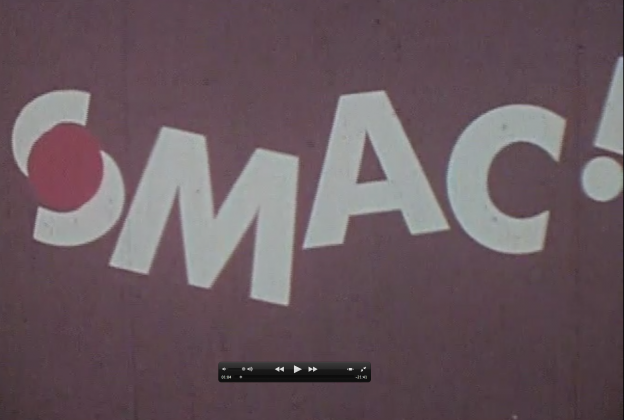
Dick Squires Presents SMAC!

Another Dick Squires promotional video extolling the virtues of the game and its growing popularity. Includes instructions of how to play and footage of various matches in the 1970 including the finals of the Mixed Nationals in 1971.

Robert R Kingsbury Scrapbook – a source for some historical artifacts during the 1970s not otherwise available

During his active playing career Bob Kingsbury’s wife keep a scrapbook of tournament records, newspaper article, photographs, etc.

The scrapbook also contained information on events at Kingsbury’s home club, Fox Meadow Tennis Club in Scarsdale NY.

A number of newspaper articles are from local Scarsdale papers and these have been difficult to find as newspaper editions during the 1970s have yet to be digitized. As such the scrapbook provides some valuable historical records not available elsewhere.

Source: Donated to the PTMHOFF by Robert R Kingsbury