The PPTA's first group of certified teaching professionals. L to R: Gerri Viant, Gary Horvath, Patty Hogan and Hank Irvine. (Missing: Rich Maier)

Professional Platform Tennis Association (PPTA) Update

On the Friday prior to the Short Hills national ranking tournament, the PPTA Board of Officers met to finalize their testing and certification process. The effort to start the organization for teaching professionals began 18 months ago and has included a series of meetings and feedback from the country’s top teaching professionals in each APTA region.

As part of the recent meeting at Beacon Hill the PPTA completed certification for its initial group of members (Gary Horvath, Hank Irvine, Patty Hogan, Gerri Viant, and Rich Maier). The PPTA tentatively plans to hold an open meeting for prospective members at the APTA Nationals in Rochester and may conduct an initial offering of the test in the Tri-State area at the end of the season.

The mission of the PPTA is to improve the standards of the teaching profession and help increase awareness in the sport. PPTA President Gary Horvath said, “We have received nothing but enthusiastic support from the APTA, the manufacturers, and prospective members since starting work on this initiative 18 months ago. We look forward to working with all of these groups and the facilities with courts to make platform tennis even more fun for more players.”

Source: Platform Tennis Magazine, Issue 4, March, 2000

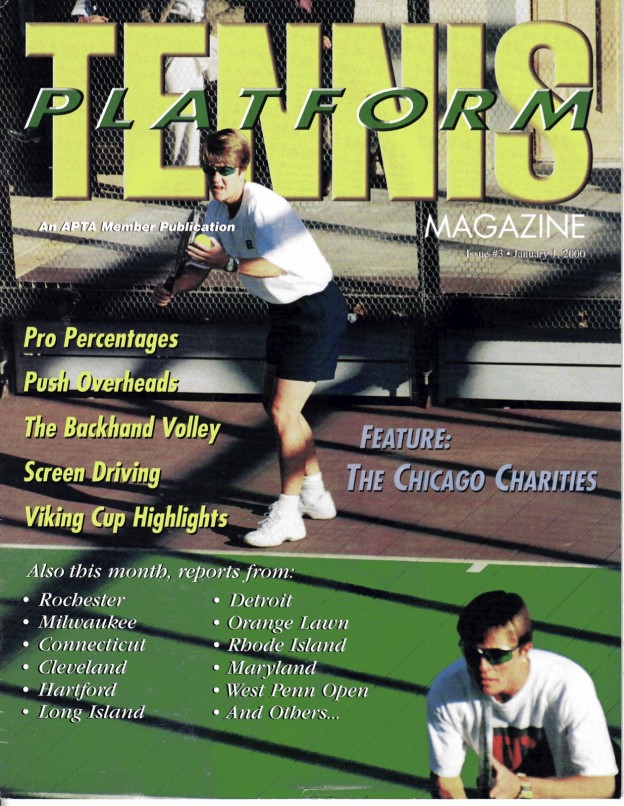
PTM Features Chicago Charities

Chicago Charities ends millennium with a bang

The final Chicago Charities Tournament of the decade/century/millennium was played on a perfect autumn weekend and showcased the top talent in the game. Over 150 teams, competing in four divisions, converged to do battle in one Tournament of the decade/century/millennium was played on a perfect autumn weekend and showcased the top talent in the game. Over 150 teams, competing in four divisions, converged to do battle in one of the most competitive fields ever assembled at an APTA tournament event.

Headquartered at Glen View Club’s new “paddle palace”, the tournament provided some upsets and some near upsets. David Ohlmuller and Chris Gambino, the nation’s number one ranked team, came in from the east to defeat Chicago’s Bill Fiedler and Scott Bondurant (two-time defending champions) in a three set men’s final, displaying some of the finest driving and net play ever. The Chicago team had come off a tight three set semi with four-time defending national champions Scott Mansager and Flip Goodspeed and gave way to the young but savvy Gambino-Ohlmuller who beat Anthony Cosimano and Steve Haller in an “All-Jersey” semi.

While the men’s seeds held mostly true to form, that was not the case in the women’s tournament. Current national champions Patti Hogan and Cindy Prendergast went out in the round of 16 to Cincinnati’s Linda Thompson and Lindy Ward. Sue Aery and Gerri Viant prevailed over Robin Fulton and Sarah Krieger in the Sunday final, but not before overcoming two up-start Chicago teams in their respective semis. Wendy Robbins and Liz Richards-Hayward (the best paddle player in Phoenix) gave Aery and Viant all they could handle in their semi. Mary Doten and Julie Sierks also came up short in the other semi against Fulton and Krieger.

The men’s 45+ saw Hank Irvine pick up right where he left off years ago when he and Wilson’s John Embree defeated former 45’s national champs Jedd (Dr. Detroit) Hodges and Indy’s Jack Hogan in a well-played three set final. The indomitable team of Tom Beach and Peter Morrow bettered Chicago’s Jim Bishop and Rochester’s Mike Hannah in the men’s 55’s to cap off the great three-day event.

Tournament co-chairs Sally Cottingham and Kip Read made sure that things went off as smoothly as David Ohlmuller’s footwork and directed everything from scheduling, to the Saturday night party, to Sunday’s final matches, to a seamless conclusion, and making a huge effort look easy.

As always, the CPTC is indebted to its generous sponsors, players, and many volunteers who make this tournament a continued success year after year. The final budget has not been completed for the event, but the ‘rough estimate’ is that donations to this year’s charity, the Lydia Home Association, will be approximately $5,000.

Sponsors of the event were: APTA, Wilson, Viking, R. J. Reilly Platform Tennis Courts, and Jean Wright Real Estate.

Source: Platform Tennis Magazine, Issue 3, January, 2000

How do today’s players compare with the top players from the 60’s and 70’s? Bob Callaway had some thoughts

Bob Callaway had these observations:

I’ve often been asked, ‘how do today’s players compare with the top players from the 60’s and 70’s?’ Back then, platform tennis was booming. Court time was at a premium. Fox Meadow closed the gates at the Nationals due to overcrowding as a reported 4,000-5,000 people packed the stands at Forest Hills. My answer is, however, today’s top players are better. The following is evidence to support my point.

When I was researching material for my book, Platform Tennis (published in 1972), I charted matches at men’s and women’s national ranking tournaments, state tournaments, and club tournaments in order to get more information on how points were being won and lost. One finding was that, depending on the level of the players’ games, 60-80% of points were determined with the serve, return, and first volley. I did the same charting this past season and the percentages had gone down to a low 23% (Cosimano/Haller vs. Ohlmuller/Gambino) to a high 38% (a consolation match at the 1999 Connecticut state women’s tournament). Now, I don’t think anyone will argue that Cosimano/Haller and Ohlmuller/Gambino were playing pitty-pat defensive “paddle”. Instead, I think the point worth noting is how consistent all the other top men and women players are today, particularly with their drives.

It is interesting that in most other categories, the percent of driving and volleying errors (after the first volley), lobbing, screen and overhead errors and winners (passing, crease, drop, and skid shots) did not change very much from the 70’s, but these skills do not show up in the statistics, possibly further supporting the point that today’s players are better, particularly in being able to handle these shots.

During the so-called “golden days”, I was not only competing, but also involved in running many tournaments. I can remember how we used to schedule matches, using an hour for early round matches and 1 1/2 hours for the quarters and on. Today, in the men’s national ranking tournaments from the round of 16 on, you need to schedule at least an hour per set. In some matches at the 1999 Nationals, 20% of the points went over 100 strokes and sets took over an hour and 15 minutes. And again, these players were not playing “no-offense paddle”.

One can argue that the top players today do not hit as hard as Herb Fitz Gibbon, John Mangan, and company of the 70’s. I don’t know. I have had limited exposure to the top players of today. I can remember how hard it was to volley Fitz Gibbon’s return of serve. But the important point is how remarkably consistent today’s players drive the ball. In addition, with the longer duration of matches, focus and concentration over a longer period of time become even more important. I have seen so many matches in recent years, where there is no discernable difference in the teams until a turn in the third set when one player’s concentration, frustration, or will to win “snaps”. I think these are elements that distinguish today’s top players from the majority of players in the 60’s and 70’s and make platform tennis unique and interesting.

Source: Platform Tennis Magazine, Issue 3, January, 2000

Metal halide lights make their debut

R. J. Reilly, Inc. pioneers metal halide court lighting systems

PTM carried the following story on the new development:

How strong are your powers of observation? Have you noticed a different look on some platform tennis courts recently? If you attended the 1999 Nationals at the New York Athletic Club, you saw it on the showpiece courts, which R.J. Reilly provided for the event. The traditional quartz iodine lights, which have sat perched atop the twenty foot light poles for as long as most players can remember, are slowly being replaced by slightly larger metal halide fixtures.

Why the change? Energy efficiency and advanced optics are the main reasons. The 400 watt metal halide fixtures only use about one third of the energy that the traditional 1500 watt quartz iodine fixtures use. This provides a cost savings to the owner and is easier on our environmental resources (paddle players are conservation minded too). Furthermore, only a 110 amp power service is required as opposed to the 220 required for the quartz iodine system. The bulbs used in these fixtures last up to ten times longer than their quartz iodine counterparts.

Because of improved optics and reflectors, the new metal halide fixtures can better direct the light where you want it. To you, this means more consistent light on the court and less spillover outside the court.

How does this type of lighting stack up in actual use? There are many different types of metal halide fixtures available, and the lighting varies for each one. However Jim Reilly, Vice President of R.J. Reilly, says that the fixtures they have installed, at a variety of courts in different regions of the country, seem to be universally preferred over the traditional quartz iodine. “We took several years to research and test a variety of metal halide fixtures,” says Jim. “We finally found a top quality shoebox style fixture which, with some customization, provides the best platform tennis lighting system we have seen. It provides minimal spillover, virtually no shadows on the court, and a shade of light that players indicate they prefer to the quartz iodine. It sometimes takes an adjustment period to get used to the new lights, but we have not yet encountered anyone who prefers the old style after playing several times with our new metal halide system.”

Source: Platform Tennis Magazine, Issue #2, November, 1999

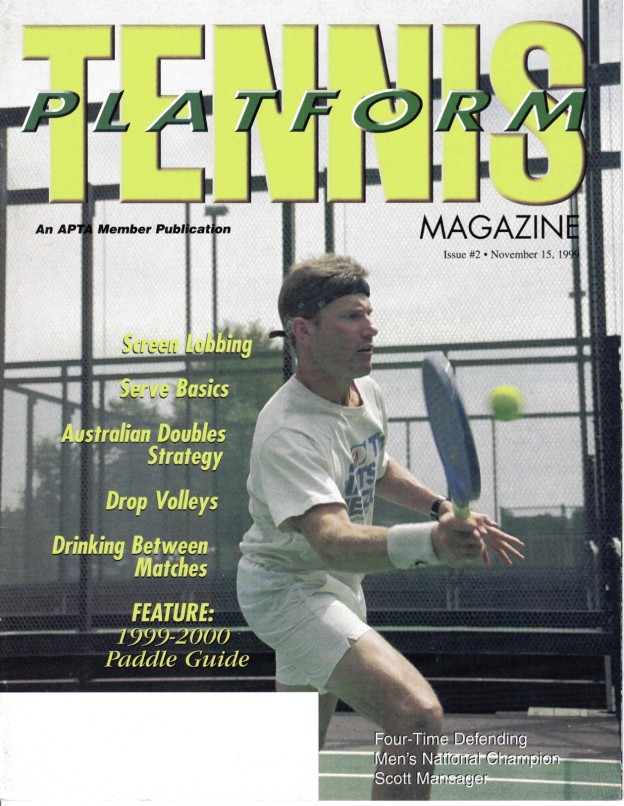
PTM Issue 2

Platform Tennis Magazine (PTM) off to a great start

The second issue of PTM carried some positive feedback and some complaints on delivery timeliness.

In the From the APTA … section APTA President John Horine had this to say:

“Our first issue was a smashing success. A heartfelt thanks to Wayne Dollard and APTA Board members Pete Mathews and Mark Holtschneider. Your summer efforts have resulted in a fantastic magazine. Wayne must have put 10,000 miles on his car this summer crisscrossing the country collecting pictures and articles for this seasons issues.”

Horine’s comments were echoed in the Letters to the Editor section:

“Just read your first issue cover to cover and wanted to congratulate you on a wonderful job! Forty-eight pages of interesting paddle reading…who could ask for anything more? Wishing you continued success in this worthwhile venture!”

Sally Rogers / Scarsdale, New York

“Thank you for the wonderful publication. Your history piece was particularly special and accurate. So many times I have read otherwise. Johnny (Ware) would be proud of you for your new Platform Tennis Magazine.”

Molly Blanchard Ware / Scarsdale, New York

However there were some issues, as with any new undertaking:

“As of today’s mail, I still have not received the first copy of the magazine except for the ten copies that you sent to me as a director of the APTA. This was an important issue with which to make a good impression, particularly because the APTA did not issue a tournament schedule and gave it exclusively to you for publication. I am deeply disappointed and I hope that this is not a harbinger of the remaining issues.”

Charles Vasoll/Cold Spring Harbor, New York

To which Dollard replied:

“Sorry about the two week delay in receiving issue #1. 1 did it the best 1 could and 1 did it by the book. As it tums out, the U.S. Postal Service mislabeled our magazines, lost them, and then stored them away for two weeks. Through numerous phone calls and complaints, I was told that resistance was useless. I am thankful that the magazines arrived late, rather than not at all. I am also thankful that the magazines came out as well as I had hoped. You never know what you’re going to get with a new printer and press department. We could have had a real train wreck on our hands for even the slightest graphics mistake. Finally, with help from my new ‘buddies’ at the postal service, I anticipate the mailing of PTM to go smoother for our future issues.”

Source: From the APTA, and Letters to the Editor, Platform Tennis Magazine, Issue #2, November, 1999

Horine opines!

APTA sponsorship of the PTM was a significant financial commitment to grow the game

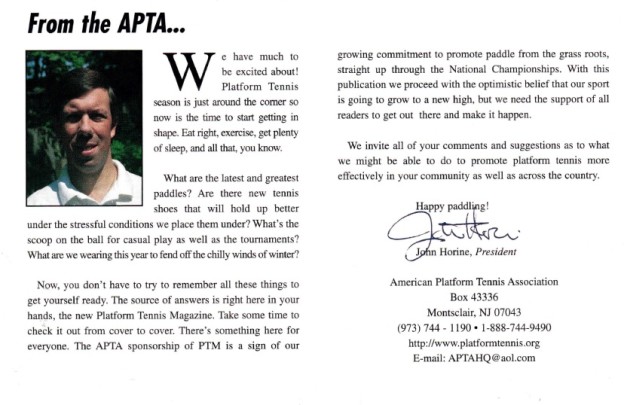
APTA President, John Horine, explained the benefits of the new magazine in helping grow the game:

“Platform Tennis season is around the corner so now is the time to start getting in shape. Eat right, exercise, get plenty of sleep, and all that, you know.

What are the latest and greatest paddles? Are there new tennis shoes that will hold up better under the stressful conditions we place them under? What’s the scoop on the ball for casual play as well as the tournaments? What are we wearing this year to fend off the chilly winds of winter?

Now, you don’t have to remember all these things to get yourself ready. The source of answers is right here in your hands, the new Platform Tennis Magazine. Take some time to check it out from cover to cover. There’s something here for everyone. The APTA sponsorship of PTM is a sign of our growing commitment to promote paddle from the grass roots, straight up through the National Championships. With this publication we proceed with the optimistic belief that our sport is going to grow to a new high, but we need the support of all readers to get out there and make it happen.”

Source: From The APTA, Platform Tennis Magazine, Issue #1, September, 1999

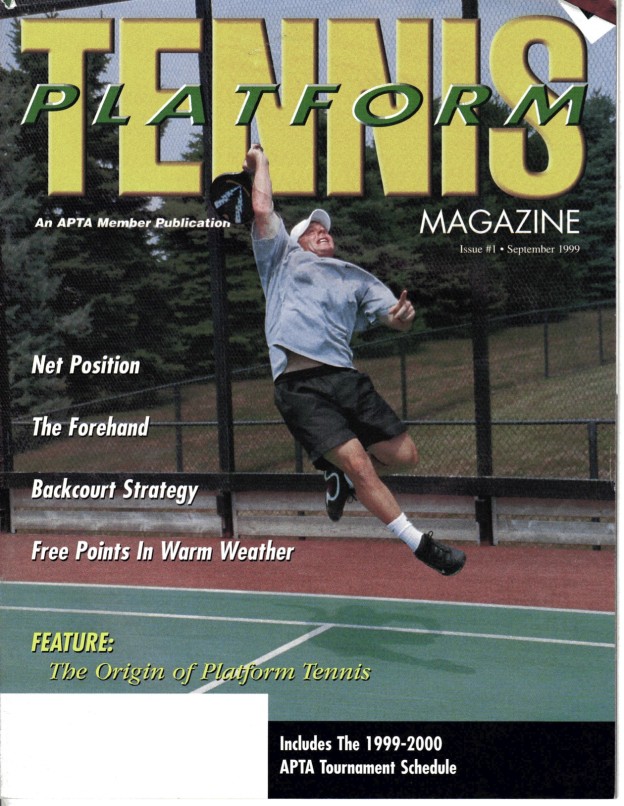
Platform Tennis Magazine's First Edition

Platform Tennis Magazine (PTM) makes its debut

Issue #1 arrived in mailboxes in September.

Wayne Dollard, the editor and publisher of PTM recalled how he decided to pursue the endeavor and his vision for the magazine:

“Ten minutes prior to catching my flight for the’99 Nationals, my father-in-law and I were brainstorming over what he might do with his upcoming retirement. Out of nowhere he said, “Maybe we should create a paddle magazine.”Having no publishing experience and a 60-hour-perweekjob I replied, “good luck.” Over the next couple of days his idea grew on me. Why don’t we have a publication for ourselves? The clincher came in the Westchester airport before my flight home when, out of the corner of my eye, I couldn’t believe what I saw on the news stand shelf: Yo-Yo World! How ridiculous! Surely, paddle is more popular than Yo-Yo-ing or whatever you call it, right? At that moment the reality of Platform Tennis Magazine began to kick in.

Over the next several weeks I developed the framework for this publication which would instruct all levels of play, assist those who have a financial investment in paddle, and ultimately provide a forum to attract new corporate advertising dollars to grow our sport. With these goals in mind and funding required, I set out to meet the APTA Board in Chicago.

The APTA understood the same thing that I did in that the only way to advance platform tennis is to involve the beginner and intermediate players more in APTA affairs. Upon completion of my Yo-Yo World story and several hours of other filler, the APTA agreed to fund a significant portion of this publication. As a result, all APTA members will receive Platform Tennis Magazine (PTM) five times per year
at no additional impact on their current dues.

Each issue of PTM will contain several instructional articles, a feature story, an ‘ask the pro’ page, all APTA sanctioned tournament results, and a ‘participating league’ section available to those entities which enroll their entire league into the APTA. Consequently, the APTA is offering this publication and full membership for only $17.50 to each participant of those leagues which enlist. The magazine alone sells separately for as much! Feel free to contact me if your league has an interest in pursuing this offer for the 1999-2000 season.

Finally, I would like to request the assistance of anyone influential in acquiring sponsors for our magazine and/or the 120-tournament APTA circuit. I am currently working on deals with several corporations to provide funds to promote free clinics
for all levels at each tournament site. Furthermore, we hope to offer pro certifications and reduce entry fees as well. I look forward to hearing your thoughts and ideas on how we might enhance our sport. We have much to be excited about!”

Source: From The Editor, Platform Tennis Magazine, Issue #1, September, 1999

Rich Maier, Inventor redux

Maier was still not through with innovating (he had founded Skymar in 1983) and started Advanced Recreational Design (ARD) in 1993, along with Gary Whalen, a friend from Rich’s college days in Jacksonville, FL.

ARD produced three new paddles and introduced a new ball that lasted much longer (six sets was not unusual) than the balls being sold at the time, primarily by Vittert. The ball had been developed with the aid of a manufacturer in Taiwan.

Source: Private communication with Rich Maier

Skymar Paddle

Rich Maier, co-inventor of the Skymar paddle – paddle innovation takes another step

Maier was not content with just playing and teaching the game. He was an innovator, with a US patent (US4379554) as proof.

Along with co-inventor Andreas D. Schuyler, they developed a new concept for the platform tennis paddle.

The patent, filed on August 24 1981 and issued on April 12, 1983, described an improved platform tennis paddle constructed “with two outer laminated ply structures and inner laminated ply structure there between. The inner laminated ply structure has a central aperture there through which, in the preferred embodiment, is filled with a resilient plug. The edge of the paddle is protected by a T-shaped molding fitted in to the perimeter of the paddle, and to safeguard against de-lamination, the handle is of pegged construction.”

The patent was assigned to Skymar Corporation, and Rich and Andreas built the racquet, Skymar Proflight, in a garage in Allendale, NJ. The racquet was a commercial success, but the garage manufacturing operation faced constraints and ultimately closed.

The concept though endured and was picked up by another manufacturer, Marcraft, with their Force model which was introduced in 1992.

Source: Private communication with Rich Maier

NOTE: For the history of the paddle from the early days through early 1990s: Jim Tate’s article The Paddle Itself has a History Too!

Hall of Fame Inductee: David Ohlmuller

Among an audience of long-time friends, family members, and the best platform tennis players in the world, David Ohlmuller was lauded for his talent and his resilience. The night was filled with laughs and some deep emotions, as Ohlmuller’s story captivated the crowd.

Tim McAvoy, last year’s inductee and a member of the Hall of Fame Committee, introduced Ohlmuller.

The transcript of McAvoy’s induction speech is printed below in its entirety.

Tonight we honor a man who dominated the sport of platform tennis and then came back from a near death accident to reach the pinnacle of our sport for a second time.

Born in 1969, our inductee was introduced to the game by his mother, Ginna, who in addition to playing platform tennis was the Executive Director for the American Platform Tennis Association. In fact, in his early teenage days our inductee was bribed by his mother to play—hot chocolate in the warming hut after playing usually did the trick.

Ginna also included some more experienced players to help teach her son the basics of the game—and one of the early mentors was none other than Mike Gillespie, who is chairing the APTA Nationals this weekend. Ginna first competed in competitive mixed doubles events with her son in Philadelphia, in the mixed MAPTA, when her son was just 17 years old.

Her son showed early flashes of brilliance— as a finalist in the 18 and Under APTA Junior National Championships in 1987 and then in 1988, winning the 18 and Under APTA Junior Nationals with Danny Galves.

Ginna remembers 1988 from a slightly different perspective as she and her son won the New Jersey State Mixed Championships that year, beating Bobo Delaney and Bruce Kelsey in the final, in a 3rd set tiebreaker. In fact, she was quoted as saying, “You can only imagine how well my son had to play to carry that anvil (me!) to victory!”

Our inductee then graduated high school and set his sights on Loyola College in Baltimore. While at Loyola, however, he maintained his interest and aptitude for platform tennis. In 1990, in his sophomore year at age 20, his mother intervened again, to see if Patty Hogan would like to play with her son because he was too shy to ask. So Ginna brokered the partnership and what a team they made—Ginna’s son teamed with Patty Hogan to not only compete in the 1990 APTA National Mixed Championships … but win!

Over the next five years, David and Patty won the APTA National Mixed title twice (in 1991 and 1995) and were finalists twice (1992 and 1993). Three Mixed National Championships in six years—twice while in college! And did I mention he also held down the #1 singles and #1 doubles position on Loyola’s varsity tennis team… Wow!

And 1995 was an even more special year, as he added to his Mixed National Championship that year by winning the Men’s National Championship with Bruce Kelsey in Montclair, New Jersey.

As many of you know, Patty Hogan is an APTA Hall of Fame member. As a teammate with our inductee, Patty was not only impressed with his shot making but even more so with his maturity and understanding of the nuances of the game at such a young age. “He understood, at 20 years of age, that the sport was about minimizing your unforced errors and forcing your opponents to play their best in order to win:’

Personally, I competed against our inductee in the early 1990’s and the offense he brought to the court was unparalleled, both from his lethal forehand and his devastating two handed backhand. There literally wasn’t a safe shot to hit, especially in mixed. I was also fascinated to hear the top men and women talk about his shot making and when he went on the court to compete, most wanted to watch his next ‘amazing shot’!

He was one of the most dominating players in the Men’s game over that five-year period and during that time, he was the most dominating player in mixed-doubles.

Everything changed in 1996. The man we honor tonight was struck by a speeding car while crossing a street in Manhattan. The hit and run accident left him in the hospital for special surgery for 28 days. His tibia and fibula were each broken in seven different places and there was discussion of possible amputation in order to save his life.

Thanks to a great medical team, the doctors were able to save his life… and his leg. He then brought tremendous determination and a positive attitude to a grueling rehabilitation process. Within two years, he was back on the platform tennis court, working to see if he could again compete at the highest level.

In 1998, teaming up, again, with Patty Hogan, our inductee was a finalist in the National Mixed Doubles Championships and they repeated as finalists in 1999. On the men’s side, he teamed up with Chris Gambino and together they did indeed reach the top of the mountain, winning the Men’s National Championship in 2000 and 2004.

And the icing on the performance cake was his winning two Husband/Wife National Championships, with his bride Marina, in 2003 and 2005.

Add that all up and our inductee has won eight National Championship gold medals and six National Championship silver medals and while doing so, earned the respect of his peers for his on-court competitiveness and sportsmanship.

And now, in recognition of these accomplishments – he is the 79th recipient of the APTA’s highest honor – the Platform Tennis Hall of Fame Award is presented to David P. Ohlmuller.