Midwest paddle booms

Although the sport was born and bred in the Northeast, fifty years later the rebirth of paddle was taking place in America’s heartland. The Midwest had witnessed a surge in paddle over the past five years, signaling good news for the health and well- being of the sport.

Growth in the region’s paddle community was evidenced by strength of play and players. As opposed to years past, many of the top-ranking competitors were from points west (Mansager and Goodspeed, men’s double champs from Michigan and ranking contender Bill Fiedler from Chicago, to name a few).

Tournament participation was up, as well as the number of mid-west-based facilities. The APTA now had five board members from mid-western states. Most telling was the fact that APTA membership in the Midwest had outpaced that in the East.

Yet, while the numbers proved a point, they did not tell the whole story. Growth came through the hard work and dedication of leaders in the Mid-west paddle community.

APTA Executive Director Ginna Ohlmuller explained, “This is not a sport that easily runs itself. To flourish, paddle needs strong organization and a catalyst.”

Source: Platform Tennis News, Summer 1996

Viking Cup Adult/Junior Tournament

An Adult/Junior platform tennis tournament was conceived by Robin Rich Fulton following her experience running the National Junior Championships the previous season at the Wee Burn Country Club in Darien, Connecticut. She enlisted the assistance of Bob Callaway in the venture, and had the support of David Kjeldsen of Viking Athletics as the title sponsor.

The goal of the tournament was to promote the game among the younger set by giving them an opportunity to play with adult partners; learn from them; enjoy the camaraderie and ambiance of a tournament; and inspire juniors to continue to practice and play. The National Junior Championship would follow the event on the APTA schedule. The concept was to have regional play in as many locations as interest could be generated. Four sites had already signed up and winning teams from these locations would be invited to a central location play-off for the Viking Cup.

Each team would be composed of one junior (male or female) under 18 years of age and an adult, also male or female, but the combined ages of the team had to be a minimum of 43 years. Viking Athletics would donate a permanent “Cup” plus appropriate prizes.

Source: Platform Tennis News, Summer 1996

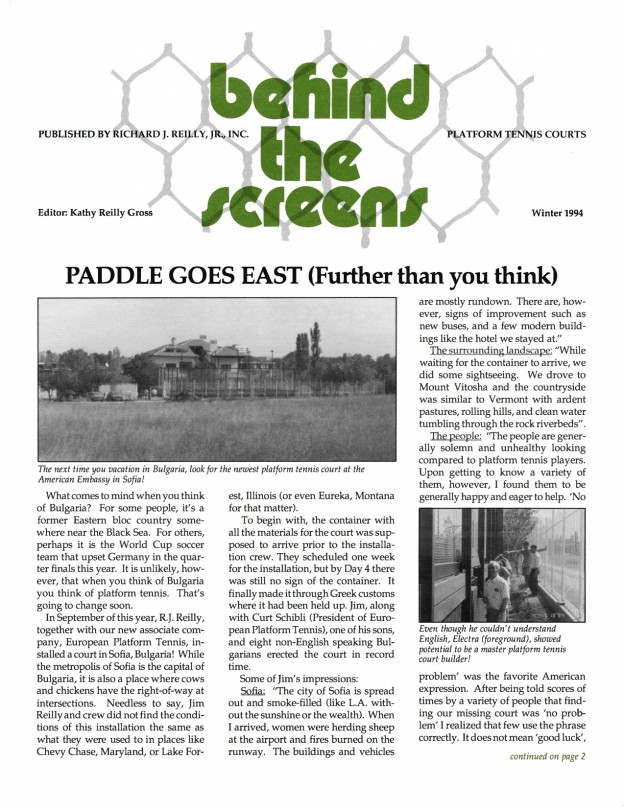
R.J. Reilly, Inc. to the rescue

Just a couple of weeks before the Men’s and Women ‘s National Championships, and despite altering schedules and expanding play to Friday night for the first time in years, it was realized that one more court would be needed. That’s when Jim Reilly of R.J. Reilly stepped into help.

His company had put up the extra “stadium” courts at the host Shadow Lake Club, where the main matches were to be played, but it was apparent one more was needed. “Jim really hit a home run for us this time,” said co-chair Fritz Odenbach. “He not only came through with his usual timeliness and quality on the two courts we originally contracted for, but he went out of his way to get us that one additional court that made all the difference in our eventual schedule. To be honest, he and his organization deserve one of those APTA medals for being a winner here at Rochester, because that’s exactly what he is.”

Source: Platform Tennis News, Spring 1996

Kilmarx won the inagural Men's National Championship in 1935 with Kip Couch

Platform loses an original; “Killy” Kilmarx

Sumner “Killy” Kilmarx, one of the very first national men’s doubles platform tennis champions, died on March 2, 1996, in Scarsdale, NY. He was 96. With his long-time paddle partner, Clifford Couch, he won the first national men’s tournament held at the Fox Meadow Tennis Club in 1935.

The 1935 final was one of the longer matches in National Men’s play, a 4-6 , 6-4, 6-3, 2-6, 9-7 victory over later champion James Hynson and Charles O’Hearn, who defeated them in the 1937 National finals. But Kilmarx and Couch were victorious again in their return finals in 1939. Kilmarx was recognized by the unusual steadiness of his play and the debonair style of his attire on the court.

He was an honorary member of Fox Meadow for many years, having contributed to the development and the popularity of the early game.

Source: Platform Tennis News, Summer 1996

Platform Tennis News, Summer 1996

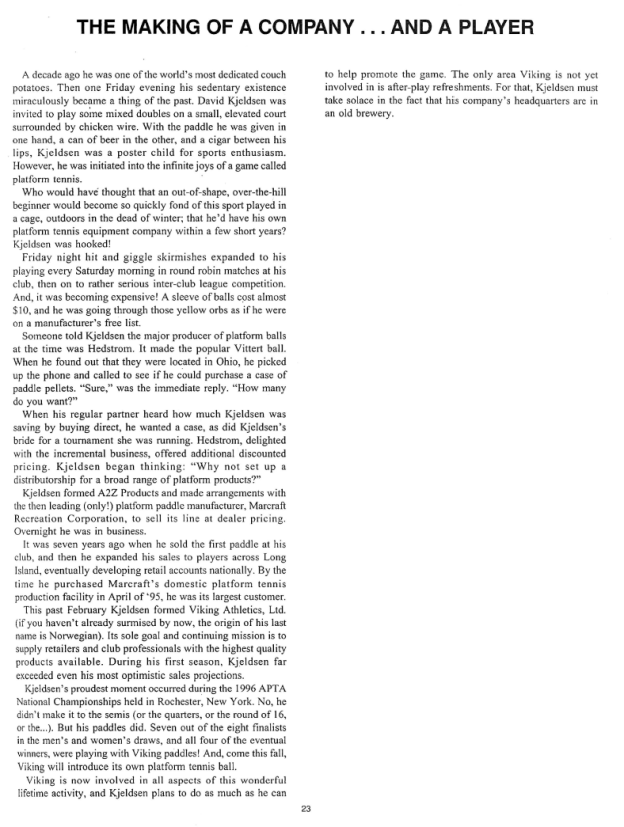
David Kjeldsen – the game’s mover and shaker extrordinaire

In the mid 1980s he was one of the world’s most dedicated couch potatoes. Then one Friday evening his sedentary existence miraculously became a thing of the past.

David Kjeldsen was invited to play mixed doubles on a small, elevated court surrounded by chicken wire. With the paddle he was given in one hand, a can of beer in the other, and a cigar between his lips, Kjeldsen was a poster child for sports enthusiasm. He got hooked on the game and started playing more and more, but it was getting expensive with a sleeve of balls costing $10.

He found out that Hedstrom, out in Ohio, was selling the Vittert balls he was using and arranged to buy case loads directly from them at a discount for distribution to friends and for use in tournaments. Hedstrom was delighted with the increase in business and offered further discounts.

Finally, Kjeldsen began thinking: “Why not set up a distributorship for a broad range of platform products?” That led to the formation of A2Z Products, and an arrangement with the only platform paddle manufacturer, Marcraft Recreation Corporation, to sell its line at dealer pricing.

Overnight, he was in business. He sold the first paddle at his Club in 1989, and then expanded his sales to players across Long Island, eventually developing retail accounts nationwide.

By the time he purchased Marcraft’s domestic platform tennis production facility in April of ’95, Kjeldsen was its largest customer.

Kjeldsen’s extraordinary support of the game and to Junior programs over many years lead to his induction into the Hall of Fame in 2008

Source: Platform Tennis News, Summer 1996

The end of Lineal Sponsorship after three years of commitment

After three years of supporting the game of platform tennis, including the commitment of tens of thousands of dollars in tournament prize money and raffle drawings, the Lineal Group announced that it would no longer be able to sponsor the Lineal Group Grand Prix Series. Several executive, as well as business, changes had occurred at the company and thus it became necessary to end its successful relationship with competitive paddle tennis.

Ginna Ohlmuller, Executive Director of the APTA, commented on the development: “The Lineal Group provided a real boost to the game of paddle tennis over the last three years and they were a pleasure to work with.”

Ohlmuller made special mention of Arnie Ditri1, head of Ditri Associates, and John Balch, Lineal’s senior marketing manager. “Mr. Ditri had a genuine interest in the game of paddle and committed substantial time and effort to help the game graduate to the next level and John gave up numerous weekends over years to attend the tournaments, as well as spending innumerable hours in the office organizing the financial details, in order to make the relationship a first class one.”

Balch made the following statement:

“The Lineal Group is grateful for the opportunity we have had to sponsor our ‘Grand Prix’ tournament series. For three seasons, these events have been a good means of increasing awareness of our furniture brands and, quite frankly, we had a lot of fun in that endeavor.”

Diane Tucker, who along with Robin Fulton, finished the 1994-1995 season at the top of the Lineal Group Championship Series, provided a view from the women’s tour:

“The Lineal Group brought the men’s and women’s games together, and I got to know a lot more players because of their sponsorship. There was an added level of excitement when there was money on the line. The players felt a little more pressure and had something a little higher to aim for.”

Source: Platform Tennis News, Fall 1995

Note 1: Arnold E Ditri was President and Chief Executive Officer of Hedstrom Corporation, a manufacturer and marketer of children’s leisure and activity products, from March 1993 to December 2000. He was non-executive Chairman of Hedstrom from January 2001 to July 2001. Mr. Ditri served as President of Ditri Associates, Inc. from 1981 until 1994, which company, with a number of financial partners, specialized in acquiring and building under-achieving companies with Mr. Ditri serving as Chief Executive Officer of the acquired companies.


Platform Tennis News, Spring 1995

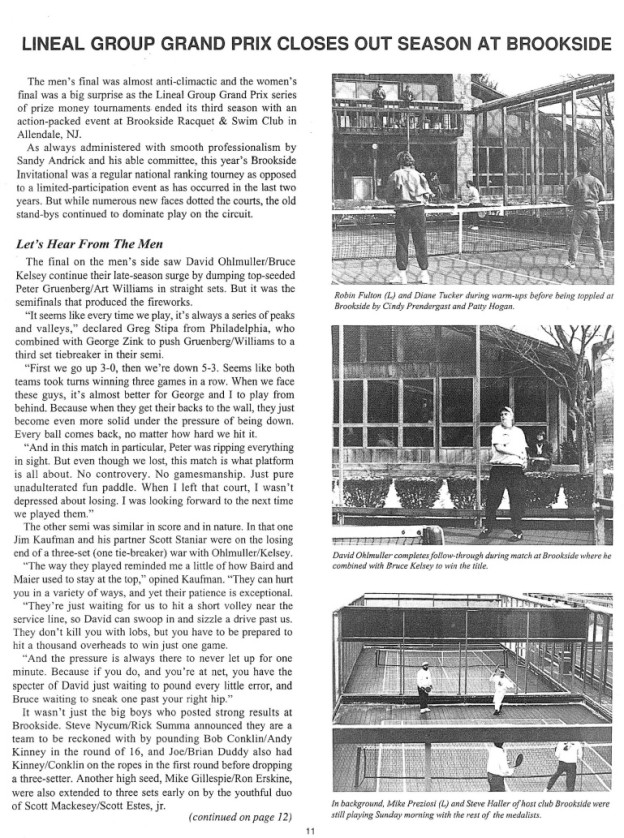
Lineal Group Grand Prix

The men’s final was almost anti-climactic and the women’s final was a big surprise as the Lineal Group Grand Prix series of prize money tournaments ended its third season with an action-packed event at Brookside Racquet & Swim Club in Allendale, NJ.

The final on the men’s side saw David Ohlmuller/Bruce Kelsey continue their late-season surge by dumping top-seeded Peter Gruenberg/Art Williams in straight sets. But it was the semi-finals that produced the fireworks with Greg Stipa and George Zink pushing Gruenberg and Williams to a third set tiebreaker, and Jim Kaufman and Scott Staniar to three sets against Ohlmuller and Kelsey.

Some people were starting to complain that women’s tournaments had become too predictable, with the same teams dominating from start to finish. Jersey’s Patti Hogan and Delaware’s Cindy Prendergast helped squelch that attitude at Brookside by knocking off heavy favorites Diane Tucker/Robin Fulton in fairly routine fashion.

Source: Platform Tennis News, Spring 1995

Charity dinners are out; Paddle tournaments are in

Instead of gala balls and celebrity-studded formals, charities around the country are finding that platform tennis can be an important vehicle for both raising funds and enhancing their visibility and image.

Paul Delaney, who played out of Bronxville, arranged a mixed tournament to support the Visiting Nurses Services of Westchester and received lots of positive reaction because of the good cause and the popularity of mixed events in Westchester. He hoped to make this an annual event, and it still is.

Source: Platform Tennis News, Winter 1995