




Sun Valley, ID has a court
Life magazine edition of March 8, 1937, publish an article on Sun Valley, ID which had been founded by W. Averell Harriman and had just opened. The pictures included one of a platform tennis court.
Ever the promoter, Blanchard wrote to Harriman to inquire about the state of the game at the resort.
The game breeds self esteem
A new notice appeared on the Old Army Athletes bulletin board on March 30, 1930.
A Scarsdale banker suffering from excessive shyness and protruding ears had become a success in society and business as well as quite the ladies man as a result of playing the game.
Frederick Allen, editor of Harper’s magazine and poet laureate of the OAA, and his wife were the suspects.

NBC broadcast on platform paddle tennis
The nationwide broadcast took place on November 21, 1935 at 6:15 pm in conjunction with WJZ- NY.
The noted sportswriter John R. Tunis moderated the event which included the Old Army Athletes, Frederick. L. Allen, Fess Blanchard and Charles O’Hearn.
In typical fashion some Old Army Athletes, in this case Peggy Brent and others, used the broadcast to tease Cogswell – see letter

Frank B. Contessa – the link between paddle and platform tennis
An article on Contessa by Vicky Cosstick appeared in in Paddle World, Vol. 1 No. 5, Fall 1976
In the article John Ware, Blanchard’s son-in-law, referred to him as the ‘missing link” between paddle tennis and platform tennis as Contessa who developed, manufactured and promoted the paddle tennis racket, net and balls which Blanchard and Cogswell bought in a New York store.
Through his church activities, Contessa met the Rev Frank Beal whose boys were playing street paddle with crude saw-cut bats, and in 1922 Contessa left his Wall Street career to form with Beal, the American Paddle Tennis Assoc. with the aim of marketing the game and equipment specifically for under-privileged youth.
Contessa began with the financial backing of Wall Street colleagues, and space donated by his brother Joseph in the basement of a yarn warehouse at 131 Spring St. (in what is now called SoHo, Manhattan). The first equipment consisted of a carrying case, nets, stanchions, paddles and balls for two or four players: ” A Complete Outfit at the Cost of One Standard Tennis Racquet: $10.00 “. A later version included tape and staples to mark out the court. In designing the equipment,
Contessa gave primary consideration to cost, portability, and flexibility. The stanchions for net-posts were made especially to be collapsible and the ” airball” (sponge rubber) was designed to bounce on an irregular surface, large enough so that a child would see it coming over the net easily. The paddles were made of plywood.
Over the period between 1922 and 1926, Contessa set about marketing the game in a systematic fashion. ” I thought it would take two years,” he says, ” but it took four.”
In 1926, the G. Lynn Sumner Co. , a Madison Avenue advertising company, offered to buy the Paddle Tennis Co., and the directors, including Doc Beal, agreed. Frank Contessa was outvoted. His concern was that the new owners would up the price of the equipment and redirect it to the more wealthy set.
He left the world of paddle tennis and went onto other ventures. But his predictions were correct. Not only did the equipment become more and more costly, but the game was taken up by two Scarsdale players named Blanchard and Cogswell,who, not satisfied with playing the game just anywhere, and with the resources to develop a more sophisticated game, built a platform and had the idea of playing the ball off the wires.
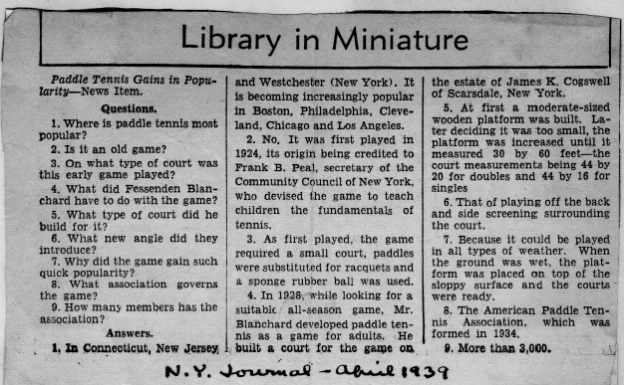
New York Journal Pop Quiz
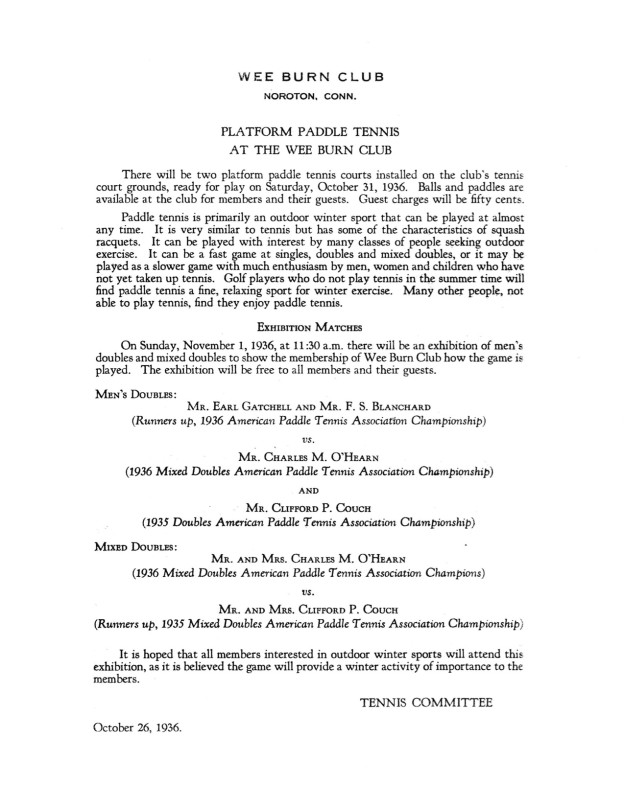
Wee Burn, Noroton, CT erects two courts and holds exhibition matches
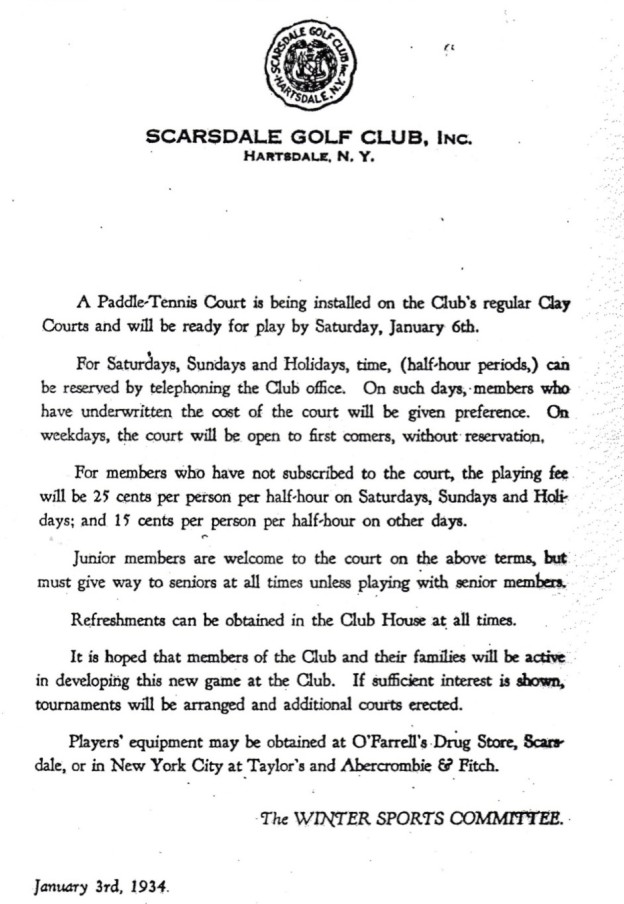
Scarsdale Golf Club erects court
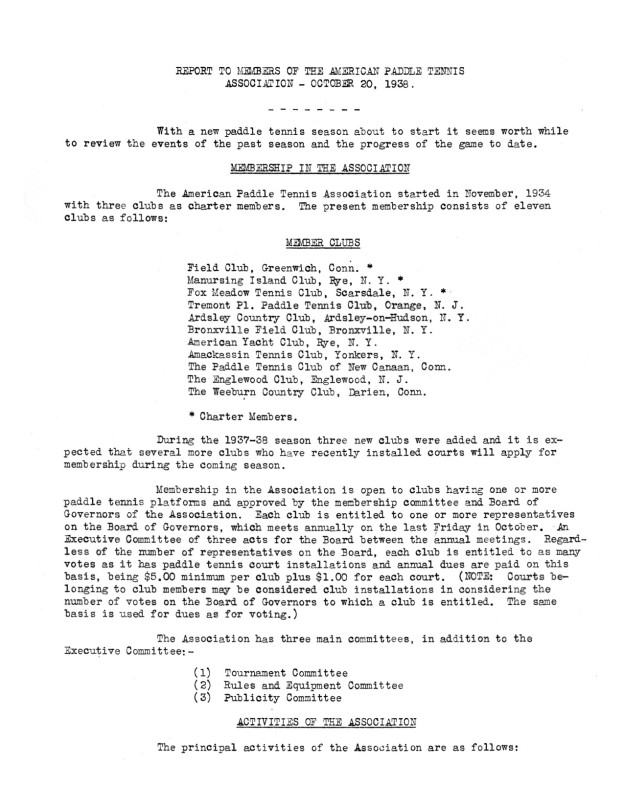
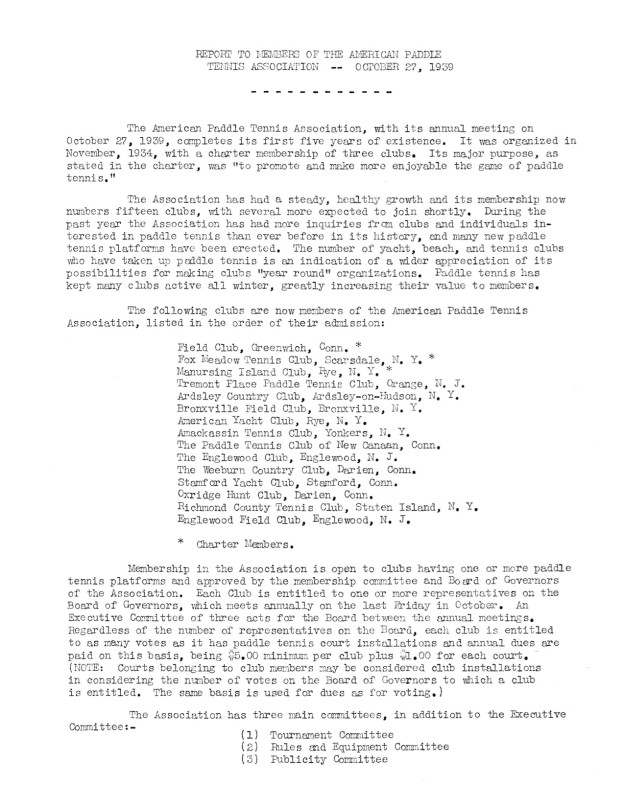
APTA Report to Members – now up to 11 clubs
 © 2026 Platform Tennis Museum and Hall of Fame Foundation, All Rights Reserved.