75th Anniversary Fox Meadow’s Governors’ Tea

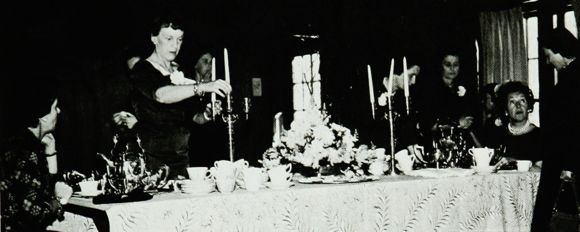
Helen Couch readies the candles for the Club's festive seventy-fifth anniversary tea
Helen Couch readies the candles for the Club’s festive seventy-fifth anniversary tea

The Governors, Tea is an annual event that takes place in April.

Tradition dictates that no recipe be printed for the punch served at the event and instructions for the punch are handed down from president to president; and theoretically, therefore, the only way to get the recipe is to work one’s way up through the Board of Governors.

However, presidents have been noted to be using bottles of champagne, Cointreau, and brandy in concocting the mixture. There is suspicion, too, that liberties are taken from time to time with the formula.

Ollie Kingsbury says every president uses what he wants in the recipe, but that his was the best, attributable to the classical caloric count of imported champagne.

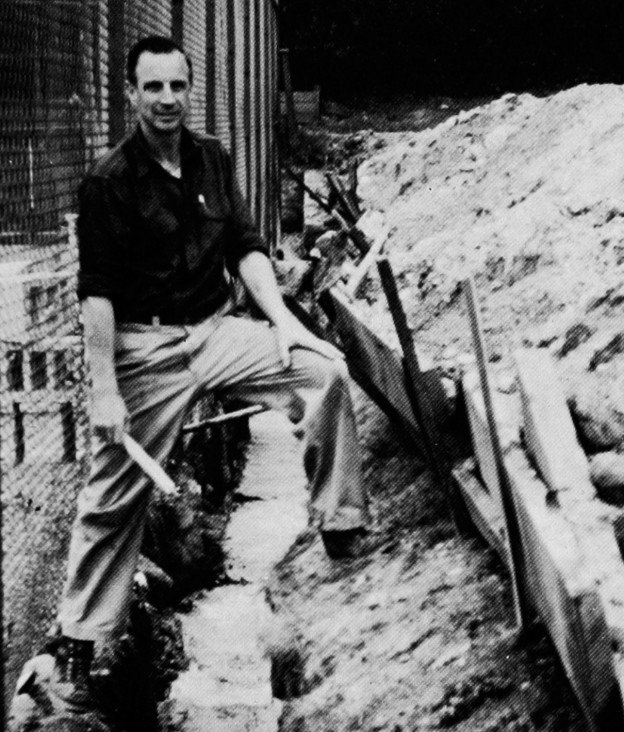
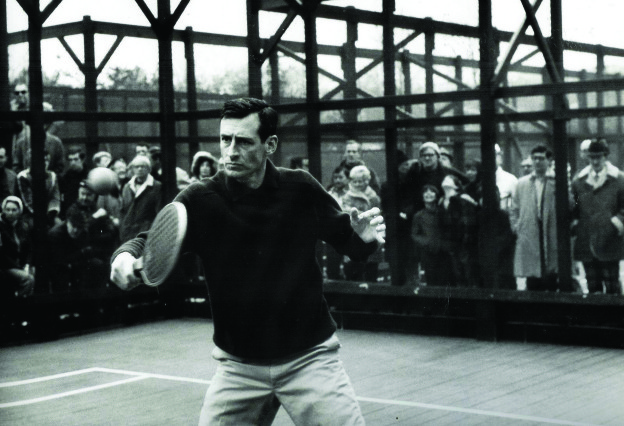
Walter Close (1916-1991) was know as a "doer" at the APTA as well as at Fox Meadow. The retaining wall he built between the club porch and the tennis courts still stands.

Walter H. Close, Jr. elected FMTC President (1963-1964)

Fox Meadow was Walter and Betty Close’s first love. All of their best friends were there and it was the nucleus of their social life. They played tennis and paddle tennis and planned, executed and attended all of the parties.

No one cared more about the grounds and the plantings than Walter. He was house and grounds chairman when it was decided that a retaining wall between the porch and the tennis courts was needed and he became the chief designer, foreman and construction worker.

Starting in 1959-60 Close and his crew of volunteers began to plant trees, dozens and dozens of them. And, when there were droughts he saved rainwater from the gutters of his home and somehow transported it to Fox Meadow to water his precious seedlings. Close claimed that over the years the Club had planted more that 256 trees to screen the paddle courts and to prevent the lights from bothering neighbors at night.

By now the grounds around the clubhouse bore little resemblance to those 40-50 years ago. The transformation was the result of the long-range plan begun in the late 1940s.

Walter Close (1914-1991) also served as APTA President from 1959-1961 and was inducted into the APTA Hall of Fame in 1967

Source: Diana Reische, Fox Meadow Tennis Club- The First Hundred Years, 1983, personal communication from his daughter Cynthia Close Larkin
Screen Shot 2014-01-04 at 11.03.48 AM

APTA policy on use of racquets and balls

The APTA Paddle Newsletter reported on the policy that stated that only officially approved rackets and balls would be sanctioned for play at APTA Tournaments.

The only rackets approved for play at the time were manufactured by the Dalton Company, Marcraft and Craig & Simplex Co.

Official balls used at APTA Tournaments were those produced by the Barr Rubber Company.

The APTA told manufacturers, interested in getting their equipment approved, to contact the APTA concerning submission requirements.

Source: First edition of The APTA Paddle Newsletter

APTA Boy’s Doubles- FMTC juniors make it to the finals but lose to the Baird brothers

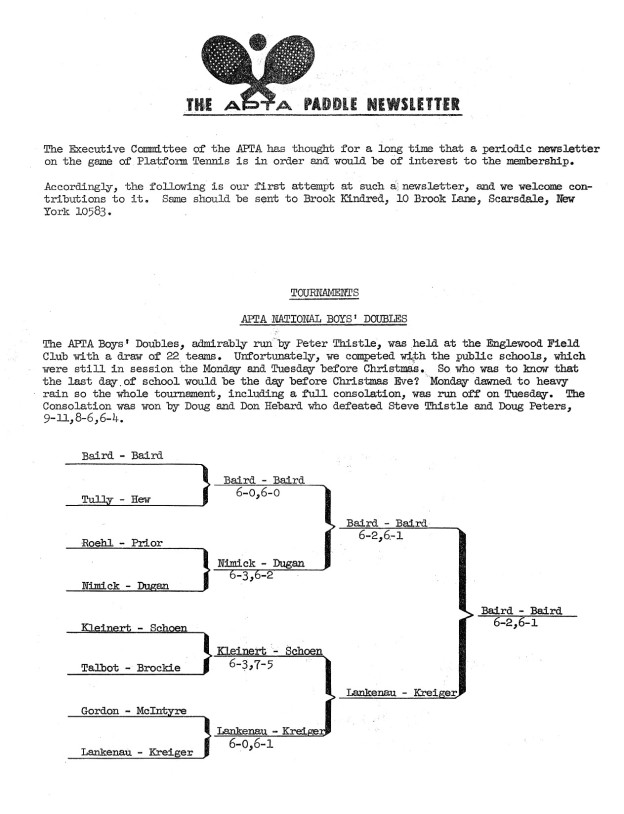
No one from Fox Meadow had won the Boys’ Doubles yet, but in 1969 the Club’s Clay Auxford, son of Sally Childress Auxford, and partner Hi Lankenau of Chappaqua made it to the finals. They lost 6-3, 2-6, 6-1 to Chip and Steve Baird, brothers from Chevy Chase, Maryland, who won the Men’s National Championship in 1976. Steve Baird and partner Rich Maier dominated the game in the 1980s and early 1990s

Source: Adapted from Diana Reische, Fox Meadow Tennis Club – The First Hundred Years, 1983

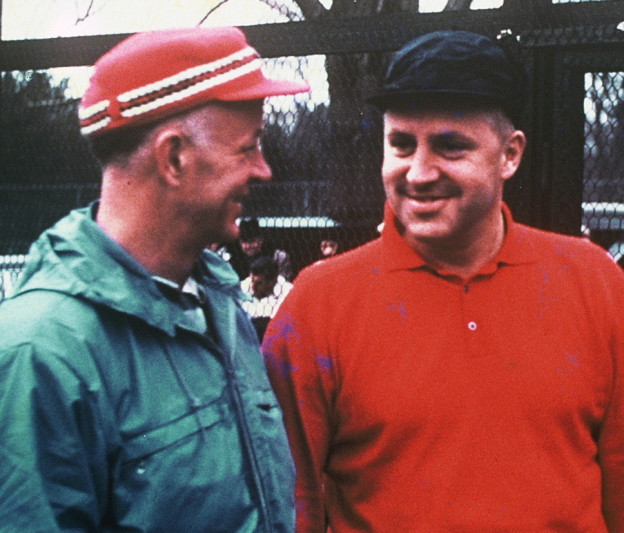
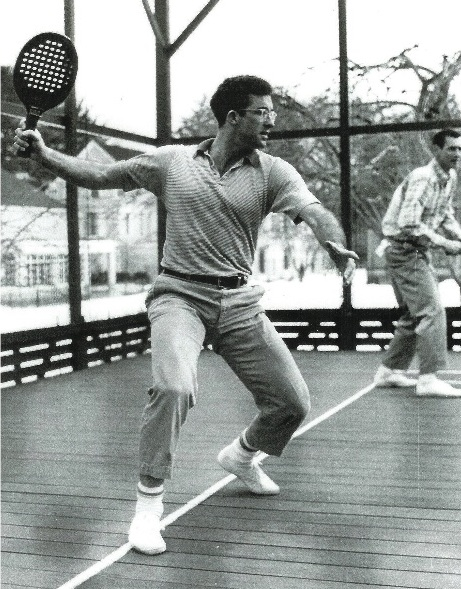
George Harrison (left) and Bill Pardoe

APTA Honor Award: Harrison and Pardoe

George R. Harrison won the Men’s Nationals in 1956 and 1960 and the Men’s 45+ in 1963. He was active in the APTA as chairman of the Rules and Equipment Committee and, during his tenure and through his efforts, the yellow-orange ball that replaced the original white ball was introduced and became the ball standard until the modern yellow ball was adopted. (Fox Meadow Tennis Club).

William E. Pardoe won the Men’s Nationals in 1956 and 1960, the Mixed Nationals in 1965. and the Men’s 50+ three straight times (1966-1968). He had one of the all-time best serves in the game, and brought the American twist service to platform tennis. (Fox Meadow Tennis Club).

APTA reviews key rules- Foot-fault and ball hit out of court

The foot-fault revision was unofficially known as the “Kimberly Rule,” after Kim Kimberly who took a running leap at the ball, ignoring the baseline and violating most rules, however modified. He was fun to watch though!

The First APTA newsletter carried a discussion on foot-faults and the let rule if a ball was bounced out of the court.

“Foot-Faults
At a recent meeting of the Executive Committee, the foot fault rule was discussed ad infinitum due to the flagrant violation of it by numerous players who are beating their serve to the net. To reiterate, the APTA foot-fault rule is a direct copy of’ the USLTA rule:

The server shall throughout the delivery of’ the serve:
A. Not change his position by walking or running.

B. Not touch, with either foot, any area other than that behind the baseline within the imaginary extension of’ the center mark or sideline.

Section A was further clarified that slight movement is movement not in excess of two or three inches. Servers are permitted to jump in the process of serving so long as their feet do not touch the court before contact of racket and ball, but they may not take a forward step with either one or both feet prior to serving whether they jump during the serve or not.

Tournament Chairmen are asked to enforce this rule throughout all play and the rule will be enforced at all APTA Tournaments.

Ball Hit Out Of Court1
There has also been much discussion concerning the ball out of court – let point rule. It was decided at the aforementioned meeting that when a ball is hit out of’ court, the point shall be replayed. So the rule stands.

Points covered in defense of’ the rule were:
1. Points are hard enough to make without being penalized for hitting the ball out of’ court.

2. Balls hit out of’ court ·are so hit by players on the offensive and such players are not trying to lose their advantage by having to replay the point.

3. The object on offense is often to hit the ball high so that it drops down close to the wires making it more difficult to return. Such a shot might result in the ball being hit out of’ court, but that is never the objective of’ the player hitting such a shot.”

Note 1: This rule was revisited in 1975 when the present day rule was adopted which stipulated that a ball hit out of the court resulted in a loss of point

Source: First edition of The APTA Paddle Newsletter. Personal communication from Robert R. Kingsbury.


First APTA Newsletter

First APTA newsletter published

The newsletter leads off:

“The Executive Committee of the APTA has thought for a long time that a periodic newsletter on the game of Platform Tennis is in order and would be of interest to the membership. Accordingly, the following is our first attempt at such a newsletter, and we welcome contributions to it. Same should be sent to Brook Kindred, 10 Brook Lane, Scarsdale, New York 10583.”

The newsletter went on to cover the National Boys’ tournament (won by the Baird brothers) and the results of the Cleveland Invitational, Connecticut State Men’s, and Long Island Invitational. It also reprinted an article from the in-flight magazine American Way on paddle tennis.

The newsletter was edited by Fox Meadow member, Brook Kindred for four years

Gordon Gray from Greenwich, Connecticut, was one of the top male players from the late 1960s to the 1970s

National Championships now Include Men’s 60+

1969 - Rev 1

CBS had coverage of the National Mixed Doubles narrated by Heywood Halle Broun, Jr. [See APTA 1969 Annual Meeting Minutes]

Gordon Gray and Jesse Sammis reversed the result of the previous year’s finals and started on a three-year streak. ABC was on hand to film the Men’s Nationals and the APTA obtained two copies that they made available for loan to member clubs of the Association, as well as individual members.

Charlotte Lee and Peggy Stanton won the Women’s again for the third time in a row, and Charlottee Lee got back into the winners circle in the Mixed with Bradley Drowne.

Walter Frese and George Holloway won the inaugural 60+ Senior Men’s.

The Junior Boy’s was won by Charles (Chip) Baird, Jr. and Steve Baird. Chip went on to win five straight titles, twice with his brother Steve, twice with George Krieger and once with James Hartmann.

Source: Oliver H. Durrell, The Official Guide to Platform Tennis, 1967; APTA Platform Paddle Tennis 1963-1973: Rules and Records, 1973

Jesse Sammis won the Men’s Nationals (with Gordon Gray) in 1969, 1970, and 1971

Paul C. Molloy

Paul C. Molloy elected APTA President (1969-1971)

Malloy had been very close to the game for many years but, despite this, in his farewell remarks as President, he said, “….there is no way I can picture where our game will be 10 years from now. The instant appeal of the game is so great that it is impossible to estimate how long the accelerated growth will last and how far it will spread.”

Under his leadership the first newsletter was created to keep players informed of activities throughout the year and much work was done in scheduling and coordinating tournaments and satellite events in recognition of the new areas of growth in the game and their demand for tournament paddle. National rankings had also been established by the end of his term, with Hennessey donating cups to the individual man and woman gaining the most points from ranking tournament play. With the upsurge in women’s play, he was also instrumental in getting the APTA nominating committee to nominate a woman as Co-Tournament Chairman and a member of the APTA Executive Committee to give women the representation on the board that they deserved