Viking’s new ball gets raves – but production issues always present

Viking had started making balls soon after they acquired the Marcraft platform tennis business in 1995. C0-incidentally, Wilson had acquired the Vittert V30 ball business from Hedstrom about the same time and decided to stop selling balls to Viking, which had been a long-time reseller, as they were a competitor.

The New Viking ball was well received and was used in the 1997 Men’s and Women’s Nationals but later batches were even better! They were on a roll.

However the ball manufacturing business was a difficult one and bad batches of balls had a habit of showing up unexpectedly.

David Kjeldsen recalls Viking’s experience just when he thought he had finally found the “perfect” ball……..

“No matter who the manufacturer was, there always seemed to surface a bad batch of balls. In the Hedstrom days bad would mean excessive “chunking”. In the early Viking days it would mean flocking that peeled off much like you would peel an orange or flocking that wore so poorly that you could only get a few games.

In our fifth or sixth year of supplying balls we had a batch of balls that were indestructible. Players were regularly reporting getting three or more sets with the balls still being playable at the end. We were very excited. I was getting pretty cocky that we had finally made the “perfect” ball.

As is necessary for proper delivery, we placed our order for balls for the following season in early April. We spent May developing a marketing plan wherein we would “guarantee” two sets of play from every ball. It would be a revolutionary guarantee for our sport. For reasons I cannot explain, in early July I decided to scrap the marketing plan and just promote the fact that were the largest supplier of balls in the industry.

Our first shipment of balls for the season were delivered in early August. The tractor trailer arrived. We always got excited when our August shipment of balls were delivered as it meant the start of the new season was only days away. When the driver opened the trailer doors a green cloud of dust appeared. I knew instantly the this was not good. I opened a case of balls that had fallen to the ground, took a ball from one of the sleeves and bounced it on the ground. My heart stopped. There on the ground was a perfect ring of optic yellow flock. It was going to be a very long season…….. and it was.”

Source: David Kjeldsen, private communication, 6/7/2012
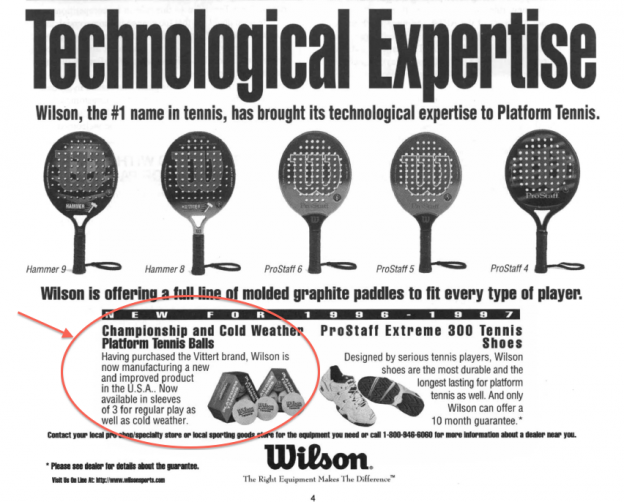
Hedstrom stops production of the game’s dominant ball, Vittert V30. Wilson Sporting Goods acquires brand and production equipment

This was a sudden decision and likely related to the changes taking place at the Dimitri Associates’ group of companies that included Hedstrom and the Lineal Group, the sponsors of the Lineal Grand Prix. This decision provided Wilson Sporting Goods with the opportunity to acquire the Vittert brand and production equipment and started promoting Championship and Cold Weather Wilson balls in early 1996.

Source: Platform Tennis News, Mid-Winter, 1996

The game comes to Montana courtesy of Richard J Reilly, Jr

In 1993, court builder Dick Reilly (Hall of Fame 1974) moved west to Montana, put up a court, and ran a small tournament. Moving to another Montana location, the town of Eureka, Reilly erected two courts and brought out professional Hank Irvine (Hall of Fame 1995) to run a paddle camp each fall. Partly because there was little else for campers to do in their off hours in Eureka, Reilly moved the camp to Jackson Hole, Wyoming, where it continues. Initially, three courts were erected on a tennis court on a dude ranch to house the camp. After a year, the camp was moved to its present location on courts at the Snow King Resort.

At one of the camps, Reilly, Irvine, and Gary Horvath talked about the need to re-institute an organization for teaching professionals. The trio produced the conceptual foundation for establishing the USA Professional Platform Tennis Association (PPTA).

APTA has a silver trophy and the 1989 Nationals planning notebook stolen!

The APTA had asked Bob Brown, the 1989 Tournament Chair, to loan them his extensive notebook covering planning documents and records as they wanted to reproduce it for use as a guidance document for future events.

Brown had been involved in running the Nationals at Fox Meadow Tennis Club for many years and had developed a very detailed play-book. The book was handed over to the APTA at the May 19th Annual Meeting.

A week later Ginna Ohlmuller, the APTA Executive Secretary, called Brown to say that her car had been broken into and a silver trophy and the play-book had been stolen. Despite reporting the loss to the police they were never recovered.

Source: Robert A. Brown note dated 5/31/1989

Change made to number of sets played and use of tie-breakers. Men’s National Championship finals now just three sets.

The APTA moved to a best-of-three sets format for the men’s national ranking and National Championship events. Many ranking events had already adopted this format. The 12 point Tiebreak was recommended for all sets except for the third set in the finals of the Men’s, Women’s and Mixed National Championships which were to be played out.

See also 1984 rule change for Men’s National Championship

Source: Platform Tennis News, Summer 1989

R. J. Reilly courts as of Summer 1997

Each dot on the map is the five digit zip code of a customer but some have more than one court. Court costs at the time could be as much as $40,000 and most were installations at private clubs and schools.

Source: R. J. Reilly Co. Brewster NY

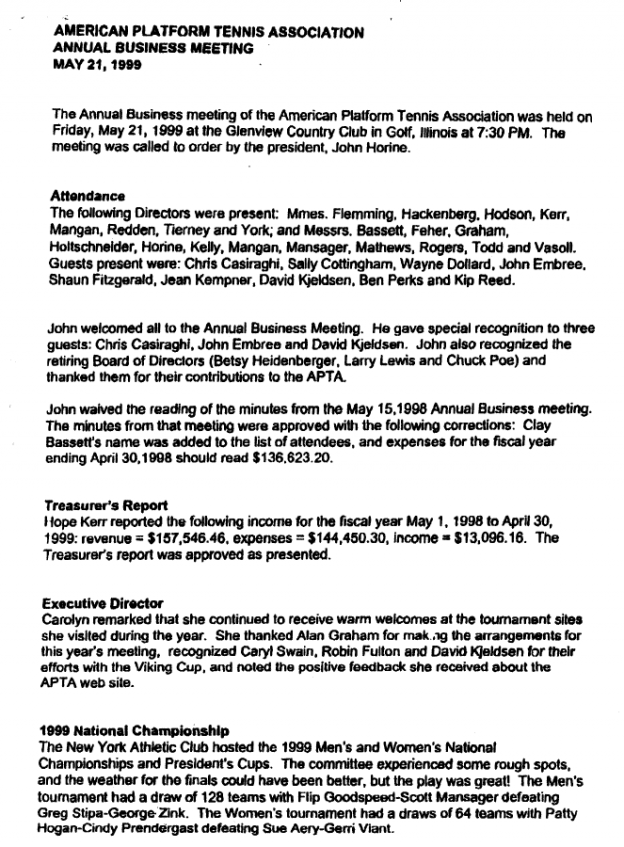
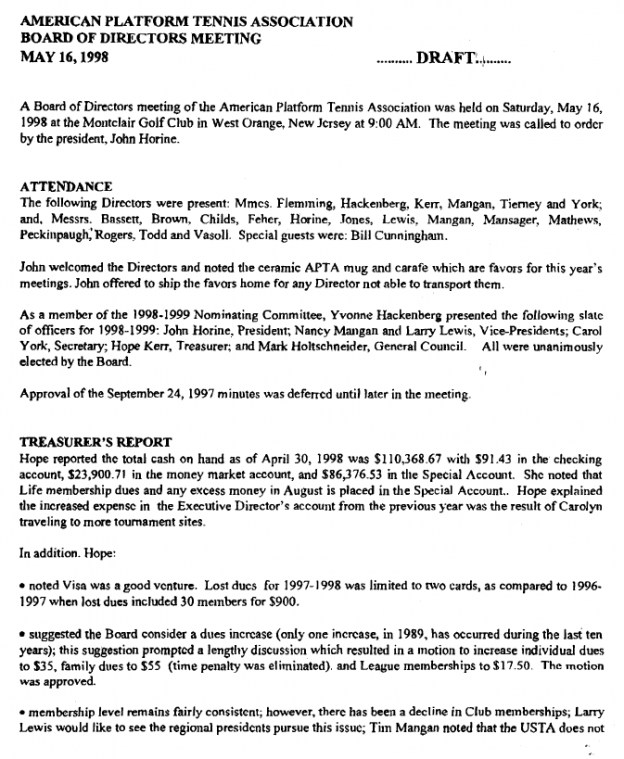
APTA Annual Business and Board Meetings

More ball issues were discussed but the big decision was the vote on “No-Let”

“Also, after two years of trial use, the NO-LET rule on service was voted in as a permanent rule. Prior to the vote, all members were polled, and the results of the APTA survey were discussed. The Board did not act on a suggestion to address the “dribbler” factor, a major complaint against the no-let rule where a loss of point is due to a “dribbler”.