Skymar Paddle

Rich Maier, co-inventor of the Skymar paddle – paddle innovation takes another step

Maier was not content with just playing and teaching the game. He was an innovator, with a US patent (US4379554) as proof.

Along with co-inventor Andreas D. Schuyler, they developed a new concept for the platform tennis paddle.

The patent, filed on August 24 1981 and issued on April 12, 1983, described an improved platform tennis paddle constructed “with two outer laminated ply structures and inner laminated ply structure there between. The inner laminated ply structure has a central aperture there through which, in the preferred embodiment, is filled with a resilient plug. The edge of the paddle is protected by a T-shaped molding fitted in to the perimeter of the paddle, and to safeguard against de-lamination, the handle is of pegged construction.”

The patent was assigned to Skymar Corporation, and Rich and Andreas built the racquet, Skymar Proflight, in a garage in Allendale, NJ. The racquet was a commercial success, but the garage manufacturing operation faced constraints and ultimately closed.

The concept though endured and was picked up by another manufacturer, Marcraft, with their Force model which was introduced in 1992.

Source: Private communication with Rich Maier

NOTE: For the history of the paddle from the early days through early 1990s: Jim Tate’s article The Paddle Itself has a History Too!

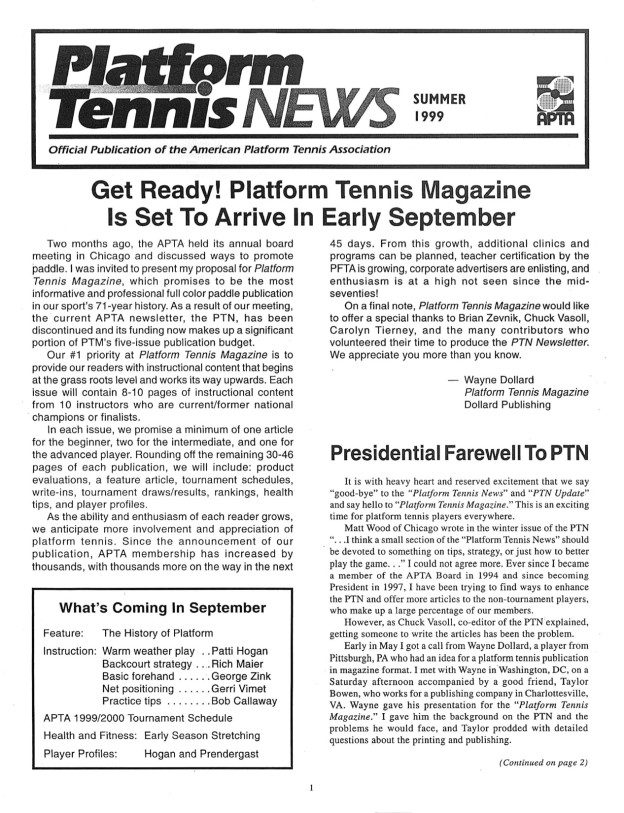
Platform Tennis News bids farewell. Platform Tennis Magazine would begin publication in the fall

Platform Tennis News and PTN UPDATE pass into history

At the APTA Board meeting in Glenview, IL, in May, Wayne Dollard of Dollard Publishing Co. proposed a professionally-produced four-color magazine format publication that would have content and scope beyond APTA capabilities with their newsletters.

The new publication was seen as a significant enhancement in member value. The summer editions of Platform Tennis News and PTN Update would be the last ones and Platform Tennis Magazine would debut in the fall.

APTA President John Horine explained the decision process:

It is with heavy heart and reserved excitement that we say “good-bye” to the Platform Tennis News and “PTN Update” and say hello to Platform Tennis Magazine. This is an exciting time for platform tennis players everywhere.

Matt Wood of Chicago wrote in the winter issue of the PTN ” … I think a small section of the Platform Tennis News should be devoted to something on tips, strategy, or just how to better play the game … “ I could not agree more.

Ever since I became a member of the APTA Board in 1994, and since becoming President in 1997, I have been trying to find ways to enhance the PTN and offer more articles to the non-tournament players who make up a large percentage of our members. However, as Chuck Vasoll, co-editor of the PTN explained, getting someone to write the articles has been the problem.

Early in May, I got a call from Wayne Dollard, a player from Pittsburgh, PA, who had an idea for a platform tennis publication ” in magazine format. I met with Wayne in Washington, DC, on a Saturday afternoon, accompanied by a good friend, Taylor Bowen, who works for a publishing company in Charlottesville, VA.

Wayne gave his presentation for the Platform Tennis Magazine. I gave him the background on the PTN and the problems he would face, and Taylor prodded with detailed questions about the printing and publishing.

After excusing Wayne, Taylor turned to me and said, “I can’t wait to get this thing. This guy really knows what he is talking about.” With those comments I decided that was enough to invite Wayne to Chicago to make his pitch before the entire Board two weeks later.

After lots of questions and discussion, the Board overwhelmingly voted to accept, in principle, the proposal by Wayne Dollard. Pete Mathews, Board member and Region III President, was nominated to negotiate the details with Wayne.

So, ironically, an APTA member from Chicago writes this spring about improving the PTN and, in Chicago, the APTA Board votes to adopt the most significant member benefit since the website.

Of course, we cannot close the last issue of the PTN without thanking those involved in bringing it to us.

Chuck Vasoll and Brian Zevnik have been the heart and soul of the PTN since I can remember (and probably longer than they care to remember). Each issue required many, many phone calls, several deadlines, countless hours collecting and editing articles and layout. Truly a labor of love. On behalf of the APTA Board and all the APTA members, I would like to thank Brian and Chuck for such a wonderful job.

Wayne Dollard provided his view of future with Platform Tennis Magazine:

Two months ago, the APTA held its annual board meeting in Chicago and discussed ways to promote paddle. I was invited to present my proposal for Platform Tennis Magazine, which promises to be the most informative and professional full-color paddle publication in our sport’s 71-year history. As a result of our meeting, the current APTA newsletter, the PTN, has been discontinued and its funding now makes up a significant portion of PTM’s five-issue publication budget. Our #1priority at Platform Tennis Magazine is to provide our readers with instructional content that begins at the grassroots level and works its way upwards. Each issue will contain 8-10 pages of instructional content from 10 instructors who are current/former national champions or finalists.

Source: Platform Tennis News, Spring & Summer 1999

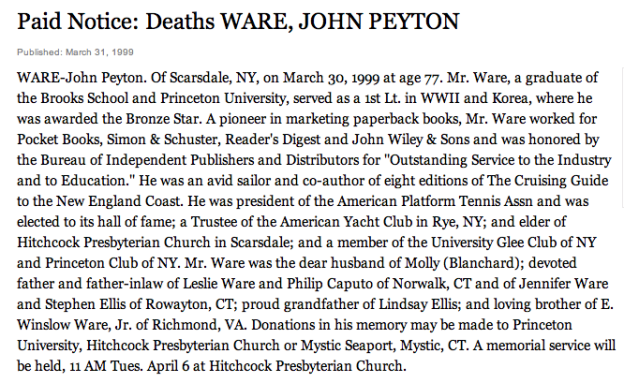
John Peyton Ware (1921-1999)

Ware was elected to the APTA Hall of Fame in 1995 and spent 40 years of his adult life nurturing and promoting the game of platform tennis and was responsible for changing the color of the original white ball to orange so that it had much greater visibility in winter.

Ware served as APTA President from 1961 to 1963 and was instrumental in bringing young people into the game when he inaugurated the first APTA Junior Boys National Championships in 1963. He also designed the crossed paddles and ball insignia that was used on stationery, trophies, ties, scarves, and everything that represented the APTA for years. The logo was modernized in the late 1970’s, but Ware’s original design remains on the crests presented to Hall of Fame recipients and past Presidents.

Ware, the son-in-law of Fess Blanchard, became the game historian and he and his wife, Molly, put together the first and only slide show presentation on the history of platform tennis which was first shown at the Princeton Club in October 1976.

Source: Platform Tennis News, Summer 1999

Rich Maier, Buffy Briggs, and Steve Baird at the induction ceremony

Hall of Fame inductees – Briggs, Baird, and Maier

The setting, the Nationals Championship dinner in the clubhouse at the New York Athletic Club’s summer home on Travers Island in Pelham, New York, was perfect and the recipients elite. Elizabeth “Buffy” Briggs, Steven W. Baird, and Richard K. Maier were added to the illustrious roster that is called the Platform Tennis Hall of Fame.

The first inductee to be introduced by Brook Kindred was Elizabeth “Buffy” Briggs. He extolled her organizational talents for women in paddle, as well as her ability in the play of the game.

Steve Baird was the next to be honored. Kindred again stepped to the podium to make the introduction and record the impact that Baird had on the game. It started with two Junior Championships with his brother and then, teaming with Rich Maier, to win 10 Nationals titles and be a finalist in three others. It was noted he also served on the APTA Board of Directors for six years, and was President for two, from 1982 to 1984.

“Guess who?” Bob Brown asked the audience when he returned to the microphone to award the green jacket to the third recipient. It was obviously the other half of the team with Baird, Rich Maier. His accomplishments with Baird in men’s competition were worth repeating, and Brown did repeat them. He also added Maier’s other triumphs in mixed, and now in the senior 45+ competition. But again, it was not all as a player that the award is judged. Maier is a teacher and much admired as a person by his students and around the country.

Source: Platform Tennis News, Spring 1999

National Championships and coverage of Men’s and Women’s Nationals

1999-2

PTN Winter 1999 covered the Men’s and Women’s Nationals:

“It was all we expected and more,” admitted a weary Bill Taubner after chairing the 1999 Nationals at the New York Athletic Club on Travers Island in Westchester, NY. “But I wouldn’t trade all the experiences for anything in the world.”

While the headaches were many and the rewards relatively few, Taubner and his crack committee came through like true champions for the platform tennis world.

The inimitable duo of Flip Goodspeed/Scott Mansager once again proved themselves kings of the hill , thwarting all efforts to seize their crown, without losing a set in the entire tourney. Steve Baird and Rich Maier proved there is life over 45 as they reached the round of 16 before losing to the eventual champs. The darkhorses of the tournament turned out to be Fritz Odenbach and Mike Stulac, as they fought their way all the way to the semis before losing to the eventual champs.

New champs Cindy Prendergast/Patti Hogan proved the queens of the three-setters as their mental toughness helped them prevail in three “overtimes,” including the final over defending champs Sue Aery/Geri Viant, who also went three sets, three times. Robin Fulton/Sarah Kreiger crashed their way to the semis without the loss of a set; Bobo Delaney/Tonia Mangan were one set away from the final slot; Kerri Delmonico/Shelley Morse proved they are a team to be reckoned with by reaching the quarters.

And Sally Cottingham/Wendy Robbins not only just missed the semis by a tie-breaker third set, but garnered accolades from spectators and compatriots alike for their exceptional play and more exceptional easy-going manners and sportsmanship.

Source: Platform Tennis News, Spring 1999

25th Annual Super Scrambles Tournament

An astronomical 102 teams on the courts. A mind-boggling 200+ people boogieing the night away on the dance floor. Why it must be the 25th Annual Super Scrambles Tournament in Bronxville, NY.

One of the highlights of Westchester’s paddle season, the Bronxville event had become a true platform cult classic. Marriages had been formed through paddle partnerships born there. Reputations for partying had been cemented (Peggie Theiss recalls several 3 a.m. closing time barriers). Senior records had been set, as Paul Delaney, at 63, became the oldest Super Scrambles winner. Multiple winners had been declared (among them Peter Sargeant, Brooke Johnson and Leighton Welsh). And best of all, paddlers had been having fun for 25 years, including Sugar Genereaux, who had never missed an event.

Source: Platform Tennis News, Mid-Winter 1999

Growing the Game: North Carolina Exhibition & Clinic

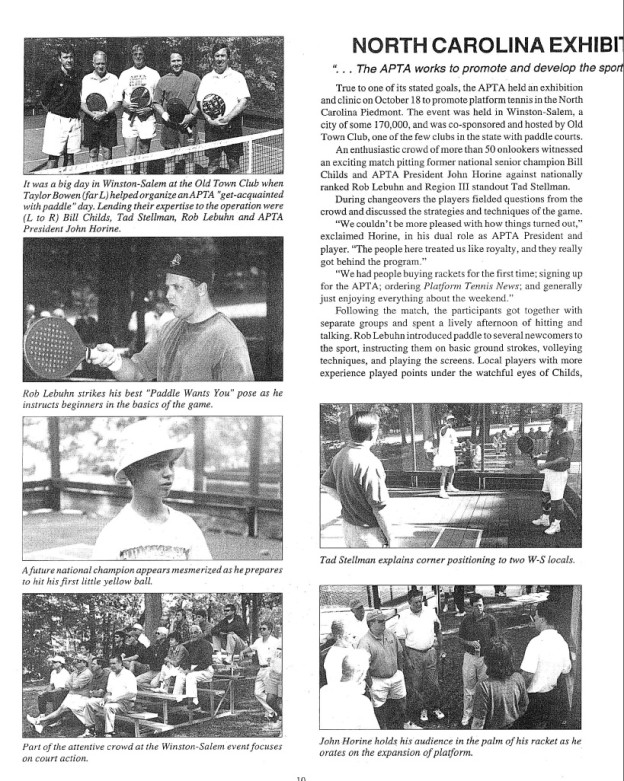
True to one of its stated goals, the APTA held an exhibition and clinic on October 18, 1998, to promote platform tennis in the North Carolina Piedmont.

The event, co-sponsored by APTA and Old Town Club in Winston-Salem, was a big success. The event was held in Winston-Salem, a city of some 170,000, and was co-sponsored and hosted by the Old Town Club, one of the few clubs in the state with paddle courts. An enthusiastic crowd of more than 50 onlookers witnessed an exciting match, pitting former national senior champion Bill Childs and APTA President John Horine against nationally-ranked Rob Lebuhn and Region III standout Tad Stellman. During changeovers, the players fielded questions from the crowd and discussed the strategies and techniques of the game.

“We couldn’t be more pleased with how things turned out,” exclaimed Horine, in his dual role as APTA President and player. “The people here treated us like royalty, and they really got behind the program. We had people buying rackets for the first time, signing up for the APTA, ordering Platform Tennis News, and generally just enjoying everything about the weekend.”

Source: Platform Tennis News, Fall 1998

Viking Cup Adult/Child Event is emblematic of the spirit of the game

Credit went to David Kjeldsen, CEO of Viking Athletics for supporting the event that had become immensely popular and a breeding ground for future top players.

Carly Swain covered the event for Platform Tennis News.

“There is always one moment in childhood when the door opens and lets the future in.”Graham Greene

David Kjeldsen, CEO of Viking Athletics has opened that door for junior paddle players and for the future of the sport. For three consecutive years, David has been the moving force that has turned the Viking Cup Adult/Child Tournament into a major national event on the paddle scene. During the month of October, 10 local tournaments were held in six different states. Two hundred fifty juniors and seniors participated in these local “play-downs.” Entries were up 20% from 1997. Each individual who entered received a Viking T-shirt and hat as well as a copy of “How to Play Platform Tennis” by Dick Squires. Viking Athletics also gave balls for all tournament play. The winners from each site came together at the Fox Meadow Club in Scarsdale, NY in November for the finals.

Fox Meadow is known as the “home of platform tennis” and seems to have now also become the “home of the Viking Cup.” It is centrally located to several other area clubs, has eight courts that the membership generously gives up for the day, and boasts a warm and friendly clubhouse where breakfast and lunch can be served. Newly added to the finals this year were winners from Baltimore and Pittsburgh. The largest local play-down (all 12- and-under) was held at Navesink Country Club in New Jersey by teaching pro Chris Gambino. And they therefore got to send the biggest contingent of winners to Fox Meadow. Representatives from all the sites and age divisions displayed excellent competitive skills. In the end, however, all the top honors went to junior/senior teams from the Philadelphia area. All three age divisions were won by players from the well subscribed Aronomink tournament, organized by Laurie Hissey.

Source: Platform Tennis News, Mid-Winter 1999, article by Carly Swain

In the same issue, Laurie Hissey reflected on David’s contribution to junior paddle:

“While sitting at Fox Meadow watching the Third Annual Viking Cup, the impact David Kjeldsen has had on junior paddle really hit me. David has sponsored the Viking Cup for the last three years, and this wonderful event is one of the big reasons my children are so “into” paddle. Before this event, there was no “reason,” no goal, for the kids to work toward. We have had so much fun getting ready for game days, that now we get out throughout the season. Whenever you see a successful event, you know there is someone behind the scenes keeping everything on track. This is definitely the case here. Robin Fulton and Caryl Swain do a fabulous job coordinating and running the local and national events. But any time there was a problem or question, David Kjeldsen came through. Nothing fazed him. Dave, once again, I want to thank you for your enthusiasm, your commitment, and your support. You have truly been a catalyst for junior paddle. Good job.”

Source: Platform Tennis News, Mid-Winter 1999, Letter from Laurie Hissey

Paddle Huts – an important part of the social aspect of the game

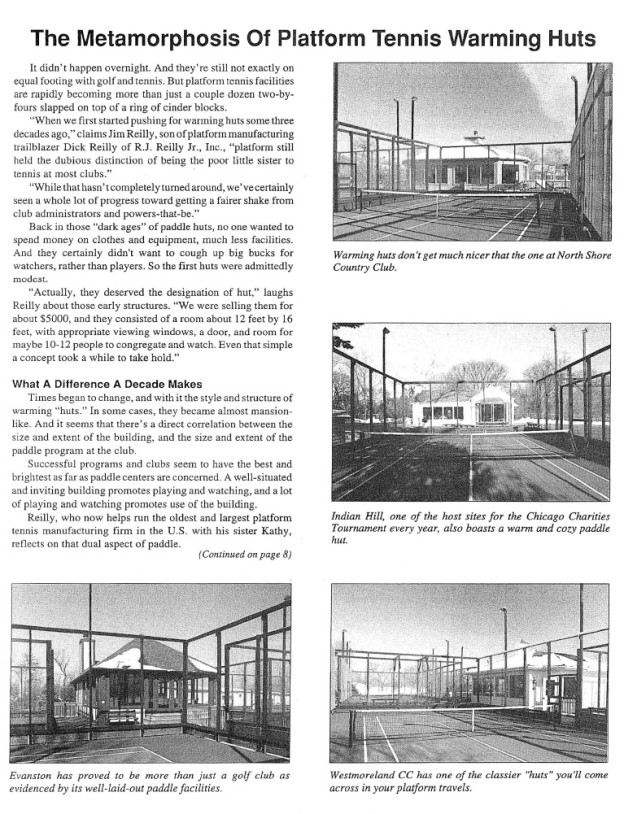
Early on it was recognized that a place for players to gather to watch play and socialize was an important part of the game. They started off as simple shacks, but have slowly blossomed into fancy edifices.

It didn’t happen overnight. And they’re still not exactly on equal footing with golf and tennis clubs. But platform tennis facilities were rapidly becoming more than just a few dozen two-by-fours slapped on top of a ring of cinder blocks.

“When we first started pushing for warming huts some three decades ago,” claims Jim Reilly, son of platform manufacturing trailblazer Dick Reilly of R.J. Reilly Jr., Inc., “platform still held the dubious distinction of being the poor little sister to tennis at most clubs.While that hasn’t completely turned around, we’ve certainly seen a whole lot of progress toward getting a fairer shake from club administrators and powers-that-be.”

Back in those “dark ages” of paddle huts, no one wanted to spend money on clothes and equipment, much less facilities. And they certainly didn’t want to cough up big bucks for watchers, rather than players. So the first huts were admittedly modest.

“Actually, they deserved the designation of hut,” laughs Reilly about those early structures. “We were selling them for about $5,000, and they consisted of a room about 12 feet by 16 feet, with appropriate viewing windows, a door, and room for maybe 10-12 people to congregate and watch. Even that simple a concept took a while to take hold.”

What A Difference A Decade Makes.
Times began to change, and with it the style and structure of warming “huts.” In some cases, they became almost mansion-like. And it seems that there’s a direct correlation between the size and extent of the building, and the size and extent of the paddle program at the club.

Successful programs and clubs seem to have the best and brightest, as far as paddle centers are concerned. A well-situated and inviting building promotes playing and watching, and a lot of playing and watching promotes use of the building.

Reilly, who now helps run the oldest and largest platform tennis manufacturing firm in the U.S. with his sister Kathy, reflects on that dual aspect of paddle. “We all know how important the social aspect of the game of platform is,” remarks Reilly in analyzing the changing nature of warming huts. “As Hemingway might say, a clean, well-lighted place is a necessity for the important side aspects of the game, joining together for drinks and discussion and watching others enjoy the game.”

Some of the oldest paddle centers are found in the East, which makes sense since that’s where the game first began. While many clubs boast solid facilities, “new” and “growing” are not words often associated with most club venues. Especially in the earlier paddle days, capital investments were hard to come by for erecting facilities, and more effort and money was focused on the courts themselves, rather than the ancillary areas. As paddle spread and new hot spots erupted, however, the entire paddle package became a concern.

Midwest Boasts A Bevy Of Beauties.
Clubs in different sections of the country, including the upper Northeast and Midwest especially, learned their lessons well from the early-day creations and began fashioning facilities that were complete entertainment packages. Now it’s not unlikely to see bathrooms, kitchens, wet bars, televisions, fireplaces, even hot tubs at the newer palatial paddle places.

“While the Midwest doesn’t have an exclusive on impressive facilities, it does have a host of them,” explains Reilly, speaking from first-hand experience. “We’ve been lucky in being asked to erect some really well-thought-out and sometimes quite expensive ‘huts.’ Some of these structures are going for $200,000 to $300,000 and are really elaborate, with upper stories and stone fireplaces and magnificent light fixtures.”

But the size of the hut doesn’t matter to most paddlers as much as the warmth within. While strong structures contribute to strong programs, it’s the people involved in those programs that really make them go.

Source: Platform Tennis News, Fall 1998