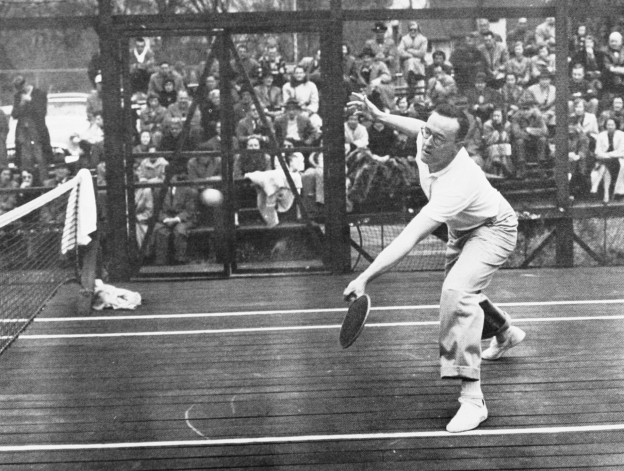
John R. Moses playing at Fox Meadow Tennis Club

APTA Honor Award: Moses and Wasch

John R. Moses was an exceptional tennis player, earning a number one ranking in Interscholastic doubles, and a number five ranking in singles. He was captain of the Yale tennis team, and was a finalist in the National Men’s at nineteen in 1943.

Four years later, at age twenty-three, he won his first title, and a second followed ten years later, in 1957. John also won the Mixed in 1955.

His record could well have been extended, but he moved to Kansas City where there were no courts. Blanchard thought that, at his best, Moses had few equals with quick hands and remarkable court coverage. (Fox Meadow Tennis Club).

Susan Beck Wasch inherited her mother’s racquet genes and grew up playing both tennis and paddle. She had played Junior Wightman Cup tennis for two years when a serious illness interrupted her racquet career, and there was thought that she might not play again.

Instead, she took up paddle and overcame the odds to win the National Women’s with her mother in 1959.

At the age of twenty-four, she was the youngest woman to win at the time. She won again in 1960, 1962 and 1965, and added a Mixed title in 1972. (Fox Meadow Tennis Club).

Phoebe Creamer in her favorite spot - the Felix McCrea memorial rock.

A woman returns to the FMTC Board of Governors for the first time since early 1900s

Phoebe Creamer became the first woman to serve on the Board since the early 1900’s: “I think they thought that if they had to have a woman on the board they would take an old-time conservative person who wouldn’t rock the boat too much,” she said.

The club’s constitution had been re-written in 1913 and women were excluded from the governance of the club. Prior th the change Hopeton Atterbury had served as President in 1907 and 1909.

Source: Diana Reisch Fox Meadow Tennis Club – The First Hundred Years, 1983

PRO-Keds Classic – Irvine and Fitz Gibbon take the $10,000 prize money. Squires creates a promotional and instructional video from the event

The PRO-Keds Classic, held in New York City, was one of the game’s greatest marketing ideas. The event was the brainchild of Dick Squires, and was co-sponsored by Uniroyal and the New York City Department of Parks and Recreation.

A court was erected in midtown Manhattan, at the site of the fifty-story Burlington House, on 54th Street and Avenue of the Americas. The area in front of the skyscraper was offered rent free, in exchange for $5,000 worth of PRO-Keds sneakers for the New York City Urban League underprivileged children.

An integral part of the tournament was the junior program. Ninety-six children were chosen from the city’s boroughs to participate in lunchtime clinics on the court, given by Bob Callaway. General Sportcraft contributed paddles for the kids and Burlington Industries provided socks and lunch. And, of course there were free sneakers for the children from Uniroyal, who also provided a fund of $10,000 to underwrite a program of continuing instruction in platform tennis to the children. Sneakers and platform tennis equipment are also being given to children in New York Urban League’s foundling homes.

Robert E. Schott , V. P. Marketing for Uniroyal, commented “We have a deep faith in New York City and it future. We also believe in the broad appeal of platform tennis and feel it should he played and enjoyed by everyone. Hopefully, the PRO-Keds Classic will prove to be the spring-board to what will ultimately be a full-fledged paddle program in our parks.”

Despite unseasonably cold weather, the crowds became enthralled by the game. Play aired nationally over two successive weekends. In the finals, Hank Irvine and Herb Fitz Gibbon topped Chum Steele and Keith Jennings earning $5,000 each in prize money.

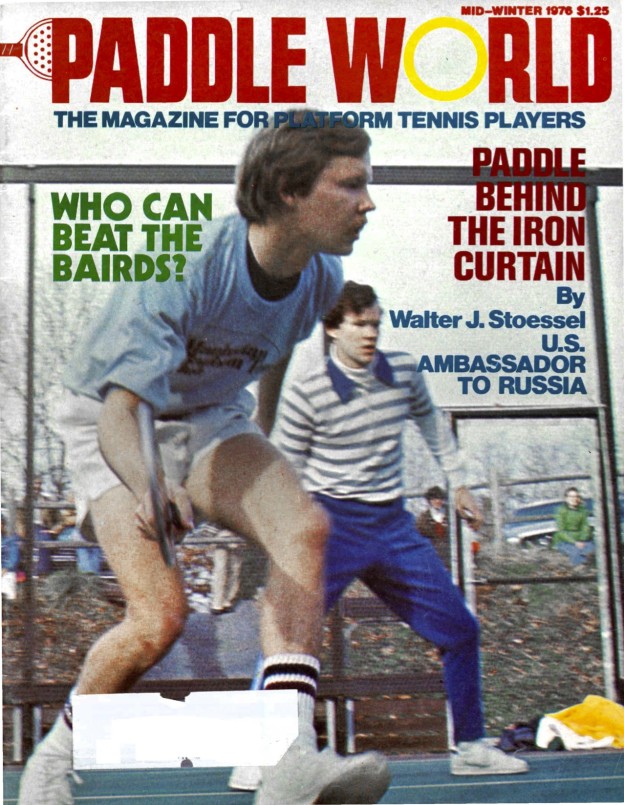
Paddle World Vol. 2 No. 1 Winter 76/77 carried the story.

Screen Shot 2013-12-01 at 10.49.52 AM

Tribuno starts a Women’s Tour

The circuit proved almost as popular as the men’s. The 1976–77 season kickoff was the Tribuno Platform Tennis Tournament of Cleveland, followed by Canoe Brook (New Jersey), Norwalk (Connecticut), Bronxville (New York), Detroit, and the World Championship at Forest Hills, New York. The prize money for the Women’s World Championship was $15,000.

Because Tribuno offered equal prize money to men and women for the World Championships, the women voted to play three out of five sets, like the men did. In the semifinals, the spectators got their money’s worth as they watched Gengler and Hilton beat Wendy Chase and Linda Wolf (7–6, 6–3, 4–6, 1–6, 6–4).

Who can beat the Bairds?

Changes needed to encourage spectator interest?

APTA President Mike North expressed his view at the Annual Meeting as part of a discussion on the growth of the game:

“The second necessary development is for the rules to be changed to encourage spectator interest. I agree with Dick Squires’ excellent article in a recent issue of Paddle World that urged reconsideration of the rules as proficiency increases. For instance, we should consider returning to a less lively ball, introducing the return of serve before the ball hits the screen, and the provision of a winning shot.”

Source: Paddle Talk, Vol. 2 No. 2 (December)

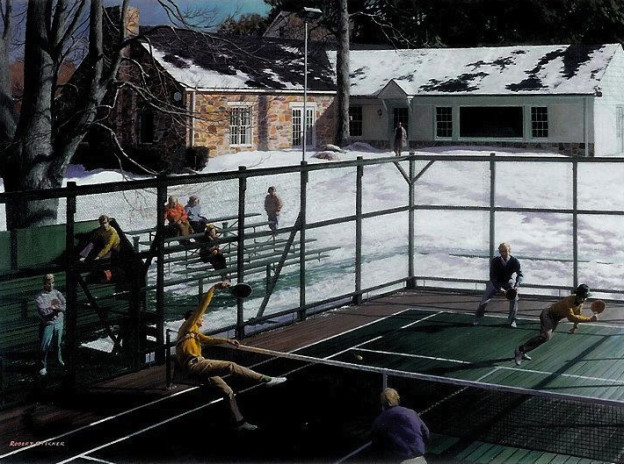
Sticker Painting commissioned by Coca-Cola Bottling Company of New York

Coca-Cola commissioned Robert Sticker to do an oil painting of a platform tennis scene at the home of the game – Fox Meadow Tennis Club.

Charles Millard, President of the Coca-Cola Bottling Company of New York and a key supporter of the game, commissioned the painting1.

Source: Paddle Talk, Vol. 2 No. 2 (December)

Who are the players?
“My guess is that Sticker drew the players from scrap art – several pictures that he patched together with his brush. He must have visited FMTC for he beautifully and accurately portrays the Club, snow, court, bleachers, and spectators. As to the players, I’ve always related to the guy hitting the overhead. I recognize the posture, the pants, the green socks and the sweater. But who knows. The other player in the foreground court sure looks like the back of Paul Sullivan’s grey head. And it makes sense that he would be there. Too bad Bob Brown isn’t on the other side of the net, because he was usually in that FMTC group. The guy with the hat looks like Dave Jennings. It doesn’t make sense that he would be there, but it’s his hat and it’s classic. The fourth guy in the forehand court has the posture and look of Paul Molloy. Trouble is the racquet is in the wrong hand. I think.”

Source: Robert R. Kingsbury (private communication)

Note 1: see article below
Screen Shot 2014-02-12 at 8.58.33 AM
Robert Sticker (1922-2011) was equally adept in watercolor and oil and was a legend in the marine art field. Over the years, he created a compelling body of work. He was revered throughout the artistic community for the careful research behind each of his paintings to ensure historical accuracy. Sticker also had a unique ability to depict the drama of the human aspect of life at sea. Sticker grew up on Staten Island where watching the busy New York Harbor sparked his initial interest in the maritime world. Educated at Brooklyn College, he served in World War II as a Navy pilot, and as an executive in the oil industry before beginning five years of study under Frank J. Reilly at the Art Students League. Reilly was famous for his “24-head” problem, which demanded painting the same head over and over in 24 different kinds of light and shadow, and requiring the student to emerge from the exercise exhilarated and demanding more. Sticker began painting full time in 1963 and has painted a variety of themes from the Revolutionary War, The War of 1812, whaling scenes and an extraordinary series of inland waterway steamboats.

Sticker has a strong following for his unique work, which can be found in many private and corporate collections, such as IBM, Dow. Union Carbide, and AT&T. He received an Award of Excellence at the 1991 Mystic International. He is a founding member of the American Society of Marine Artists.


APTA struggles with balance between amateur and professional play

APTA struggles with balance between amateur and professional play.

At the Annual Meeting, APTA President Mike North reflected on the issue:

The key question is this: How should the APTA cope with growth and commercialization? These are the conclusions I have come to: There should be a clear-cut division between commercial and non-commercial activities within the APTA.

Commercial activity should continue to come under the aegis of the APTA board so that the “sound development of the game” can be controlled, but, because of the time demands, the APTA office should be split into two function areas, with the commercial headed by a second paid Executive Secretary. There should also be a separation of commercial and non-commercial tournaments, with the tournaments, at least initially, held on the same weekend at the same location, as is being done at Cleveland this year. This has been shown to be a major concern of the WPTA members, of whom over half wished the tournaments to be split in this way. This is a necessary development if the sport is to become a major commercial sport.

Source: Paddle Talk, Vol. 2 No. 2 (December)

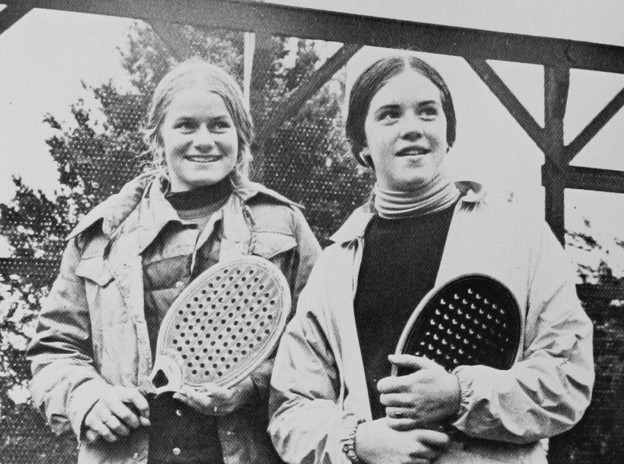
1976 Girls Fifteen and Under National Champions: Laura Parker and Becky Brown of FMTC

First New England Junior Open

In the fall, the Suburban Indoor Tennis Club in Randolph, Massachusetts held the inaugural tournament. Draws were held for both boys and girls in the 11 & under and 15 & under categories.

The Western Pennsylvania PTA (WPPTA) grows

The organization grew from the original five clubs in 1967 to seventeen clubs by 1976, and now included the Sewickely YMCA and the Mt. Lebanon Community Courts. The first five years saw a formation of a men’s League, followed by women’s A, B and C Leagues. In 1976, there were plans for an informal junior League.

Ken Ward at Maursing Island Club, Rye NY.

Ken Ward (1900- 1977): A founding father of the APTA

As President of the APTA from 1939-42, winner of one of the first Honor Awards in 1965, and inventor of the Scrambles tournament, Ken Ward’s contributions to platform tennis were many and various. He was a friend of all the pioneers of the game in the early days and maintained his interest throughout the years.

John Ware said, “Ken Ward was kind of a special man. He was a great advocator of platform tennis. He had, you might say, an acute case of the game. I remember him as being a presence at close to 40 Annual Meetings. Every year, he would get up and give the Board his personal vote of confidence and thanks. He had a graciousness and dry wit and a wonderful way of expressing himself.”

Ken Ward had this to say in a letter to Bob Brown, Chairman of the Presidents’ Council, after the last Annual Meeting:

“I thought the meeting went off very well. Everyone was well prepared. I was quite naturally disappointed that professionalism has caught up with our wonderful sport, but I am sure it was inevitable. I realize you are torn between the old nostalgia of the sport and the new generation of active players who are lured by a possible remuneration for their skill. I remember when Sidney Wood and I played together in 1948. I think it was then that we went to see Sears, Roebuck to manufacture the court on a wholesale basis for play on the roofs of apartment houses. They thought they would have to get the costs down to under $500 per court to make it successful. Imagine!”

Source: Paddle Talk, Vol. 2 No. 1 (October)