William E. Pardoe (1912 – 1978)

Former paddle champion and Hall of Fame member Bill Pardoe died on February 10 at his home in Stratton, VT, at the age of 62.

A graduate of Brigham Young University and Fordham Law School, he was senior vice president and senior financial officer for the Union Carbide Corporation.

Bill Pardoe and his partner, George Harrison, won the National Men’s Doubles championship in 1956 and again in 1960. He won the National Mixed Doubles with Charlotte Lee in 1965. In the Senior Men’s Doubles, he and his partner George Lowman won the championship three years in a row – 1966, ’67 and ’68.

In 1969, William Pardoe received the APTA Honor Award given to those individuals who have made significant contributions to the game of platform tennis.

Source: Paddle Talk, Vol. 3 No. 5 (April-May)

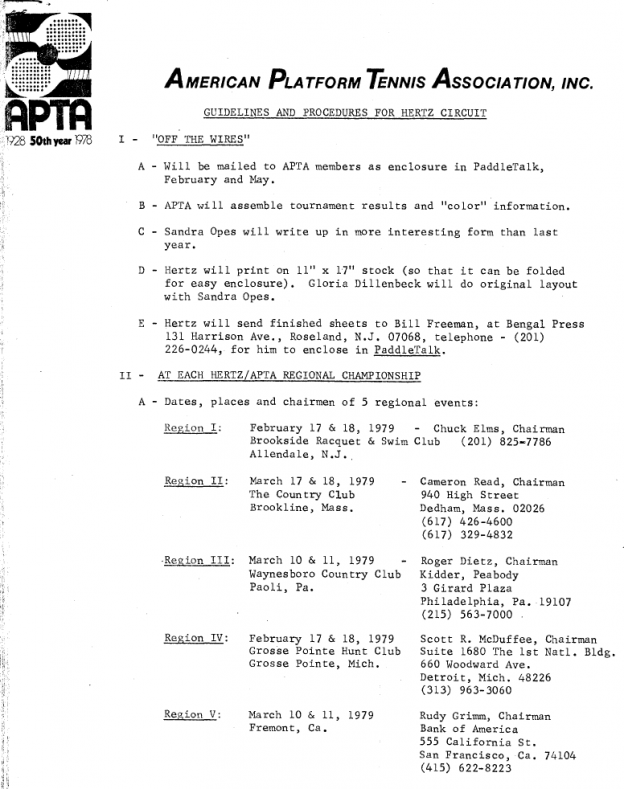
Hertz supports the weekend player

The APTA established the relationship with Hertz to stimulate interest in the “Amateur” regional circuit of tournaments that had been conceived as competitive opportunities for the “weekend player.” The Hertz Corporation, the largest vehicle rental and leasing company in the world, agreed with the APTA that these players deserve support.

The agreement called for Hertz sponsorship of the four Regional Championships and the Presidents’ Cup. Prize money was not a part of this tour, but the cost of the trophies for the Regional Championships was to be underwritten by the Hertz Corporation. In addition, travel expenses for the regional teams to the Presidents’ Cup, as well as a reception honoring all former APTA Presidents, would also be paid for by Hertz.

Paul DeForest Hicks (1903-1977)

Paul DeForest Hicks (1903-1977)

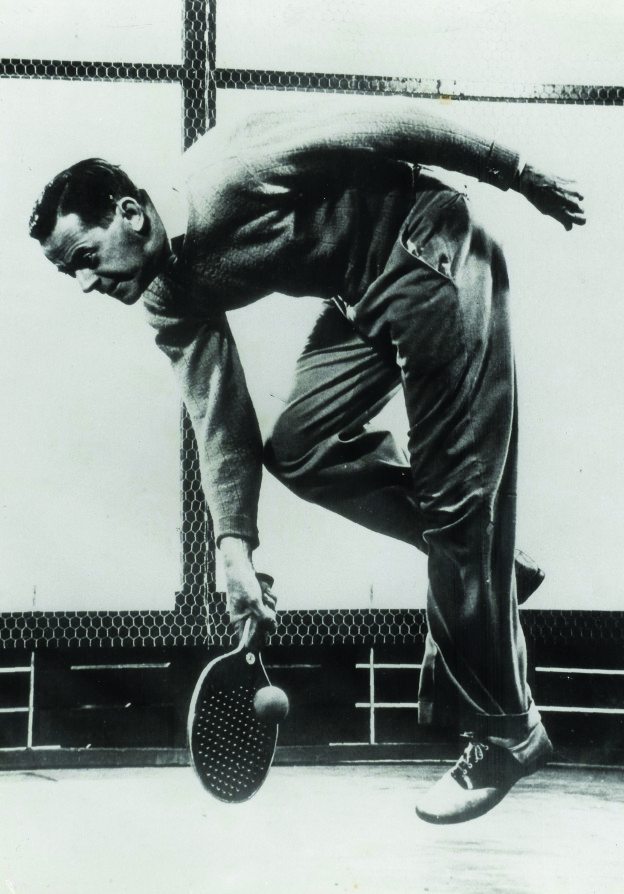
Hicks started playing platform tennis at the Manursing Island Club in Rye back in the 1930’s and in 1940 he captured the APTA National Men’s doubles title with Witherbee Black. He had been featured in a 1940 Life Magazine article of the game that had been arranged for by Ken Ward. The photographs for the article were by the noted Albanian-American photographer Gjon Mili who was a pioneer in the use of stroboscopic instruments to capture a sequence of actions in one image.

Hicks died suddenly at his home in Rye, NY, on September 24, 1977. The 74-year old insurance executive, a paddle pioneer, was a member of the Class of 1926 at Princeton and had enjoyed many tennis triumphs. He captained his college team in his senior year when his doubles partner was sophomore John Van Ryn (’28). Van Ryn gained later fame on the courts by winning both the Wimbledon and U.S. Open doubles championship with Wilmer Allison.

Source: Paddle Talk, Vol. 3 No. 3 (January 1978)

“Join the American Platform Tennis Association?”

“Me? You gotta be kidding! What’s it gonna do for me? I’m just a cannon fodder type!”

Sound familiar? It sure is! But the answers to those questions are easy. They are “Yes.” “No!” and “Lots!” In other words, yes, you ought to join. No, we’re not kidding. And joining the APTA will do a lot (a) for you and (b) for this 50-year-old sport.

The APTA entered the 1976-1977 season with 3,589 members. In 1973, it had 810. The goal for the next season was 7,000. That didn’t seem unrealistic for a game that had blitzed the landscape from San Diego to Georgia, North Carolina, and the entire northeast.

Source: Paddle Talk, Vol. 3 No. 1 (September-October)

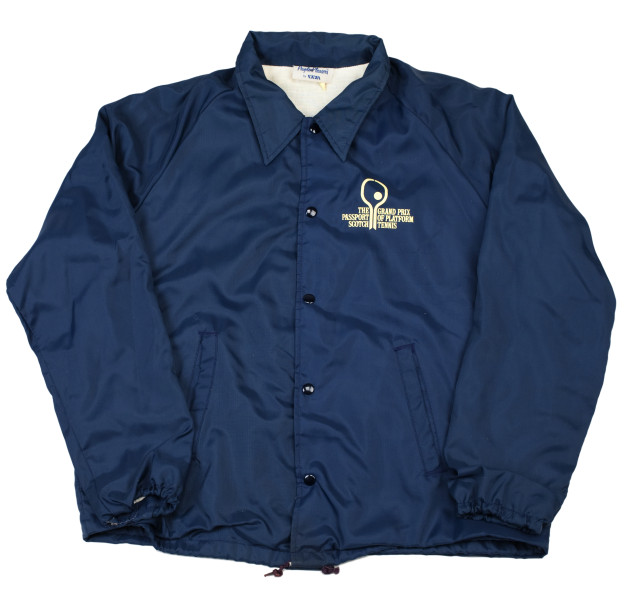
Passport jacket

Passport Platform Tennis Tour starts

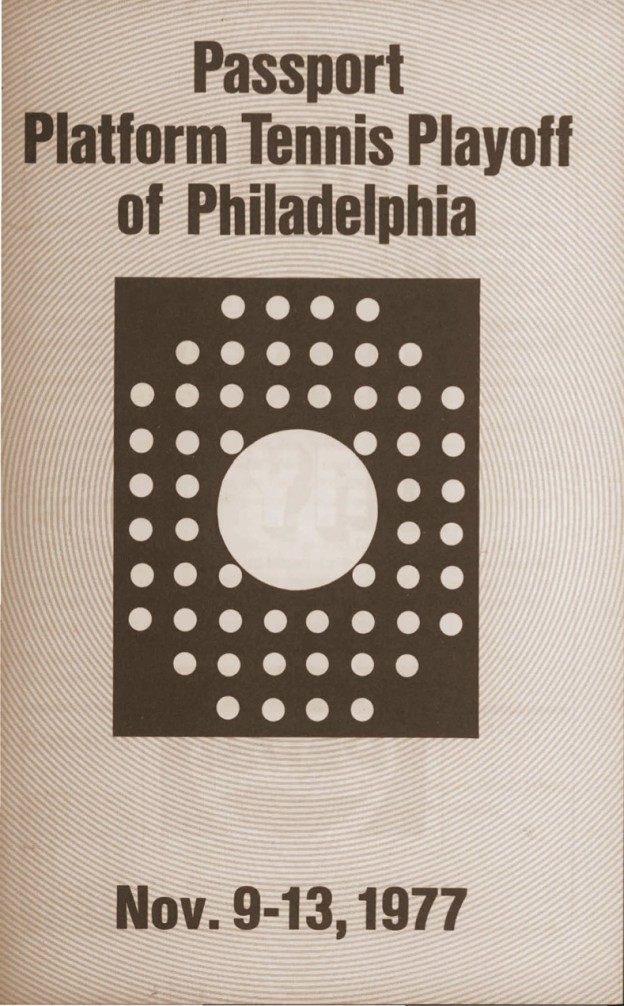
Calvert Distillers Company, the producer of Passport Scotch, agreed to sponsor the Passport Platform Tennis Playoffs, which consisted of six men’s events and five women’s events, all leading up to the $50,000 Passport Platform Tennis Classic in March 1978 at the Orange Lawn Tennis Club, South Orange, NJ.

The Platform Tennis Playoffs were announced at a series of exhibitions at the Seagram Building on Park Avenue in New York City to start the 50th anniversary celebration of Platform Tennis.

Passport Scotch sponsorship

Philip E. Beekman, President of Joseph E. Seagram & Sons, Inc., announced that Calvert Distillers Co. & Passport Scotch would be the sponsors of a tour for men and women during the 1977-78 season, offering prize money of over $140,000.

In October, the Seagram Building on Park Avenue in New York City held two days of matches. Platform tennis enthusiasts in the New York metropolitan area were encouraged to stop by and watch the top teams in action.

Source: Paddle Talk, Vol. 3 No. 1 (September-October)

A good year for junior play

Eleven different cities hosted open tournaments in the 18 and 15 and under categories for boys and girls, including the Nationals. A sizeable increase in the number of teams over last year was evident in all age groups.
Source: Paddle Talk, Vol. 2 No. 5 (July-August)

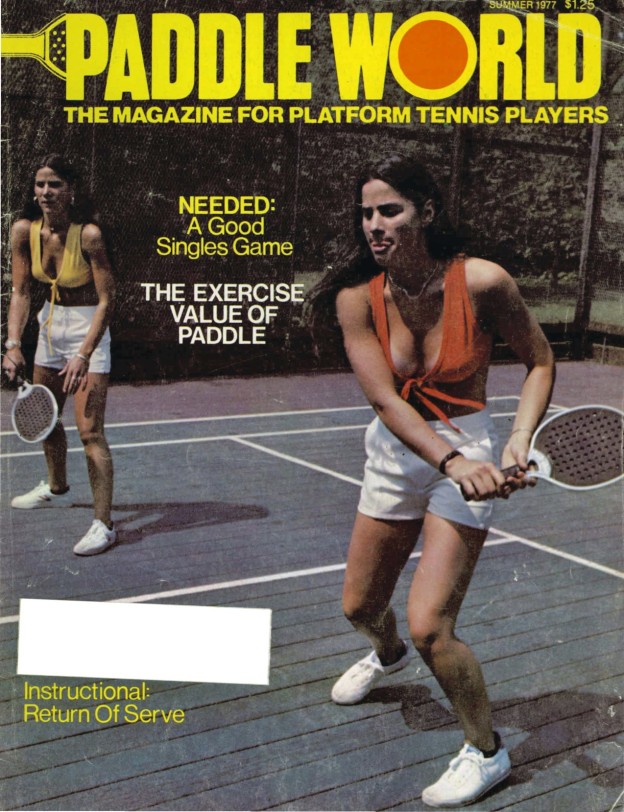
Karen (left) and identical twin sister, Kim Barker, enjoy playing summer platform tennis on a private court in New Canaan, CT. The court belongs to Herman Schaefer, a finalist in the APTA Men's Nationals, 1953

APTA focuses on helping weekend players and building regional support

APTA President Mike North’s remarks:

“At the Annual Meeting last year, I said that I thought that one of the APTA’s most important objectives should be to develop a program for the players who do not participate in major tournaments.

These may be players on the way up, on the way down, or people who love the game but do not have the ability to compete at the top level. We have not yet come up with the right name for this group. It is not ‘amateur’ because the distinction we are trying to make is not based on playing for money, but on the caliber of play. Neither is it truly ‘weekend players’ because many people play during the week. But the term ‘weekend player’ somehow comes closest to capturing the spirit that many of us want to retain.

The Western Platform Tennis Association (WPTA) under Dick Hornigold, George Black and, now, Dick Hall, has made great progress in developing programs for weekend players. Thus, we have tried to build on the experience of the WPTA in developing the APTA program. Here is what we have done:

Developed a schedule of Regional Tournaments leading to a Regional Championship. For men, the tournaments exclude the top players. For women, they continue their practice of distinguishing between A and B players with the B tournaments considered Regional Tournaments.

Created the Eastern Platform Tennis Association (EPTA) to provide a focal point for Regional Tournaments in the east. The role of the EPTA is to run the Regional Tournaments and to develop a program for broadening the base of interest in platform tennis in the east. Bill Dodd is the President of the EPTA.

Emphasized the importance of the Regions within the EPTA by creating the position of Regional Coordinator. George Black, who fills this position, has already done a good deal to improve the exchange of ideas among Regions and to make sure regional programs take shape. We want to get across to the players in each Region that the Regions are there to serve them. Anyone who takes the initiative and who has the interest can do a great deal to shape the development of platform tennis in his Region. Our objective is to bring the game back to the weekend player.”

Source: Paddle Talk, Vol. 3 No. 2