President’s Cup winners: Region V Men and Region IV Women

For the first time since Region I claimed the 2002 President’s Cup in Long Island, the hosting women’s region won the event The women of Region IV hadn’t taken home the Cup since 1996 (Rochester). Congratulations to Region IV team players: Jessica Guyaux and Kelly Fischer, Lissy Hill and Janet Mazzola, Holly Peck and Karen Henke, Nathalie Lemieux and Ann Wagner and Nancy Budde and Heather Hairston-Prop.

The Men of Region V have claimed the President’s Cup for the first time since dominating the competition in their region (in the 1998 Chicago Nationals). The ten-man team deprived Region IV of a President’s Cup sweep by defeating them by one set. Congratulations to Region five teams: Jay Woldenberg and Mike Sullivan, Michael Chabraja and John Noble, Ben McKnight and DanWilliams, Peter Berka and Ed Granger and Mike Marino and Mike Rahaley.

To gap or not to gap?? A new method for aiding service line calls

As competitive play increases in platform tennis, so does the need for accurate line calls. Platform tennis courts are smaller than tennis courts and line calls are typically easier to make, with the exception of where the singles line meets the service box. To solve this issue Jason Gray (Beckett Ridge Country Club in West Chester, OH) and David Dodge (Premier Platform Tennis) implemented an idea used in tennis which is to leave a three inch gap in the singles line. Jason had mentioned this idea to David two years ago but with ‘The Battle of Beckett’ during the Cincinnati Midwesterns, and the Premier Purple introduction, the service gap issue was unintentionally neglected until the idea surfaced by John Stefanik, a private court owner from Philadelphia. John wants the service gap incorporated in his court when he resurfaces with Premier Purple this spring 2005. Jason put this new idea into play and got positive feedback from his players with renewed excitement for competitive play. Again, this innovative introduction gained national attention when it was incorporated in the stadium court in the 2005 APTA National tournament in Pittsburgh.

Source: Platform Tennis Magazine, Vol. 6, Issue 5, April 2005

APTA President Mark Fischl reports on his first year in office

On behalf of the American Platform Tennis Association I would like to thank you for another terrific season. As I close my first year as President I want to reflect on some of the initiatives the Board and I set out for this season.

Our two main goals for the year were to be in the black financially and have a web site that provided additional member services. On the financial front it looks like we will return to profitability. The Web site provided a bit more of a challenge, but with the never-ending help of Marjorie Hodson, our Executive Director, and Jim Ingle of the Revere Group, we seem to be headed in the right direction. Building a web site is always a work in progress, with the first year being especially difficult. Fortunately, we have the infrastructure to continue the building process.

Our secondary goals were marketing the sport through exhibitions and other promotional ideas as well as the National League Championship. The two exhibitions we did in Atlanta and Kansas City were greeted with great enthusiasm. Thanks to the PPTA and all its professionals who contributed to their success. Our bumper sticker seems to be a big hit. It is always nice to pull into a tournament parking lot and see multiple cars with the PT sticker.

[enlarge image to read full report]

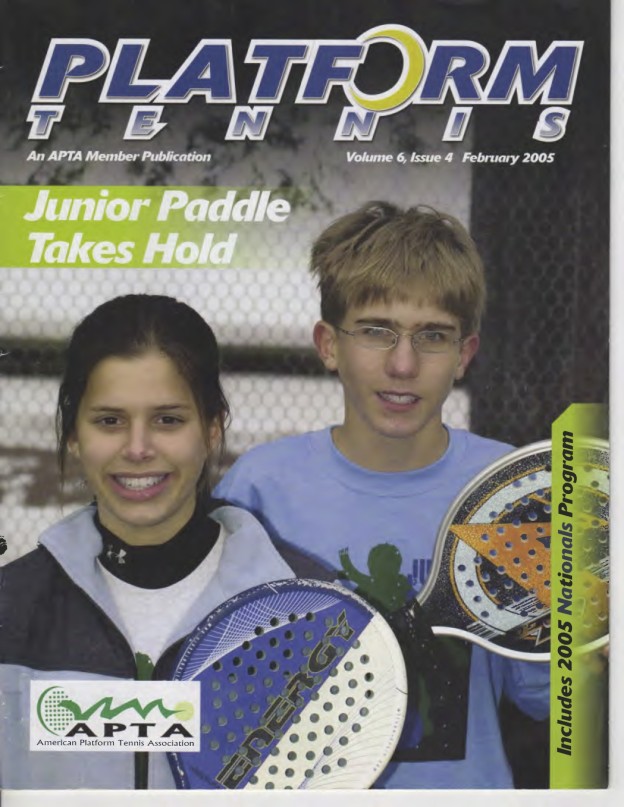
Junior paddle, past and present – a short history of the ups and downs. Kudos to David Kjeldsen, Robin Fulton and Patty Hogan for revitalizing the junior game

Maura Judkis provided a summary of efforts to grow junior paddle over the past decades

One of Whitney Snyder’s most poignant memories from his childhood in Sewickley, Penn., is the slow scratch of a shovel being dragged across a snow-covered aluminum floor. While his weeks were filled with middle school, his weekends were devoted to platform tennis. Instead of waking up early on wintry Saturday mornings for cartoons, Snyder would go to the paddle courts at 7 a.m. and hear the scraping shovel that signified the beginning of his early morning group lesson.

The 1970s generated junior paddle leagues across the country. Both Snyder and his friend Bill Hallett recalled their junior paddle days as being sponsored by enthusiastic parents who were willing to teach the game and send their children to the Junior Nationals by the bus load. “There really weren’t pros teaching the game,” said Hallett, who recalled playing at the local YMCA. “Most of us were just introduced to it by our parents. Even I taught clinics to younger kids when I was in high school”

“The parents really do get credit for organizing it,” said Snyder, who described the paddle craze as “very contagious,” and a typical part of an after school routine. “Since girls and boys played together, it broke the ice socially for those awkward teenage years,’ he said.

Junior paddle in the 1970’s provided not only a social activity, but also a forum for real competition. Both players recalled bus rides to tournaments in Detroit, Indianapolis, and Cleveland, among others. The Junior Nationals were even held in Pittsburgh once during their high school years.

However, transitions in paddle corresponded with transitions in the young players’ lives. As kids graduated and moved away to college, programs began to diminish, and disappeared altogether by the 1980s in Pittsburgh. Nationals, too, became a memory when Hank Irvine, longtime organizer of the Junior Nationals, resigned. Paddle for juniors entered a latency period, and interested kids were left with nowhere to turn but a few lessons with parents on whatever court time they could spare.

Even though kids were interested, there was no official means for play until the Viking Cup Parent-Child tournament, sponsored by David Kjeldsen and Robin Fulton. The tournament, held in 1996, began the rebirth of a dormant Junior Nationals. Following the tournament, Fulton revived nationals for a few years, before resigning her position to Patty Hogan.

Junior Nationals would not be the only program Patty Hogan would have built from next to nothing. Hogan’s junior paddle organization at the Beacon Hill Country Club in Summit, NJ, began with only three kids, but soon grew to 80.

Viking Junior Tour comes to Long Island

On Saturday, December 11, 2004, the Long Island Platform Tennis Association hosted its 2nd Annual Viking Junior Tour tournament at the Garden City Country Club and Cherry Valley Club. Among the four age divisions, 28 teams participating (56 kids!), with countless parents and grandparents cheering. The level of paddle was extraordinary, the good sportsmanship was commendable and the smiles were constant!

John Cerga and Alex Bancila, the Directors of Racquet Sports at the Garden City Country Club and Cherry Valley Club, respectively, volunteered their time and helped make it a memorable day for the players. We expect to have even more teams next year, so sign up early! The Champions and Finalists were as follows:

10 & Under
Winners: Jack Stiuso and Dylan Neville
Finalists’ Hunter Robinson and Timmy Schnier

12 & Under
Winners: Liam Neville and Warren Trunz
Finalists: Jack Mara and Zachary Morris

14 & Under
Winners: Bryan Kallenberg and Matthew Kallenberg
Finalists: Steve Chmil and Dillon Talcott

18 & Under
Winners: Christopher Souther and Jay Schwab
Finalists: Paige Brown and Alyson McArdle

Source: Platform Tennis Magazine, Vol. 6, Issue 4, February, 2005

New APTA President Mark Fischl reports on the financial state of the APTA and new initiatives

On behalf of the Board of the American Platform Tennis Association, I am pleased to welcome you to another season of fun and competition.

I am very excited to be starting my first year as your President.Your Board and I have been working hard on establishing a strategic vision that builds upon recent successes and help take the APTA and our sport forward with a clear sense of purpose and a renewed sense of vigor.

As for the short term, we are pleased to announce a number of initiatives for the upcoming season designed to improve member services. Look for a redesigned Platform Tennis Magazine and a greatly enhanced APTA website. In addition, we have begun a new effort to share learning from across the country that will help build better players and programs.

[enlarge images to read full report and financials]

Chicago Charities coverage

Wayne Dollard reported for PTM from Chicago:

A refreshing 2004-05 season was on display in Chicago from November 5-7 for the annual Charities tournament. The best players in the game, including 214 men and women, competed in this season’s extravaganza. New pairings, veteran teams, and reunited legends captured off a weekend of unparalled platform tennis.

2004 Chicago Women’s Charities: What would you like to see when going to watch a major platform tennis championship? Power, finesse, excitement? You might also like to see new teams rising to greater heights and veteran teams returning to show a younger generation that they’re not ready to go away any time soon. This year’s Chicago Charities provided all of these things plus much more.

The ladies of platform tennis kicked off the weekend on Friday, November 5th. The absences of Lauren Zink, Shelley Morse, Patty Hogan, Sarah Krieger, and Robin Fulton were
felt, but the Chicago spectators had plenty to cheer about with hometown favorites dominating the draw. Mary Doten, Sally Cottingham, Chris Sheldon, Leslie Hough, and Kelly
Rudolph held up their end of the bargain and advanced to the quarter-finals. Doten and Keane (Grosse Pointe, Michigan), current National Champions and second-seeded team, were stopped short of their goal of capturing the title when they ran up against the third-seeded team of Bobo Delaney and Tonia Mangan in the semi-finals.

However, the story of the tournament was not the loss of one team to another, but rather the re-addition of Sue Aery and Gerri Viant to the Charities. Aery retired from platform tennis in 2002 to pursue a chiropractic education. Returning to the 2004 Nationals in Cleveland this past March, the unseeded Aery/Viant reached the finals before losing to Doten/Keane 6-3,6-4.

At the Charities, Aery and Viant defeated Cottingham and Sheldon (three sets) in the quarter-finals and the #1 seeds-Hilary Debbs/Cindy Prendergast (6-2,6-4) in the semi-finals. The finals proved to be a challenge, but Aery/Viant took the title 6-4,6-4 over Delaney/Mangan.

2004 Chicago Men’s Charities: The men’s draw was packed tight with most of the eastern teams making the trip to the Midwest. There may have been a lack of upsets and emotional letdowns, but there was an abundance of excitement and unbridled enthusiasm in the air.

All of the top eight seeds advanced to the quarter-finals, including the top three ranked teams in the country, Chris Gambino/David Ohlmuller, Scott Mansager/Flip Goodspeed, Scott Estes/Scott Mackesy. Chicago talent was strong in the men’s draw with four seeded players Scott Bondurant, David Keevens, Mike Rahaley, and Bill
Fiedler.

The match of the tournament was, without a doubt, the semi-final battle between newcomers David Caldwell/Blake Cordish and current National Champions Flip Goodspeed/Scott Mansager. The two-hour, three-set knock-down, drag-out fight left Goodspeed/Mansager bruised for their finals rematch with the APTAs #1- ranked doubles team Ohlmuller/Gambino.

Mansager dominated the first set with powerful returns that kept the top-seeded team off balance. Goodspeed played flawlessly both at the net and in the back-court. At the same time, Gambino/Ohlmuller did not play anywhere near to their potential.

The second and third sets looked more like a rematch of last year’s Charities final where Gambino and Ohlmuller defeated Goodspeed and Mansager 6-2,6-4, This time around the last two sets went 6-2,6-3.

With another Charities win under their belt, Gambino and Ohlmuller have set themselves up early in the year once again as the team to beat. At the same time, on the women’s tour, Sue Aery and Gerri Viant have told the field that they’re back and that their goal is to recapture the National Championship.

Source: Platform Tennis Magazine, Vol. 6, Issue 3, December, 2004

Player Profiles: David Caldwell and Blake Cordish

PTM Editor Wayne Dollard reported:

PTM recently had the opportunity to sit down with Baltimore’s up-and-coming paddle sensations Blake Cordish (age 33) and David Caldwell (age 30) and asked about their remarkable history with tennis and their seamless transition to platform tennis.

Blake Cordish was born in Baltimore and played tennis at an early age. As a junior, he was ranked in the top 100 in the United States in singles and the top ten in doubles before going on to play for the varsity team at Princeton.

David Caldwell was raised in Danville, Virginia. As a junior, David was ranked #1 in the country. At the University of North Carolina, he improved and was a three-time All-American. By the late 1990’s, David was playing the top pros in the world at the Australian Open, French Open, and US Open. He was ranked in the top 150 on the ATP Tennis Tour.

David and Blake have been long-time friends. “From the age of ten, I grew up playing doubles on the junior tennis circuit with Blake’s younger brother, Reed,” David explained. He added, “Reed and I have remained close friends, in fact, after college Reed and I traveled together on the professional tennis tour. The Cordish family has always been an extended family for me.”

When David retired from the tennis tour, Blake hired David at his real estate development corporation, “The Cordish Company,” with divisions in retail, office, hospitality/gaming as well as operating divisions focused on restaurants/clubs, live music and film. David enthusiastically stated, “Real estate development appeals to my competitive instincts and in many ways is an intellectual extension of my sports background.'”

One of Blake’s mentors, David Iglehart, was a highly ranked national platform player (with his brother) and raved about the game. At his encouragement, Blake played platform tennis for the first time four years ago in the Baltimore League. Blake recalled, “I was always aware of the game growing up but never played. I instantly fell in love with platform tennis and the following fall, I introduced David to it. We played our first tournament in the fall of 2001. Naturally, we took a beating the first year or two. Needless to say, we played our share of back-draw matches but found the tournament competition invaluable. Our low point the first year was losing in a fifth round back-draw match of Nationals in a third set breaker to a guy who was cramping and alternatively chucking Red Bull beer on change-overs. It was both a humbling and soul-searching experience!” Blake added, “One of the major differences from conventional tennis is how much more quickly the momentum changes in platform tennis. In tennis, there is so much more time between points and change-overs to control tempo and momentum. As a result, platform places an increased emphasis on mental intensity. In addition, there is a huge mental difference with the realization in platform tennis that the point is almost basically never over. In terms of similarities, doubles tennis and platform tennis are both intellectually challenging in terms of strategy and positioning and require excellent communication between partners. As a result, in both sports it is a huge advantage to be close friends with your partner and have that level of trust.”

David expanded on Blake’s analysis, “One of the major differences I see between the sports is the flow and shot patterns within the points. Platform requires reprogramming your tennis brain in terms of how you approach the development of a point and how you react to the ball. Learning platform for us has been fascinating because, without formal training, in many ways it was trial and error. On a most basic level, the great similarity between the sports and the thing Blake and I enjoy most about both sports is that they represent competition in its purest sense. No coaches, no subs, both sports require competitors to just lay it on the line.”

David and Blake offered PTM a few recommendations for tennis pros or those new to the game. David explained, “My main piece of advice is to be mindful of the basics of paddle, but not at the expense of changing your core strengths. The game is certainly evolving and a major strength in tennis can more than likely be adapted to fit paddle and ultimately add a new dimension to the game.” Blake agreed, “Players with a tennis background should recognize they have a major advantage as they approach platform tennis and should build on those strengths. Many of the core fundamentals of the modern era of tennis such as semi-western forwards and extreme kick serves are all directly applicable to platform tennis.”

PTM asked David Caldwell what avenues their team has taken to better learn the sport? He responded, ‘We do read Platform Tennis Magazine, but in one sense we made a conscious effort early on to develop our game through competition and let our backgrounds in tennis be the driving force in the learning process. The theory is to not restrict the learning process with pre-conceived ideas about how to play. One great thing about sports is that they always evolve and the challenge is to figure out new ways to play and maintain an edge on the competition. The more talented tennis players we can get into the game the better. Platform tennis is clearly evolving and I am convinced that those with a tennis background will play a major role in the development of new shots and strategies on the platform tennis court.

As active APTA members, playing as many as six to ten sanctioned tournaments per season, David and Blake offered potential rule changes for the APTA to consider moving into the future. ‘We believe that lobs that land in the court and bounce over the wall should be in. We also feel that adding a second serve could be an interesting concept and change the basic dynamic of the sport.”

Regarding competitive play, Blake concluded, “We personally feel that tournament competition has been the key to our improvement. Every tournament we get to see new balls and we learn new things on the court. Our ultimate goal is to win a National Championship. We feel like we are still improving and we want to see how far we can go.”

Source: Platform Tennis Magazine, Vol 6., Issue 3, December 2004

Chicago…. The future of platform Tennis?

Wayne Dollard, PTM editor in Vol 6, Issue 3 reported:

For each of the past six years, ! have spent my birthday weekend at the Chicago Charities tournment. There are few places I’d rather be. Thi Midwest hospitality offered by our Chicago friends is matched only by their enthusiasm for the sport. And there is no other place in the country experiencing the growth rate that we are now seeing in Region V.

Six years ago, 90% of the APTA’s membership came from the East Coast; today that number is less than 50% The change is not due to an eastern decline, but rather a western expansion. Of the 7,500 APTA members, 30% are from Chicago and 52% overall are from the Midwest.

Source: From the Editor, Platform Tennis Magazine, Vol. 6, Issue, 3, December, 2004

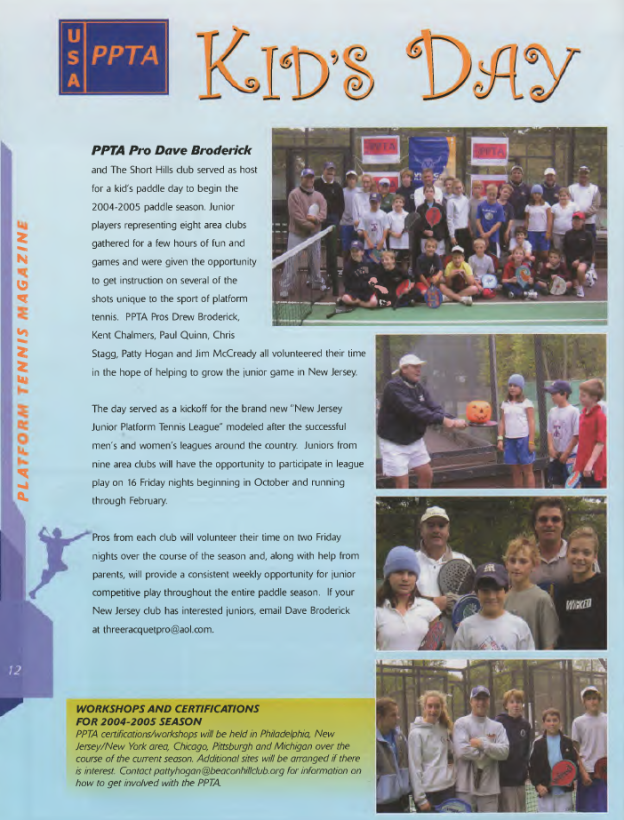
PPTA hosts Kids Day

The day served as a kickoff for the brand new “New Jersey Junior Platform Tennis League” modeled after the successful men’s and women’s leagues around the country. Juniors from nine area clubs would have the opportunity to participate in league play on 16 Friday nights beginning in October and running through February.