Should the court have singles line?

Bob Brown, chair of the APTA Rules and Equipment Committee, on a proposal to eliminate the singles lines:

Why do we have white lines defining a singles court when the game of platform tennis is rarely, if ever, played by just two people? That is the question that was raised by the APTA Rules and Equipment Committee in a recent proposal to the Board of Directors to eliminate the unnecessary singles lines.

If this were done, the lateral service line would be extended (by two feet per side) to the outside service line. The concern would then be whether the wider service box would have any effect on the play of the game. The committee has conducted some play tests and preliminary results have concluded that the wider service box does not have any noticeable effect on the game.

However, the Board decided that it would be appropriate to advise the membership of this proposed change and encourage them to experiment. This can be done simply by extending the lateral service lines with a two-inch wide piece of masking tape and play the service line that lands in the alley as ‘good.’

The reasoning behind this proposal, as explained by the Committee, is that the court would then reflect the true nature of the game as intended for doubles play. The layout is simpler and has an attractive, uniform appearance. There is a 29% reduction in white lines on the court, which would be a benefit for maintenance and construction. The incidence of foot-slipping on wet lines would also be reduced.

The Board understands that if this proposal is adopted, there will be some minor costs incurred by court owners in order to revise the lines. Consideration is being given to an implementation program that would minimize this expense.

The Rules and Equipment Committee presented this proposal for a vote at the annual meeting in May of 2001 but based upon a number of negative letters received in response to the proposal, the proposal was voted down and discarded from future consideration.

Source: Platform Tennis Magazine, Vol. 2, No. 3, January, 2001 and Vol. 3 Issue 1, September, 2001

“Why should I pay APTA dues?” – Gary Horvath has the answer

Anyone who has run an APTA sanctioned tournament knows that one of their many responsibilities is the ominous task of collecting dues from those participants who are not members of the APTA. I will never forget the first time I had this responsibility. I mentioned the dues payment to one of the participants who responded by saying, “Why should I pay APTA dues? What benefits do I get from being a member? If they are like most organizations they surely don’t do anything, and besides, I probably don’t want whatever they are selling.”

At the time I fumbled to find an appropriate response, even though the answer was obvious to me. It seems only logical that by supporting the governing body, you are supporting the infrastructure for the sport. In addition, in a sport as small as platform tennis your voice will most likely be heard when you have questions or concerns. This line of thinking is obvious to me because I have been close enough to the sport that I can see the inter-workings of the APTA. To those not as close, the answer is less obvious.

In a nutshell, the APTA serves as the governing body for the sport. In this capacity, its most important duties are to maintain the rules and serve as a focal point for the sport. Initially, these tasks sound rather trivial. As a way of understanding the
importance of these duties, let’s look at some of the suggestions that have been made for improving the sport over the past 25 years. Some of the more memorable proposed changes have been to: lengthen the service box by six inches, allow oversized paddles, allow a let when you bounce the ball out of the court, cut a hole in the back screen so that it is possible to hit winners, allow two serves, color the inside of the ball the same color as the flocking, play on a grade level (tennis court) surface, allow the carry or double hit, round the corners to make the crease shots less predictable, allow let serves, use a tiebreak that was different from the tennis tiebreak, allow winners when a shot hits a 2′ x 4′ target placed on the back screen, and use red balls.

Can you imagine playing interclub matches, tournaments or social events where every club uses a different set of rules and with matches played on courts with different sizes or configurations? Most people find it challenging enough to deal with a constant set of rules and the different shots of their opponents without having to deal with a different set of rules for each facility. When you think about it, the payment of the annual dues is justified by having the peace of mind that there is standardization in our sport that allows it to be enjoyable for the masses.

Now, let’s look closer at the manner in which the APTA serves as a focal point for the sport. First and foremost, it provides communication opportunities with members and manufacturers almost full-time), and the financial support for Platform Tennis
Magazine. By sanctioning tournaments, the APTA provides organized playing opportunities for the members and helps draw attention to the sport. Pages could be written expanding on the value of these member benefits, but hopefully that’s not necessary.

The entertainment value gained from these immeasurable benefits far exceeds the cost of the annual dues, or if you don’t like to be dinged for annual dues there is the painless life membership. I am almost embarrassed to call myself a life member, as I purchased the membership over 20 years ago for $100. Annual dues cost less than a round of golf or cart fees. They also are less than four tickets to a newly released movie or a single ticket to a professional hockey or football game. The APTA annual dues are about the same as a dozen packages of Oreos or Ben and Jerry’s double scoop ice cream cones. The cost is truly a small price to pay for the structure and enjoyment that it brings to the sport.

Source: Platform Tennis Magazine, Vol. 2, No. 3, January, 2001

Tournament play ebbing but state of the game positive

APTA President John Horine in the PTM column From the APTA…

Many people have called and e-mailed me regarding the recent size of tournament draws. In several areas, the numbers of teams signing up for tournaments has been smaller over the past few years. I have noticed the same trend in the event that I run, the Maryland State Men’s Championships. For many years, we had full draws of 48 teams. In the last four years, the numbers have been approaching 32 teams. Upon doing some research, I found that most teams not participating did so for good reasons (i.e. Injury, work, family or other commitments). In some cases people
could not play for several years. However, virtually everyone I spoke to still plays and intends to play in the future events. I have also spoken to league players and captains around the country. In nearly every conversation, the numbers are up in league play. This is particularly true in the “B” and “C” categories.

Evening court time for casual play is booked solid in many areas and teaching pros’ calendars are full most of the season. In general, although tournament play may be experiencing a slight lull, play throughout the country is on the rise with activity springing up in new areas every year. What does this mean for the APTA? More members!

The perception that the APTA is mostly for tournaments and tournament players could not be farther from the truth. We are here for you. Whether you are a first year player or a national champion, the APTA is available to help you. Just moved to an area? We can help you find courts and a contact person. Thinking about building a court? We have a list of court manufacturers. Question about rules? Check out the Web site (www.platformtennis.org) or contact the office. Need help with your forehand? So do I! The APTA office will soon have a list of APTA certified teaching pros in your area available to give lessons.

The point is, “yes,” the APTA is interested in the size of the draws of all the tournaments we sanction. However, looking at the big picture, we have to be pleased that the sport continues to grow. As our sport grows, so will the commitment we make to our members to help you enjoy our wonderful game.

Source: Platform Tennis Magazine, Vol. 2, No. 3, January, 2001

Player profiles: Bobo Mangan Delaney and Tonia Mangan

Patty Hogan, Tonia’s college classmate, was responsible for getting the sister-in-law team together. Tonia had met future husband Tim Mangan at Bobo’s wedding in 1983 and began playing with Bobo after getting married in 1992.

Bobo Mangan-Delaney

Born: Yakima, Washington
Profession: Head Pro at the Noe Pond Club in Chatham, New Jersey, for the past four years (tennis and platform tennis instructor for the past 14 years).
License Plate: BOBOPRO
Children: Zealand (8), Corey (7), and Trevor (3)
Marital Status: Bobo’s husband, Frank, is an Investment Banker at TD Securities in New York City.

Past: When it comes to platform tennis family history, the Mangans are famous. Bobo was introduced to `paddle’ as a child by her mother, Nancy, and her Uncle, John. Nancy had a high women’s national ranking and John was the men’s national champion. If that wasn’t enough, legendary Hank Irvine was her local professional instructor.

Future: “Tonia and I began playing together the year she married my brother, Tim. We find it amusing that we are so often mistaken as sisters. We certainly play alike and most of our matches turn out to be long drawn-out wars. This season we hope to cause some damage in Chicago, Philly, Fox Meadow, Short Hills, and the Nationals.”

Tonia Dillon-Mangan

Born: Scotch Plains, New Jersey
Siblings: Four brothers and a younger sister
College: 1982 Douglas College / BA in Economics
Profession: Financial Planner for Paine Webber, managing over $120 million in assets.
Stress Relief: Platform Tennis
Children: Brooke (7), Jack (3), and Caroline (3 mos.)
Marital Status: Tonia met her future husband, Tim, at Bobo’s wedding in 1989. They married three short years later.

Past: Tonia’s college classmate, Patty Hogan, first introduced her to ‘paddle’ In 1983 Tonia conquered her first title, the New Jersey “C” flight State Championships. Tonia recalls that in her first National Championship she got “smoked” by Diane Tucker and
Robin Fulton 6-0, 6-0. Last year Tonia finally got her revenge, recording her first win against the famed duo.

Future: “Patty Hogan introduced me to Bobo six seasons ago. We’ve been battling it out and have finally cracked the top five. This could be our season. Last season was our best, which is ironic considering I was pregnant and we skipped the Nationals. Bobo and I reached two finals and two semi-finals.”

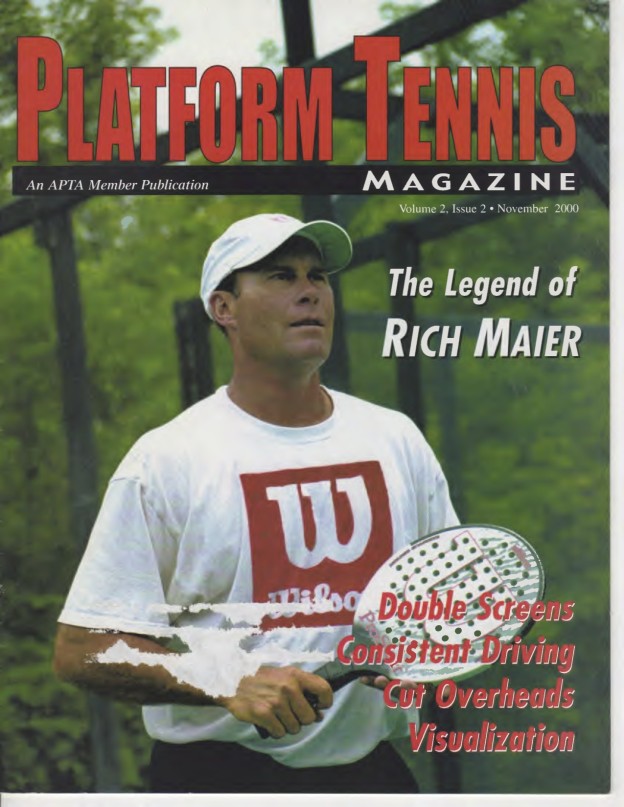
Player profile: Rich Maier

Rich is widely regarded as the best man to ever play platform tennis and was first introduced to platform tennis at the age of 18 by his high school tennis friend, Jay Edwards. Six years later, after graduating college, Jay got Rich to take platform tennis more seriously. At the ages of 23, Rich and Jay entered their first paddle tournament. On that day a star was born. In his first round match in his first platform tournament, Rich defeated Keith Jennings and Chauncey Steel, the previous season’s national champions.

Born: Born March 2nd, 1953 in The Bronx, New York, Rich currently lives in Northfield, Illinois, 30 minutes from downtown Chicago.
Profession: Head Racquets Pro at the Sunset Ridge Country Club in Northfield for the past six years. Rich has been teaching tennis and platform tennis for over 20 years.
Family: Rodman (9), Lindsay (6), Kevin (3) and wife Susan
Men’s National Titles: 10

In The Beginning: Rich was first introduced to platform tennis at the age of 18 by his high-school tennis friend, Jay Edwards. Six years later, after graduating college, Jay got Rich to take platform tennis more seriously. At the ages of 23, Rich and Jay entered their first paddle tournament. On that day a star was born. In his first round match in his first platform tournament, Rich defeated Jennings and Steel, the previous season’s national champions.

As the years went on, Rich improved faster than anyone else in the history of the game. Between the years 1980 and 1992, Rich made it to the National Championship finals each year! Nine of Rich’s ten national titles were earned playing with his favorite partner, Steve “the other legend” Baird.

When asked about his most memorable match with Steve, Rich recalls his 5 hour and 40 minute duel with Tully and McAvoy in the 1985 Hartford Invitational finals. During this five set event, spectators were able to watch a couple hours of paddle, go eat dinner, and then return to watch a couple more. Rich is still amused when he recalls the umpire leaving the cold at 17-16 in the fifth set. Rich and Steve closed out the match the following game.

What Have You Learned?:“The more you play, the more confidence you develop. When you are confident that you can win, you will.”

Future:“I’ll continue to play as long as my body allows. Now that my kids are growing up, I look so forward to the future with them. This morning I took Rod out to the courts. His screens are already better than some of my friends.”

When asked why Rich got so involved in platform tennis, he said, “I have always enjoyed platform tennis tournaments more than tennis events because of its social aspect. In tennis you often play someone you’ve never met before. Usually the match isn’t as sociable and afterwards you don’t see them again. In platform tennis there is usually a cocktail party the night before the event; and on the day of the tournament, all of the players will sit down together for lunch. Also, something is always going on Saturday evening.., dinner, dancing, socializing, etc.”

Recently: Rich was inducted into the Hall of Fame 1n 1999.

The 'hut" at Glen View CC in Chicago is more like a palace

A “hut” makes all the difference

What’s the difference between a good platform tennis facility and a truly wonderful one? More often than not, it’s a warming house. While a facility can boast the best courts with the newest lighting and heating systems, history has shown that its success will be limited if there is not a central place where players and spectators can congregate and keep warm when not on the court. On the other hand, even a modest two-court facility can become a buzzing beehive of paddle activity when it is supported by a well-designed paddle house.

Paddle is by nature a social sport. A paddle house, therefore, serves a variety of purposes. It is not just a place to keep warm while you wait your turn for a court. It is perfect for carrying out those all-important side aspects of the sport like joining together for drinks and discussion and being with fellow players. Watching others play is a significant way to improve your own game, or at least provide topics for conversation!

Source: Platform Tennis Magazine Vol.2 Issue 2, November, 2000
Jack Davis - Warming Up the Warming Hut

Gary Horvath reflects on the President’s Cup

The Presidents Cup

“As the sun set on the Rochester horizon, John Horine took to the court to play the 75th and deciding match of the 2000 President’s Cup. Because of an upset earlier in the day at the hands of a strong Region VI team, Horine and partner, Scott Freund, had been handed an opportunity to redeem themselves for their earlier loss. Even though the commentary of Bob Costas and the cameras of ESPN were missing, this match contained all the drama, excitement, plots, and subplots of any of the more widely covered sporting events.

As the match progressed, the score remained close and teammates from both sides started to cheer louder, causing a crowd of 75-100 people to convene around the court. I turned to fellow Region VI player Dan Magee, who had been a President’s Cup virgin just eight hours earlier in the day, and asked him what he had learned from playing in the tournament. Magee had the type of smile on his face that you see on a young boy with a ten dollar bill in a candy shop. With an exhausted yet excited voice, he said “I learned a lot. This game is simple. You can hit any shot you want to hit, just so long as it goes in.” As Magee completed that sentence, Horine and his partner closed out the match with a victory. It was a fitting end, considering the contributions Horine has made to the sport in recent years.

The wisdom of Magee’s words and the drama of the Horine match brought flashbacks of my many varied experiences playing in President’s Cups. For the umpteenth time, I realized what a special event the President’s Cup is and how it has been one of the most significant changes in the sport in the past 25 years.”

Throughout the years there have been a number of dramatic matches and close finishes that rival the closing match of the 2000 championships. There has been an endless string of players, such as Dan Magee, who have experienced platform tennis at a different level because of the Presidents Cup. I think it is safe to say that almost every person who has played President’s Cup has been able to walk away from the event with a smile on his face and at least one lesson learned about how to play the game better.

There are very few events in sports that combine the camaraderie, fierce competition, and genuine sportsmanship of the President’s Cup.”

Source: Platform Tennis Magazine Vol.2 Issue 2, November, 2000

PTM begins posting entire tournament draws

APTA President John Horine reported on the development in the From the APTA column:

“Speaking of the web site, this season’s tournament results are being posted on the site. On the “Home Page”, scroll down to and click on “Check Results.” Look for your event by region or National Ranking. This year we are posting entire draws, including all consolation draws. So, if you know someone from Kansas City who played in the Chicago Charities, you can check the web site and see how they fared.”

Source: Platform Tennis Magazine Vol.2 Issue 2, November, 2000

Platform Tennis arrives in Switzerland; facility hosts an R. J. Reilly paddle camp

The gospel of platform tennis continues to spread beyond the borders of the good old USA. R.J. Reilly recently completed three new platform tennis courts in conjunction with European Platform Tennis AG (just outside Zurich). The Sportcenter Stork decided to complement its tennis and squash courts with three new Reilly All-Aluminum Courts. The courts are ideally sited for viewing, as they are placed inside a small stadium which allows spectators to watch play from all sides. They can simultaneously take in the beautiful surroundings in this glorious Alpine setting.

The club hosted a grand opening of the courts in which many members and local sports enthusiasts watched the game played for the first time. Following the exhibition the guests tried it themselves. Jim Reilly, Vice- President of Sales and Marketing of R. J. Reilly, paired up with accomplished player and Reilly court builder Donald Bleasdale to demonstrate the game. Three German players from the Tennis Club Gaufelden (which boasts two other Reilly courts) made the trip across the border to make it a truly international exhibition. Wolfgang, Nadine and Simone’s mastery of the sport in three short seasons since they’ve picked it up provided encouragement to the Swiss players who planned to give it a try. Reilly and Bleasdale spent the rest of the weekend helping future international paddle stars of all ages learn the rules, understand the wires, and become the newest aficionados of the sport we call paddle.

For U.S. paddle players looking to improve their game in a spectacular and romantic setting, R.J. Reilly has exciting news. R.J. Reilly’s fall paddle camp will be hosted at the new Swiss paddle center during the first two weeks in October. Local paddle converts will also have the opportunity to learn the fine points of the game from some of the sport’s finest teaching professionals including Hank Irvine, Bob Callaway, and Gary Horvath. The first Swiss/German/U.S. International Platform Tennis Tournament is scheduled to take place at the end of the camp sessions.

Source: Platform Tennis Magazine Vol.2 Issue 1, September, 2000