Maier, Rich

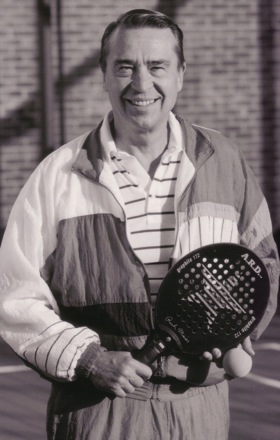
Richard Maier first showed up on the platform tennis scene as a finalist in the Junior’s, but he set the paddle down for a few years, during which he made a considerable mark in college racquet sports, and later spent a brief amount of time in Europe and India trying to make money playing the tennis circuit. On returning home, he picked up his paddle racquet again and his play improved faster than anyone else in the history of the game. From 1980-1992, Maier made the Men’s Nationals finals each year, winning ten titles, including four in a row (1980-1983) and five in a row (1988-1992). Only two other players—Flip Goodspeed and Scott Mansager (1996-2000)—have matched Rich’s feat of five in a row. A paddle entrepreneur, Rich is the Hall of Fame’s only patent holder. Starting by building paddles in a garage, he later formed Advanced Recreation Design to design and sell new paddles and a ball. Along the way, Rich developed a reputation as one of the best teachers of the game and instilled a love of the sport in his junior students.

Maier grew up in Westchester County, NY, and attended Mamaroneck High School where he was active in a number of sports, but did not get serious about tennis until his junior year. His racquet skills developed quickly, leading to a tennis scholarship at Jacksonville University, Jacksonville, FL, where he started playing varsity tennis in his sophomore year. He made a mark on the school’s racquets program by winning singles, mixed, and doubles titles in tennis, and singles in badminton. After graduating in 1975, Rich went to Europe, and then to India, to play in whatever tennis tournaments he could enter. While an educational experience, it was not too remunerative financially and he returned to the U.S. after a few months.

A friend named Jay Edwards first introduced Maier to platform tennis while they were both at high school, but, while at Jacksonville, there were few opportunities to play. After Rich got back from his overseas stint, Jay got him to take platform tennis more seriously. They entered their first tournament in 1976 and defeated Keith Jennings and Chauncey Steele, the previous season’s national champions, in their first round match. They were both 23 at the time.

As the years went by, Maier’s game improved faster than anyone else in history and, from 1980-1992, Rich and his partner, Steve Baird, made the National Championship finals each year, winning ten including four in a row (1980-1983) and five in a row (1988-1992). Only two other players have matched Rich’s feat of five in a row. All but one of Rich’s ten national titles were earned with Baird.

Maier and Baird’s most memorable match was the 5 hour 40 minute duel with Greg Tully and Tim McAvoy in the 1985 Hartford Invitational finals. Spectators watched a couple of hours of paddle, ate dinner, and returned to watch a couple more. At 17-16, in the fifth set, the umpire quit because of the cold, and Rich and Steve closed out the match the following game.

In mixed doubles, Rich was a finalist four times and a national champion once, in 1992. He won the National Men’s 45+ in 1998 and 1999 with Steve Baird, but hip-related issues started to plague Rich in 2000-2001. After surgery, he stopped playing competitive events and focused on teaching and this is where a large part of Maier’s contribution to platform tennis was made. His first position as a Head Pro was at Brookside Racquet and Swim Club in Allendale, NJ, starting in 1978. In more than three decades as a teaching professional, he inspired a love of the game in hundreds of paddle players. His ability as a teacher was best reflected by sentiments from some of his students: “To us, he was the cream of the crop, the best of the best, the Michael Jordan of paddle. He provided us with countless fond memories of paddle. The many hours we spent with him on a paddle court are invaluable beyond description. We admire him as an athlete, we love him as a friend, and we idolize him as a teacher.” Two of these pupils, Nick Swain and Mark Wilson, were National Junior Champions in 1989 and 1991. Without exception, youngsters and adults alike all enjoyed and benefitted from his advice. Well almost without exception. After several frustrating attempts to teach the basic techniques of platform tennis to one student, he was overheard saying to her, “Could I offer you a fee not to take another lesson?” The student was his mother-in-law, Roxanne Zilenziger.

Chip Baird, who Rich had known since 1971 when he had lost to him in the finals of the Junior 18-and–under, played a significant role in encouraging Rich to get more involved in paddle. A number of years later, the Baird brothers sought out Rich for advice on how to beat Doug Russell and Clark Graebner (Greg Brents and Rich had a good record against this team but the Bairds did not). Rich’s secret was to bore Graebner. This relationship paid dividends when Chip had to retire from competitive play and Rich started teaming up with Steve.

Maier has always been a pleasure to watch, with quick hands, fluid motion on the court, and accurate, relentless drives. In difficult situations, or when down in the score, he was unflappable, took his time, measured his opponents, and watched for the opening to work his magic. In summary, he was one of the most accomplished ad-court players ever to play this game.

But, Maier was not content with just playing and teaching the game. He was an innovator, with a US patent (US4379554) as proof. Along with co-inventor Andreas D. Schuyler, they developed a new concept for the platform tennis paddle. The patent, filed on August 24 1981 and issued on April 12, 1983, described an improved platform tennis paddle constructed “with two outer laminated ply structures and inner laminated ply structure there between. The inner laminated ply structure has a central aperture there through which, in the preferred embodiment, is filled with a resilient plug. The edge of the paddle is protected by a T-shaped molding fitted in to the perimeter of the paddle, and to safeguard against de-lamination, the handle is of pegged construction.” The patent was assigned to Skymar Corporation, and Rich and Andreas built the racquet, Skymar Proflight, in a garage in Allendale, NJ. The racquet was a commercial success, but the garage manufacturing operation faced constraints and ultimately closed. The concept though endured and was picked up by another manufacturer, Marcraft.

However, Rich was not through with innovating and started Advanced Recreational Design (ARD) in 1993, along with Gary Whalen, a friend from his Jacksonville days. ARD produced three new paddles and introduced a new ball that lasted much longer (six sets was not unusual) than the balls being sold at the time, primarily by Vittert. The ball had been developed with the aid of a manufacturer in Taiwan. With the initial positive market acceptance, they went into a 30,000 ball production run, only to find out that the samples used to test the balls against the APTA specifications did not pass.

Both on and off the court, Rich was uniformly liked and admired by those who knew him. He was unassuming about his ability, and modest about his achievements. Always fair and sportsmanlike on the court, his calls were never questioned, and close calls were always made in favor of the opponent. Off the court, he never had a negative comment about anyone. If there was a fault, it was that he was a perfectionist and a “neat-nick,” so much so that he took over the laundry duties at home, because he didn’t like the way his wife, Susan, folded the laundry!

Maier was also a giver, voluntarily helping with school events, women’s events, and charity events in Chicago, and often personally on a one-on-one basis.

Rich said he has always enjoyed platform tennis tournaments more than tennis because of the social aspect of the game. “In tennis, you often play someone you’ve never met before, the match isn’t as sociable, and afterwards you don’t see them again. In platform tennis, there is often a cocktail party before the event and social lunches and evening events during the tournament.”

Buffy Briggs

Briggs, Buffy

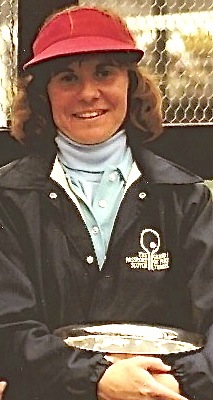
Elizabeth “Buffy” Briggs won two back-to-back Women’s Nationals in 1963 and 1964 and in her role as chair of the Woman’s Tournament Committee and the Players Committee acted as the liaison between the APTA and its largest sponsors at the time, Passport Scotch and Tribuno, a task that required extensive travel and endless decision-making. Buffy was also a strong supporter of developing B level events for those not competing in the big-money tournaments, and helped develop a point system to rank players as an alternative to the random seedings used earlier.

Born in Fall River, MA, Briggs attended Miss Porter’s School in Farmington, CT, where she later became a trustee and the recipient of the prestigious Daisy Pin Award for outstanding contributions to the school. She graduated from Vassar in 1947. During her active playing days in the 1960s, Buffy was a two-time Women’s National Champion with Charlotte Lee, in back-to-back years, 1963 and 1964, and was a finalist in 1968. Just the fact that Charlotte teamed with her is a testament to her ability on the court. Though a skiing injury prevented her from continuing to compete at the top-level of play, her most important achievements in paddle were still ahead of her.

If Holly White had known Buffy Briggs, it is likely her book might have been titled The Organization Woman. Briggs was responsible for many of the lasting innovations on the distaff side of our sport, and labored diligently to get people to work together. In 1974, she was appointed chairperson of the Women’s Tournament Committee on the APTA Board, and was also named chairperson of the newly formed Players’ Committee. With the rapid growth and popularity of our sport, the 1970’s was a time of considerable challenge, and also some controversy in women’s platform tennis. One problem was access to tournaments. New Jersey women were having a difficult, if not impossible, time getting into tournaments across the great divide we call the Hudson. River. Often, by the time they got their entries in, the draws had been filled. It was like getting an invitation to a party after it was over. Buffy faced much resentment about this inequity and set about fixing it.

Those who toiled with her in women’s paddle all said she was the best organized woman they had ever met and that she put her heart and soul into the game. Brigg’s time in the corner office of women’s paddle also came during the incubation and growth of commercial sponsorship in our sport, with moneyed tournaments, the establishment of a true women’s tour, and all the problems and frustrations that pertained to these developments. Hers was a volunteer job but it carried the time demands and responsibilities normally associated with that of a paid position. She was everywhere the women played during the time when Passport and Tribuno sponsored competitions, and acted as a liaison between the sponsors and the APTA. Her travels took her to Chicago, Cleveland, and Cincinnati, to Washington, Philadelphia, and to Boston. With the travels came a seemingly never ending parade of decisions to be made—to play or not to play in bad weather; to wear or not to wear sponsor-provided clothing—as well as dealing with player disputes and altered draws as teams dropped out or were added.

In this climate of “big-money,” the “A” player was naturally favored, but Buffy felt strongly that something should be done to encourage players one level or more down. So, at her urging, the concept of A and B tournaments was born. The B Tournaments would protect the amateur, while the A schedule could be the basis for a sponsored or open women’s tour. Winners in the B schedule would then also be able to move up. Another creative change was the introduction of loser playoffs. Losing quarterfinalists were expected to return for playoffs, thereby providing for more accuracy in rankings. She and her committee also developed the point system to seed and rank players, as the time had long-passed for random seeding. Some events were even designated “ranking tournaments” to attract stronger fields.

Briggs was so good at her job that she held it for 10 long years, many of which were after her tour on the Board had ended. She truly was an organization woman and brought exciting ideas to the women’s tour.

Source: G.Estabrook Kindred, Induction remarks

Baird, Steven W.

Stephen Baird started winning National titles as a junior and didn’t stop. The son of Charles F. Baird, who was inducted into the Hall of Fame in 1992, Stephen partnered with younger brother Chip to win back-to-back Junior titles before his age made him ineligible. Several years and five straight titles wins for Chip later, the two paired up again for the Nationals in 1973, where they earned a number four ranking nationally. Steve and Chip won their first Men’s title in 1976, becoming the youngest team to do so. When health issues forced Chip to stop playing in 1979, a dynasty was born when Steve began to partner with Rich Maier. Starting with that 1979 finalist spot and ending 13 years later, in 1991, Steve went on to be a finalist every year, winning ten and coming in second in the other three. During this span, he twice won four titles in a row. No player has won more Men’s titles. Steve was on the Board of the APTA for six years and President for two, during which he pushed for more tournament levels with more competition for the average player. In short, he wanted the game to be what made it so great to begin with.(Manursing Island Club)

Baird was a four-sport letterman in high school and the captain and star player on the tennis team at Bucknell, amassing a record of 25 wins against one loss and capturing a conference singles championship. He matriculated to paddle because his father and brother played the game. At the beginning, it was kind of an add-on for him but, very early on, he showed a natural affinity for the game and appeared destined to accomplish great things.

The first time Baird played paddle competitively was in the APTA Junior Nationals in 1969. At that time, he had only two years of eligibility, but he and Chip won both times (1969 and 1970). They played in their first National Men’s Doubles in 1973 and had a good enough record to achieve a #4 national ranking. They won in 1976, defeating defending champions, Keith Jennings and Chauncy Steele, and losing only three sets along the way. With this win, they became the youngest players to-date—Steve was 25, and Chip, 22—to win the Nationals.. They continued playing together during an era when Herb Fitz Gibbon, Hank Irvine, Clark Graebner and Doug Russell were dominating play. Despite the competition, they were finalists in 1979.

In 1980, when Chip retired, Steve forged a partnership with Rich Maier never equaled before or since. No player has won more Men’s Nationals and, in the history of our game, only one other team, Flip Goodspeed and Scott Mansager, has won more than four in a row (1996 – 2000) and no team has ever one four in a row twice (1980-1983 and 1988-1991) during years where there was some heady competition from tennis players turned paddle players. The dossiers of the opposition included two teaching professionals, three Davis Cup players, a team ranked #10 in U.S. tennis doubles, a player ranked #3 in U.S. Tennis Doubles, a player on the professional tour and one on the satellite tour.

At the core of what Steve did on the court was his athleticism. He could do amazing things with that unforgiving, perforated racket. The shots this deuce court player was best known for were his forehand return of serve and his lashing forehand drive off the screen. Virtually all of his shots were placements and hit at a constantly changing pace. It was the surprise factor—of not knowing what he would do—that challenged opponents. Watching Steve play was marvelous fun.

Steve’s approach to competition was identifying and understanding the pattern of play that won that team points, and then recreating the patterns that led to his team’s strengths. He always played as a team, making his partner better by fitting their games together. He knew that it was the combination of skills that made a great team. And this, unquestionably, was a great team.

The other important side of this paddle player was what he did off the court. He was on the Board of the APTA for six years and President for two, taking the helm at a difficult time for the sport. Platform tennis was still commercially-focused but, as sponsors lost interest, there was a need to change the focus to keep the sport and the organization healthy. He pushed for more tournament levels with more competition for the average player—a considerable perspective for a champion who had never really known what it was like to be average.

Watson, Jack L.

An athlete who excelled in several sports, Watson played basketball, baseball, and football at Lake Forest Academy, in Lake Forest, IL. He was also president of his graduating class and of the student council at the Academy. The first indication that he would excel in racquet sports came at the University of Michigan when he played on the table tennis team that won a Big-Ten championship.

When the first platform tennis court was built at Exmore Country Club in Highland Park, IL, Watson participated in the introductory exhibition, and then continued to give clinics and promote the game. His biggest contribution to the sport was his work in organizing league play in Chicago and serving as chair or co-chair of both regional and national championships for more than 20 years. Jack was one of those few people who would always step up to further the development of the games.

But, these commitments to the administrative side of the sport did not prevent him from becoming an accomplished player. Neither did starting the sport at a relatively late age. There are not many who have logged more miles as a senior player than Watson. He competed in many regional and national tournaments all over the country and was a winner of a number of regional tournaments, including a 13-year run as the Illinois State 45’s Champion. Nationally, he won the National Senior Men’s 50+ in 1985, and was a finalist in 1986 and 1987. He won the 55+ in 1989 and was a finalist in 1991. In the 60+, he was a finalist in both 1993 and 1994.

Watson had a well-established reputation for good sportsmanship, integrity, and consideration for others. He was a true gentleman both on and off the court. He was modest, and fun to be with, on either side of the net, and his friendliness and encouragement attracted many new players to the game.

At the same time, Jack’s keen competitiveness was legendary. A long-time partner recalls that, “we were in an important tournament match, and I was not serving well, having faulted several times. At a key stage of the match, I served two more faults in a row, and my partner raised his hand, called time out, walked back from the net to the baseline, and said to me (loudly), ‘if you fault one more time, you’ll finish playing this match by yourself!’ I didn’t fault again.”

In recognition of Jack’s contribution to the game at Exmore Country Club, the warming “hut“ is named the “‘Watson House.”

Hilary Hilton Marold

Marold, Hilary Hilton

Marold was dubbed “Queen of the Racquets” and probably won more state and national titles in racquet sports, appeared more times on national media as a player and commentator, and written more for national media on racquet sports than any other woman who has played competitive platform tennis. She brought a new dimension and strategy to platform tennis and ushered in a new era in the women’s game.

Born in Santa Monica, CA, and raised in a sports-minded home in Pacific Palisades, CA, Marold played tennis at the Riviera Tennis Club and paddle tennis at the Beach Club. She attended Marlborough School, graduating in 1968, and was elected their Woman of the Year in 1979. As a drama major at USC, she was a runner-up to “Helen of Troy,” the “Sweetheart of Sigma Chi,” Vice President of the Associated Women’s Students, and rush chairman of her sorority, Kappa Alpha Theta. While at USC, she won six National Public Parks doubles tennis titles, and was also a many time over National champion in paddle tennis, leading to her induction into the USPTA Hall of Fame for paddle tennis in 2012.

In 1973, Bobby Riggs, shortly after beating Margaret Court in tennis, challenged Hilary to a singles winner take all match in paddle tennis, a game he knew well. She whupped him 8-3. This lead to considerable publicity. The Los Angeles Times put a photo and story on the second page, Billie Jean King put Hilary on the cover of her Women’s Sports magazine, and Sports Illustrated featured her in their “Faces in a Crowd” section, which caught the attention of platform tennis enthusiasts out East.

In 1974, Oliver “Kim” Kimberly, an APTA National Champion in 1964 and 1967, called Hilton in California and, with the backing of the R. J. Reilly Co., offered to sponsor her trip East in order to teach her their game. The goal was to learn the screens in two weeks and enter the APTA Mixed Nationals with Kim Kimberly. Figuring she was going to travel East to play the Mixed Nationals, Hilton thought she might as well play the Women’s Doubles as well, and she took them up on their offer with the stipulation that her long time paddle tennis partner, Annabel Rogan, be included. Both traveled to Darien, CT, and there, and in upstate New York, they trained and learned the wire game from Kim Kimberley, Dave Jennings, and Myles and Dick Reilly. The rest was platform tennis history, as captured in a Sports Illustrated article in 1977.

“What we need to attract the public,” the platform tennis people must have said, “is a dynamite chick. A superstar. All we’ve got now are these country-club gals with their station wagons, needlepoint and pitty-pat serves. We want a bona fide, all-American, knock-your socks-off girl. What we need,” they mused, “is a cross between Farrah Fawcett and Chris Evert.”

They got what they needed in Hilary Hilton at age 26, a 5’5″, 129 pound, blonde hair, blue-eyed professional platform tennis player. She is pure California. Her dazzling teeth have promoted Gleem on TV. She was even—and this is too good to be true—on The Dating Game once and won a trip to Paris with Tim Culbertson the Heavyweight Boxing Champion of the Armed Services.

Hilton was weaned on the version of the game known as paddle tennis, which is played with the same paddles on a miniature tennis court, with no screens and a punctured tennis ball to deaden the bounce. The step up to platform was a logical one, and in the second tournament in which she ever played, the national championship in 1975, Hilton and her partner, Annabel Rogan, won. At the time Annabel was 23 and Hilary was 24, the youngest team ever to have won the championship. Hilary and Annabel (now Annabel Rogan Lang) teamed up again in 1979 and were finalists but Lang had always preferred living on the West coast and the pair had limited time to prepare for the increasingly competitive sponsored tournaments and associated commitments.

When she heard that Tribuno was sponsoring a women’s tour for the first time in 1977, Hilton decided to enlist her friend, Margie Gengler, as a partner. But Margie had to travel with her tennis playing husband, Stan Smith. Well, what about her younger sister Louise? Well, why not? Coming into the Tribuno, Gengler-Hilton had won all six tournaments on the circuit without dropping a single set in any final. They were a well-matched pair. Gengler, 24, had been captain of the women’s tennis, field hockey and ice hockey teams at Princeton. She has been playing racket sports all her life and had no trouble picking up paddle. She has a menacing two-handed backhand and a powerful forehand drive and developed into a fine screen player. Hilton was the first to admit that her serve was not the strong point of her game and, in fact, thought it was weak at times. However, she never felt the need to work on improving it, because she was the best volleyer in the women’s game at the time and was confident she could handle all opponents’ return of serves.

Hilton’s forte was her smartness in strategy, her competitiveness, and her natural athletic talent. She loved the psychological aspects of competition and liked to win by outsmarting an opponent, as much as by outplaying them. She complimented her partners with a variety of offensive service returns from the ad court—she won National Championships playing the deuce side, but could generate more offensive from the ad court—while charging the net behind any offensive shot. No player at the time had thought to be this aggressive, and the strategy was denigrated by some at the time as “not the game of platform tennis, just tennis on a platform court.: However, this was a time when the women’s game, in particular, was changing and becoming more offensive and was “not your mother’s game” anymore. This offensive style came from Hilton’s paddle tennis and tennis expertise, and worked effectively because of her fast hands and skillful volleying.

When Hilton was introduced to the game in ’74 and ’75, all the female players did off the wires was lob. Hilton and her partners not only lobbed, but drove off the wires, charging in behind the shot to pressure their opponents. Hilary would also often choose to volley her opponents’ overheads from mid court as a surprise tactic to turn defense into offense. While constantly challenging their opponents with offense, she and her partners played patiently enough to wait for the error from the opponents, aided by the variety of their great shot-making.

On most teams, “mine” or “yours” is sufficient as a communication device. But Gengler and Marold carried it one step further, resulting in them being presented with matching T shirts, one emblazoned “Me, Me, Me” and the other reading “You, You, You.”

In the semi-finals of the Tribuno Championship, Gengler-Hilton won the first two sets 7-6, 6-3 against Wendy Chase and Linda Wolf and, normally, the match would have been over. But, because Tribuno was putting up equal prize money ($15,000) for men and women, the women voted to play three out of five in the semis and finals, just as the men did. Gengler and Hilton lost the next two sets 4-6, 1-6, before pulling the match out 6-4 in the fifth. They went on to win the finals against Sis North and B. J. DeBree. In addition to the Tribuno World Championship, Hilton also won the Dutch Championships in Holland, the British Championships outside of London, and the Belgium Championships in Brussels.

Hilton and Gengler captured the Women’s Nationals in 1977 and 1978 and, when Gengler retired from competitive platform tennis to become the women’s tennis coach at Princeton University, Hilary teamed with Yvonne Hackenberg to win three straight Women’s Nationals in 1980-1982. Partnered with Doug Russell, she won five Mixed Nationals, including four-in-a-row (1979-1982),. It could have been six in a row but she was a runner-up in 1978, losing to ex-partner Louise Gengler and Clark Graebner. Hilary married Charlie Marold in 1979, and was five months pregnant with her first child (Chad) when she and Yvonne won the second of their three National titles in 1981. Her last Women’s National title came in 1982, after which she retired to raise Chad and have two more children, Burke and Morgan. Burke won the APTA National Boy’s 12 and under in 1997, and Chad claims that he also won a national title for his part in the 1981 win. While she had retired from competitive platform tennis, she remained active as a teacher in the western suburbs of Hinsdale and as far north as Milwaukee.

Hilary was a national champion in four different racquet sports over the years. She won twelve gold ball USTA national tennis titles, including the Husband/Wife on grass, clay and hard. In paddle tennis, she won over twenty National titles in singles, mixed and women’s doubles. Since being introduced to the sport of Pickleball by Yvonne Hackenberg in 2009, she has won ten National USAPA Pickleball Championships, in both singles and doubles (five with Yvonne) and ten Huntsman Senior World Championships in singles and doubles (five with Yvonne).

Marold had a very busy life off the various racquets courts during her active playing days. In 1977, she was the only female athlete invited by CBS to compete against five world-class male racquet athletes on the World Racquets Championships and, in 1978 she was asked to be part of the NBC broadcast team of Bud Collins and John Newcombe to do the Wimbledon coverage from England.

In 1976, The Paddle Pro Co. out of Venice, CA, made and marketed the first ever female autographed platform/paddle tennis paddle, the “Hilary Hilton, World Champion,” the first mass produced female autographed platform tennis paddle sold nationally.

Sources: People, Vol. 9, No. 13, April 03, 1978. Sports Illustrated, April 11, 1977

Footnote: Pickleball reunites old partners: After not seeing Hilary and her husband, Charlie, in well over 20 years. Yvonne decided to give Hilary a call to see if she would play with her in the Pickleball Nationals. After she explained the game, Hilary made a leap of faith and said, “Sure, let’s give it a try.” Yvonne and Hilary, (who had NEVER played the game before she went to Buckeye, Arizona for the 2009 Nationals), came in second in both their age group and the women’s masters division. This past year (2010) they teamed up again, first at the Huntsman Games in St. George, Utah. They won their 60-64 age group and the Women’s 5.0 Skill Level. Then, at the Nationals the following month, they won gold in both the 60-64 age group and the Women’s Open Division. Yvonne and Hilary’s remarkable partnership has been rekindled, thanks to pickleball.
Jim Hackenberg, USAPA Newsletter , 5/1/2011

Chet Kermode

Kermode, Chet

Kermode lived in an area where there were no paddle courts for many years, so he was in his 40s when his tennis club installed some courts and he saw the game played for the first time. He loved the competition and the camaraderie on a tennis court, but here was a game where the camaraderie was in much closer proximity, and there was exercise that he loved. He was more than a credible tennis player as he had been on the tennis team in college, had won two state father/son tournaments, and represented the U.S. for six years on the international senior tennis team that competed against Canada.

Two years after picking up the game, at an age when most of his brethren were quitting competition or playing for fun, Kermode was competing and winning regionally in the 45+ events Between 1977 and 1984, he won the Cleveland 45’s championship six times, and was a finalist twice. After the fifth regional win in 1983, he competed at the Men’s Senior Nationals, playing against the likes of Chuck Baird, Roger Lankenau, and Gordon Gray. He won the Cleveland Masters 45’s for the seventh time in 1997 at the age of six-eight.

As Chet moved up in the successive age groups, he kept on winning, beating teams that at one time had been seeded in the Men’s Nationals. He won the Men’s 50+ in 1983, the 55+ in 1984, the 60+ in 1989, 1993 and 1994 and the 65’s in 1996. He played in the final match of the National 60+ four times in the five-year span from 1993 to1997, as he was a finalist in 1996 and 1997, and a finalist in the 65+ in 1997. With this record Kermode found himself in exclusive company, being one of only two people, the other being Chuck Baird, to win a National Championship in four of the five senior age brackets 45+, 50+, 55+, 60+ and 65+ .

One can love the competition and the camaraderie, but standing up to the rigors of consecutive matches on consecutive days at any age takes stamina. To do it in your 60’s is remarkable. Kermode won with ability, but he also won with his mind. He analyzed the game, bringing his engineering mind to it. And, platform tennis is a game that lives on strategy and cunning, particularly at the senior level. Chet’s love of the sport was contagious and so was his attitude on the court toward his partners and opponents alike. He was a gracious competitor, win or lose, unalterably fair, and never let the heat of battle get in the way of the fun he was having.

Kermode also loved to teach new players and for years willingly gave clinics at the Cleveland Racquet Club. He was the 1990 Senior National Tournament Chairman and served on numerous other tournament committees. He has also written instructional articles on the game, both in local publication and in the APTA newsletter.

Yvonne Hackenberg, winner of 1980 Women's Nationals with Hilary Hilton Marold

Hackenberg, Yvonne

Hackenberg made a wonderful contribution to the game both on and off the court. As with many champion players, she came to the game through tennis, which she took up in Junior High School and competed in junior tournaments throughout the Midwest. She ended up as a coach for the man who first recognized her ability. After playing tennis in high school and college and then getting married and having a child she got a fortuitous exposure to platform tennis. While looking for a place to live, she and her husband toured a planned development community. Their interest was drawn to what looked like two small tennis courts sitting on posts and surrounded by ‘chicken wire’. What were these things? Come back next week and watch they were told. They did and were instant converts. They played every chance they got, and very soon Yvonne was organizing neighborhood matches and Sunday round robins.

Yvonne became as good as any local man and was often asked to be fourth in men’s doubles and lucky was the man who got her for a partner. She was so good that she expanded her summer job as tennis pro at a local country club into a year round position by also being its platform tennis pro. She brought her tennis students to paddle and they in turn got hooked. She then expanded this local teaching to paddle clinics throughout the Midwest.

In the mid ‘70s Yvonne competed at the regional level and won many tournaments with Janet McCutcheon. It was in 1979 that Yvonne teamed up with Linda Wolf, a Connecticut player, with whom she had never even practiced, and won, defeating Hilary Hilton and Annabel Lang Rogan. The following year she teamed with Hilary Hilton (Rogan had moved back to her native California) and they proceeded to win three consecutive national titles from 1980 – 1982; she also was a finalist in the Mixed Nationals in 1982. A fifth Women’s title was added two years later in 1984 with still another partner, Robin Fulton. At this time, platform tennis was at one of its zeniths with lots of top level competitors drawn by the games popularity, sponsors and prize money, a heyday of six or seven years during which she won her five national titles. Truly remarkable!

The game fosters intense but friendly competition and this player was known, win or lose, for her class, her friendliness, her wide circle of paddle friends and the esteem in which they all hold her. Constantly supportive and encouraging to partners and passionate about our great game, she was a competitor’s competitor. She had contributed off the court as well, as an APTA director for nine years, and at the time of her induction was the woman’s director for this region V, and had been the chairperson of the Kalamazoo platform tennis tournament for as long as anyone can remember. She was truly an ambassador of the game.

Despite all her titles the ones she most cherishes, are not hers, but the two junior national titles won by her daughter, Kristy, in the 15 and 18 and under championships in 1985 and 1988.

Historical Factoid: Pickleball reunites old partners: After not seeing Hillary and her husband, Charlie, in well over 20 years. Yvonne decided to give Hilary a call to see if she would play with her in the Pickleball Nationals. After she explained the game, Hilary made a leap of faith and said, “Sure, let’s give it a try.” Yvonne and Hilary, (who had NEVER played the game before she went to Buckeye, Arizona for the 2009 Nationals), came in second in both their age group and the women’s masters division. This past year (2010) they teamed up again, first at the Huntsman Games in St. George, Utah. They won their 60-64 age group and the Women’s 5.0 Skill Level. Then, at the Nationals the following month, they won gold in both the 60-64 age group and the Women’s Open Division. Yvonne and Hilary’s remarkable partnership has been rekindled, thanks to pickleball.

Source: Jim Hackenberg, USAPA Newsletter , 5/1/2011

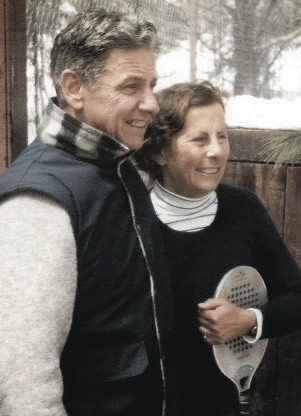
Wooley and Pam Bermingham. Wooley received the APTA Honor Award in 1979.

Bermingham, Pamela Macrae

Bermingham became a paddle missionary after she and Wooley (Honor Award in 1979 and Hall of Fame inductee in 1996), moved west to Pittsburgh. She got Pittsburgh women and their husbands to come to clinics, and encouraged local women to travel and play outside the region, and those outside to join her within the region. None of this would have been possible without her zeal to teach, her infectious enthusiasm for the game, her desire to get people who knew the game to strive for another level, and those who were content at their level to realize how much fun it was to play. A “quality player” and a fine teacher of the game, her former partner and long-term friends Anne Jackson and Bam Behrer noted that the true testimonial to Pam’s success as a player and teacher was the number of her former students from the Sewickley area who played in the Nationals the year she was inducted into the Hall of Fame (1997).

Pam Bermingham spent part of her childhood as a neighbor of the founders of platform tennis, Fessenden Blanchard and Jimmy Cogswell, and remembered her parents and friends playing on the Cogswell court behind her house in the 1930’s before she ever took up the game. Twenty years later, she was not only playing paddle, but also winning many mixed and women’s tournaments at Manursing Island Club in Rye, NY. Those victories gave her enough confidence and skill to blitz her way into the final of the Women’s Nationals in 1958. As Pam remarked, “Those were the days of Madge Beck, Barbara Koegel and Elfie Carroll. Heavy competition.”

In 1959, Pam and husband, Wooley, moved to Sewickley and introduced the game of paddle tennis to their newfound friends. The Berminghams engendered enough enthusiasm for the sport that the Edgeworth Club board approved the plans for building a paddle court in February 1962. A second court was added by the fall of 1964 to accommodate the increasing popularity of the game. While raising six children, Pam devoted many daytime hours to teaching the game that she grew up with as a resident of Scarsdale. With her playing and teaching partners, Jenny Scott and Anne Jackson, Pam took her paddle on the road to conduct beginning to advanced clinics throughout the Midwest and as far west as Lake Forest, Illinois. At home, she devoted her time teaching in the Saturday morning clinics for beginning junior players started by David Schaff at the Edgewort Club, as well as teaching the advanced players how to improve their consistency and strategy. She set up junior tournaments to provide youngsters the competition they needed to elevate their levels of play.

At the Edgeworth Club, she was considered the best player but was seven months pregnant during one tournament and, as David Schaff, one of the opponents recalled, this had all the ladies watching gasp aloud every time she had to retrieve a low shot. This was so un-nerving to David and his partner that they would react by hitting the next shot into the net or out. As David said, “Pam never though of the spectator reaction as a gamesmanship ploy but it certainly was effective! “

Her enthusiasm and affection for the sport did not stop with teaching the youth. Pam was equally tireless teaching women and other who had never played racquet sports before picking up their first paddle in one of her clinics. She also initiated women’s interclub and league divisions, enabling players of all ability to enter into the fun and competition of the popular winter sport. By 1970, the beginnings of a paddle explosion emerged as paddle courts had already been built in Fox Chapel and Upper St. Clair Country Club in the South Hills. Pam and Wooley were receiving calls from these paddle enthusiasts to demonstrate how the game was played. Through these exhibition matches—in Sewickley, Fox Chapel, South Hills, and at Oakmont Country Club, where the first two aluminum courts were built in 1971—players multiplied by the dozens.

Witnessing the increasing popularity of the game, Wooley laid the foundation for the Western Pennsylvania Platform Tennis Association. The organization served as a model for other associations that have formed since—the Middle Atlantic Platform Tennis Association for the eastern seaboard, and the Western Platform Association for the West Coast.

At the time of Pam’s induction, there were seventeen clubs and public parks participating in men’s and women’s WPPTA interclub competition from September through March. There were seven divisions in the women’s league and four divisions in the men’s. An evening league, with two divisions, had been added in the 1992-93 season to accommodate the increasing population of working women.

In recognition of his contributions to the growth, development and administration platform paddle tennis, Wooley, more formally known as Eldredge L. Birmingham, received the Honor Award in 1979, and it was fitting to recognize the immense contributions of both Bermighams as the development of the game in Pittsburgh was truly a team effort.

Source: Platform Tennis News Spring 1997

John P. Ware (1921-1999)

Ware, John P.

Ware, a graduate of the Brooks School and Princeton University, served as a First Lieutenant in WWII and Korea, where he was awarded the Bronze Star. A pioneer in marketing paperback books, Ware worked for Pocket Books, Simon & Schuster, Reader’s Digest and John Wiley & Sons, and was honored by the Bureau of Independent Publishers and Distributors for ‘”Outstanding Service to the Industry and to Education.” He was an avid sailor and co-author of eight editions of The Cruising Guide to the New England Coast.

Brook Kindred, who made the induction presentation, started his introduction with this sentence: “The man we now honor has spent roughly 40 years of his adult life nurturing and promoting the game of platform tennis.” He continued, “This man had the titles, but when his tenure was over, he didn’t move on; rather, he continued to work for the game.” Ware was regularly called upon to serve on numerous tournament committees, and was always willing to accept any responsibility,. He was, in fact if not in formal title, the game’s historian and it is safe to say that Ware knew more about the history of the game than anyone. He helped with the publication of Oliver Durrell’s The Official Guide to Platform Tennis, published in 1967, which drew heavily upon his father-in-law, Fess Blanchard’s, earlier two books, Paddle Tennis (1944) and Platform Paddle Tennis (1959). Ware also wrote a chapter on the game’s history in Dick Squires’ first book, and was responsible for numerous articles on the game in The New York Times, and various journals (Time, Sports Illustrated, On the Sound, The National Observer, Travel and Leisure, Country Journal, and American Way).

With his wife, Molly Blanchard Ware, he put together platform tennis’ first and only historical slide show presentation. This slide and audio presentation has been digitized and is available in the Museum Archives. It was shown again a few years ago at the Fox Meadow Tennis Club in Scarsdale, New York, which is known as the “Home of Platform Tennis,”,when a special anniversary of the Club was celebrated.

He served as secretary of the APTA from 1959 to 1961, during which time he did extensive research on format, size, and timing of tournaments and the composition of paddles. And, as President from 1961 to 1963, he was instrumental in bringing young people into the game when he inaugurated the first APTA Junior Boys National Championships in 1963. Another of his contributions, during his tenure as President, was designing the crossed paddles and ball insignia for the Association. The logo was modernized in the late 1970’s, but Ware’s original design remains on the crests presented to Hall of Fame recipients and past Presidents.

But, perhaps his most important contribution had to do with the color of the balls used in play. Platform tennis balls were white, but that proved to be a difficult color when playing against a snowy background and during the night play that was becoming popular. Ware decided to color the balls in his basement with spray cans of orange paint. Eventually, he got the orange ball to be commercially manufactured, and used before it gave way to today’s optic yellow.

Ware served as President of the Fox Meadow Tennis Club (1975-1976), was a trustee of the American Yacht Club in Rye, NY, an elder in the Hitchcock Presbyterian Church, where he was also a bass singer in the choir, a member of the University Glee club in New York City, and an officer in the Princeton University Class of 1944.

Hank Irvine

Irvine, Hank

Irvine was born and raised in Rhodesia, now the Republic of Zimbabwe, and coming from a tennis playing family—his Father was a tennis coach—started playing tennis as a young boy. He played tennis, cricket, squash and field hockey at Prince Edward High School in Salisbury (now Harare) and, after high school, he taught at a Primary School in Salisbury. He played on the Rhodesian field hockey team and had a chance to go to the Tokyo Olympics in 1964, but decided to concentrate on tennis instead. He represented Rhodesia in the Davis Cup in 1968 and 1969, which provided some interesting moments given the politics of the day (Rhodesia was banned from the Davis Cup in 1970), and held the number one tennis ranking in his country in both 1970 and 1971. If that was not enough, Irvine was also a world-ranked squash player and played against Australia, South Africa, and Great Britain in International matches. He played on the tennis tour for five years, beginning in 1968, which was the first year of the so-called Open tennis movement. Although Hank admits he didn’t set the world on fire with his tennis skills, he did get to the semis of the Mixed Doubles with Australian Helen Gourlay at Wimbledon in 1970, and played Stan Smith in the second round at Wimbledon in 1972, which was the year Smith won the Championship. His Wimbledon experiences are a highlight in his career . He once recalled, “It was like going to Heaven. It is the Mecca of tennis. You go out there the first time and it is a nerve-racking experience. The one and only time I got to play on Centre Court, I had to go on after the five-set final of the Men’s Doubles between John Newcombe and Tony Roche and Ken Rosewall and Fred Stolle, which was very intimidating to say the least. But it was fun and it is an experience I will never forget, and will have with me until the day I drop down dead.”

Although Hank made his initial mark on racquet sports as an accomplished tennis and squash player and teacher, he became one of the great champions of platform tennis. That he played paddle at all was fortuitous. He was a school teacher by vocation and a tournament tennis player, on tour in the United States in 1971, where he played at the Orange Lawn Tennis Tournament and the U.S. Open. The latter was then at the venerable West Side Tennis Club at Forest Hills. At the time, he was looking for a career change and the contacts he made while playing at the Orange Lawn Tennis Tournament, and his consummate racquet and teaching skills culminated in his being tapped for the head professional job at the Short Hills Club in 1973. He had no love for cold weather, had never experienced snow, and if you had squash indoors in the winter, why would anyone ever play platform tennis outdoors? Well, in this case, it came with the job description. So here he was, a man who had never even seen a paddle court, teaching the game as if born to it. As with all his teaching, it was done with considerable patience, humor, and dedication, and much respect from those whom he taught. As he once commented, “the easiest way to improve your own game is to go out and have to teach it to somebody else!!”

Every so often, a player comes along who changes the game, makes it his own and brings something new to it, and Hank Irvine was such a player. He was always exciting to watch, and his shot-making and control of the ball set new standards. He had, great hands and ease of stroke, coupled with economy of body movement and consistency, which is the key to platform tennis. And, he accomplished this with the old Dalton, the standard wooden paddle used in the ‘70s. He began to play competitively, locally and then nationally, and teamed with another Davis Cup player, Herb Fitz Gibbon, to win the APTA National Championships in 1977 and 1978, and to be a finalist in 1980. Six years later, while in his mid 40s, he again had back to back victories, winning the Nationals in 1986 and 1987 with fellow Short Hills pro Greg Moore. Those two victories broke up what could have been an almost straight twelve-year era of domination by Steve Baird and Rich Maier. In the fifty-nine years of National Tournament play at the time of his induction, he was one of only five players who had won the Men’s Nationals four or more times. He was also a finalist in the Mixed Nationals in 1976.

In senior play, Hank also had a fine record winning the Men’s Senior Nationals 50+ once in 2002, the 55+ four times (2001, 2003, 2005, and 2006), the 60+ three times (2004, 2005, and 2006), and the 65+ in 2009. He was a finalist in the 50+ in 2005, the 55+ in 2004, 2007 and 2008, and the 60+ in 2007.

Irvine had a depth of character and degree of sportsmanship that set him apart and brought to our game an excellence many of us strive for and few attain, coupled with an attitude atypical in competitive sports, particularly at the highest levels. He is a remarkable player and, by all counts, as loved as any man can be. When he became a U.S. citizen, his many friends were as excited as he was. A true friend, and a true gentleman who imparted so much to the game, to those he taught, both young and old, and to those who watched him play.