To support the growth of the game beyond the NYC metropolitan area the APTA Board elected two Regional VPS located in MA (New England) and MD (Mid Atlantic).
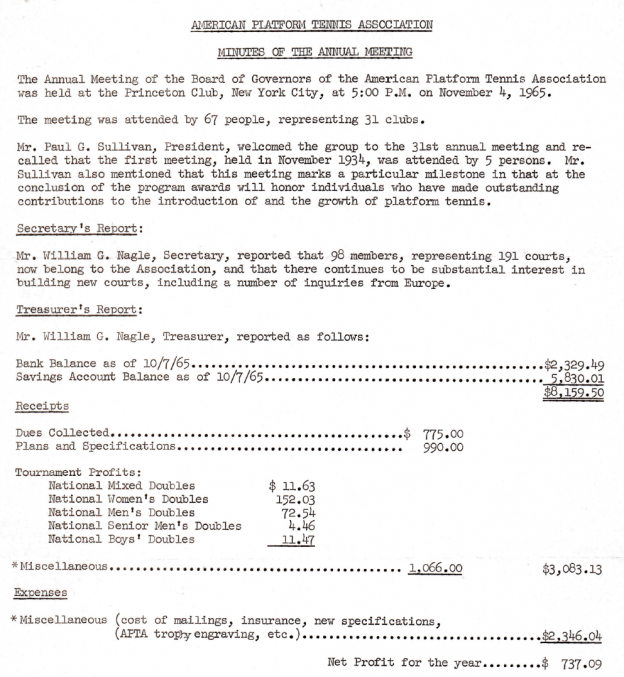




To support the growth of the game beyond the NYC metropolitan area the APTA Board elected two Regional VPS located in MA (New England) and MD (Mid Atlantic).

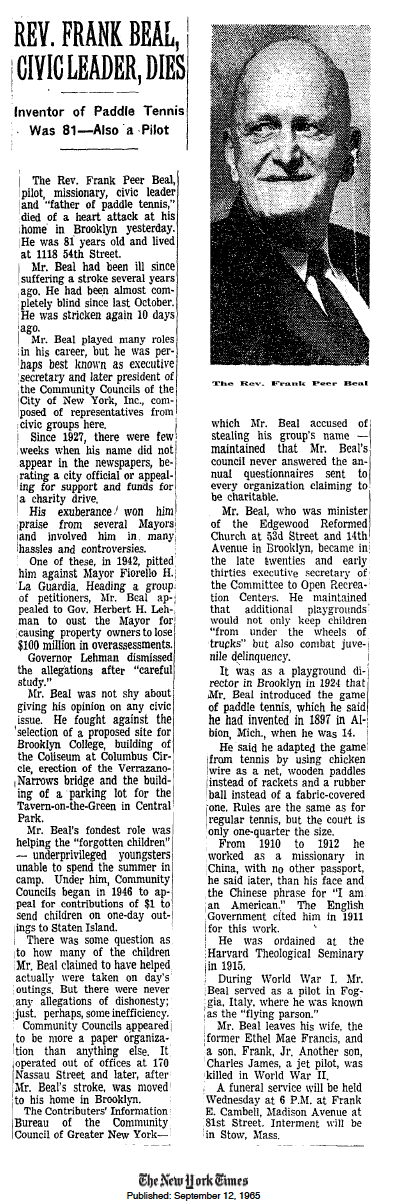
In the immediate post-war years, the Club’s boards concentrated on adding paddle courts and improving the grounds. Not until that was done and the old mortgage retired could the board move on to the long-held dream of expanding the little 1927 clubhouse.`
The addition would contain both a new kitchen and clubroom. Such construction required a zoning variance from the Village, and some nearby residents protested strongly. They said doubling the size of the clubhouse would add to existing traffic problems and noise.
At the time of the controversy the Club had 145 family members, thirty house members, ten nonresident members, and two honorary members. The parking lot could hold twenty-two cars.
Building the wing involved months of planning and was accomplished principally because of the presidential perseverance of Walter Close and Oliver Kingsbury. Hours were spent soliciting agreement forms from all property owners who lived within 600 feet of the Club’s perimeter.
In another move to nullify the opposition, the Club board amended the bylaws to establish a permanent ceiling of 160 active members and inserted a clause prohibiting any future application for a liquor license.
Source: Adapted from Diana Reische, Fox Meadow Tennis Club – The First Hundred Years, 1983

Kingsbury (1902-2005) was born in Clifton, NJ and graduated from Paterson High School. For many years he was an officer of the advertising firm Donahue & Coe, Inc. in New York City where he handled one of the key accounts, Metro Goldwyn Mayer in the hay day of MGM musicals.
During Kingsbury’s tenure the board developed plans for a major addition to the clubhouse that would contain a new kitchen and clubroom.
The undertaking created much controversy with neighbors and the new wing only became a reality in 1967 because of the perseverance of Walter Close and Kingsbury who were feted by the club for their achievement, at which time the addition was unofficially dubbed the Kingsbury Wing.


Holmes and O’Hearn (son of Hall of Fame member Charles O’Hearn), the previous year’s finalists won a five-setter over Dick Squires and Ted Winnpenny, Jr.1
Hebard won his first 50+ with partner Sidney Sweet and Charlotte Lee won her fourth Mixed title, this time with Bill Pardoe.
Do Cogswell Deland and Susan Beck Wasch won the Women’s; it was Wasch’s fourth Women’s title and the second one for the team.
Note 1: Charley O’Hearn was seen anxiously walking back and forth around the court where the final was being played like an expectant father. He was overjoyed at the outcome.
Source: Oliver H. Durrell The Official Guide to Platform Tennis, 1967; and APTA Platform Paddle Tennis 1963-1973: Rules and Records, 1973; Personal communication from Michael O’Hearn.
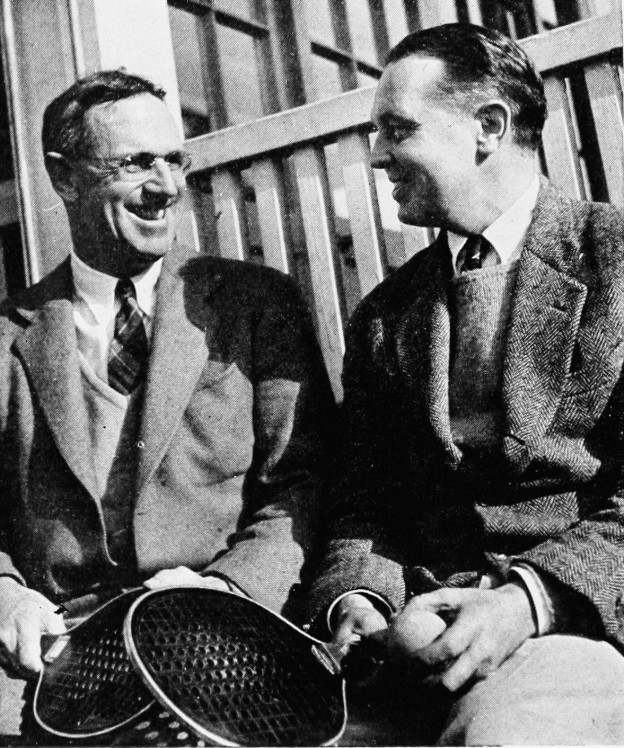
On February 18, 1965, the APTA gave out the inaugural Honor Awards to individuals who had made outstanding contributions to platform tennis. The awards were to be presented when the association’s Executive Committee felt that one or more individuals merited inclusion in the group of men and women who had created the game, nurtured it, or played it as champions.
The first APTA Honor Award Recipients were:
Madeline (Madge) Childress Beck: Considered one of the outstanding women players of the game, Madeline (Madge) Childress Beck won 17 National Championships—12 Women’s, 4 Mixed, and 1 Singles—from 1936 to 1960 and likely would have won more except that the Women’s Nationals were not held from 1943-1948, and the Mixed Nationals were not held from 1943-1945 and in 1948. (Fox Meadow Tennis Club) When it comes to discussing the leading women players developed since the game began, selecting the “leading lady” is easy. According to Fess Blanchard, “not only has this player won more national championships, by far, than any other woman but she has done it with a number of different partners.” (Fox Meadow Tennis Club).
Fessenden S. Blanchard: A co-founder of platform tennis and the game’s greatest supporter and promoter in the early days, Blanchard was also co-founder of the APTA, and its first president from 1934 to 1938. He was a tireless promoter of the game and acted as secretary, chief correspondent and publicist for paddle tennis during his tenure on the APTA Board. He authored two books on the game – Paddle Tennis (1944) and Platform Paddle Tennis (1959). (Fox Meadow Tennis Club).
James K. Cogswell, Jr.: Cogswell was a co-founder of platform tennis, and the first court was erected on his property on Old Army Road in Scarsdale, NY. He discovered the paddles and balls used in paddle tennis, which made the game we know today. With the Cogswell’s hospitality the court became a lively gathering place for enthusiasts. This social aspect has been a hallmark of the game ever since. As a trained engineer and an enthusiastic builder of things from fences to boats, he was responsible for many of the technical improvements in court construction, and developed the first set of construction drawings that were essential for the growth of the game. (Fox Meadow Tennis Club).
Clifford D. (“Kip”) Couch, Jr.: Couch was a three-time National Champion and top contender in National Tournaments from 1935 to 1949. He was considered the “stylist” of platform tennis. (Fox Meadow Tennis Club).
Katherine L. (Kitty) Fuller: Kitty Fuller was one of the pioneers of women’s platform tennis, a fine player and winner of the first mixed doubles championship, with Charley O’Hearn as a partner (1935). She also won the first two women’s doubles championships, with Jean Eaton (1935, 1936) and won the last women’s singles championship ever held (1937). (Fox Meadow Tennis Club).
Earle Gatchell: Gatchell was one of the original group of players on the first court and was credited by Blanchard for being an enthusiastic promoter of the game, “carrying the torch into dark places”.; He was an active player for over thirty years and was particularly interested in promoting the game with younger players. The Boys’ Trophy is dedicated to “Gatch.” (Fox Meadow Tennis Club).
Richard K. Hebard: Richard K. (“Dick”) Hebard was one of the outstanding players of the game, winning eight National Men’s Championships, and five National Mixed Doubles titles,. He continued to play competitively into his “senior” years, winning the National 50+. He was still winning National titles when he received the Honor Award. He served as APTA Secretary/Treasurer from 1950-1952, and President from 1953-1955, completing the latter term while also serving as President of Fox Meadow Tennis Club from 1954-55. (Fox Meadow Tennis Club).
James N. Hynson: Hyson, an excellent tennis player, won two consecutive National Championships (1937-1938), and was instrumental in the construction of the first court at a club—Fox Meadow Tennis Club in 1931. Serving as FMTC President from 1933-35, he helped oversee the addition of courts, and the building of a vibrant paddle community that lead to the club becoming known as “the home of platform tennis.” (Fox Meadow Tennis Club).
Charles M. O’Hearn: Charley O’Hearn dominated the game from 1935 through to 1950 and won ten National Championships—four times in Men’s , five times in Mixed, partnering with his wife Ginnie for four of them, and the last Singles Championship. When he moved to New Haven, CT, in 1951, his involvement in the game declined, although he remained an excellent player. (Fox Meadow Tennis Club).
Kenneth Ward: Kenneth Ward, the father of Scrambles Tournaments, which Blanchard viewed as “one of the greatest steps forward for the game,” served as the third APTA President from 1939-1942. Prior to taking over as president, he served as chairman of the association’s Publicity Committee, and his enthusiasm, combined with sales and promotional ability, brought considerable success to the game, and, by November 1941, the association had 21 member clubs. Blanchard considered him one of the best presidents the APTA had during the first two decades.(Manursing Island Club, Rye, NY).
The Awards continued until 1980, when there was a hiatus in activity. In the early 1990s, under the leadership of then President Chuck Vasoll, the APTA reactivated the Honor Award. In 1996, the APTA Board decided to replace the award and establish a Hall of Fame at the recommendation of President Charley Stevens. The Hall of Fame inducted all former Honor Awardees.
Source: Adapted from Diana Reische, Fox Meadow Tennis Club – The First Hundred Years, 1983, and Christina Kelly, Passing Shots: A Pictorial History of Platform Tennis, 2010
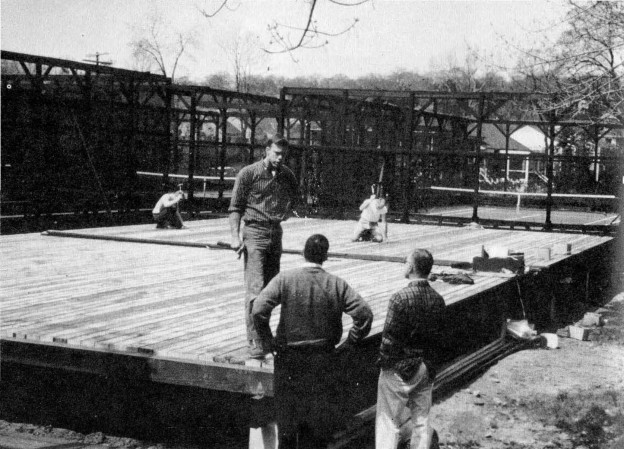
Dick Reilly had started building courts in 1965 and, by 1967, had built over sixty around the country. An enthusiastic player, Reilly developed many improvements in court construction that greatly enhanced durability and playability.
In the early 1970s, he pioneered the aluminum deck, which has become the standard.
Among the many improvements he made to court construction are:
• The use of thirty-foot, kiln-dried deck members, joining under the net, making the playing surface as technically perfect as is possible.
• A two-toned, green and red deck surface on which the white lines were two inches in width. This aided the players’ vision and promoted greater accuracy in a fast-paced rally.
• Hinged snow-boards which facilitated rapid clearing of the court.
• Quartz-iodine lighting for night play.
• The use of one-inch, hexangular, galvanized mesh with a gauge of sixteen, producing a truer rebound from the wire.
• Two-inch pipes in two-and-one-half-inch collars for the net posts, making them removable so that the court could be put to other use.
Source: Oliver H. Durrell, The Official Guide to Platform Tennis, 1967

 © 2026 Platform Tennis Museum and Hall of Fame Foundation, All Rights Reserved.