Robert R Kingsbury Scrapbook – a source for some historical artifacts during the 1970s not otherwise available

During his active playing career Bob Kingsbury’s wife keep a scrapbook of tournament records, newspaper article, photographs, etc.

The scrapbook also contained information on events at Kingsbury’s home club, Fox Meadow Tennis Club in Scarsdale NY.

A number of newspaper articles are from local Scarsdale papers and these have been difficult to find as newspaper editions during the 1970s have yet to be digitized. As such the scrapbook provides some valuable historical records not available elsewhere.

Source: Donated to the PTMHOFF by Robert R Kingsbury

APTA renames Newsletter Off The Wire

December saw the publication of the first edition of Off The Wire.

President Robert Brown’s letter read, in part:

“As you can see, with this issue of the Newsletter there are a number of changes — new title, new format, and, since the Annual Meeting, some new people on the APTA Board. The Board has been expanded to 13 Directors, and we are pleased to have wide geographic representation. Four of the Directors are from regions other than the New York Metropolitan area — and we have a good balance of experienced and ‘new blood’. The Newsletter is our main communications medium with the membership. We’re trying, under the guidance of our new editor Bill Ballard, to make it informative and interesting and to keep you posted on what’s going on in the world of platform tennis.”

Ballard wanted Off The Wire to be more than just a compilation of draw sheets, minutes and official rankings. He wanted it to serve all APTA members, individual and clubs, at all levels of playing skill.

Source: Off The Wire, Vol. 5 No 1

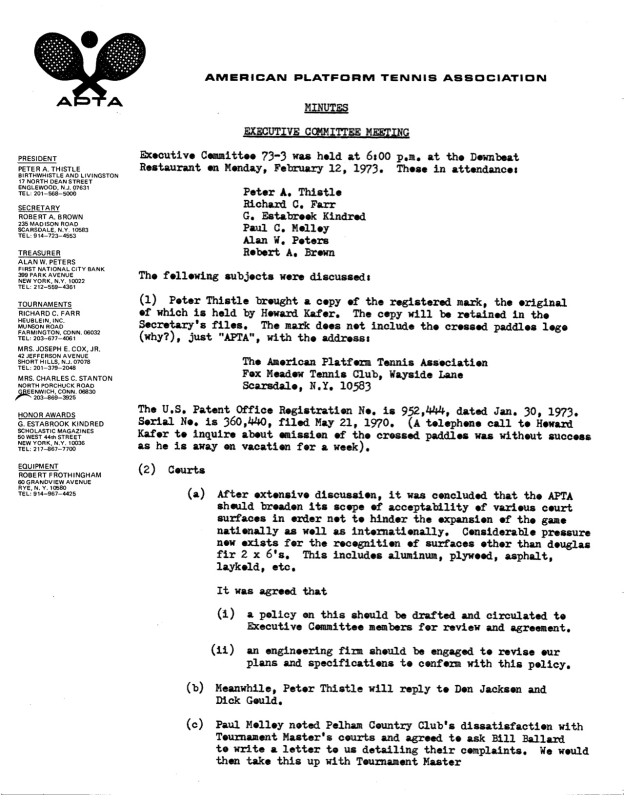
APTA reviews options for court surfaces and approves Reilly’s aluminum deck

In addition to Reilly’s aluminum deck other innovators had been suggesting alternative materials such as plywood, steel, asphalt and Laykold. Courts had to pass a two season test before the APTA would provide approval.

The plywood surface was developed by “Mr. Paddle”, the Hall of Fame Inductee Dick Squires’ company Squires Marketing Associates Company (SMAC). The Minutes note that the APTA expected SMAC to seek approval soon but there had been some issues reported; ultimately the plywood deck proved unworkable. The surface had been used at the VAT Gold Cup earlier in the year.

APTA EC Minutes Feb 12 1973

The Battle of the Sexes

The tennis match between Billie Jean King and Bobby Riggs at the Houston Astrodome on September 20, 1973, captivated America and was a triumph for women’s athletics. Platform tennis benefitted with an increase in participation by women.

King entered the Astrodome in Cleopatra style, carried aloft in a chair held by four bare-chested muscle men dressed in the style of ancient slaves. Riggs followed in a rickshaw drawn by a bevy of scantily-clad models. Riggs presented King with a giant lollipop and she gave him a piglet named Larimore Hustle.

Rather than playing her own usual aggressive game, King mostly hugged the baseline, easily handling Riggs’s lobs and soft shots, making Riggs cover the entire court as she ran him from side to side, and beating him at his own defensive game. After quickly falling behind from the baseline, where he had intended to play, King forced Riggs to change to a serve-and-volley game. Even from the net, the result was the same: King defeated him, 6–4, 6–3, 6–3.

Source: Selena Roberts, A ray of progress for women as Battle of the Sexes turns 35, Sports Illustrated, 9/20/2008. Bobby Riggs Vs Billie Jean King, Assortment.com


Sponsorship draws talent

Corporate sponsorship ended up attracting several professional tennis players to the sport, with Herb S. Fitz Gibbon II, Clark Graebner, and Hank Irvine being the most successful.

Fitz Gibbon ranked among the world’s top tennis players between 1961 and 1973, and became the first amateur to beat a professional in the 1968 Wimbledon.

Graebner, originally from Cleveland, was on the winning U.S. Davis Cup team and ranked seventh in the world in 1968.

Irvine was from Rhodesia (now Zimbabwe) and represented his country on the Davis Cup team in 1968 and 1969, and at Wimbledon from 1970 to 1972. In 1970, he teamed with Helen Gourlay from Australia and made it to the semifinals of the Mixed at Wimbledon.

Commercial sponsorship

During the early 1970’s, commercial sponsorship came knocking, raising difficult policy questions for the APTA.

The exposure gained by commercial sponsorship would bring the sport to a much wider audience, but critics argued that money would detract from the game’s social aspects.

Foreseeing the likelihood of company-sponsored “tours,” the APTA formally established its policy on commercial activities and decided to maintain control over all commercial tournament activities.

This decision allowed platform tennis to broaden its horizon. The alternative would have undoubtedly led to the establishment of a separate professional organization.