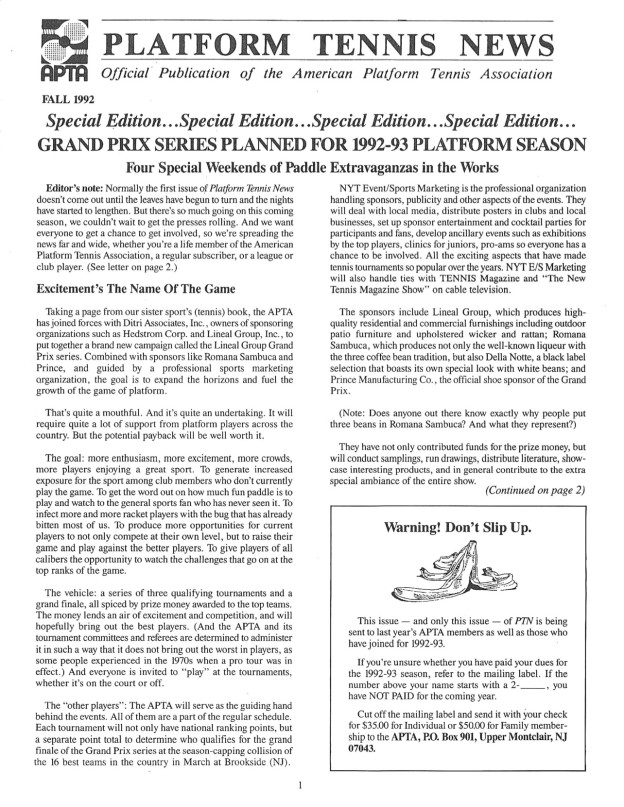
Platform Tennis News announces the Lineal Group Grand Prix Series

APTA joins forces with Ditri Associates, Inc., the owners of the manufacturer of the Vittert ball, to form the Lineal Group Grand Prix Series

APTA joined with the owners of Hedstrom Corp., the makers of the Vittert balls, and Lineal Group, Inc. to form the Lineal Group Grand Prix Series.

Platform Tennis News had the details:

“Combined with sponsors like Romana Sambuca and Prince, and guided by a professional sports marketing organization, the goal is to expand the horizons and fuel the growth of the game of platform. That’s quite a mouthful. And it’s quite an undertaking. It will require quite a lot of support from platform players across the country. But the potential payback will be well worth it. The goal: more enthusiasm, more excitement, more crowds, more players enjoying a great sport.

The vehicle: a series of three qualifying tournaments and a grand finale, all spiced by prize money awarded to the top teams. The money lends an air of excitement and competition, and will hopefully bring out the best players. (And the APTA and its tournament committees and referees are determined to administer it in such a way that it does not bring out the worst in players, as some people experienced in the 1970s when a pro tour was in effect.) And everyone is invited to ‘play’ at the tournaments, whether it’s on the court or off.”

Source: Platform Tennis News, Fall 1992
Brian L. P. Zevnik elected APTA President (1992-1994)

Zevnik took Vasoll’s accomplishments one step further and developed the successful collaboration with the Lineal Group for their Grand Prix competitions.

He broke the barrier of 3,000 in individual memberships, and turned Platform Tennis News and PTN Update into periodicals anxiously anticipated by all members.

APTA Honor Award Reinstated: Chuck Baird, Nancy Mangan and Lucie Bel McAvoy

Chuck Vasoll, APTA President, who had pushed to re-establish the award had this comment: “I believe the Committee, which was established last year, has done an excellent job in the selection process. I wish to extend my sincere thanks to former APTA president Bob Brown, who served as chairman, and Roger Cole, also a former APTA president, and Brook Kindred, chairman of the original Honor Awards Committee, who served with me on this year’s Committee. I hope that now that this tradition has been rekindled, it will not be allowed to burn out.”

Source: Platform Tennis News, Winter & Spring 1992

Charles F. Baird: Chuck Baird was introduced to the game when he was in his mid thirties, but only started playing seriouslyin his mid-forties when overseas job postings stopped and he could participate more frequently. He then proceeded to amass an enviable record. In the late 1960 through early 1970s he and his partner Roger Lankenau were ranked in the top eight teams and became a formidable force upon entering the senior events. In 1982 Baird won titles in three age groups, the 50+, 55+ and 60+, possibly a record that will never be broken. He also won the 65+ and 70+.

Nancy Mangan: Nancy Mangan’s service to the game was legendary and spanned decades of teaching, promoting junior play, serving as president of the New Jersey Women’s league, and assisting the APTA Women’s Tour director. She won a number of New Jersey State mixed tournaments and the Women’s 50+ in 1981. (Short Hills Club).

Lucie Bel McAvoy: Lucie Bel McAvoy, or “Mother Paddle” as she was affectionately known by her Region III friends, was a major factor in the growth of the game in Region III, starting in the late 1960s as a teacher, and introducing paddle to many clubs and organizations in the area. When she started the Eastern Pennsylvania region had just two platform tennis courts, but twenty-five years later Region III could host the Nationals using 31 courts at 13 locations. Lucie won many regional women’s and mixed tournaments, including four with her son, Tim, and won the Women’s 50+ four years in a row (1982-1985).

Joseph Quintillan recycling used balls

National Championship ecology program

Among the volunteers at the National Championships was Joseph Quintillan, outfitted with a special red cap donated by McDaniel Ford. He rounded up used balls for recycling. Quintillan was a finalist in the 1997 Boys 18 and under, and won the event in 1999.

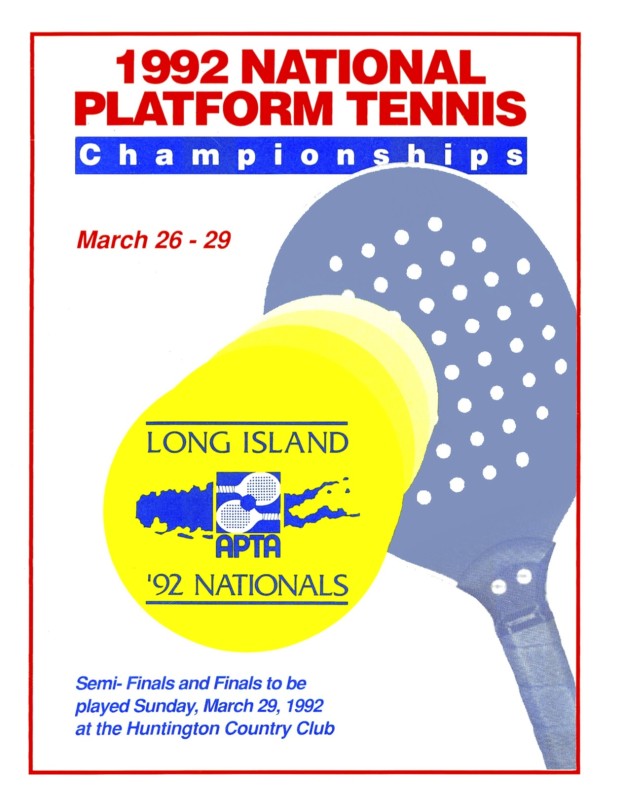
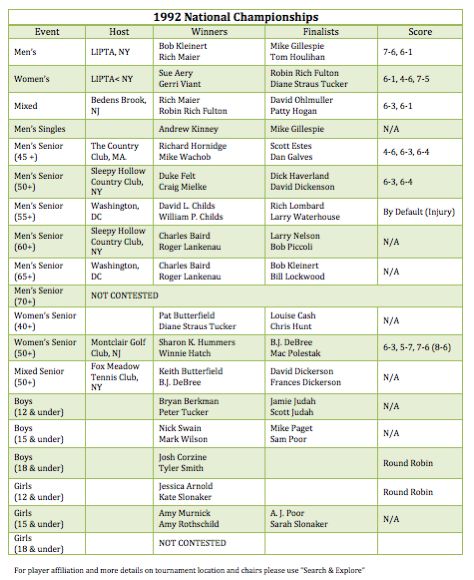
1992 National Platform Tennis Championships, Long Island, March 26-29, 1992

National Championships

1992

The Men’s and Women’s Nationals were covered in PTN Spring 1992:

Gerri Viant and Sue Aery returned to the top of the women’s paddle heap with a gutsy three-set win over Robin Fulton and Diane Tucker, the year’s #1 seeds going into the tourney.

On the men’s side, defending champ Rich Maier was forced to find a new partner just a week before the tourney when his long-time ally Steve Baird injured his leg. Along came Bob Kleinert, acknowledged as one of the top individuals in the game and a force over the last few years at the top of the men’s rankings with his brother, Jack. The veteran, but newly constituted, duo met up in the final with the surprise team of the entire tournament, Tom Houlihan from Region II and Mike Gillespie from Region I.

With his usual partner, Ron Erskine, unavailable, Gillespie joined Houlihan and proceeded to knock out seeds #6, #1, and #3, before losing a tightly contested final to Kleinert/Maier.

Source: Platform Tennis News, Spring 1992

Nationals raise money for charities

When the Long Island Platform Tennis Association (LIPTA) undertook responsibility to conduct the Men’s and Women’s National Championships in March, it decided to designate the Children’s House and the Interfaith Nutrition Network as co-beneficiaries of the net proceeds of the fund-raising efforts for the event.

These two recipients were chosen because of the involvement by two of LIPTA’s Directors with the organizations. Alfred Devendorf presented the case for the Children’s House, and Gloria Grafer represented the INN.

Initially, there was great skepticism among the Tournament Committee as to whether a worthwhile sum could be expected to be raised, because the previous championships, in Chicago and Philadelphia, had not made a profit.

Once the charities were named, the fundraising and volunteering of services moved ahead quickly. Sport clothing with the logo of the championship was sold to raise funds; local club teams placed advertisements in the program, and four major sponsors, Norstar Bank, Mobil Corporation, EAB and Hallen Construction were signed. The success of the event allowed a donation of $11,000 to be made to each named charity

Source: Platform Tennis News, Summer 1992

Hedstrom works on problems with ball quality

Hedstrom, the maker of the Vittert ball, stepped up communication to the paddle community about their program to address issues with ball quality and durability.
James Braeuing, VP Operations reported on progress:

A. Wobble/out of round – We have isolated the cause of this problem and currently have a program to update our press temperature and cooling water controls to increase the consistency. We feel these changes will eliminate the problem.

B. Bounce consistency – As you are aware, we recognized that our bounce adjustment at the beginning of last season was too severe and led to a squishy feeling as well. We adjusted the firmness and bounce in early September. Since that time, we feel we have isolated what we consider to be the most appropriate firmness and bounce. We are revising our producing equipment to target this specification and are also engineering and fabricating special equipment to insure a narrow band of compliance, eliminating the wider variations you may have encountered.

C. Flock adhesion – We have sent the samples many of you have returned which exhibited poor flock adhesion to our glue supplier. We also recognized that the flock adhesion problems were accelerated in a wet environment. Our glue supplier feels that it has identified the problem and has given us a solution to try.

D. Flock coverage consistency – We are evaluating a new flocking chamber, which we are told will allow a more consistent deposit of flock on all areas of the ball. Hopefully, that will solve the thick and thin condition.”

Source: Platform Tennis News, Spring 1992