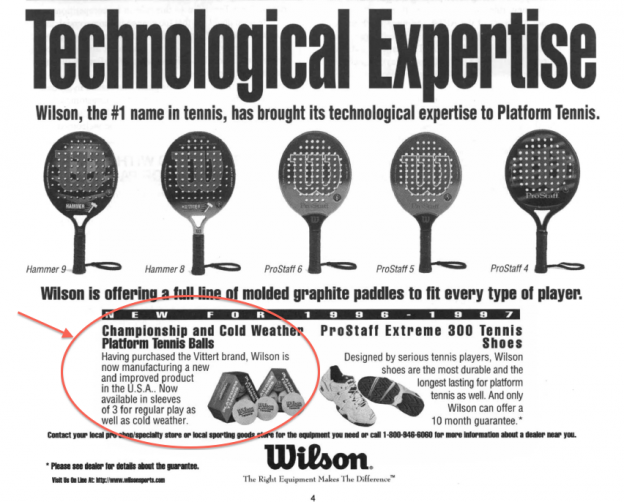
Hedstrom stops production of the game’s dominant ball, Vittert V30. Wilson Sporting Goods acquires brand and production equipment

This was a sudden decision and likely related to the changes taking place at the Dimitri Associates’ group of companies that included Hedstrom and the Lineal Group, the sponsors of the Lineal Grand Prix. This decision provided Wilson Sporting Goods with the opportunity to acquire the Vittert brand and production equipment and started promoting Championship and Cold Weather Wilson balls in early 1996.

Source: Platform Tennis News, Mid-Winter, 1996

Court locations in Europe, late 1995

Map of platform tennis locations in Europe as of late 1995 . Clubs may have had more than one court so this does not indicate the number of courts. The large number of courts in the Netherlands came about because R.J. Reilly worked there in the 1970s assisting a Dutch company to install about 50 courts.

[See also Paddle Hits Holland With Gloria Dillenbeck’s Help

Source: R.J. Reilly Co., Brewster, NY

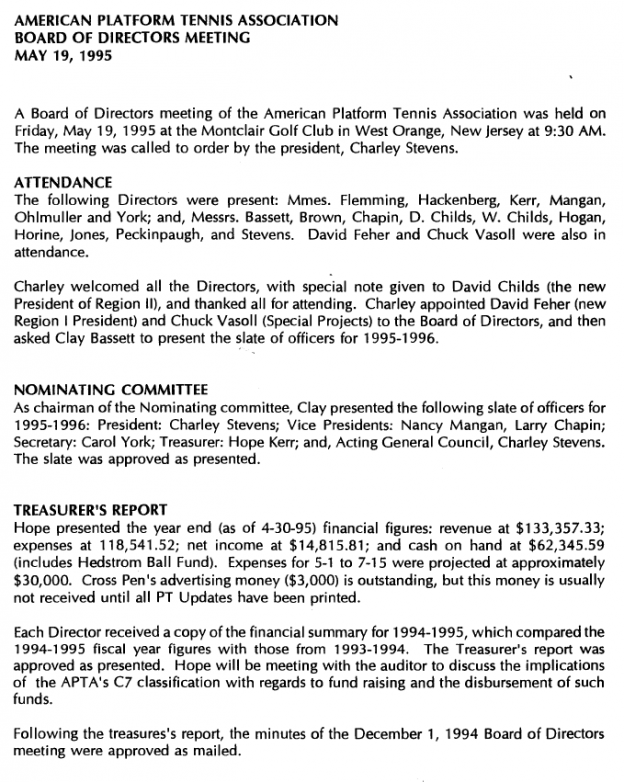
APTA Annual Business and Board Meetings

The Board had a busy agenda.

Paddle manufacturers A2Z (Kjeldsen’s company had acquired the assets of Marcraft), Wilson and The Paddle Co. were producing paddles for the upcoming season and these included a few prototypes which prompted some tweaking to paddle specifications as cited in the Minutes:

“a. approved a change to paddle length, so total length does not exceed 18″
b. eliminated the handle length/play length specification
c. retained 87 as the maximum number of holes
d. retained 3/8” as the hole diameter
e. approved a change to the rim, so the rim may be flush or wrap around within limits noted in revision documentation (attached)
f. retained surface finish as “slight texturing” subject to further research (Bob and Charley will attempt to further define “slight texturing” using the sandpaper grit scale as a standard reference by 6-1-95)
g. retained surface as flat, not yellow

The Board reaffirmed its position that non sanctioned or sanctioned equipment modified by its owner cannot be used in ranking and National tournaments.”

Balls by Vittert, Marox and ARD where also a topic of discussion.

The Board started to look at a marketing plan as securing adequate tournament sponsorship was becoming an issue.

APTA seed money for Nationals

The Board approved a proposal to loan “seed money” of up to a maximum of $5,000.00 to a National Championships Committee for expenses prior to the receipt of entry fees and sponsorship funds.

It was anticipated that the funds would be used for the purchase of products for fundraising activities and other deposits needed to secure facilities for the event.

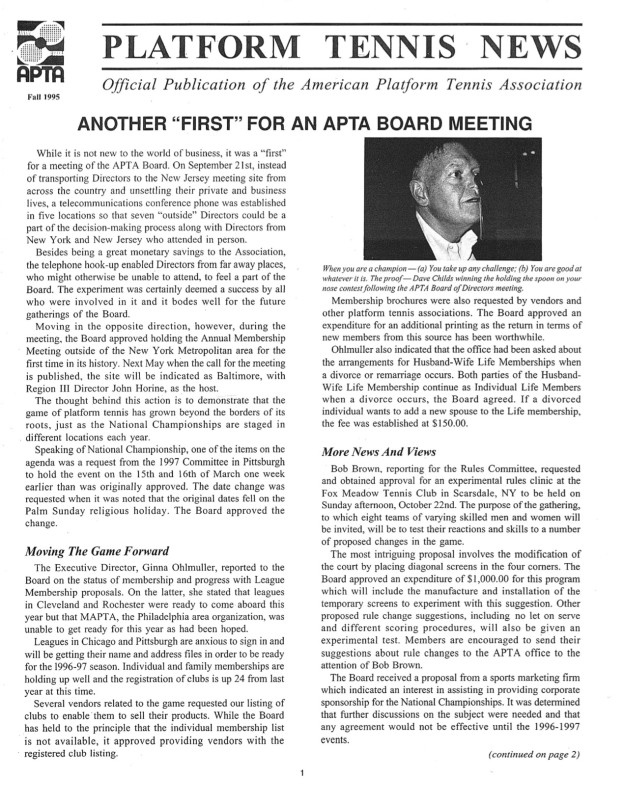
APTA Board meetings are not all work. David Childs shows his form

Changes planned for APTA Board meetings

The first step was implementing teleconferencing for Board meetings to make it easier for seven Directors outside of the New York Metropolitan area, historically the usual location of the meetings, to participate.

The second step was Board approval of holding the Annual Membership Meeting outside of the New York Metropolitan area for the first time in its history. The next meeting, in May 1996, would be in Baltimore, with Region III Director John Horine, as the host.

The thought behind this action was to demonstrate that the game of platform tennis has grown beyond the borders of its roots, similar to the way the National Championships were now staged in different locations each year.

Source: Platform Tennis News, Fall 1995

The APTA goes to market(ing)

In 1995, the APTA Board of Directors embarked on the most aggressive and comprehensive marketing program in its history.

The Board had started preliminary discussions with RHB Ventures to assist the APTA in the growth of the game throughout the country. RHB Ventures, a sports marketing firm based in Philadelphia and Washington D.C., had secured corporate sponsors for sports such as tennis, golf, cycling, sailing, basketball and football, and owned and managed The Champions Tour, the 35-and-over professional tennis tour featuring Jimmy Connors, John McEnroe, Bjorn Borg, and others.

Tapping the extensive marketing expertise of RHB Ventures, the APTA hoped to implement a multifaceted marketing program.

Among the major points of this program were:

a) sell corporate sponsorships on behalf of the APTA

b) complete a comprehensive demographic study of the current membership

c) attain a greater membership base from among the estimated 400,000 paddle players from around the United States

d) produce promotional materials to help “grow the game”

e) develop membership opportunities for non-tournament level players

f) create new events and stimulate interest among the “B” and “C” level players and juniors

g) provide greater benefits – via new corporate sponsorships – for new and existing members of the APTA.

Source: Platform Tennis News, Fall 1995

Wilson enters the Platform Tennis market

The announcement by Wilson Sporting Goods Company that it was entering the platform tennis market with a line of paddles and paddle accessories was made at a press conference at the U.S. Open tennis tournament.

In a separate news release, it was indicated that development of the new platform tennis paddles stemmed from the technology used in Wilson’s tennis racquets. All four paddles would be constructed of molded graphite. The new models were designated Hammer 9, Hammer 8, Pro Staff 6, and Pro Staff 5. The numbers assigned to each paddle corresponded to a specific “Power Series” rating that fit a certain style of play.

Source: Platform Tennis News, Summer & Fall 1995

Separately, Wilson had acquired the Vittert V30 ball business from Hedstrom so they now could supply both balls and paddles. This development became an issue for A2Z/Viking Athletics as Wilson no longer would supply them with balls as they were a competitor in the paddle business. This forced Viking to enter the ball manufacturing business – see also A2Z Acquires Marcraft’s Platform Tennis Business