Viking’s new ball gets raves – but production issues always present

Viking had started making balls soon after they acquired the Marcraft platform tennis business in 1995. C0-incidentally, Wilson had acquired the Vittert V30 ball business from Hedstrom about the same time and decided to stop selling balls to Viking, which had been a long-time reseller, as they were a competitor.

The New Viking ball was well received and was used in the 1997 Men’s and Women’s Nationals but later batches were even better! They were on a roll.

However the ball manufacturing business was a difficult one and bad batches of balls had a habit of showing up unexpectedly.

David Kjeldsen recalls Viking’s experience just when he thought he had finally found the “perfect” ball……..

“No matter who the manufacturer was, there always seemed to surface a bad batch of balls. In the Hedstrom days bad would mean excessive “chunking”. In the early Viking days it would mean flocking that peeled off much like you would peel an orange or flocking that wore so poorly that you could only get a few games.

In our fifth or sixth year of supplying balls we had a batch of balls that were indestructible. Players were regularly reporting getting three or more sets with the balls still being playable at the end. We were very excited. I was getting pretty cocky that we had finally made the “perfect” ball.

As is necessary for proper delivery, we placed our order for balls for the following season in early April. We spent May developing a marketing plan wherein we would “guarantee” two sets of play from every ball. It would be a revolutionary guarantee for our sport. For reasons I cannot explain, in early July I decided to scrap the marketing plan and just promote the fact that were the largest supplier of balls in the industry.

Our first shipment of balls for the season were delivered in early August. The tractor trailer arrived. We always got excited when our August shipment of balls were delivered as it meant the start of the new season was only days away. When the driver opened the trailer doors a green cloud of dust appeared. I knew instantly the this was not good. I opened a case of balls that had fallen to the ground, took a ball from one of the sleeves and bounced it on the ground. My heart stopped. There on the ground was a perfect ring of optic yellow flock. It was going to be a very long season…….. and it was.”

Source: David Kjeldsen, private communication, 6/7/2012

R. J. Reilly courts as of Summer 1997

Each dot on the map is the five digit zip code of a customer but some have more than one court. Court costs at the time could be as much as $40,000 and most were installations at private clubs and schools.

Source: R. J. Reilly Co. Brewster NY

Second Annual Viking Cup, Junior/Senior Tournament

During October, local tournaments were held in six states at thirteen different clubs. The winners from each tournament—35 teams—arrived at Fox Meadow Tennis Club for the finals in November. Robin Fulton had conceived of the event and was the tournament chair.

Viking Athletics was the primary sponsor, and David Kjeldsen, CEO, spent the day at Fox Meadow supporting all the activities.

Carly Swain filed this report in the Mid-Winter edition of Platform Tennis News:

“The field was very strong on the ‘senior’ side, with many nationally ranked players in the draw, but it was the ‘juniors’ who were the stars. Twelve teams competed in the 12 and under category. The final four were Tim McAvoy/David Hissey, up against Phil/Tyler Gaffney. The final score was in favor of repeat winners, McAvoy/Hissey, 6-1, 6-1. The 15-and-under draw was the largest, with 15 teams and the “cliff-hanger” finals decided in a third set tiebreaker when Bob Considine/Anthony Nunziata prevailed over Patrick Nowlan Sr./Patrick Nowlan Jr. This match was a perfect example of both juniors staying calm and playing their best under extreme pressure. At match point, Anthony hit a winning forehand drive to clinch the title. The Nowlans were last year’s winners. The 18-and-under titIe went to Bill Saunders/Geoffrey Williams who defeated Jon/Ben Holskin, 6-2, 6-3 in the final. Geoffrey and Bill were last year’s finalists in the 15-and-under. Nick Swain, past junior national champion, and now a ‘senior’ at age 21, traveled the farthest to participate. He flew in from Oberlin, Ohio, to play with junior, Ann Louise Bigliani.”

Source: Platform Tennis News, Summer & Mid-Winter 1997

The game expands in Colorado and in Germany

Mike Dougherty reported from Colorado and Eric Stern from Gaeufelden, Germany.

Letter to Chuck Vasoll from Mike Dougherty:

“Chuck,
Things are moving forward on the paddle front out here (Colorado). I’ve placed a couple of ads for platform tennis courts, adult leagues and have a junior program January 24th at the Boulder courts. Viking is donating eight junior paddles. We hope to run 96 Boy Scouts, Girl Scouts and other area youth……”

Letter from Eric Stern to Carolyn Tierney:

“Dear Carolyn:
My father, Harold Stern, has successfully installed the first two R.J. Reilly aluminum platform tennis courts in Gaeufelden, Germany. At the opening in 1996, we had some of the top U.S. players showing us how the game is being played on beginners’ and competitive levels.

George Zink did a terrific job in demonstrating this new sport. His enthusiasm infected a lot of players in our tennis club. For myself, I was always a fan of this sport ever since I played it during a visit in Sommers, N.Y. where my parents lived over a period of four years…….”

Source: Platform Tennis News, Mid-Winter 1997

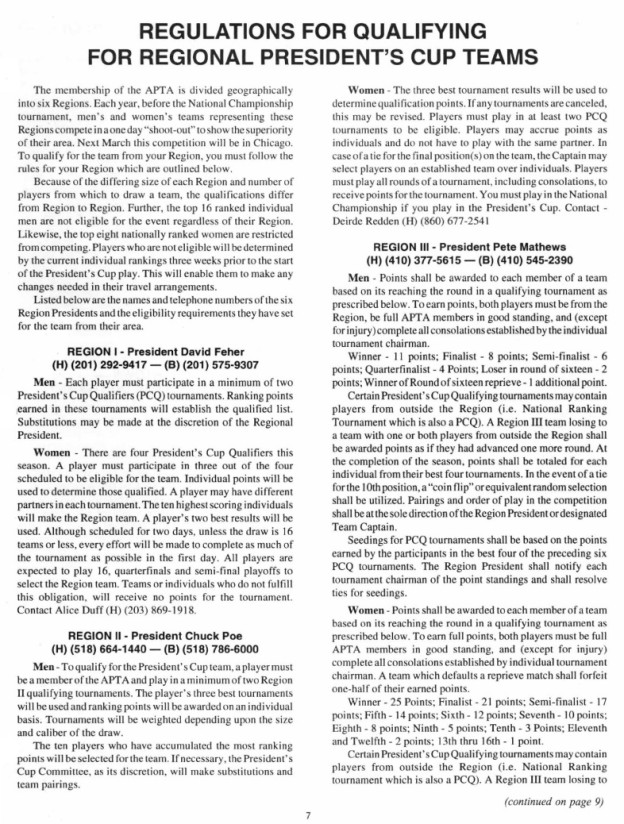
Regulations for qualifying for Regional Teams

Because of the differing size of each region and number of players from which to draw a team, the qualifications differed from region to region, but the top 16 ranked individual men, and the top eight nationally ranked women, were not eligible regardless of their region.

The Fall edition of Platform Tennis News carried descriptions of each region’s criteria for qualification

New instructional video supports Junior Paddle

Green Mountain Platform Tennis, a leading court manufacturer and maintenance company, released a new instructional video for paddle players, the proceeds of which would be donated to the APTA to support junior paddle throughout the country.

“Bring Your Game to the Next Level” featured platform tennis pros Robin Fulton, Connie Jones, and George Zink.

In the 45-minute video, these leading players offered up the skills, strategies and drills to help platform enthusiasts at all levels play better.

Source: Platform Tennis News, Fall 1997

Pros flock to Chicago for first Wilson Teaching Clinic

“Give us more” was the general opinion of the first platform tennis clinic conducted for teaching professionals by Wilson Sporting Goods in Chicago to kick off the 1997-98 season.

“It fits in with a lot of trends that we’re seeing in the game,” said John Embree, General Manager of Racquet Sports for Wilson, because “…..Chicago is a hotbed of the sport, as evidenced by this clinic, the annual Charities event, and this season’s National Championships being played here.”

What the 30 pros from seven states got was absolutely spotless weekend weather, expert advice on everything from drills to strategy to running programs, and the opportunity to hear two former National Champions and current teaching pros, Rich Maier and Hank Irvine, dispense a wealth of knowledge about what makes a teaching pro good.

Source: Platform Tennis News, Fall 1997

No-Let rule trial period to continue

At the Annual Meeting in May, the Board of Directors of the APTA voted to continue the rule established at the 1996 meeting, which eliminated the let on a net cord service.

The motion agreed upon left the door open for a further review in May 1998; however, the Directors were much stronger in support of the rule change than they were when they first instituted it.

Part of the reason for their change in approach was due to the fact that tennis was also moving ahead with abolishing the let. The USTA Senior Father and Son circuit would be experimenting with the “no let” service on a trial basis in its 1997 national championships, and the men’s and women’s senior divisions of the U.S. Open instituted the change in 1996. The APTA Board was not as “far out” in making this change as some players thought.

Source: Platform Tennis News, Summer 1997