The Spirit of Platform Tennis – video by Eric Taylor featuring David Ohlmuller, John Schmitt, Chris Gambino and Mike Cochrane

The video was shot at Sleepy Hollow Country Club, Briarcliff, NY and produced by Fox Meadow member and indie film producer Eric Taylor. It shows the fun of paddle competition and the spirit of the players.

The foursome involved were: David Ohlmuller, Chris Gambino, Mike Cochrane and John Schmitt.

Source: Eric Taylor

Is there an advantage to service?

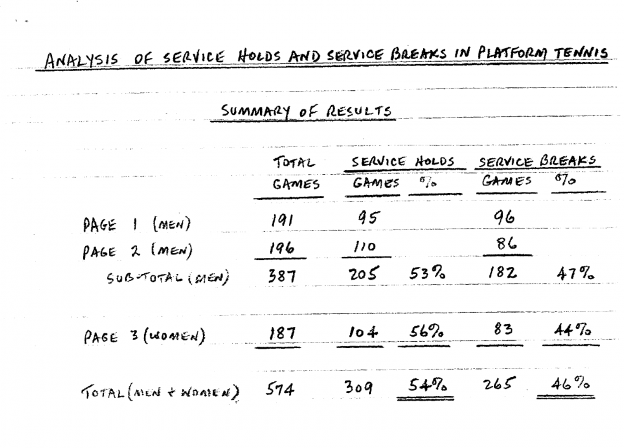
During his tenure as the chair of the APTA Rules and Equipment Committee Robert A Brown had conducted a number of surveys of service holds and breaks, in part because of the no-let decision in the late 1990s. In 2003 he updated his earlier work with and analysis on the 20003 Senior Men’s 50+, 60+ and 70+ championships and filed the following report with PTM.

In discussions with players about the “pros” and “cons” of the no-Jet on net cord serve rule, the conversation usually progresses to a question as to whether the server In platform tennis has an advantage in serving. The “con” proponent will generally comment that this is the case and that the no-let rule further favors the server. While there Is a modicum of truth to the latter comment, It is not a significant factor, since most of the net-cord serves are returnable and the Incidence of the “dribbler” occurs on less than one-half of one percent of the serves delivered.

Regarding the question as to whether the no-let rule does, or should, help the server, maybe a case can be made that such help Is needed. Research has shown that service holds and service breaks In platform tennis are roughly 50/50, with some variation for men and women. The usual reaction to this fact: “That’s hard to believe!” That is a natural reaction from players· whose exposure to tennis over the years reflects the known dominance of the server In tennis – the result of having two serves, improved equipment and no wires. In platform tennis, with one serve and friendly wires, it’s a different story.

In a (limited) update of prior research, the chair umpire’s score cards for the championship matches in the 2003 Senior Men’s 50+; 60+ and 70+ tournaments were analyzed and yielded the following results:

In the 50+ final, Jean Kempner / Jim McNitt vs Steve Nycum / John Stefanik, a total of 30 games were played In three sets. There were 13 service holds and 17 service breaks.

In the 60+ final, Alan Graham / Stu Opdycke vs. Roy Anderson / Joe Holmes,a total of 17 games were played in two sets. There were 8 service holds and 9 service breaks.

In the 70+ final, Bob Brown / Dave Childs vs. Herb Bascome / Blair LeRoy, a total of 34 games were played in three sets. There were 17 holds and 17 breaks of service.

Grand total for the three matches: 81 total games (a pretty good sample), 38 service holds, 43 service breaks. (47% holds, 53% breaks)

These results seem to be typical of results in prior research for the men. Prior studies on the women indicated a higher percentage of service holds (56%) and a lower percentage of breaks (44%) which may be a reflection of a generally less offensive serve returns (?).

What about the average players, or players of lesser ability? While their performance has not been studied, It Is likely that we would find similar results or possibly an even lower percentage of service holds, since serves are weaker, providing as added advantage to the returner, and faults are more frequent.

So, aside from the matter of consistency between the net-cord on service and the net-cord during a rally, considering the generally poor service-hold performance, what’s wrong with giving the server a little help?

An interview with David Ohlmuller

PTM: Dave, you’ve been with Viking for two years now and know the operations well. Can you tell me how long a paddle should last?

DO: That question comes up all the time. The rule of thumb is a new paddle every year if you’re playing two or more times a week, and a paddle every other year if you’re playing competitive paddle once a week.

PTM: No offense, but are you saying that to encourage players to purchase more paddles?

DO: The fact is the high-tech cores that are in paddles today breakdown over time and with extended play. It doesn’t matter whose paddle you are talking about. Don’t forget today’s paddles offer greater control, more power, and far, far more shock absorption than the wooden paddles of the past. Unfortunately, in platform the luxury of restringing doesn’t exist. And, in paddle the average points last far longer than those in tennis. That translates to many, many more hits a paddle must survive. The beauty of today’s technologies is that tennis elbow has been virtually eliminated from the game.

PTM: Okay, let’s move to balls. Why do balls change color when we play?

DO: The best explanation to date is that the flock on the balls picks up the chlorophyll deposited on the courts when the leaves on the trees change color. Have you noticed that the balls rarely turn darker in December, January and through the end of the season? It’s only in September and October when the leaves are falling that the balls really discolor. Some clubs even power-wash their courts to reduce the discoloration.

PTM: How long should a ball last?

DO: Optimally, the average player should get two sets from a ball. In tournament play and league play balls will typically be changed after every set.

PTM: What do you say to those who complain that balls should last longer?

DO: Over the years everyone who has entered the ball business, and there have been many, has tried to make a longer lasting ball. But think about what the ball must withstand. You have very gritty aluminum court surfaces, gritty paddle surfaces, and super-tight screens that act like knife-edges. Add weather conditions that go from zero degrees to seventy degrees, with rain and snow thrown in for good measure. Furthermore, the points today are lasting far longer than in the past. In tournament play, it is common to have points that last 30, 40, even 50 hits. Some might think that it is a miracle the ball lasts as long as they do.

PTM: And what do you say to those people who think that you just want to sell more balls?

DO: Of course I do, but selling a lousy ball does nobody any good. Regrettably, Viking produced a horrible batch of balls three seasons ago, just when I started with the company. Trust me, the few extra cases sold weren’t worth the tarnished reputation. The fact is that 10 years ago an average of 250,000 platform balls were sold a year. Today, the number is closer to 175,000 and the level of play hasn’t diminished. As a matter of fact, statistics show play has increased. That means the average ball is lasting longer.

PTM: That brings me to my next question. Do you know how ball sales in platform compare to tennis?

DO: In tennis, over one million balls are sold every single day of the year! Every four hours, more tennis balls are purchased than platform uses a year. Pretty remarkable.

PTM: One of the big questions about ball play is the high bounce in warm weather. Can anything be done to make the balls bounce lower?

DO: From a personal point of view, I would love to see a lower bouncing ball for tournament play. I think it would shorten the points and thus speed up play. But the fact is, for 90% of the players, the current ball is much better for them. Remember the V30 of old? You’d go out to play on a cold winter day and you would have better luck getting a rock to bounce than that ball. The ball shouldn’t be a hindrance to learning the game or playing it. Teaching others to play the screens is much more difficult with a lower bouncing ball The average player wants to hit the ball more than a couple of times in a point. They aren’t afforded that opportunity with rocklike balls.

PTM: Why not make two balls: a regular ball and a lower bouncing tournament ball? You’re making two different colored balls already.

DO: To be honest, the sales volume doesn’t support that many choices of balls. In addition, let’s face it, it’s the top player or tournament players at most clubs who decide what ball gets purchased for the club and used at club functions. If a lower bouncing ball is available, that’s what is going to be chosen by the top guys. The needs of the average player are going to get neglected. The only way to grow the sport is to cater to the average players, not the tournament players.

PTM: Speaking of growing the game, what’s Viking doing to help?

DO: We’re heavily involved in junior programs across the country. We sponsor the Viking Cup Child Adult tournament, the Viking Junior Tour, and are major contributors to the APTA Junior Nationals. Supporting juniors is a long-term investment. As for efforts that will result in more immediate growth, Viking was a founding sponsor and currently the sole sponsor of the PPTA. The teaching professionals are the key to growing the sport. Without their support, commitment, and enthusiasm, the sport languishes.

PTM: Viking went to the US Open this past August. How was it?

DO: We set up a booth at the Tennis industry Association Tennis Show that was held in conjunction with the Open at Flushing Meadows. And while I can’t say we had any direct converts to the game, we certainly had hundreds of visitors view the video that we had playing. We had lots of sales reps from other racquet sports companies stop by just to learn about the game. They had all heard the name “platform tennis,” but most had no idea what it actually was. I am hoping they were stopping by to learn about the sport rather than just stopping by to ask David Kjeldsen (CEO of Viking Athletics) about his ever-present Viking horn hat.

PTM: On to personal stuff, rumor has it that you played number one singles at Loyola College for four years. Is it true?

DO: Yes.

PTM: While in college were you playing platform also?

DO: I played a few tournaments here and there, but never had great success. I had a lot of fun and was fortunate enough to play President’s Cup on several occasions.

PTM: Speaking of successes, how does it feel to be platform’s current Men’s
Open Champion as well as the Husband/Wife National Champion?

DO: The Men’s Open was great; however, winning the Husband/Wife was the toughest challenge of my life. But that is officially off the record, right?
The 34-year-old Sales Manager for Viking Athletic and the 2003 APTA Men’s Open and Husband/Wife Champion discusses new paddles, the ball market, and recent media exposure for platform tennis.

David Ohlmuller was inducted into the Hall of Fame in 2013.

His playing career was impacted by a serious “hit and run” injury in 1996 while he was walking in Manhattan. His mother Ginna, who was the Executive Secretary of the APTA at the time, had to resign her position to help David with the extensive recovery process.


PPTA adds 24 Pros in Chicago and Philadelphia

The PPTA had a very busy fall certifying teaching professionals from all around the “paddle” world. Hank Irvine and Bob Callaway had the opportunity to go to Rich Maier’s world on the north side of Chicago and join him in a two-day certification marathon. Fifteen pros were tested thanks to Scott Bondurant, who recruited many prominent pros from the north shore area. Among the pros who went through the certification process were former national champion Scott Mansager and the current women’s national champions, Mary Doten and Susie Keane.

While Hank and Bob were in Chicago, Gerri Viant, Patty Hogan and Paul Quinn went to Philadelphia and conducted certification exams for nine pros from the Middle States area.

Source: Platform Tennis Magazine, Vol. 5, Issue 3, January 2004

Chicago Charities marks its 31st year

John Noble filed the report on the event with PTM:

The 31st year of the Chicago Charities seemed to be an event enjoyed by all. With a slightly smaller draw, due to the Halloween holiday, the pressure on the volunteer staff to run the four tournaments within the event was not as much of a drain as it has been in previous years. The Northwestern Cancer Research program was the beneficiary.

The Women’s Open was witness to a pleasant number of upsets. Only one of the top four seeds made it to the semifinals. In the finals, Cindy Prendergast and Lauren Zink won a hard-fought three-setter against Hilary Debbs and Patty Hogan, the second seed (6-1, 2-6, 6-2). The Men’s Open was marred by rain in the last set and a half. Last year’s Champions David Ohlmuller and Chris Gambino had to work a little harder on their way to this year’s final, as they were taken to three sets in the quarters by Bill Fiedler and David Keevins, and by Mike Cochrane and Mike Marino in the semis. They were met by the always-tough Flip Goodspeed and Scott Mansager duo, which bested Greg Stipa and George Zink in the quarterfinals, and Anthony Cosimano and John Milbank in three sets in the semi-final. Gambino-Ohlmuller won the final 6-2, 6-4 in an entertaining climax to the Charities tournaments. The play was both educational and enjoyable to watch.

The 90’s+ and 115’s+ were both well-participated events run by the always present Howard Sipe (who also umpired the men’s final in the rain). The Men’s 90’s was won by Ray Murphy and Mike Sullivan over a worn out Jean Kempner and Peter McNitt team who had to beat Alan Graham and John Noble in three sets in the semi’s.

Source: Platform Tennis Magazine, Vol 5, Issue 3, January, 2004

2003 Viking Cup Child/Adult Tournament to be the last; the goal had been to get more kids playing and it had succeded

David Kjeldsen, CEO, of Viking Athletics, announced that the recently completed 2003 Viking Cup will be the last for the Child/Adult Tournament. Asked why such a well respected tournament is being stopped, Kjeldsen responded:

“The Viking Cup was started eight years ago in an attempt to get more young people on the courts. At the time, there were few outlets for kids to play platform tennis. We felt that if we could get the adults involved, we could get the kids on the courts. We’ve more than accomplished that goal. More kids are playing than ever before. We’d like to put our emphasis now on kids playing with kids. The Viking Junior Tour is gaining momentum and we’d like to increase our support in that area. In addition, we are exploring with a number of platform tennis communities around the country starting a Viking Junior Platform Tennis League, with much the same format as the adult leagues have. For our wonderful sport to survive, we all must support the juniors. Juniors are the future of the game and Viking is as committed as ever to support them.”

Source: Platform Tennis Magazine, Vol. 5, Issue 3, January 2004

Walt Peckinpaugh on the history of the game in Cleveland, OH

Hall of Fame member Walt Peckinpaugh, Jr. filed the story with PTM:

Platform tennis made its debut in Cleveland shortly after World War II when the Chagrin Valley Hunt Club built the first courts. Even the arrival of Witherbee Black, the 1940 National Champion from Rye, New York, could not stir the interest in “paddle.” The facility faltered from neglect until 1968 when two new courts were built and the “modern era’ of platform tennis began. Members of the Hunt Club then arranged a paddle exhibition and clinic featuring four top ranked players from the East: Roger Lankenau, Don Miller, Oliver Kimberly, and Dick Squires. Members of all east side clubs attended the, exhibition and from cooperative relationships, paddle began to gain momentum in Cleveland.

A most important contribution to the growth of Cleveland paddle was the decision by John Bernet, Carrington Clark, David Dickenson, and Will McFarlane to create a major platform tennis event in Cleveland. Along with Dick Taylor, Bob Bartholomew, and Jack Turben, these men served as the directors of Cleveland Tournaments, Inc., the non-profit organization created to support major paddle events in Northeast Ohio. Oliver “Kim” Kimberly and Jesse Sammis, each National Champions with other partners, defeated Cleveland’s first Nationally-ranked (6th) team of David Dickenson and Carrington Clark in 1970 at the Cleveland Invitational. The Men’s event continued to be held annually and 1972 saw the birth of the Women’s Invitational with Peggy Stanton and Charlotte Lee establishing themselves as perennial National Champions.

The spring of 1973 brought the Men’s National Championship to Cleveland and away from the metropolitan New York area for the first time in 40 years of paddle. John Mangan and Bob Kingsbury were the champions and Cleveland Tournaments, Inc., had accomplished its goal – the very best platform tennis was being played in Cleveland.

Wooden courts were replaced by aluminum and the Cleveland Invitational evolved into the prestigious ‘Masters’ tournament. National Champions Jennings/Steele, Fitzgibbon/Irvine, and Baird/Baird dominated the early Masters Championships, and in the eighties, Steve Baird and Rich Maier won the Masters, continuing the tradition of bringing the best players in the world to Cleveland. The Women’s Masters was also making a name for itself through the wins of National Championship teams like Hilary Hilton/Louise Gengler and Wendy Chase/Linda Wolf.

In 1975, a Senior Masters, including teams from other cities, was inaugurated and conquered by Jim Kline and Bill Gunton. The next year saw the arrival of the first professional event, which was sponsored by Tribuno Beverage. Passport Scotch sponsored another professional tournament in 1976, but professional paddle quickly ceased its association with the Masters. The Masters continues to attract the very best paddle teams to Cleveland for its annual National Ranking event.

Paddle tennis in Cleveland was certainly growing, but still lacked a city championship until Bill Nook and Walter Dimling founded the Cleveland Cup in 1977. The Men’s Championship was unique in the respect that five different teams won in the first five years of play. In the eighties, the Cleveland Cup was dominated by the team of Dick Haverland and Dud Humphrey, the number one-ranked team in the Midwest region and 8th nationally in 1983. The joint effort of the Cleveland Skating Club and Higbee’s Department Stores produced the Higbee Cup Women’s Championship that same year, with the support of Bonne Bell, Inc.

In 1984, Cleveland Tournaments, Inc., under the direction of Dick Haverland, brought the APTA Open Nationals back to Cleveland for its second appearance here. Dick and his committee changed the look of the National Championships forever with the hosting of a week-long party involving several social events for both men and women and a serious party on Saturday night. Just three years later, in 1987, Cleveland again hosted the Nationals under the direction of Walt & Marilyn Peckinpaugh as part of the Cleveland Skating Club’s 50th Anniversary. Walt brought the Nationals to Cleveland again in 1993 after an eastern committee decided they weren’t up for the task. He also brought three senior men’s National events here in 1990, 1996, and 2000.

In 1988, Walt reorganized and renamed Cleveland Tournaments, Inc. into what is now The Greater Cleveland Platform Tennis Association and served as its President for 12 years. The purpose of this organizational move was to bring together the tournament committees and interclub organizers into one functioning entity. Today, Brian McCreary and his wife, Beth, keep this group together.

The history of Cleveland Paddle could not be complete without acknowledging the contributions of the nationally ranked teams of John Brownlow and Scott Rogers, Anne Kline and Ruth Sadler, and Dick Haverland and Dud Humphrey. Chet Kermode heads the list of men including David Dickenson, Dick Haverland, and John Brownlow, who have won National titles in the 45, 50, 55, 60, and 65 age divisions, winning seven titles and being inducted into the Platform Tennis Hall of Fame in 1998

All of the wooden courts are now gone, but Cleveland still has thirty-eight heated aluminum courts in the eastern suburbs. The new millennium brings a new era to Cleveland paddle. We are anxious to see what new stars and organizational leaders will emerge.

Copyright IP 1998-2003 Peckinpaugh & Associates, Inc.

Source: Platform Tennis Magazine, Vol. 5, Issue 2, November, 2003

President’s Cup: Men’s Region III win 9th title and Women’s Region I win 4th straight

With defending Region IV champs missing several veteran players, the Region III dark-horse men’s team delivered a stunning victory in front of their hometown fans. After four rounds of competition, Region III had won 18 out of a possible 20 points, mathematically winning the Cup prior to the final round against a strong Region I (NY/NJ) squad.

Lead by the undefeated play of John Stefanik and Tim McAvoy at #1, Region III started strong and never let up, bringing the Cup back home for the first time since 2000, when Captain Pete Mathews led the team in Rochester.

As with every PC victory, this year was a total team effort. The up and coming rookie team of David Caldwell and Blake Cordish went 4-1 at #4. Also, Chris Gorman, another first-time PC player, joined forces with Fred Gumbinner in the #5 slot and also went 4-1. They too, went undefeated in their first four matches. The veteran teams of Scott Freund and John Horine at #2 and Larry Hyde and Bruce Redpath at #3, also delivered winning performances for the home team.

Region 1 dominated the Women’s Presidents Cup this year (New England, Long Island, and Connecticut) during the worst conditions ever to be seen on paddle courts! Rain, sleet, heavy hail, snow, and frigid temperatures never seemed to dampen any of the spirits of these girls. Never was there heard a complaint about the conditions.

President’s Cup is famous for always having lousy weather so I guess everyone thinks it comes with the territory. Region I defeated Regions 4, 5, and 6, by 5-0 shutouts. They won over Region 2 by a score of 4-1. Region 3 was spared since it was the last match of the day and nothing could not have changed the final outcome.

The evening was held at Overbrook Country Club with a fabulous sit down dinner and a special award given to Yvonne Hackenberg for the longest running participation in PC (since 1979).

Source: Platform Tennis Magazine, Vol. 4, Issue 5, May, 2003

Business Week features Platform Tennis

In the October 13, 2003 issue of Business Week, platform tennis got another plug. Staff writer Marilyn Harris wrote about the wintertime enjoyment that we look forward to in her article entitled, “Paddle, Anyone?”

The night air was beyond bitter, the wind cut like a buzz saw. Light flooded a metal platform enclosed by chicken wire, on which four figures, bundled in fleece, chased a yellow ball and smashed it across the net. A car screeched up, and out jumped a man. “She has been crying since you left!” he shouted. His wife dropped her graphite paddle with a clang, raced into the car, and as soon as she could peel away the layers, was nursing her infant daughter. A short while later, play resumed.

What would make a mom run out on her newborn? “Neither rain, nor snow, nor crying babies keep me away from platform tennis,” says the athletic mother of three. Male or female, old or young, if you’re hooked, you’re hooked. “It’s like a cult sport,” says Patty Hogan, the over-40 national women’s champion and a teaching pro based in Summit, N.J. “Anybody who plays it, loves it.”

The season for platform tennis — called paddle, for short — is coming up fast. By tradition, the game is played in fall and winter, and for aficionados who like to defy the weather, the colder the better. The court measures 44 by 20 feet and resembles a miniature tennis court, made of aluminum and coated with a sandpaper-like finish, for better traction.

Paddle is so easy to learn that the tournaments run by the American Platform Tennis Assn. (www.platformtennis.org) feature players as young as 8. Equipment is minimal. A paddle, about 18 inches long and made of a composite material with aerodynamic holes drilled in the head, costs roughly $100. Three balls — solid rubber and spongy — cost about $10. The only other special gear you may need is a fleece mitt that fits over your hand and paddle handle for when the weather is frigid. As for rules, they’re essentially the same as in tennis, except paddle allows only one serve, and serves that touch the net are played. You can also hit the ball off the wire walls, similar to what you do in squash.

The major challenge for newcomers is finding a place to play. Most of the 4,000 or so courts in the U.S. are at private country clubs and resorts, including Snow King Resort in Jackson Hole, Wyo., and Shelter Harbor Inn in Westerly, R.I. Some public courts are available, mostly in metro New York and Chicago, and parts of California, Colorado, and Wisconsin. And new adult communities are increasingly building courts to attract buyers.

Paddle is largely a doubles game, marked by rapid volleying at the net. “There’s no better way to get some exercise on a cold winter’s day,” says New York banker Roger Bredder. “Fast-paced action, great competition, no long drive to a ski resort. Plus you can keep your tennis in shape without having to play in a bubble.” Hey, who couldn’t love a sport that makes it fun to be outdoors in nasty weather?

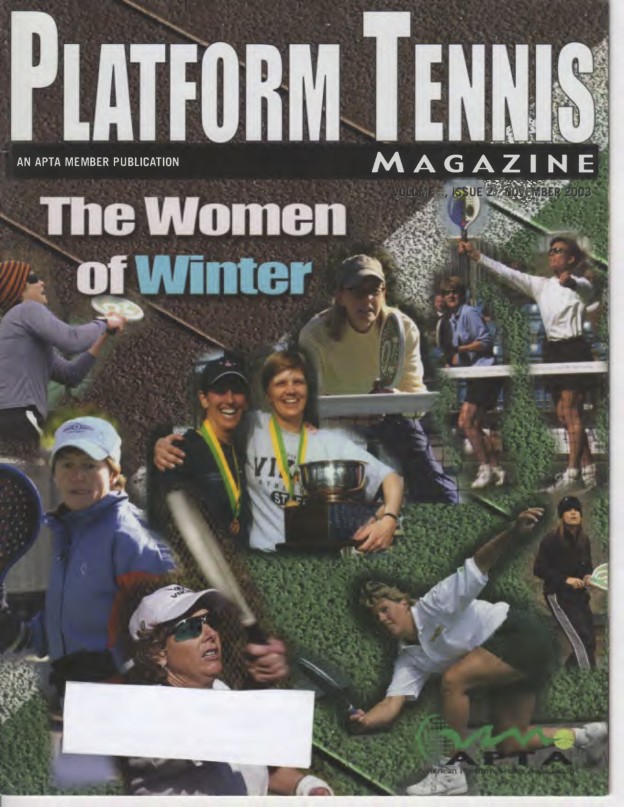
PTM celebrates The Women of Winter

PTM Editor Wayne Dollard had these observations:

This issue is a tribute to women and their changing role in platform tennis. When I first jumped on the tournament scene in 1997, I was amazed at the talent level among the top women players. As a newcomer to tournaments, it helped me to improve by watching their form, technique, preparation, and intensity. Gerri Viant showed me the ready position I use today. Patty Hogan drilled a steady and more compact volley out of me. And Sue Aery taught me that consistent groundstrokes are more valuable than powerful ones.

Looking back through the pages of paddle history, women such as Charlotte Lee, Hilary Hilton, and Robin Fulton have also added so much to the sport. Powerful one- handed backhands, backflips off the screens, blitzing the net, and more. These women showed the paddle community that they could do it all. The women of yesterday can still compete (and win) against today’s younger generation. As a matter of fact, eight of the top 18 women ranked in the 2003 APTA Women’s Open Division were also ranked in the APTA Women’s 40+ Division.

Today, younger players such as Lauren Zink, Sally Cottingham, and Chris Sheldon offer tremendous power and consistent groundstrokes while veterans Patty Hogan,
Bobo Delaney, and Tonia Mangan counter with near-perfect volleys. Then there are players such as Gerri Viant and Mary Doten who offer all-around consistency and make for outstanding deuce-court players. And let’s not forget the APTA Women’s Ranking Champions, Kerri Delmonico and Shelley Morse, who demonstrated best all-around play over the 2002-2003 season. Kerri is matched only by Hilary Debbs as being the most colorful player on tour. Last but now least, when looking for talent, look to the future with Susie Mascarin-Keane – formerly a top world-ranked tennis player and 2003 APTA Women’s Open National Champion (with Mary Doten).
Legends retire and new ones are made. That’s how it’s always been and how it will always be. In the past, platform tennis has had its share of colorful and talented women, however, the future is safe and secure with The Women of Today.

Source: Platform Tennis Magazine, Vol. 5, Issue 2, November, 2003