Platform Tennis Museum and Hall of Fame Foundation (PTMHOFF) application for 501 (c) (3) status finally approved; fundraising can begin

The APTA had financed and supported the creation of the PTMHOFF1 as an independent 501 (C) (3) entity. With the IRS finally granting exempt status effective February 19, 2004 the Foundation could now embark on a fundraising effort to “realize the dream”

Because the Foundation was a newly created corporation the approval was an “advance ruling” and was only effective through December 31, 20082.

NOTE 1: APTA President John Horine was the driving force to accomplish this and had worked closely with Andrew Giannella of ulmer berne llp of Cincinnati, OH to incorporate the Foundation and file the application for non-profit status. [See Also]
NOTE 2: This was subsequently extended

APTA Board Meeting recap

The Annual Meeting of the APTA was held in the evening of April 30, 2004. On the afternoon of April 30, the APTA Board of Directors and invited guests met to discuss marketing plans and strategies to promote paddle. On May 1, 2004 the APTA Board of Directors met for the annual business meeting.

At the annual meeting, new APTA directors Bob Callaway, Sally Cottingham, David Lowe, Marina Ohlmuller and Todd Ward were elected and returning director Martin Sturgess was reelected. Retiring directors Mark Holtschneider, John Horine, Tim Mangan and Jo Rogers were also recognized.

This was a very emotional meeting. In addition to the regular APTA business that was conducted, the meeting marked the end of John Horine’s 7-year tenure as President. John closed the meeting with a heartfelt review of his activities and accomplishments and thanked those who helped make them happen including Charlie Stevens, Carolyn Tierney, Mark Holtschneider, Bill Cunningham, David Kjeldsen, Wayne Dollard, Taylor Bowen, Pete Matthews, Gary Horvath, Mark Fischl, Marjorie Hodson, Bob Brown, Charles Vasoll, Hope Kerr, and his wife Paige. New APTA President Mark Fischl presented John with a plaque in recognition of his years of service to paddle and the APTA.

[enlarge images to read full recap]

Fox Meadow Tennis Club approached as a location for the Platform Tennis Museum and Hall of Fame

In July 2004 a proposal was made to Fox Meadow Tennis Club to establish the Museum and Hall of Fame in a new building on the Fox Meadow premises. While a number of discussions were had at the Fox Meadow Board level no consensus could be developed. Alternative proposals were made to Fox Meadow in 2007 and 2010.

[Note: the first proposal to establish a “home” for APTA artifacts was made to Fox Meadow in 1972]

Source: Robert A. Brown personal communication, 2013

Player Profile: Mats Wilander

Mats Wilander is a tennis legend—and for nearly 20 years he has enjoyed playing platform tennis in his spare time. Mats won 33 career singles titles including 7 Grand Slams (Australian Open in ’83, ’84 and ’88, French Open in ’82, ’85 and ’88, and US Open in ’88). He was also a member of three champion Swedish Davis Cup teams.

Occupation? I’m still involved in tennis. I travel about 51h months a year playing the senior tour and exhibitions. I’m also the Captain of the Swedish Davis Cup Team.

When and where did you first start playing platform tennis? I started playing around 1986 in New York City. My wife lived in the city, and I played on a court in her neighborhood around 3rd Avenue and 23rd Street.

How often do you play? About 10 times a year.

Why do you enjoy platform tennis? I like any sport where you have a ball or a puck and something in your hand to hit it with. Hockey, ping-pong, paddle, golf, badminton, whatever. Paddle is also great because you have four guys out there. You can talk. It’s very social, and you can work as hard as you want.

What’s the best part of your game? I have a good return of serve. And my shots are flicky. It keeps my opponents wondering where I’m going to hit the ball.

Worst part of your game? My forehand.

Favorite shot? Backhand. One-handed, by the way. Not sure why people hit a two-handed backhand in paddle.

Patience or power? It depends. I don’t play paddle to hit winners. I was very patient in tennis, and I use that experience in paddle. But I don’t like just lobbing, especially on the return of serve. I like to mix it up.

Yellow or orange ball? We usually play with yellow up here. How old is your paddle? I finally stopped borrowing my friends’ paddles and bought my own about 3 years ago!

Do you think platform tennis helps your tennis? It definitely helps your volleys. And paddle trains your eyes. That’s very important for me.

Describe a perfect day. I would ride my snowmobile back into the hills behind my house and strap on my skis for a little downhill. Also, there are a couple of weeks in November and April here when I can ski and play golf in the same day. Toss in a little tennis or platform tennis and a round at the pub and you’d have a perfect day.

What’s always in your refrigerator? Swedish shrimp spread and fish eggs that my mother sends me.

What’s in your car CD player right now? I don’t actually have a CD player in my car. My friends made me a CD of my favorite songs for my 40th birthday, though, that I play all the time at home. Stones, Dylan, Clapton, Dire Straits, U2.

What do your friends find annoying about you? That I’m good at every sport they can find. Of course I only play sports that I’m good at!

What would people be surprised to know about you? I can’t swim. I mean if it was life or death I could swim, but basically I sink like a stone! While I was on the tennis courts as a kid, my friends were swimming in the lakes.

What accomplishment are you proudest of? I actually think my greatest accomplishment is in the future. I still like to put myself into situations where I’m challenged. But I do know when to stop. Really though, all of my accomplishments are not important compared to the fact that I have a wonderful wife and 4 great kids.

Platform Tennis News.com goes online. A new platform for past APTA President Chuck Vasoll

The iconoclastic Platform Tennis News.com was published by 2005 Hall of Fame inductee Charles Vasoll and a former President of the APTA.

The first issue was in September 1, 2003 and after a year of publishing hard copies the newsletter was moving online. Vasoll wrote articles that gave his view of happenings in the sport and invited others to submit articles with their views.

Vol 1-1 discussed Vasoll’s view of the new APTA logo [enlarge pages to read his views]. The APTA had started a search for a new logo in late 2002 and had picked a winner in May 2003.

Note: All issues of Platform Tennis News.com are available in Search and Explore

Source: Platform Tennis Magazine, Vol. 6, Issue 1 (mislabeled as Issue 6), September, 2004

Viking Junior Tour comes to Long Island

On Saturday, December 11, 2004, the Long Island Platform Tennis Association hosted its 2nd Annual Viking Junior Tour tournament at the Garden City Country Club and Cherry Valley Club. Among the four age divisions, 28 teams participating (56 kids!), with countless parents and grandparents cheering. The level of paddle was extraordinary, the good sportsmanship was commendable and the smiles were constant!

John Cerga and Alex Bancila, the Directors of Racquet Sports at the Garden City Country Club and Cherry Valley Club, respectively, volunteered their time and helped make it a memorable day for the players. We expect to have even more teams next year, so sign up early! The Champions and Finalists were as follows:

10 & Under
Winners: Jack Stiuso and Dylan Neville
Finalists’ Hunter Robinson and Timmy Schnier

12 & Under
Winners: Liam Neville and Warren Trunz
Finalists: Jack Mara and Zachary Morris

14 & Under
Winners: Bryan Kallenberg and Matthew Kallenberg
Finalists: Steve Chmil and Dillon Talcott

18 & Under
Winners: Christopher Souther and Jay Schwab
Finalists: Paige Brown and Alyson McArdle

Source: Platform Tennis Magazine, Vol. 6, Issue 4, February, 2005

New APTA President Mark Fischl reports on the financial state of the APTA and new initiatives

On behalf of the Board of the American Platform Tennis Association, I am pleased to welcome you to another season of fun and competition.

I am very excited to be starting my first year as your President.Your Board and I have been working hard on establishing a strategic vision that builds upon recent successes and help take the APTA and our sport forward with a clear sense of purpose and a renewed sense of vigor.

As for the short term, we are pleased to announce a number of initiatives for the upcoming season designed to improve member services. Look for a redesigned Platform Tennis Magazine and a greatly enhanced APTA website. In addition, we have begun a new effort to share learning from across the country that will help build better players and programs.

[enlarge images to read full report and financials]

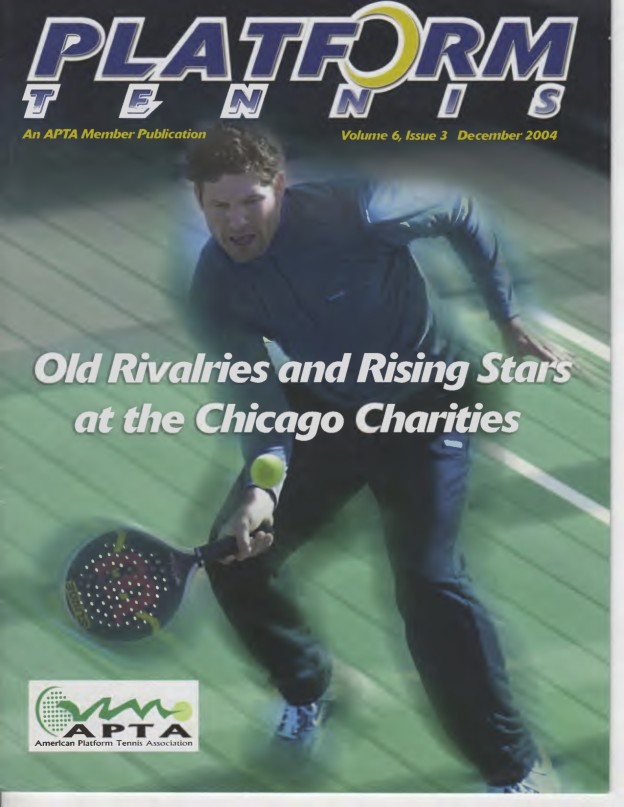
Chicago Charities coverage

Wayne Dollard reported for PTM from Chicago:

A refreshing 2004-05 season was on display in Chicago from November 5-7 for the annual Charities tournament. The best players in the game, including 214 men and women, competed in this season’s extravaganza. New pairings, veteran teams, and reunited legends captured off a weekend of unparalled platform tennis.

2004 Chicago Women’s Charities: What would you like to see when going to watch a major platform tennis championship? Power, finesse, excitement? You might also like to see new teams rising to greater heights and veteran teams returning to show a younger generation that they’re not ready to go away any time soon. This year’s Chicago Charities provided all of these things plus much more.

The ladies of platform tennis kicked off the weekend on Friday, November 5th. The absences of Lauren Zink, Shelley Morse, Patty Hogan, Sarah Krieger, and Robin Fulton were
felt, but the Chicago spectators had plenty to cheer about with hometown favorites dominating the draw. Mary Doten, Sally Cottingham, Chris Sheldon, Leslie Hough, and Kelly
Rudolph held up their end of the bargain and advanced to the quarter-finals. Doten and Keane (Grosse Pointe, Michigan), current National Champions and second-seeded team, were stopped short of their goal of capturing the title when they ran up against the third-seeded team of Bobo Delaney and Tonia Mangan in the semi-finals.

However, the story of the tournament was not the loss of one team to another, but rather the re-addition of Sue Aery and Gerri Viant to the Charities. Aery retired from platform tennis in 2002 to pursue a chiropractic education. Returning to the 2004 Nationals in Cleveland this past March, the unseeded Aery/Viant reached the finals before losing to Doten/Keane 6-3,6-4.

At the Charities, Aery and Viant defeated Cottingham and Sheldon (three sets) in the quarter-finals and the #1 seeds-Hilary Debbs/Cindy Prendergast (6-2,6-4) in the semi-finals. The finals proved to be a challenge, but Aery/Viant took the title 6-4,6-4 over Delaney/Mangan.

2004 Chicago Men’s Charities: The men’s draw was packed tight with most of the eastern teams making the trip to the Midwest. There may have been a lack of upsets and emotional letdowns, but there was an abundance of excitement and unbridled enthusiasm in the air.

All of the top eight seeds advanced to the quarter-finals, including the top three ranked teams in the country, Chris Gambino/David Ohlmuller, Scott Mansager/Flip Goodspeed, Scott Estes/Scott Mackesy. Chicago talent was strong in the men’s draw with four seeded players Scott Bondurant, David Keevens, Mike Rahaley, and Bill
Fiedler.

The match of the tournament was, without a doubt, the semi-final battle between newcomers David Caldwell/Blake Cordish and current National Champions Flip Goodspeed/Scott Mansager. The two-hour, three-set knock-down, drag-out fight left Goodspeed/Mansager bruised for their finals rematch with the APTAs #1- ranked doubles team Ohlmuller/Gambino.

Mansager dominated the first set with powerful returns that kept the top-seeded team off balance. Goodspeed played flawlessly both at the net and in the back-court. At the same time, Gambino/Ohlmuller did not play anywhere near to their potential.

The second and third sets looked more like a rematch of last year’s Charities final where Gambino and Ohlmuller defeated Goodspeed and Mansager 6-2,6-4, This time around the last two sets went 6-2,6-3.

With another Charities win under their belt, Gambino and Ohlmuller have set themselves up early in the year once again as the team to beat. At the same time, on the women’s tour, Sue Aery and Gerri Viant have told the field that they’re back and that their goal is to recapture the National Championship.

Source: Platform Tennis Magazine, Vol. 6, Issue 3, December, 2004

Player Profiles: David Caldwell and Blake Cordish

PTM Editor Wayne Dollard reported:

PTM recently had the opportunity to sit down with Baltimore’s up-and-coming paddle sensations Blake Cordish (age 33) and David Caldwell (age 30) and asked about their remarkable history with tennis and their seamless transition to platform tennis.

Blake Cordish was born in Baltimore and played tennis at an early age. As a junior, he was ranked in the top 100 in the United States in singles and the top ten in doubles before going on to play for the varsity team at Princeton.

David Caldwell was raised in Danville, Virginia. As a junior, David was ranked #1 in the country. At the University of North Carolina, he improved and was a three-time All-American. By the late 1990’s, David was playing the top pros in the world at the Australian Open, French Open, and US Open. He was ranked in the top 150 on the ATP Tennis Tour.

David and Blake have been long-time friends. “From the age of ten, I grew up playing doubles on the junior tennis circuit with Blake’s younger brother, Reed,” David explained. He added, “Reed and I have remained close friends, in fact, after college Reed and I traveled together on the professional tennis tour. The Cordish family has always been an extended family for me.”

When David retired from the tennis tour, Blake hired David at his real estate development corporation, “The Cordish Company,” with divisions in retail, office, hospitality/gaming as well as operating divisions focused on restaurants/clubs, live music and film. David enthusiastically stated, “Real estate development appeals to my competitive instincts and in many ways is an intellectual extension of my sports background.'”

One of Blake’s mentors, David Iglehart, was a highly ranked national platform player (with his brother) and raved about the game. At his encouragement, Blake played platform tennis for the first time four years ago in the Baltimore League. Blake recalled, “I was always aware of the game growing up but never played. I instantly fell in love with platform tennis and the following fall, I introduced David to it. We played our first tournament in the fall of 2001. Naturally, we took a beating the first year or two. Needless to say, we played our share of back-draw matches but found the tournament competition invaluable. Our low point the first year was losing in a fifth round back-draw match of Nationals in a third set breaker to a guy who was cramping and alternatively chucking Red Bull beer on change-overs. It was both a humbling and soul-searching experience!” Blake added, “One of the major differences from conventional tennis is how much more quickly the momentum changes in platform tennis. In tennis, there is so much more time between points and change-overs to control tempo and momentum. As a result, platform places an increased emphasis on mental intensity. In addition, there is a huge mental difference with the realization in platform tennis that the point is almost basically never over. In terms of similarities, doubles tennis and platform tennis are both intellectually challenging in terms of strategy and positioning and require excellent communication between partners. As a result, in both sports it is a huge advantage to be close friends with your partner and have that level of trust.”

David expanded on Blake’s analysis, “One of the major differences I see between the sports is the flow and shot patterns within the points. Platform requires reprogramming your tennis brain in terms of how you approach the development of a point and how you react to the ball. Learning platform for us has been fascinating because, without formal training, in many ways it was trial and error. On a most basic level, the great similarity between the sports and the thing Blake and I enjoy most about both sports is that they represent competition in its purest sense. No coaches, no subs, both sports require competitors to just lay it on the line.”

David and Blake offered PTM a few recommendations for tennis pros or those new to the game. David explained, “My main piece of advice is to be mindful of the basics of paddle, but not at the expense of changing your core strengths. The game is certainly evolving and a major strength in tennis can more than likely be adapted to fit paddle and ultimately add a new dimension to the game.” Blake agreed, “Players with a tennis background should recognize they have a major advantage as they approach platform tennis and should build on those strengths. Many of the core fundamentals of the modern era of tennis such as semi-western forwards and extreme kick serves are all directly applicable to platform tennis.”

PTM asked David Caldwell what avenues their team has taken to better learn the sport? He responded, ‘We do read Platform Tennis Magazine, but in one sense we made a conscious effort early on to develop our game through competition and let our backgrounds in tennis be the driving force in the learning process. The theory is to not restrict the learning process with pre-conceived ideas about how to play. One great thing about sports is that they always evolve and the challenge is to figure out new ways to play and maintain an edge on the competition. The more talented tennis players we can get into the game the better. Platform tennis is clearly evolving and I am convinced that those with a tennis background will play a major role in the development of new shots and strategies on the platform tennis court.

As active APTA members, playing as many as six to ten sanctioned tournaments per season, David and Blake offered potential rule changes for the APTA to consider moving into the future. ‘We believe that lobs that land in the court and bounce over the wall should be in. We also feel that adding a second serve could be an interesting concept and change the basic dynamic of the sport.”

Regarding competitive play, Blake concluded, “We personally feel that tournament competition has been the key to our improvement. Every tournament we get to see new balls and we learn new things on the court. Our ultimate goal is to win a National Championship. We feel like we are still improving and we want to see how far we can go.”

Source: Platform Tennis Magazine, Vol 6., Issue 3, December 2004