Junior paddle blitz by APTA and PPTA

The APTA and PPTA will partner this season in an effort to bring more juniors into our sport. The APTA will provide the funding and the PPTA the know-how at Junior Paddle Days around the country. Generally, these will be scheduled to precede a junior tournament by a few weeks, in order to build interest in those “follow-up” events. All juniors who become APTA members, during one of these events (necessary for participation in APTA tournaments), will receive a gift from the APTA. If you would like to host an event in your area, or learn about an event scheduled for your area, please contact Marjorie at the APTA Office. Parents, pros and other interested adults are encouraged to get involved.

Source: Platform Tennis Magazine, Vol.8, Issue 1, September, 2006

Viking celebrates production of 25,000th OZ paddle

Viking Athletics announces the manufacture of its 25,000 OZ paddle, the most played with paddle in platform tennis.

To celebrate, Viking is giving away more than $25,000 in product.

Viking will be supplying every paddle manufactured for the upcoming 2006/2007 platform tennis season with a scratch-off ticket that is redeemable for product at the Viking Pro Shop.

APTA Annual Meeting

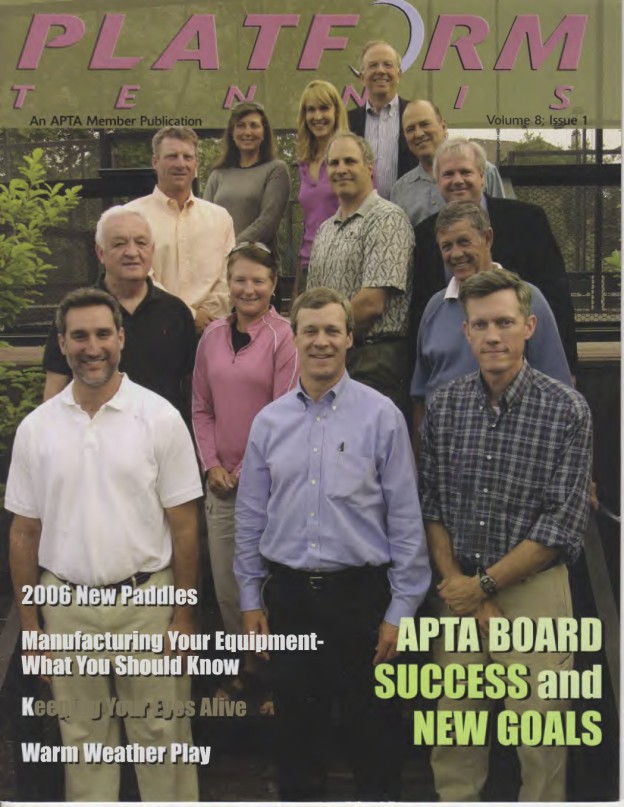
PHILADELPHIA — The APTA held its Annual Meeting and Board Meeting at Waynesboro Country Club in Paoli, PA, May 5-6, 2006. Highlights from the meetings include:

A new APTA mission statement was developed. It reads:

The mission of the APTA is to:
A. Govern the sport
B. Grow participation
I. Among all levels and types of players
2. Across all our regions
C Improve all aspects of the game

We will accomplish this mission by: maintaining the rules and codes of behavior to ensure the integrity of the game; creating and increasing awareness of our sport; providing guidance to clubs and municipalities on how to start platform tennis programs and then how to make those programs successful, and; promoting the sport among current players to raise their level of addiction

APTA finances in 2005-06 were in the black by approximately $49,000.

The Board approved a $12,500 grant for the Chapel Hill Tennis Club (Region VII) for the purchase of two platform tennis courts and the development of a platform program.

CHTC, located in the heart of North Carolina’s Research Triangle, will be the first club in central North Carolina to have platform tennis courts. The club and the APTA hope to capitalize on the growing interest in the area for platform tennis among new players and the many paddle transplants who call the area home.

The Chapel Hill experience will serve as a test case for future development projects the APTA hopes to support. If you know of an area that would benefit from a similar court- seeding project please contact APTA President Mark Fischl.

A check for $8,000 was presented to the APTA by Bill O’Brien on behalf of the Chicago Platform Tennis Tournament Charities, Inc.

The funds were generated from Chicago area events last season and will enter the APTAs Junior Development fund. The Board is grateful to the CPTC for their generous gift. The APTA will hold exhibitions this season in Niagara/Toronto, Chapel Hill, and possibly other cities. If you are interested in having an exhibition or clinic in your area please contact the APTA office or Board member Todd Ward.

The Board acknowledged the outstanding work of APTA Executive Director Marjorie Hodson.

Marjorie’s devotion to the game goes well beyond the “part-time” official status of her APTA job. Her tireless efforts and many talents are key elements behind the APTA’s strong
financial showing.

The Board voted to approve a “service gap” of no more than six inches.

The service gap has become popular with new and repainted courts and is intended to make it easier to make service calls in the outer corner of the service box. The service gap is not mandatory.

Eyewear Endorsed

The APTA now recommends the use of protective eyewear, especially for juniors. Signs encouraging use of protective eyewear will be distributed to APTA member clubs for hanging on court entrances.

A new age category will be tried this year at selected events: the 95s.

Fundraising

Now that the APTA is officially a tax-exempt 501 c3 organization, a major effort is underway to raise money which will fund future initiatives in keeping with the Association’s mission statement. Fred Gumbinner, Region I President, is leading the fundraising program.

Present at the Annual Meeting were: Mark Fischl (President, Long Island), Tim McAvoy (Vice President, Philadelphia), Scott Bondurant (Vice President, Chicago), Sally Cottingham (Treasurer, Chicago), Taylor Bowen (Secretary, Charlottesville), Marjorie Hodson (Executive Director, Summit), Bill O’Brien (Chicago), Nancy Budde (Dayton), Fred Gumbinner (Washington/Region III President), Beach Kuhl (Ross), Rich Lombard (New York), Marina Ohlmuller (Chicago), and Todd Ward (Cincinnati).

Visitors at the Friday afternoon working sessions and evening Annual Meeting included: Jacki Brown (Bulletworks), David Dodge (Premier Platform Tennis), Wayne Dollard (Platform Tennis Magazine), David Kjeldsen (Viking), Brian Mills (Viking), and Clark Reed and Jerry Brown (The Paddle Company).

Source: Platform Tennis Magazine, Vol. 8, Issue 1, September, 2006

Paddle in Atlanta surges

Ansley Golf Club and Piedmont Driving Club played hosts to the 1st Annual Peachtree Invitational Platform Tennis Tournament January 14 & 15. This is a new APTA Region VII PCQ event that follows on the heels of last year’s successful exhibition and clinic that kicked paddle in Atlanta into a higher gear. The two-day event was limited to 16 teams due to court capacity (there are currently just two courts in Atlanta). Nine players traveled in from as far away as New Jersey and Virginia to participate in the event.

Atlantans Jay Bailey and Peter Lauer took the inaugural Peachtree title over brothers John and Nick Gill (from DC & Alabama). Bailey and Lauer also won the Southern Invitational in Winston-Salem, NC, two weeks later over Mark Fischl and Alex Whaling. [enlarge image to read full story]

Junior Nationals

Patty Hogan, Junior Nationals Director, summed up the action:

This year’s Junior National Championships, hosted by The Beacon Hill Club in Summit, N.J. will be remembered for several significant “firsts”.

This was the first year there were enough players to hold a separate championship for the 10-and-under girls.

This was the first time we had a player from Yale win a Junior National Title, as Brandon Kutcha took time off from his studies to team up with his brother Michael to win the very competitive Boy’s 18-and-Under title. They won a thrilling three-set, third set tie-breaker over the first player ever to come back from a stroke to reach a national final. That player is the incredible Eric D’Elia, who suffered a stroke in July but was able to team up with Marc Powers to beat some very tough teams en route to the finals and the close loss to the Kutcha brothers.

It was a great Nationals for these and for all of the nearly 200 juniors who participated this year. When it was all over, eight teams were crowned 2006 National Champions.

In the first-ever Girls 10-and-Under tournament, Elizabeth Kallenberg and Katie Hammond won a close three-set final over Yassi Shafaie and Avery Hatfield. The Boys 10-and-Under final was won by Peter Simonds and Daniel Adajian over Kevin O’Malley and Grant Van Fossan.

In the final of the Girls 12-and-Under, Corey Delaney and Nicki Ross topped Katie Hopper and Maddie More. The finals of the Boys 12-and-Under saw Ryan Hissey and Scotty Safford pull it out over Taylor Geiger and Rory Shepard. The Hissey/Safford team had thelargest cheering section, as many of the “Philly Faithfuls” made the annual trip to New Jersey to cheer on their teams.

The Girls 14-and-Under title was won by the team of Hana Bowers and Karen Cash. They topped the team of Adrienne Bourget and Margaret Souther to claim the title. The Boys 14-and-UnderChampions are Nick Newhouse and Jason Ottomano. They had a strong tournament, especially in their win over the veteran team of David Dickson and Cody Newton in the finals.

The Girls 18-and-Under winners were Mia Kent and Elspeth Boynton. They topped Molly Findley and Lindsay Toth in the finals. Findley and Toth’s appearance marks yet another first; they are the first team from the Pittsburgh area to reach a junior national final.

Special thanks goes to the sponsors: Marsh, Viking, The New Jersey Men’s Platform Tennis Association, The New Jersey Women’s Platform Tennis Association, the APTA Junior Development Fund and to first time sponsor Balle de Match.

Source: Platform Tennis Magazine, Vol. 7, Issue 5, April, 2006

Summer paddle…why not says Matt Terry

The snow had melted and leaves were starting to appear on the trees. Knees swollen from a winter of pounding on the paddle courts had started to heal. Tennis whites and racquets with strings had been removed from the closet. Then the phone call came. A good friend called and said, “I played tennis last night. It occurred during the match that paddle is much more fun than tennis. Would you be interested in playing paddle during the summer?” Three thoughts came to mind after hearing the proposal. First, that paddle really is more fun than tennis. Second, there was no reason that we couldn’t play during the summer. Last, could we find anyone else crazy enough to play? [enlarge image to read full story]

Player Profiles: David Keevins and Brian Uihlein

It seems that David Keevins must have grown up with a racquet in his hand. At 18, he received a full scholarship to play tennis at the University of Kentucky. By the end of his senior year, he was ranked #37 nationally in singles.

After earning his MBA from the University of Chicago, David was burned out on tennis. He explained, ‘Tennis no longer interested me. Someone suggested platform tennis so my dad and I went to our club (Tennaqua) and played. We both liked it. I was hooked.”

David knew Brian Uihlein from junior tennis. About ten years ago, Brian and John Hough began inviting David to play in their platform tennis practice games. They have been practicing ever since.

Comparing his tennis background to platform tennis, David said, “Paddle is a game of mistakes. Power has less of a premium, just look at the lobbing nature of the game.” He added, “In tennis, sometimes one break is all a person needs to win a set and two breaks almost certainly ensures winning a set – especially if the tennis player has a big serve. Not so in paddle. I have lost my share of sets after being up 5-0 or 5-1.”

Asked why he liked platform tennis, David said, “My three favorite aspects of platform tennis are: First, it is a great cure for cabin fever. There is nothing better than being outside in the winter time. Second is the people. Some of my closest friends I have met through platform. Third is the social nature of the game. Although everyone tries hard and competes well, no one seems to lose sight of having fun and sharing a drink after the game.

Not a natural volleyer, David had to work hard on that aspect of his game. He said, “I knew if I wanted to compete at a higher level there were two parts to my game that needed to really improve. The first was my volley and the second was my lob.” David was lucky to have two practice partners for one-on-one-type drilling – his wife Kristin and his friend and mentor, Craig Wilson.

Before Short Hills and the Nationals, David and Brian played a warm-up tournament – the Illinois States. They were pressed along the way and wound up losing in the semi finals to their good friends Peter Berka and Ed Granger. David recalled, “The next day we talked about the match and one very obvious conclusion was that my lobs were way too short. We never got a good look at a drive because they were always hitting overheads two feet from the net. Brian suggested we take few lunch hours and do some lobbing drills.” He added, “Even in practice I was really struggling. I was focusing on height (trying to hit my lob sky high) as opposed to depth (five feet behind the service line).”

It just so happens that as they were drilling, the pro at Onwentsia Club, Rod Workman, was walking by the courts. Brian said, “Hey Rodney, how do you teach the lob?” Without skipping a beat, Rod fired back, “The lob? That’s easy. Cup of water. Pretend you have a cup of water on the face of the paddle. Get the paddle below the ball, having the paddle face parallel to the ground. If you don’t extend straight up toward the sky, keeping the paddle face parallel to the ground during contact, the cup of water will spill. Cup of water, baby!”

From that moment on, David’s lobs improved. More importantly, he became just as excited about a good, deep lob as he did a big forehand drive. David concluded, “Drilling is key. Craig Wilson can attest we did a lot of lob / drive drills the three weeks leading up to the nationals.”

Asked about the transition from tennis, David feels that tennis players should try as quickly as possible to leave their tennis instincts behind (not their tennis skills, but their approach to the game). He said, “Tennis players need to become comfortable letting the ball go to the screen and lob it back. I see too many new (and even veterans) try and block hard overheads and drives from the baseline, as opposed to letting the ball hit the screen and have an easy lob back.”

Looking back at his stellar year, David said, “Brian and I went 16-1 over three national ranking tournaments with victories at Short Hills and the Nationals. Never in my wildest paddle dreams did I think I would ever be part of a team that could have that sort of a Cinderella season.”

Discussing his health, David said, “After some bad knee injuries over the past seven years, the greatest pleasure for me is just being out on the court.” He added, “In the future I would like to see trying to spread the National Tournament over three days — perhaps play the first round or two late Friday afternoon / evening. I understand the logistics of this are challenging but having to play five matches on Saturday (for many teams) is extremely hard on the body.”

David concluded that he reads PTM religiously – particularly enjoying the features and instructional articles.

Known by his peers as the most offensive player in platform tennis, Brian first started playing platform tennis in his early 20’s after graduating from the University of Minnesota. In college, Brian was an All-american tennis player, ending up ranked #3 in the country senior year!

Brian was intrigued by the strategy of paddle tennis. He said, “There are a lot of different shots and strategies that occur in a match.” He added, “When you are playing well you can anticipate how the point is played out 3-5 shots ahead of time. In tennis the rallies are so short.”

Asked what he enjoys about playing platform tennis he smiled and said, “I like frustrating people with spin overheads, hitting a great deep lob, winning volley exchanges at net, and definitely winning.”

Brian plays twice a week because he feels that if he only played once a week he wouldn’t get used to seeing the ball very well. “1 do drills a couple of times a year especially before a tournament.” He smiled and referred to his friend Peter Berka’s new book and said, “I also try to read Winter Warriors before each tournament.”

Asked how the average player can improve, he said, “For newcomers I would try to play with people that are better than you and ask them their strategies. Some of the best advice I have received has come from Rich Maier, Bill Fielder, etc.

Brian’s spin overheads have dominated the tour for years even though he just earned his first National Title. Looking towards the future, Brian said, “I hope my shoulder doesn’t fall off and that I can continue to play three tournaments per year.” He added, “I think paddle is a great game and would like to see the game continue to grow. It is a very social game that really helps pass the winters by and make some great friends.”

Asked about making improvements to the game, Brian said, “I think the APTA has done a good job of growing the game. I hope they continue to make decisions in the future based on the growth of the game.” He added, “I would like to see the game change to reward aggressive play.” Elaborating further, he said, “I don’t know how you can do it but I don’t think having people being able to hit back 50 lobs is fun for people to watch. I would love to see the ball take spin even more. Obviously I am biased but I remember actually being able to cut some of the old balls in half. It makes it pretty hard to retrieve a ball that ends up in two pieces lying on the ground.”

Brian concluded by talking about shortening the number of rounds played per day in tournaments. He said, “Short hills is a great format for me. Trying to play five matches in one day at the Nationals took a few years off my life.”

Source: Platform Tennis Magazine, Vol7. Issue 5, April, 2006

New England Junior Boy’s Open

On Saturday, December 10th the New England Junior Open was held at The New Canaan Field Club. It was one of the first ranking event of the junior paddle season. Seventy four children participated, representing four states in the general area.

10-and-underWinners:
Peter Simonds and Daniel Adajian both of Southport and Fairfield defeated Reed Schultz & Jack Jeffrey of New Canaan 8-1 in a pro set.

12-and-under
Patrick Newton and Carter Lovejoy from New Canaan, played a tough fought match against CJ Purse of Greenwich and Parker Connolly of Wilton. They were victorious after an exciting three setter (1-6, 6-1, 6-3).

14- and-under
Jason Ottomano and Nick Newhouse from Weston, CT pulled out a third set tie-break beating the Safford brothers from Philadelphia.

18-and-under
Terry Keegan from Fairfield and Liam Bohonnon of Westport, defeated Jay Schwab and Cole Barris of Scarsdale 2-6, 7-5, 6-4.

The juniors received “got paddle?” long sleeve shirts, printed by former national champion Cindy Prendergast.

Mike Gillespie, tournament director said there has been a very impressive increase of juniors playing in the area. He attributes one reason for this growth is that more pros are teaching paddle. The Professional Platform Tennis Association (PPTA) tests and certifies pros and over the past three years, certification has tripled. Gillespie said “People are improving and having more fun in the process”. Gillespie has been running the New England Junior Open for years and in just one year the event has grown by an additional 25 kids competing. Gillespie has a bit of experience himself, having competed and won the 18-andunder Nationals in 79 & 80. He went on to become a finalist in the 92, 94 and 02 Men’s open Nationals.

Source: Platform Tennis Magazine, Vol. 7, Issue 4, February, 2006

Viking Junior Tour – Mark Brosnan covered the event for PTM

Mark Brosnan reported for PTM:

On Saturday, December 17, 2005, the Long Island Platform Tennis Association hosted its 3rd Annual Viking Junior Tour tournament at the Garden City Country Club, the Cherry Valley Club and the Garden City Community Park. With Christmas only a week away, the children received a surprise early morning visit from that jolly old Nordic man with rosy cheeks and a little round belly – that’s right, David Kjeldsen, founder and chairman of Viking Athletics, was there to provide his support, wearing his trade-mark “horns”! Among the four age divisions, there were forty-two (42) teams participating (84 kids!), and countless parents and grandparents cheering. The level of paddle was extraordinary, the good sportsmanship was commendable, and the smiles were constant! John Cerga, Alex Bancila and Steve Bromley, the Directors of Racquet Sports at the Garden City Country Club, Cherry Valley Club and Port Washington Yacht Club, respectively, volunteered their time and helped to make it a memorable day for the players.

<strong>10 & Under Division
Champions: Aidan Talcott (Old Brookville, NY) and T J. McLaughlin (Plandome, NY)
Finalists: Jack Stiuso (Port Washington, NY) and Dylan Neville (Port Washington, NY)

12 & Under Division
Champions: Amaury Dujardin (New Vernon, NJ) and Christopher Ju (Mendham, NJ)
Finalists: Jack Mara (Garden City, NY) and Alex Morris (Garden City, NY)

14 & Under DivisionC
hampions: Bryan Kallenberg and Matthew Kallenberg (Port Washington, NY)
Finalists: Chris Brosnan and Pat Brosnan (Garden City, NY)

<strong>18 & Under DivisionC
hampions: Cole Barris (Scarsdale, NY) and Jay Schwab (Scarsdale, NY)
Finalists: Ryan Muzzy (Huntington, NY) and Edward Krupski (North Babylon, NY)

Source: Platform Tennis Magazine, Vol. 7, Issue 4, February, 2006

G. Estabrook Kindred, APTA Treasurer, Umpires Committee founder, and the editor of APTA’s first newsletter for many years (1930-2006)

Brook Kindred died on January 7, 2006 after a long and brave battle with cancer.

He had the distinction of having served the cause of platform tennis for more years than practically any other living individual. Dating back to the early 1960’s he was a tireless, unselfish and dedicated contributor to the support and promotion of the game.

He was elected to the APTA Board in the early 1960’s and served on the Board for 16 years. He was Treasurer, Tournament Director, and single- handedly produced the Newsletter for many of those years. He also served on many National Championship committees and was the Tournament Chairman of the 1968 Men’s Nationals.

He was instrumental in the formation and administration of the APTA Umpires Committee in the 1970’s, and although that activity no longer formally exists, he still continued to go far and wide to officiate at APTA Championships and other sanctioned events, no matter what the weather.

When the Platform Tennis Hall of Fame activity was inaugurated in 1965, Brook was the driving force in getting this underway, and designed the jackets and charms that are awarded to inductees. He served on the Hall of Fame Committee from its inception until his death, and authored the majority of induction speeches for the sixty individuals who have been inducted to date. In a fitting recognition of his contributions to the game, in the fall of 2005 he was honored by the APTA Board of Directors by his election into the Platform Tennis Hall of Fame.

Brook Kindred was a special person, a provider of wisdom, a person of good judgment, and a “do-er”. He will be sorely missed.

Source: Robert A. Brown, Platform Tennis Magazine, Vol. 7, Issue 4, February, 2006