Player Profiles: Scott Freeman and Don Schwake

Scott Freedman was born in 1962 in Venice Beach, California. As a child of the late 60’s, Scott was attracted to the excitement generated by the great paddle tennis players of the era who called Venice Beach their home.

Paddle tennis is (and was) played next to the beach on miniature tennis courts with a playable area 20′ by 50′ and a 31″ high net. In comparison, the playable area of a platform tennis court is 20′ x 44′ with a 34″ high net. Paddle tennis utilizes a tennis ball that is punctured with a hypodermic needle. There are no screens, so points are short and aggressive.

Although Scott had never played tennis or racquetball, the allure of this beach sport appealed to his superior coordination, conditioning and fast hands.

By the age of 18 (1980) Scott had accumulated four World Junior Paddle Tennis titles. After college, Scott returned to the beach and renewed his passion for paddle tennis. In 1984, he made the move to the men’s open division where he conquered his first of many world singles titles.

From the years 1984-2005, Scott accumulated 19 world singles titles, 16 world doubles titles (all with partner Sol Hauptman) and 14 world mixed doubles titles. He is the only player in the sport’s 108 year history (National Championships did not began until 1949) to win the world singles, doubles and mixed titles all in the same year. He has completed this feat a total of six times.

Scott went on to author “Paddle Tennis: Anyone Can Play’ a comprehensive paperback instructional book and video DVD that has sold thousands of copies from California to New York.

When asked about paddle tennis, Scott said, “Paddle tennis is one of the hottest growing sports in the country because its appeal to young players. There has been a major influx of tennis players over the past five years.”

In comparison to paddle tennis Scott added, “Platform tennis is complex because it is so physically and mentally demanding. An average point could last 30-40 shots and positioning is key on each shot. Because of this constant focus, platform tennis is on a whole different level competition-wise.”

Now at the age of 43, Scott is still on top of paddle tennis. In March, Scott will compete for $50,000 in prize money at the 2006 World Championships in Las Vegas. He is the favorite to win the singles, doubles and mixed doubles events.

Don Schwake grew up in Chicago • a product of the public tennis program. In college, Don was a tennis star at Western Illinois University. After school, in 2001, he moved to Venice Beach. His first days in California he witnessed Scott Freedman in a paddle tennis exhibition.

From there he was hooked. “On the court, Scott is a great teacher. Off the court, we talk about life and all the great things going on in our respective endeavors,” Don explained.

A week later Don entered his first paddle tennis tournament and won it, defeating the #3 player in the sport in the first round. Don is now the #2 ranked player in the world. Don’s doubles partner, Pierre Belmont, is also his best friend. Together they are the second ranked doubles team in the country.

Asked about platform tennis, Don said, “Growing up in Chicago, I saw platform tennis and always wanted to give it a try.” He added, “We didn’thave enough money for a country club membership, but I would have played platform tennis if it was publicly available.” He added, “These past few days, I learned that platform tennis is unbelievable difficult.

After one week in paddle tennis I was a top five player in the world. In platform that can not happen. The difference between the sports is in the mental focus.” Don concluded, “People in platform are incredibly nice. The weather is not desirable, but the people are great. You have an awesome thing going here.”

: Source: Platform Tennis Magazine, Vol 7., Issue 4, February, 2006

Player Profiles: Terry Miller and Jane McNitt

Terry Miller was born in New York City 38 years ago. After tremendous success on the local junior tennis circuit, Terry jumped on the professional tour at the ripe old age of 16.

From 1983 to 1991, Terry competed with and defeated the top female tennis players in the world. Over this time period she reached the quarter-finals of the French Open, Wimbledon and US Open Grand Slam events. At one point, Terry was ranked 14th in the world.

After leaving the tour, Terry moved to Winnetka, Illinois, and became a tennis teaching professional. In 1993, she was introduced to her future platform tennis doubles partner, Jane McNitt. “I met Jane when I was teaching tennis at Indian Hill Club in Winnetka. We were then re-connected last fall when we played together at the exhibition opening of the new paddle hut at the Winnetka Park District.”

Terry spoke about her new-found favorite sport, “I started playing platform tennis two years ago as it is very popular in Chicago. The Winnetka Park District has a fantastic center just minutes from my house which made it very accessible. I also joined Bath and Tennis Club in Lake Bluff and began working with the pro, Ray Murphy.” She added, “I haven’t been playing for long, but I believe my tennis background has given me a strong foundation. I’ve really enjoyed getting involved in platform tennis. It is such a great way to get outdoor exercise in the winter, and it is so popular in Chicago.”

A racquet sports sensation, Terry compared the crossover skills from tennis to platform tennis and squash. She said, “As opposed to squash, I think tennis and platform tennis are highly compatible. I like the fact that I basically use the same strokes for both sports. However, platform tennis is somewhat more challenging than doubles in tennis as you’re only allowed one serve, of course, and the correct positioning is crucial in platform tennis.

When asked about the camaraderie differences from tennis to platform tennis she said, “Platform tennis is much more social than tennis doubles, and it is also a better workout as points can often last 40-50 shots. Also, we have an incredible league in Chicago, so each week we’re playing top players that we would also be facing at the Charities or other national events. That’s a great way to stay match tough,”

To come as far in platform tennis as she has over the past two years, Terry has relied on hard work, training, and studying the sport. “I drill regularly with Ray Murphy at Bath and Tennis…he has helped me tremendously.” She added, “Those new to the game should enroll in as many clinics and play as many league matches as possible. And, of course, there is nothing better than taking private lessons with a good pro.” When asked if her reading carries over to PTM, Terry answered, “Yes, I enjoy reading the articles in Platform Tennis Magazine…especially those that focus on court positioning. I also like to read the player bias to learn what motivated them to start playing platform tennis.” Commenting on future goals and plans, Terry stated, “Jane and I were so excited to win the Chicago Charities this year. Of course, it would be great to win another big tournament. As the tournaments keep getting tougher with a deeper field of talent, it will become increasingly difficult to win a major tournament; however, that is what makes platform tennis so fun and challenging”

Growing up in Pittsburgh, Jane McNitt enjoyed all sports. Early on, she was an accomplished swimmer and golfer but decided to try out for the tennis team in her junior year of high school because it looked like more fun. She recalled, “My dad encouraged me to play tennis because he said it was something I could play all my life. It was a great decision!” In the mid 70s, platform tennis was a more recognized recreational sport. Jane said, “We used to play paddle in high school with a bunch of kids just for fun. My first paddle was the ‘wooden board’ by Marcraft. I still have it.”

After graduating from Penn State, Jane went to work for Mellon Bank in Pittsburgh. She moved to Chicago in 1988 with Mellon where she met a great group of paddle players – most notable was Peter McNitt. “Peter and his brother Jim were a top nationally ranked team for many years,” Jane said. She added, “They were instrumental in teaching me the game and have been very supportive all along the way.” Over the years, Jane has been ranked as high as 5th nationally several times and has won tournaments in Indianapolis, Milwaukee, and Cincinnati as well as the Mixed and Women’s Illinois State tournaments, but winning the Charities in November was the biggest win of her tenured paddle career.

Reflecting back, Jane said, “I have had a lot of terrific paddle partners over the years and I’ve learned something from each of them.” She added, “I really enjoy playing with Terry because she is a very positive and supportive partner. She is also a great competitor.”

Discussing changes to the sport, Jane said, “Paddle has changed so much over the last ten years. There are more players, new programs for kids, better technology and a magazine that is a great source of info and updates. I feel lucky to be involved in paddle at this point in history.” Jane added, “Paddle is a great game! I have met so many long time friends through paddle. In fact, as much as I enjoy the exercise and competition, the camaraderie is unparalleled.” Jane closed the interview with her hopes and goals, ” I will play paddle as long as I can. Paddle is one great way to get through the cold Chicago winters! Would I like to win some more big tournaments? Sure, but more importantly, I look forward to meeting some more great people along the way!”

Source: Platform Tennis Magazine, Vol. 7, Issue 3, January, 2006

Warming “Huts” keep evolving – from trailers to mansions and an important part of the camaraderie of the game

There’s a growing trend in paddle that is helping to make the sport hotter than ever.. or at least warmer than ever. Today’s warming huts are elegant, multifunctional structures with expansive social spaces both indoors and out that offer full kitchens, bathrooms and more. In fact, the term “hut” no longer does these buildings justice.

A force behind many of these new and improved huts is Chris Casiraghi, President of Reilly Green Mountain Platform Tennis. Most know the firm for their 45+ year history and innovation building of platform tennis courts; yet, they have expanded their offerings to meet the changing needs of their clients. ‘We have definitely seen a shift in what our clients are asking for when it comes to warming huts,” Casiraghi explained. “More than a decade ago, Reilly Green Mountain built (for the most part) modest warming huts. Today we are asked to build state-of-the-sport, useful buildings to sit alongside our platform tennis courts.”

Source: Platform Tennis Magazine, Vol. 7, Issue 3, January, 2006

Results of National Championships and coverage of Men’s and Women’s Nationals in Chicago

2006O&S

2006J

Screen Shot 2013-05-21 at 12.45.01 PM

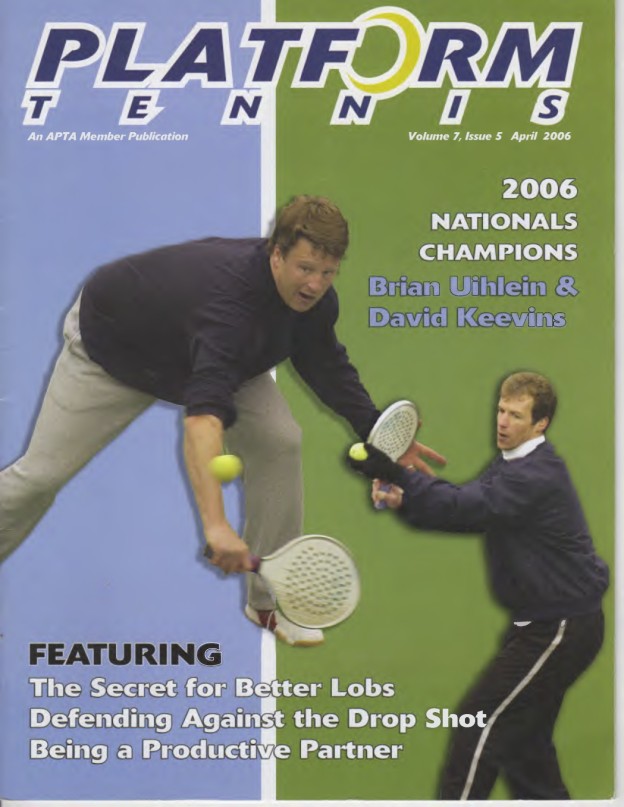
If the 2006 Nationals had a decidedly Chicago flavor, it wasn’t lust because of the location. Men’s champions Brian Uihlein and Dave Keevins and Women’s champion Mary Doten are all long standing area residents and Susie Keane, though living in the Detroit area, learned her paddle skills in Chicago.

The path to the finals for both winning teams was dramatic, though in very different ways. Keevins and Uihlein had to survive four consecutive three-setters from the round of 16 on, and came from behind in every match to win. Maybe their gutsiest win came in a three-set quarter-final against Anthony Cosimano and Steve Haller when, down 5-6 and triple match point and Uihlein cramping badly, they survived in a tie-breaker. The semis proved no easier against defending National Champions Bill Anderson and Mike Stulac. Stulac showed his toughness by overcoming a sprained ankle incurred in the first set while diving for a particularly nasty Uihlein spin serve. The teams traded the lead throughout the match with last year’s champs staying in it by virtue of their spectacular volleying and the new champs applying relentless pressure with their big forehands. At the conclusion of the 2 1/2 hour match, Keevins/Uihlein came up with just enough big points to win 6-3, 3-6, 7-5 to reach the final.

The final matched Keevins and Uihlein against Blake Cordish and David Caldwell who were on an amazing roll having given up a total of only 6 games in their three previous matches. The final was played in a steady snowfall that made the conditions challenging at best. The Chicago “ground crew” mopped the court with towels before the match and during changeovers to give the players decent footing. Everyone from tournament chair Alan Graham to former national champions Bill Fiedler and Rich Maier pitched in to make the
court playable. The level of talent on the court overcame the conditions and Caldwell/Cordish took the first set in a tiebreaker. They went up a break in the second set and were serving at 4-2 when the Chicago team made their move. In nailbiting fashion, with every game tight, Keevins/Uihlein won the second set in a tiebreaker.

In the final set, the steam from the heaters was so thick that most of the 300+ spectators could only guess at what was going on during most points. But the players maintained a ridiculously high level of movement and shot making and waged a seesaw battle that ended with Keevins and Uihlein breaking serve to win the title 6-4 in the third to become only the second all-Chicago team to win the Championship in the 76-year history of the event.

The drama on the Women’s side was not contained solely on the court. The semis were set with two New York/New Jersey teams on one side of the draw and two Chicago/Detroit teams on the other. Defending champions Kerri Delmonico and Aila Main squared off against Bobo Delaney and Tonia Mangan in a match-up of the #1 and #4 seeds. Delaney/Mangan played a nearly flawless first set and won it 6-4 relying on their well-refined teamwork attack. But Delmonico/Main were not ready to give up their title and battled back to take the second set 6-4. With both teams fighting for every point, the top seeds prevailed in a tiebreaker to advance to the finals.

Waiting for Delmonico and Main were Mary Doten and Susie Keane, who had their two-title winning streak ended at last years Nationals by Aila and Kerri. If Doten and Keane looked surprisingly fresh, it was because they received a pass to the final when the unseeded team of Kristen Klauke and Terry Miller defaulted just before the scheduled semi. Klauke had come down with a bad flu bug after defeating the third-seeded team of Dardis and Shea in the quarter-finals and was unable to play thus setting a match-up of the winners of the last three National Championships.

Doten and Keane showed no ill effects from their layoff and took the first set 6-4. With their rhythm established and confidence growing, they dictated played and gave Delmonico
and Main no openings to counterattack. They gave the Chicago crowd what they wanted and closed out the match by winning the final set of the Women’s tournament 6-2.

Congratulations to all the participants of this years Nationals. It seemed like the over 420 players were unanimous in their praise of the exceptional job done by the tournament staff. The food and service at Glen View Club were great, the beer and wine never ran out, and the Saturday night party was one of the best in years. Special acknowledgment goes to behind-the-scenes magicians Bill O’Brien and ARIA. Executive Director Marjorie Hodson who ran tournament central and coordinated innovations like hourly result updates on paddlepro.com and the distribution of current draw sheets at the lunch locations and throughout the tournament.

Source: Platform Tennis Magazine, Vol. 7, Issue 5, April, 2006