It may have been “The Year of the Ball” but there was plenty of paddle innovation for such a small sport, and four suppliers

Platform tennis players have it made.

What sport our size has four major manufacturers competing so heavily for the equipment market?

Since the mid 1990’s, Viking and Wilson have been going head-to-head in the ball market.

Due to a heavy, individualized marketing effort by owner David Kjeldsen, Viking was able to secure a substantial market majority through the 1990’s.

In April of 1999, Kjeldsen bought out Wilson’s ball market share for an undisclosed figure and term limit. Since then, Wilson’s former promotional Director John Embree began to focus on the paddle market, particularly in the Midwest and amongst women. Two years ago, Jim Burda replaced Embree to direct the platform tennis program. His duties included detailing paddle specification, testing equipment and then marketing to players and instructors across the northeastern states.

Burda’s success was evident last year when Wilson sold out their entire new paddle line less than one month into the season. With the success of last season in hand, Wilson has kept their top four 2006 models and launched two new (K)Factor paddles, based on their tennis racquet products. The paddles are an exciting addition to a sport filled with amazing technological advances for a sport so small.

The K-Factor paddles feature: a large hitting surface, (K)ore Foam that Wilson says provides a more stable hitting surface, and (K)ontour Rim – an enhanced stiffness for improved stability and (K)ontrol.

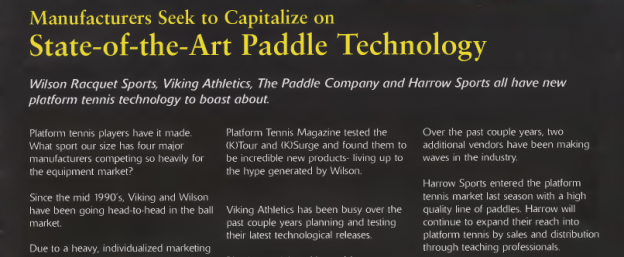
Platform Tennis Magazine tested the (K)Tour and (K)Surge and found them to be incredible new products- living up to the hype generated by Wilson.

Viking Athletics has been busy over the past couple years planning and testing their latest technological releases. Billed as paddles with precision, power and passion, the new line features Viking’s new VASTT” technology system.
Some of the technology is “under-the-hood”, and some is “visible technology”.

Variable Tempered Rims match rim temper to core densities that Viking says will optimize power and control. Surtar2TM and Tempered ImpactTM bonding technology match bonding levels to core densities.

Viking’s Core Impact TechnologyTM matches paddle “skins” to paddle “cores”. You won’t see them but Viking swears that players will notice the performance differences.

What does all this mean? It means that Viking has matched up variations of foam cores, rims and surface materials to create paddles with great variances in power, feel and flexibility. On two of Viking’s paddles, the Ignite and the Pro V-1, you will see a Shock Absorbing Ring billed to provide extra shock protection while not limiting power.

Over the past couple years, two additional vendors have been making waves in the industry.

Harrow Sports entered the platform tennis market last season with a high quality line of paddles. Harrow will continue to expand their reach into platform tennis by sales and distribution through teaching professionals.

At the same time, The Paddle Company has continued to expand their market share with their “body friendly” equipment (i.e. Soft, one-piece paddles with reduced shock).

Harrow Sports and The Paddle Company remain heavily invested in platform tennis; but, due to the launch of several new paddles in 2006 (and a new ball from the Paddle Company this summer), no new products have been released this season from these two manufacturers.
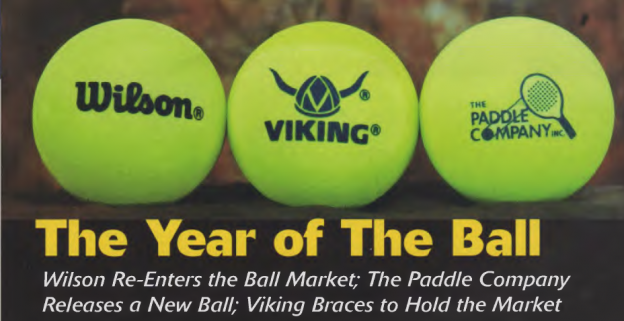
2007 – The Year of the Ball. The Paddle Company introduced new balls and Wilson Racquet Sports re-entered the market

Although there were some incredible new paddle technologies being released, 2007 may very well be membered as “The Year of the Ball”

A problem for our sport from the manufacturer’s standpoint – the ball has always been a loser. Not economical from any standpoint, the situation has come to a head in the last couple of years as the APTA asked, “What are our alternatives to the conventional platform tennis ball?”

Our ball has to endure up to 100-degree variations in heat, increasing amounts of grit applied to paddles, and the ability to be seen at night under the lights. Is it time we ask ourselves “Are we asking too much from this yellow piece of rubber?”

The volume of balls manufactured yearly (less than 200,000) is minuscule compared to balls for other sports.

The health concerns alone for the workers who apply the flocking to the ball are enough to make your hair stand on end.

Consistency in bounce, right amount of bounce, right color, and getting the flocking to stay on the ball are all factors contributing to the reluctance in manufacturers to even attempt to make a ball in the first place, given the small amount of numbers that need to be produced every year compared to tennis balls.

Is our unwillingness to change the ball inhibiting our sport’s ability to grow? Do we absolutely have to have this ball? What are our alternatives?

The Paddle Company, Wilson and Viking Athletics can tell you how hard it is to manufacture a ball. However, no ball, no sport. Someone has to take on the job to enable platform tennis to thrive.

The Paddle Company has surprised the manufacturing market by producing its first new batch of balls in years.

In March, 2007, CEOs Jerry Brown and Clark Reed sent out three different ball samples to platform tennis teaching professionals and top-ranked players. The balls were tested and compared to the existing Viking ball. The result is a new, brighter Paddle Company ball with a consistent bounce.

Wilson Racquet Sports also has just officially launched their reentry into the platform tennis ball market. Having bowed out of the market in April of 19991, an equipment sales surge has convinced the powers that be that the time to invest is now.

With Viking’s estimated 95 percent hold on the ball market share, Wilson felt that it was important to their overall platform tennis strategy to guarantee a stable environment by investing in their own product.

Terri Graham, Wilson’s Business Director of Indoor Racquet Sports said, “Jim Burda spearheaded our pursuit back into the ball market. We agreed that in having only one major ball manufacturer, we were posed with the question, ‘How would the sport suffer in the event something happens to them?”

Graham added, “We have taken a very aggressive forecast in our ball market re-entry. We have a long-term, better yet, call it a life-time agreement with the factory to produce balls.”

How will the new APTA Approved balls be different that those of Viking and The Paddle Company? Graham answered, “Our flocking is extra thick for added durability and spin.” She added, “This is a game of spin, and our ball will fit in perfectly.”

The three new balls are all excellent. They are very similar, yet subtly different in color, bounce and flocking. The manufacturer that succeeds in the best marketing approach will gain the upper hand in the ball market.

NOTE 1: Viking had acquired the Wilson ball business in 2000 but the five year non-compete restriction had elapsed

Source: Platform Tennis Magazine, Vol. 9, Issue 1, October 2007

Proposals made to Fox Meadow Tennis Club and Village of Scarsdale for the Museum and Hall of Fame

An expanded version of the 2004 proposal to Fox Meadow was made in July 2010 which contemplated adding a two story wing onto the existing building. In addition another proposal was made to the Village of Scarsdale to renovate their Brite Avenue facility to include a modernize structure to house the Museum and Hall of Fame and act as a “warming hut” and add three new courts.

Fox Meadow terminated the discussions in October citing doubts about the ability of the Platform Tennis Museum and Hall of Fame Foundation (PTMHOFF) to raise the necessary funds and concerns about obtaining all the necessary building and zoning approvals to construct such a facility.

Likewise, the Brite Avenue proposal ran into a number of logistical issues with implementation on Village property.

Source: Robert A. Brown personal communication and Minutes of the PTMHOFF meetings

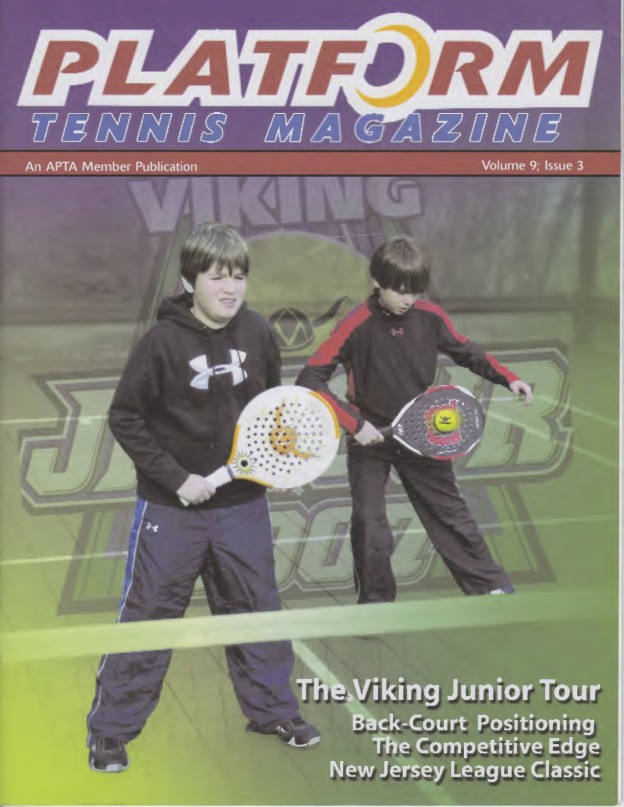
Viking Junior Tour

The Viking Junior Tour began in November at Fox Meadow Tennis Club, kicking off our season at the birthplace of platform tennis. Almost 80 juniors came out for an afternoon of fierce competition and outstanding sportsmanshipThe Viking Junior Tour began in November at Fox Meadow Tennis Club, kicking off our season at the birthplace of platform tennis. Almost 80 juniors came out for an afternoon of fierce competition and outstanding sportsmanship.

Gold Medalists
10 & Under: William Cannon/Alex Slobin
12 & Under Girls: Kaitlin Ball/Tess Tregellas
12 & Under Boys: Will Burger/Gardner Tregellas
14 & Under Girls: Katey Hopper/Maddie More
14 & Under Boys: Tyler Kratky/CJ Purse
18 & Under Girls: Margaret Souther/Rachel Whitney
18 & Under Boys: Reid Coopersmith/Evan Zimmer

Silver Medalists
Christopher Salisbury/Ethan Shire, Dylan Neville/Jack Stiuso, Hannah Kratky/Phoebe Wilks, Jack Mara/Alex Morris, Hillary Hall/Sara Shaughnessy and Chris/Patrick Brosnan.

A new event was held that same day in Baltimore. Although smaller in size, the enthusiasm was just as high! Next stop on The Tour was Chicago. Back for a second season, the tournament expanded to 25 teams this year.

10 & Under Gold • Andrew Wiggin/Nathan Wiggin
10 & Under Silver – Luke Massar/Jackson Smyth
12 & Under Gold • Michael Baddeloo/Peter Stellas
12 & Under Silver – Andrew Giertsen/Richie Thompson
14 & Under Gold • Fitz Bowen/Ryan Rickter
14 & Under Silver John Harmon/Michael Fyk
18 & Under Gold John Beam/Brantner Jones
18 & Under Silver Andrew Schlonick-Andrew Myron

Moving to Long Island in mid-December, the tour hosted 36 teams in the four age groups.

The Philadelphia Junior Open fell prey to the weather and had to be rescheduled, causing the loss of some teams who were competing in the Jersey Shore Junior Open that same day.

Boys Gold: Harry Colville/Liam Breen
Boys Silver: Tom Kelley/Will Cannon
Girls Gold: Cami AdaIlan/Emily Simonds
Girls Silver: Alexandra Shay/Emily Dardis
Boys Gold: Gardner Tregellas/Will Burger
Boys Silver: Peter Simonds/Daniel AdaIlan
Girls Gold: Hannah Kratky/Isabel Lee
Girls Silver: Hannah Reach/Sydney Reichert
Boys Gold: Tyler Kratky/CJ Purse
Boys Silver: Patrick Newton/Rory Shepard
Girls Gold: Corey Delaney/Nicki Ross
Girls Silver: Maddie Stern/Maggie Rooney
Boys Gold: Reid Coopersmith/Evan Zimmer
Boys Silver: Louis Croce/Zachary Morris
Girls Gold: Margaret Souther/Rachel Whitney
Girls Silver: Lindsay Wheeler/Carly Fink

Looking ahead to January, there will be new events in Cleveland, Pittsburgh and Charlottesville prior to the traditional Nationals tune-up, the New Jersey Junior Open. After Junior Nationals, there will be two Connecticut events, a second Chicago event and a new tournament in Cincinnati to wrap up the 2007 tour.

Last year, the Junior National Championships had a record 242 participants. This year we are hoping for more!

Richard K. Hebard – the best in his era (1914-2007)

Richard K. Hebard passed away on October 22, 2007, at the ago of 93. He was survived by his wife Lois, three sons, Richard, Douglas, and Donald, his daughters-in-law, and four grandchildren.

Dick Hebard was a member of Fox Meadow Tennis CLub, in Scarsdale, New York, where he excelled in both tennis and platform tennis.

During his playing era, he won more Platform Tennis National Championships than any other man at that time. He won eight National Men’s Championships, and was a finalist twice.

Hebard also won five National Mixed Doubles Championships, and was a finalist twice. He continued to play competitively into his senior years, winning the 50-and-over Men’s Nationals four times and the 60-and-over Nationals once. In all, Hebard won 18 National Platform Tennis Championships. He also served as President of Fox Meadow Tennis Club and the American Platform Tennis Association.

Hebard was also a very fine tennis player. At the age of 14, he won the National Boy’s Singles Championships. In both tennis and platform tennis, he was a relaxed, classic stylist, and he was highly respected by everyone, both partners and opponents.

Hebard was inducting into the Hall of Fame in 1965.

Source: Platform Tennis Magazine, Vol. 9, Issue 3, January, 2008

Hall of Fame Inductees: Gloria Dillenbeck Dodd, John Mangan, Pat Butterfield, Herb Fitz Gibbon, and Doug Russell

Gloria Dillenbeck Dodd was the first Executive Director of the APTA and served from 1975 to 1981, setting a bar for her successors that continues to challenge them to this day. Dodd took the sport on the road, showcasing it in locations from Hilton Head to New Canaan. She was instrumental in the creation of the President’s Cup and recruited people of influence such as New Jersey Governor Brendan Byrne to play in competition. Despite all of the back-end support she gave the APTA, Dodd was also an accomplished player, competing in five consecutive finals between 1969-74, and winning three titles in a row from 1971-73 with her partner, B.J. DeBree. Dodd also played the finals of the 1974 and 1975 Mixed Nationals with John Mangan.

John Mangan was honored not only for his exemplary court performance but his duty on the APTA Board. He won the Men’s Nationals with Bob Kingsbury in 1972 and 1973 and the duo were runners-up in 1970, 1971, and 1975. They also won the first prize money tournament ever – 1973 Sea Pines Resort in Hilton Head. Mangan and Kingsbury also had the distinction of winning the first nationally televised tournament – 1974 Amelia Island, FL, which was broadcast on CBS Sports Spectacular. Mangan, known for a crushing, top-spin forehand, was a Mixed Nationals champ with Mrs. David Harris, and a Mixed Nationals runner-up with Gloria Dilenbeck Dodd. Still competitive in 1980, Mangan came back to win the Indoor Men’s Nationals with John Adams.

Patricia Ann Butterfield was a force to be reckoned with through the 1980s. In the span of 1982-88, Butterfield was in six of seven Women’s National Championship finals. She won three times and was a finalist three times. She enjoyed a top ranking through most of her playing career and was known for her forehand drive as well as a stong backhand volley. Beating Butterfield was a badge of honor that few could boast about earning. Her speed was another hallmark that kept her ranking high and her competitors at bay. Butterfield took her talent in stride and was never unapproachable in the sport. Gracious and sportsmanlike, Butterfield conducted herself as a true ambassador of platform tennis. “Pat was one of the first people, for me, whom I really enjoyed watching and learning from,” said Robert Fulton. “I got anunderstanding from her of the true spirit of platform tennis with the great sportsmanship that seems inherent in the game.”

Herb Fitz Gibbon started his platform tennis career at Princeton as a star tennis player. He later played on the U.S. Davis Cup team. In 1973, with partner John Beck at his side, the team dominated every event they competed in during the 1973-74 season, including the ’74 Men’s Nationals. Fitz Gibbon came back in 1975-76, winning two Mixed Nationals with B.J. DeBree. The duo were finalists again in 1977 Fitz Gibbon also cleaned up the 1975-76 Tribuno Tour with teammate Hank Irvine. They won the inaugural event in Cleveland and were finalists in two other Tribuno Tour events. They took the Men’s Nationals in 1977, 1978 and were finalists in 1980. Fitz Gibbon’s height and powerful serve returns left opponents quaking and devising ways to sidestep his force. The innovative strategies even included a desperate attempt by one team to serve Fitz Gibbon’s team underhand to defuse
his explosive returns.

The final inductee, Douglas Sands Russell, like many platform players, was an accomplished tennis player, graduating from the University of Georgia in 1966 as captain of his team. He entered the world of platform tennis in the 1970s and won the 1976 Tribuno World Championships with Gordon Gray at Forest Hills. He and Gray were finalists in the Men’s Nationals in 1977. That same year, Russell and Hilary Hilton were Mixed Nationals champions. The two went on to win the Mixed Nationals from 1979-82. Russell and Clark Graebner took the 1979 Men’s Nationals. He returned to win the same event in 1984 with Bob Kleinert. That pair were finalists in 1982, 1983, and 1985. Off the court, Russell worked with the APTA to reactivate the Men’s Singles Championship, which was dormant since 1937. He went on to win the event five times between 1980 and 1987 He ran the Manhattan and Apple Platform Tennis Clubs and even had his own Marcraft signature paddle, a first for the sport. Russell put his expertise on paper and published a book and numerous articles about platform tennis, not to mention starting up a Professional Platform Tennis Teaching Association. Playing today in the senior circuit, Russell continues to win. With partner Hank Irvine, he won the 55+ Nationals in 2001 and 2003 as well as the 60+ Nationals in 2004, 2005 and 2006.

The ceremony for Mangan, Fitz Gibbon and Russell was held at the Men’s Senior National Championships at Fox Meadow Tennis Club, Scarsdale, NY. Inductions were delivered by Hank Irvine (Hall of Fame Inductee, 1995), Bob Kingsbury (Hall of Fame Inductee 2003) and Steve Baird (Hall of Fame Inductee, 1999). Also in attendance was Molly Blanchard Ware, daughter of Fessenden Blanchard, who in 1928 with James Cogswell, invented the sport we know today.

In a statement written about the occasion, Molly Blanchard Ware said she was happy to see these new members and their colleagues speaking eloquently about the “old times”,their encounters with each other, and the importance of platform tennis on their lives. “I’ve watched Doug, John and Herb over the years, as well as those who partnered with them and delivered the inductions. It was a pleasure to witness the outpouring of sentiment about each other, about the game and how it has affected peoples’ lives,” she wrote. “It was truly memorable. If you weren’t able to come, you missed something very special.”

Source: Robert A. Brown, Platform Tennis Magazine, Vol. 9, Issue 2, December, 2007

Chicago hosts Premier Cup – Goodspeed and Mansager win again

0n October 6th & 7th Chicago not only hosted the Chicago Marathon and the Chicago Cubs, but the 3rd Annual Premier Cup made it’s way to the Saddle & Cycle Club in downtown Chicago.

After two successful years in Cincinnati at Four Bridges Country Club, Scott Mansager and Bill Fiedler offered to help run and organize this year’s Chicago event… and they put on one heck of a show for all to see.

The Premier Cup, the brainchild of Jason Gray and David Dodge, was started as a way to promote interest in platform tennis. This year’s event again brought eight of the top-ranked teams from the 2006-07 season together to compete for $5,000 in prize money put up by court builder Premier Platform Tennis.

This year’s event saw a different and unique format as all 8 teams played a single set round robin format throughout the day on Saturday to establish the top 4 teams. Those teams competed for the money rounds on Sunday. [enlarge image to read full coverage of event]

Player Profiles: Annica Cooper and Laura Berendt

Laura Berendt-Parsons was born in Barrington, Illinois, a Chicago suburb, 30 years ago. Laura competed heavily in junior tennis.

Among others, Laura played against Annica Cooper in 10-and-under competition.

During childhood, Laura moved to Florida where she was ranked #1 in the state in 18- and-under tennis competition. She had a national ranking of #16.

Laura earned a tennis scholarship to the University of Texas. In her sophomore year, she reached the prestigious status of All-American.

After college, Laura hit the pro tour for two years. “I didn’t like being on the tour. I always felt alone,” she said.

“I started playing platform tennis a few years ago. Nate (Parsons) needed a tennis/platform tennis assistant at theGlenview Club in Chicago,” Laura said. She added, “I love the
social aspect of platform tennis much more than tennis ‘

Laura had only played in four tournaments before getting the “out-of-the-blue” call in October from her former 10-and-under junior rival Annica Cooper to play in the Chicago Charities tournament.

Annica Cooper was born in the Chicago suburb of Geneva, Illinois She was a tennis sensation, to say the least.

In her early years, Annica competed against Berendt at Chicago’s Midtown Club.

When Annica reached the 16’s, she proved that she was a force to be reckoned with. At 16, she won the Western Open and was ranked #8 nationally.

Selected on a full scholarship to play tennis at UCLA, Annica played #1 singles and won the PAC Singles Championship. In her best year, she was seeded #8 at the Division 1 National Championships.

After college, Annica went on the WTA Tennis Tour for two years where she had modest success.

Off the tour, Annica moved to New York and picked up platform tennis one year ago. She said, “I love tennis in the summer and I love platform tennis in the winter months.” She added, “I love outdoor sports. What better way to pass the winter than playing platform tennis.”

Annica plays in the New York league and has shown an interest to compete at a higher level. With her league partner nine months pregnant, Annica called her old tennis rival to play together in the Chicago Charities. She said, “I had no idea how good Laura is. We had so much fun playing the Charities, that winning was just a bonus”

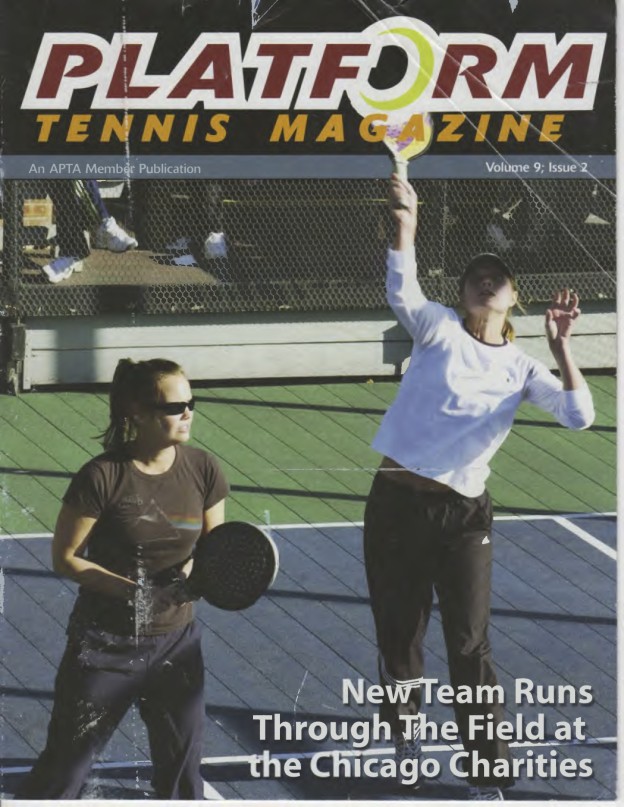
In the 2007 Charities (November), the new team ran through the 8th, 3rd, 2nd, and 1 st-seeded teams. None of the veteran players could recall any past team completing this feat.

“I hope we play more tournaments together,” Annica said. She concluded, “We want to play the National Championships together this March in Rochester. To win the Nationals would be the ultimate! I think we have a good chance as long as we are healthy ‘

Laura and Annica said that they didn’t have any goals or expectations of how well they would do before going into the Chicago Charities. It was clear after speaking with these ladies that having a good time, competing, and meeting new friends is what they are all about.

There is no doubt that this pair can be a force in women’s platform tennis for many years to come. Look for this team to make an impact at the 2008 National Championships.

Source: Platform Tennis Magazine, Vol. 9, Issue 2, December, 2007

Chicago Charities – Berendt and Cooper capture the Women’s and Caldwell and Cordish the Men’s

Screen Shot 2013-05-22 at 6.10.38 PM

With the lone exception of the National Championships, no other tournament packs the talent like the Chicago Charities. With few exceptions, the best of the best showed up for the 35th annual tournament benefiting the Northwestern Healthcare Kellogg Cancer Care Centers.

Women’s: On November 2nd, 52 Women’s teams kicked off the 2007 Chicago Charities. Six of the top eight teams from the 2006-07 season competed. Absent was the nation’s top team – Lauren Zink/Cindy Prendergast and the nation’s #6 team – Bobo Delaney and Tonia Mangan.

Last season’s #2 team of Sally Cottingham and Chris Sheldon took the #1 seed spot, while Delmonico/Main, Doten/Keane, Dardis/Shay, Prop/Schneebeck, Ohlmuller/Takach, Flynn/Tarzian and Henke/Lemieux rounded out the 2-8 seed spots. Tournament Director John Noble’s draw sheet ran as expected with all seeded teams reaching their anticipated finish with one exception and it was a major exception!

In the round-of-16, the 8th seeded team from Pittsburgh, Karen Henke and Nathalie Lemieux, ran into a freight train when they lost to Laura Berendt and Annica Cooper 6-0, 6-0. Cooper (New York City) had been playing the sport for just over a year when she called Berendt (Chicago), the assistant pro at the Glenview Club, looking to pair up. The two had been Chicago junior tennis rivals before eventually starring in college and eventually playing the pro circuit.

With all other seeds making their way into the quarterfinals, Berendt and Cooper ran into the top-seeded team (and #2 in the country), Sally Cottingham and Chris Sheldon.

After losing the first set 6-4, Berendt and Cooper stepped up their baseline ground-stroke attack. At the same time, they elected a net strategy rarely seen in the women’s game, with Berendt pounding low forehand overheads into the corners. The unseeded team won the remaining sets 6-2 and 6-4.

In the Saturday morning semi-finals, the 3rd seeded team, Mary Doten and Susie Keane felt little consolation with their drawplacement, knowing that they had to play the ladies that just defeated the #1 ranked team.

The two-hour match began at 11a.m. and was watched by 100+ spectators. Everyone got their money’s worth as the former national champions traded ground-strokes and volleys with the tournament’s upset team. In the end, Berendt and Cooper outlasted the veterans, Doten and Keane, 7-5, 4-6, 7-5 paving the way for a final against the 2nd seeded team from New York, Aila Main and Kerrie Delmonico-Stulac. Main and Delmonico-Stulac made their way to the finals by winning back-to-back three-setters against the #7-seeded team of Flynn/Tarzian (6-2, 3-6, 6-3) in the quarters and #4-seeded Dardis/Shay (7-5, 3-6, 7-6) in the semis.

On one side of the net, the finals exhibited powerful backhand drives from Main and well-placed forehands from Delmonico-Stulac. On the other side, Berendt and Cooper stunned the seeded team with powerful forehands and backhands from every angle.

With the final score of 7-5, 4-6, 7-5 it was certainly one of the most offensively-oriented women’s finals ever played in the Chicago Charities. All who attended were privy to an amazing show of platform tennis.

Men’s: For those surprised how packed deep the women’s draw was, they must have been amazed to see that 14 of the top 15 men from the 2006-07 season competed in the 2007 Charities.

The seeded teams were: #1 Cochrane/Estes, #2 Caldwell/ Cordish, #3 Goodspeed/Mansager, #4 Bancila/Easterbrook, #5 Gambino/Ohlmuller, #6 Keevins/Uihlein, #7 Berka/Granger and #8 Bondurant/Johnson.

The round-of-16 had one upset, if you’ll call it that, when two Chicago teams met up; one, a pair of former national champions- Mike Marino and Bill Fiedler and two, the #8-seeded team of Scott Bondurant and Mark Johnson. Marino and Fiedler defeated the seeded team and then went on in the quarterfinals to defeat the #1 seeded Mike Cochrane (New York) and Scott Estes (Toledo) 6-2, 6-2.

The biggest surprise of the men’s draw occurred in the Saturday evening men’s quarter-finals when the #6 team Uihlein and Keevins defeated the #3 seeded Goodspeed/Mansager, 6-0, 6-0!

The semi-finals were set with Marino/Fiedler against Gambino/ Ohlmuller and Caldwell/Cordish against Uihlein/ Keevins. Gambino and Ohlmuller made it to the semi after a tight 6-2, 7-5 win in the quarters vs. Bancila/Easterbrook and a win against Heil/English in the 16’s. Caldwell/Cordish reached the semis, defeating Albrikes/Jonason in the 16s and Berka/Granger in the quarters.

A game of momentum and match-ups, the semis showcased the best players in the sport, with Caldwell and Cordish advancing over Keevins/Uihlein 6-1, 6-4; and, Gambino/Ohlmuller over Marino/Fiedler 6-3, 6-3.

A hundred spectators packed the Glenview club to witness a display of inhuman reflexes, power, consistency and chessmanship. After 90 minutes of battle, Caldwell and Cordish walked away with the Charities title, taking the finals 6-2, 6-3.

Source: Platform Tennis Magazine, Vol. 9, Issue 2, December, 2007

Bulletworks launches “Advantage Paddle Courts” – growth eyed in Southeast and West

Bullet and Jacki Brown, owners of BulletWorks Platform Tennis, are pleased to announce the formation of Advantage Paddle Courts. The new entity was created to market ground level courts in Regions VI and VII. The first official Advantage court was installed this spring in Napa Valley, California.

“We see tremendous growth potential for the sport in the Southeast and West,” says Bullet Brown. “There are tens of thousands of active seniors in these areas who have never heard of platform tennis. We plan to introduce targeted groups to the sport and position our product as a smart recreational amenity for their home or community.”

BulletWorks, Inc. operates out of a 5,000 square foot manufacturing space in Rutland, Vermont. Currently, in response to limited market demand for new courts from the existing platform tennis community, BulletWorks manufactures 10-20 courts a year. “We could easily produce 80-100 Advantage courts a year,” says Brown. “We hope to get to that point within the next few years.”

The Browns are focusing efforts on ground level court construction for a number of reasons – one being that they are a lot less expensive for the buyer than traditional platform tennis courts. An Advantage Paddle Court is basically a standard platform tennis court superstructure installed on a concrete pad. By eliminating the heavy, expensive aluminum deck, the price drops significantly – for the purchaser of one court it can mean a $20,000 savings. That cost differential makes the discretionary purchase more realistic for many potential clients. [enlarge image to read full story]