Are today’s top players the best ever?

Mark Holtschneider opined.

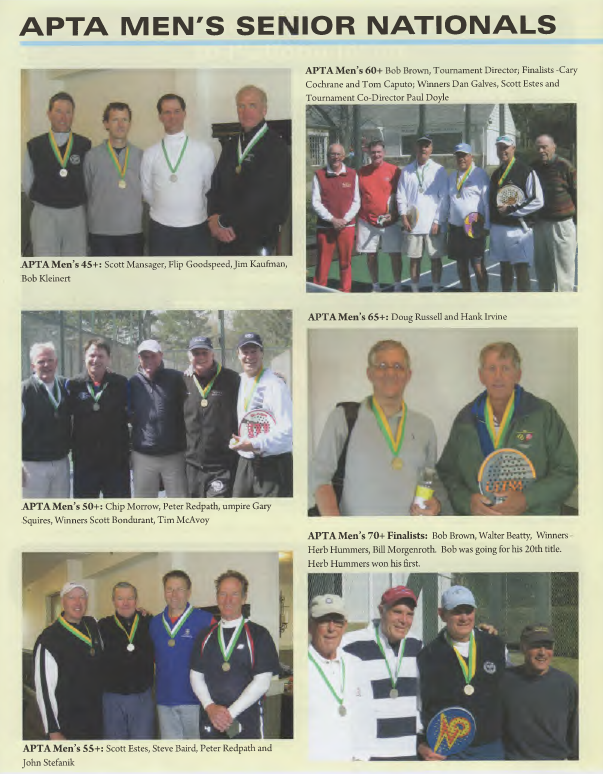
At this year’s National 45s/55s/65s Championship, a tape of the 1976 Men’s Nationals was playing in the paddle hut. The play was dominated by lobs and soft overheads to the corners. There was an occasional flat forehand drive. There were no Mansager-like crushing forehands, no Goodspeed-like two-handed backhand drives, and no Uihlein super cut overheads. Contemporary players look much quicker and more athletic. A few players in the hut said that today’s top players are definitely better than the best players of the ’70s. Others agreed that athletes in all sports are better today than they were 30 years ago – track times are faster, pole vaults are higher, basketball players are taller, and football players are bigger.

I disagree. I think the late 1970s champs could compete with the best of today’s players.

First, the rackets and balls in the ’70s were very different from today. The rackets were wooden and much heavier. The balls were denser and much less bouncy. As a result, many of today’s shots could not be hit with the old equipment. Just because today’s players hit harder and with more spin does not mean that the former champs could not have done the same things with today’s paddles and balls.

Second, the “Tennis Boom” was in full swing in the 1970s. More Americans played tennis in that decade than today. Nearly every top platform tennis player was first an accomplished tennis player. If there were more tennis players in the ’70s, then it stands to reason that there would be more good platform tennis players.

Finally, there was the money. In the 1978-79 platform tennis season, Passport Scotch offered over $100,000 in prize money. The year-end tournament alone was $50,000. In inflation adjusted dollars, that’s $160,000 for just the last tournament! Not surprisingly, that kind of money attracts top players. For example, the 1977 and 1978 Men’s Nationals were won by Herb Fitzgibbon and Hank Irvine. Fitzgibbon played on the U.S. Davis Cup team and won a gold medal in tennis at the 1968 Mexico City Olympic Games. Irvine played Davis Cup for Rhodesia and was a semi-finalist at Wimbledon in Mixed Doubles. In 1979, Clark Graebner and Doug Russell won the Men’s Nationals.

Graebner was a member of a winning U.S. Davis Cup team, a Wimbledon singles semifinalist, a U.S. Open finalist, and a French Open doubles champion. These players competed at the highest international level and had incredible racket skills. Those skills easily transfer to platform tennis. And, these players were only in their mid-thirties when they won their platform tennis National Championships. (As a point of comparison, if three similarly accomplished tennis players, ten years off their prime, entered platform tennis today, we’d see the likes of 1998 Davis Cuppers Todd Martin, Justin Gimelstob and Jan-Michael Gambril.) Could the late ’70s champs compete well today? I sure think so.
Paddle under the influence…..of Tennis

David Caldwell & Blake Cordish had thoughts on the subject:

Over the last five to seven years a fresh crop of experienced tennis players has dramatically influenced the way the modern game of paddle is being played. Tennis players have helped to make paddle a faster, more aggressive game characterized by new shots, spins and strategies.

New Shots
Tennis players have brought their ground strokes to paddle and the effect has been increased pace, spins and additional offensive firepower off both sides from the baseline and the net.

On the forehand side, many tennis players utilize a semi-western grip that allows for more topspin so the ball can be struck harder and still come down in the court. This has also allowed for new offensive strategies such as using an off-pace, topspin groundstroke to dip the ball to a net person’s feet so the player can then “blitz” and volley the next shot, effectively ending the point or taking over the net position.

Interestingly, the semi-western grip has also introduced a new offensive shot for the net person with the full swinging forehand volley. Generally hit off of a short lob, this swinging volley is actually a forehand groundstroke hit with tremendous velocity targeting the feet of the baseliner. The goal is to aim at the backcourt player’s feet so he has to take a half-step back to avoid being hit, thus making it harder for his team to track down the next ball after it comes off the back wire. This, coupled with increased side spin on the overheads, has provided a way for the net team to more effectively control the point by keeping the backcourt team off balance and making it harder for them to get a clean ball to drive or lob.

On the backhand side, the most noticeable shift is the number of tennis players that have brought aggressive, two-handed backhands to paddle that obviously leads to more offense and takes away “safe” zones for net players to hit to. One interesting result, as traditional in tennis, more and more two-handed backhanded players are standing in a “neutral” position to return serve versus the traditional paddle stance that opens up the forehand. This provides for a more varied and therefore more effective return strategy.

Faster Points
One of the more subtle but substantive changes introduced by tennis players is the speeding up of the game, not only in terms of pace of shot, but also in the tempo of points (i.e. less time between balls being struck and quicker points with fewer lobs). Tennis players, without the benefit of wires, are obviously conditioned to take the balls off the deck. As a result, fewer balls are being left to the back wire.
Interestingly, tennis players are much more likely to “control” a point from the baseline with drives than they are lobs. It is certainly not clear that this strategy is necessarily the most effective, but it does make for a faster paced, more dynamic game, especially with four tennis players on the court.

New Technology
Along with the players, major tennis equipment suppliers like Wilson, have played a more pronounced role in paddle and brought over existing tennis technology. For example, when we took up paddle eight years ago, we naturally gravitated to Wilson because the grips were shaped like tennis grips versus the traditional smaller, rounder paddle grip. Wilson has retained the tennis grip trait but, reacting to the feedback of players, has introduced improved paddles that are firmer and provide more feel and grit that has allowed for more effective spins. Today’s paddles are more conducive to an aggressive style of play that was not possible even as recently as five years ago.

New Strategies
All of the above tennis influences have contributed to evolving strategies in paddle. In addition, it is important to note that while errors play an important role in tennis, winners do as well. Tennis players bring to paddle an instinctive desire to figure out a way to end points. In some ways, it is the Achilles heel of tennis players when they first take up the game, but this mindset has also helped to evolve and improve the game as tennis players creatively look for ways to win points versus avoiding losing them.

Perhaps, the most pronounced and most exciting trend is the growing importance of “blitzing” or opportunistically charging the net to volley an opposing team’s volley. The basic goal is take advantage of a dipping or hard hit groundstroke to make the opposing team volley up. The best volleys from the blitzing team are generally aimed right back at the first volleyer’s forehand hip. A tennis background which focuses on increased topspin, an instinctive preference to take the ball off the deck and court positioning closer to the baseline, all make this offensive strategy a natural for tennis players.

Even with all the exciting offensive influences tennis players are bringing to paddle, it is critical to remember that with its small court and the lively nature of the present day ball, that paddle is ultimately not a game of winners but of errors. For tennis players, coming to terms with that mindset is critical. This year’s Men’s National Champions, Flip Goodspeed and Scott Mansager, are a great reminder that whether you have a tennis background or not, ultimately sound fundamentals are essential to success on the paddle court.

Coverage of the Mixed Nationals

Marjorie Hodson reported for PTM:

The weather was beautiful, the site spectacular and the tournament committee, Indian Trail Club staff and volunteers outdid themselves in staging the 2009 Mixed Nationals and Husband-Wife Mixed Nationals.

With sunny skies and temperatures that were cool enough for the players but comfortable for the spectators, the Indian Trail Club hosted the Mixed Nationals the weekend of March 13 — 15. The club took this opportunity to show off their new McBride House, which is so much more than a paddle hut! The staff anticipated needs before the contestants even knew they had them – with such touches as a bin of ice and plastic bags for after match aches and pains — to add to a memorable weekend.

Play began on Friday with the Husband-Wife contests, with both Open and Senior divisions playing in a one-day format. In the Open draw, Jessica and Matt Guyaux of Pittsburgh survived three straight 3-set matches to finally defeat Sandra and Fritz Odenbach, of Rochester, and claim the gold medal.

The Senior Husband-Wife tournament saw new teams in the finals, with neither of last year’s medalists making it that far. Janet and Chuck Faig (Gillette, NJ) took home the gold medal, with Laurie and Steve Schelz (Riverside, CT) earning the silver.

On Saturday, play in the Open Mixed Nationals began at area clubs. Following lunch, all matches were scheduled for the eight courts at Indian Trail Club so that there was a lot of action for the spectators to watch. By late afternoon, all back-draw play had been completed and there were four teams left in the main draw.

Multi-time champs Bobo Delaney & John Milbank faced Aila Main & David Caldwell and Cooey Burkhart-Lyon & Scott Falatek squared off against Liz Jaffe & Juan Arraya in the Sunday morning semi-finals. Main & Caldwell (NYC) and Jaffe & Arraya (Port Washington, NY/Cos Cob, CT) emerged victorious.

In an amazing display of athleticism and skill, Main & Caldwell prevailed to claim the Mixed Nationals title for 2009.

Source: Marjorie Hodson, Platform Tennis Magazine, Vol. 10, Issue 5, 2009

APTA President Mark Fischl (2004-2009) bids adieu

As I finish up my last year as President of the APTA, I realize how lucky I was that John Horine approached me seven years ago and asked me to consider succeeding him.

These last years have flown by. Recently, one of my friends on my league team asked me if I was glad to finally be done. I quickly responded with a resounding “no.” I am sad my term is over. I have loved almost every minute of it.

During my first year serving as a shadow Board member, I participated without an “official” vote in all Board activities, although John always encouraged me to voice my opinions. I’m sure he did not realize how little a concern this was!

The first year of my presidency was a year of transition. Term limits had been enacted and the entire Board was being replaced over a three to four-year period. In considering who my vice president would be, the name that came to mind immediately was Scott Bondurant. He and I go back over 35 years, when we played tennis together as kids. Later we were reunited, playing the National Father-Son Circuit. Scott has always been one of the smartest people I know, and one of the best at finding good people to do quality work. He certainly helped me and the APTA immensely!

My first opportunity to spend significant time with Tim McAvoy was at the 2003 Board meeting. I was immediately impressed with his ability to get to the crux of an issue and not be distracted by ancillary issues. I knew that I wanted him to be a part of my team. What a surprise to discover later that Scott and Tim were cousins! To suggest that there would be some byplay over the next few years would be an understatement.

There were several board members leaving at the end of John Horine’s term, providing an opportunity to suggest several people for the proxy. Among those selected was Sally Cottingham, who became treasurer. While being treasurer would have been more than enough for most people, Sally brought several other terrific qualities to the Board. First and foremost, she spoke the plain, unvarnished truth, a rare and valuable trait that had me and everyone else laughing on more than one occasion.

Another addition was Todd Ward, whose work on the exhibition tour has been one of the APTA’s most successful initiatives. His tireless effort organizing clinics for adults and kids at all the tour’s stops has been amazing. His contributions were instrumental in growing platform tennis around the country.

Of course I cannot say enough about our Executive Director Ann Sheedy, who never seems to go off duty. Ann has been both a pleasure to work with and a terrific ambassador for the sport.

A true team is one in which the whole is greater than the sum of the parts. Working with this group of extraordinary people has been a privilege and a joy, and I have learned so much from them. They and the other wonderful Board members that served with us, along with the many members who added their contributions, deserve so much credit for the accomplishments of the last six years. Thank you for allowing me to be the President of this great organization.

President’s Cup – Region IV Women and Region I Men come out on top and Region VI sends a full Women’s team for the first time

Region IV Women’s team included Kathy Allen, Janet Mazzola, Ann Turner, Kelly Fischer, Tammy Simone, Sandra Odenbach, Chrissy Johnston, Lynn Thompson, Nancy Budde, and Lindy Ward

Region I Men’s was captained by Mike Cochrane and included Juan Arraya, Mark Ruppert, Ray Crosta, Mark Parsons, Drew Broderick, Guy Moore, Scott Slobin, Patricio Misitrano, Chris Fitzgerald, Brian O’Connor, and Mike Stern (not pictured at left)

Teaching pro Christi Hayes had arrived in Ross, CA from Pittsburgh in 2007 and had added energy to the program by starting a junior program and league play. By 2009 Region VI was able to send a full women’s team to the President’s Cup.

Hall of Fame Inductees: Sharon Hummers, Winnie Hatch. Plus 2008 Inductees Scott Mansager and Flip Goodspeed who made the ceremony this time!

In a celebration held at the Women’s 40/60 National Championships on February 11, 2009, Winnie Hatch and Sharon Hummers were inducted into the Platform Tennis Hall of Fame, in recognition of their outstanding achievements both on and off the court over many years.

The induction presentations were delivered by Steve Baird for Edwina “Winnie” Worth Hatch and by Bob Brown for Sharon K. Hummers, before a large, enthusiastic, and appreciative audience at the Canoe Brook Country Club in Summit, New Jersey. Each honoree acknowledged the election with thanks, and other comments of adoration followed by several relatives and friends.

The induction of Mansager and Goodspeed, the 2008 Hall of Fame Inductees, took place on January 17, 2009 at the Cincinnati Midwesterns. Todd Ward explained why:

The Cincinnati Midwesterns played out the way most Midwesterns have gone for the last several years. What differed this year was that at the Saturday night party at the Ridge Club, 120 people witnessed a little platform tennis history.

Cincinnati benefitted from the lengthy quarter-final match that Flip and Scott played at previous year’s 2008 Nationals in Rochester. As a result they didn’t make it to ceremony of their induction to The Platform Tennis Hall of Fame until after 10:30 p.m. which required rescheduling the ceremony until the 2009 Cincinnati Midwestern’s.

Hall of Fame representatives Steve Baird, Walt Peckinpaugh, and Fritz Odenbach were all on hand to dedicate the honor to the sport’s greatest team to ever play the game. All talked of the amazing feats the duo accomplished on the court – not to mention off the court as well. Both players addressed the crowd with some light-hearted barbs at each other but humbly accepted the honor with the same ease and grace they displayed on the court for 16 years together.

The induction speech for Goodspeed and Mansager was delivered by Steve Baird.

And by the way, Goodspeed and Mansager defeated Estes and Cochrane 6-4, 7-5 in the Midwesterns final. Flip and Scott hope to continue their mastery of Cincinnati this March as they will return and go for their 8th National Title in March.

Source: Platform Tennis Magazine, Vol. 10, Issue 4, February, 2009