


Senior Women’s Nationals

Women’s 40+ and 60+ National Championships
The weather was spring-like and the ladies showed there was still a lot of spring in their step as they competed for the Women’s 40+ and 60+ National titles.

Helen Garrett and Sandy Simmers once again claimed the Women’s 60+ National title despite strong competition from some new teams. This was their 5th gold in a row and their 6th as a team. In a rematch of last year’s final, they defeated Louise Cash and Mary Fenton by the score of 6-2, 6-7, 6-4. Other winners were: Winnie Hatch and Courtia Worth, 3rd place; Ginny Sniatkowski and Ruth Weil, 5th place and Sharon Hummers and Hope Kerr, Last Chance winners.

An exceptionally strong field in the Women’s 40+ event led to some exciting matches. Continuing their title run, Cynthia Dardis and Amy Shay defeated Bobo Delaney and Tonia Mangan to win their first National title. Liz Jaffe and Sue Tarzian topped Robin Fulton and Betsy Heidenberger in the battle for 5th place and Donna Charlton and Janet Faig finished 9th, ahead of Darlene Finnegan and Susan Penney. Lamia Beydoun and Debra LaMountain claimed the Consolation crown and Anne Delaney and Amanda Dolan won the Last Chance battle.

Women’s 50+ National Championships
Frigid temperatures did not deter the enthusiasm of the 23 teams participating in the Women’s 50+ National Tournament at Fox Meadow Tennis Club on January 14. Given the caliber of the teams involved, it was not surprising that there was some incredible platform tennis played that day. The team of Bobo Delaney and Sarah Krieger, newcomers to the 50+ tournament, lived up to expectations. The number one seeds had no trouble reaching the finals where they played the unseeded team of Janet Faig and Donna Charlton who also had little trouble reaching the finals. The match was played on January 15 at the Center Court Tennis Club in New Jersey. Given that all four participants were from New Jersey, there was a great turnout to watch the finals where Delaney and Krieger beat Faig and Charlton 6-0, 6-4. Congratulations to both teams and to all the participants. It was an exciting tournament and one that is expected to get bigger each year as more paddle playing women reach the magic age of 50!

Submitted by Judy Luskin

Women’s 70+ National Championships
The Women’s 70+ National Championship was played at Fox Meadow Tennis Club on January 14, 2009. The day had a very low temperature, but a very high spirit and performance. The first seeds, Sharon Hummers and Ann Moriani, lost in an exciting first round 3 set match to Hope Kerr and Betty Michinard. Kerr and Michinard went on to win the tournament with two more 3 set matches. Gingie Greene and Lynne Verna in the semis gave them a fight with the score 7-5,1-6, 6-3. The fmals were also exciting. They played the second seeded team, Nancy Libby and Margot Turk, 6-4,6-7,6-2. They all played beautifully. It was a proud day for all the 70+ women who participated.

Submitted by Ann Brown
Paddle’s newest weapon – The Dagger

Deception can be an effective weapon in any paddle player’s arsenal. Throwing up an offensive lob when your opponents are on top of the net or hitting a drop shot off a hard drive will keep them off balance and lead to a lot of free points. Here you will learn how and when to attempt a Dagger, an extremely low percentage shot that, if executed successfully, could win the point outright and get some laughs in the process.

The Dagger is a shot off the end of the paddle that should only be tried under certain circumstances.

The Set-up
A good spin overhead from an offensive position backs one of your opponents deep into his corner and puts him on the defensive. All he can do now is hope to dig the ball out and keep the point going. A weak floater towards the middle of the court is the perfect setup for a Dagger attempt.

The Reaction
The other team sees that they have hit a weak shot and prepare to suffer the consequences. They will be expecting you either to hit a slash back into the corner or maybe a drop shot that will force them to lunge forward in a desperate attempt to stay in the point.

The Execution
To set up for the Dagger, point your paddle directly at the net. If the opponents see this they will think you are setting up for a drop shot into one of the alleys.

As they lunge forward, you execute the shot by hitting the ball off the end of the paddle.
Do not thrust forward too much as this will make the shot more difficult. Just allow the ball to come to you and let it bump off the end of your paddle.

A perfectly executed Dagger should bounce for the first time near the service line at the T. At this point your deflated opponents should be completely out of position as the ball heads right up the middle between them. (Note: An off-center dagger hit could spin off the edge of the paddle and become a drop shot winner so hit the shot from very close to the net)

Once you have mastered the Dagger, or become bored with it, and you need to add even more variety and arrogance to your game, it is time to try a Bagger (The Butt Dagger is shown below). Here you just simply flip your paddle over so the tip is pointing behind you and hit the ball with the butt of the paddle. Then duck!

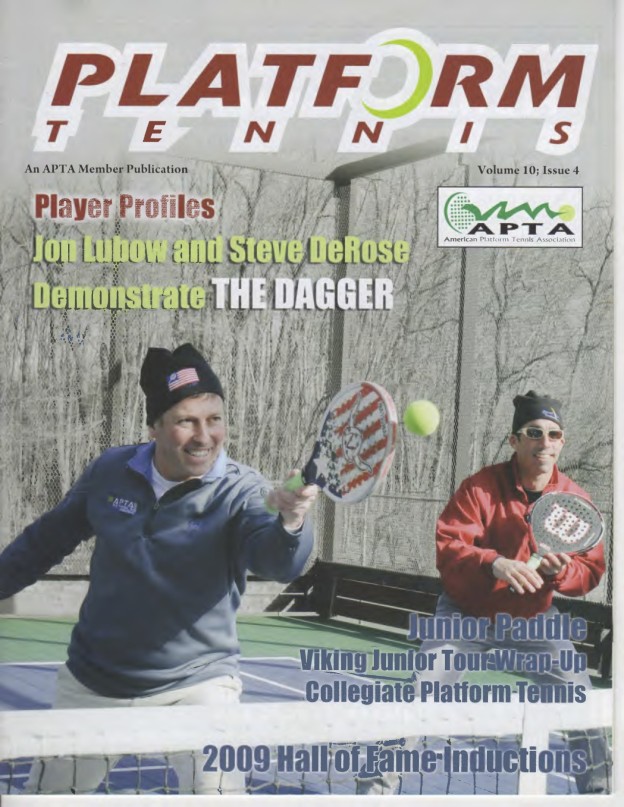
Player Profiles: “The Dagger” Men – Jonathan Lubow and Steve DeRose

Jonathan Lubow

Hometown: Randolph, NJ
Spouse and Kids: Wife: Jessica. Daughters: Caroline (8), Katie (5)
Hobbies: Gardening, Golf, Skiing
Personal Note: Wrote Options on Futures: New Trading Strategies
Paddle used: The National
Favorite shot: The “Dagger”
Sports experience: Played tennis in high school
Team accomplishments: 2006 and 2009 NJ State champs, 2008 Chicago Charities champions

Platform tennis partner history: “I used to play with Chip Dyer. He moved to Colorado four years ago and I hooked up with Steve.”

How do you train for the season: “I do not train. I try to play all year round. Night paddle in summer is great.”

Nutritional regimen, vitamins, stretching, etc.: “I drink Gatorade and I never stretch.”

When did you start playing platform tennis? “After College. Charlie Stevens (Paddle Legend) got me into the game.”

What do you like most about platform tennis? “Fun, exercise, and camaraderie.”

How did you partner with Steve DeRose? “Steve is the tennis pro at our club (Morristown Field Club). He just took up the game five years ago. I was captain of our team and played the first doubles court. He was playing the 4th court. When my partner moved away, I pulled Steve up to be my partner.”

How would you like to do in the 2009 Nationals: “In the 2008 Nationals, we lost badly to Caldwell and Cordish in the round-of-16. In the future, we would like to do better.”

Future goals: “Be a good husband and father.”

Steve DeRose

Hometown: Morristown, NJ
Hobbies: Golf, Reading, Skiing, Gym, Thinking, and Photography
Paddle used: Wilson K Boom
Favorite shot: Any shot that ends the point
Started playing paddle: After lunch one day with Drew Broderick
Paddle partner history: Paul Marshall, Bill Maxwell, Sean Flanigan, Carol Kimmelman, Jonathan Lubowmirsky
Sports accomplishments and experience: MHHS one-on-one basketball tournament winner, Rutgers Keller Cup, Men’s B National Finalist, A-10 All-Conference Men’s Tennis

How do you train for the season? “By doing the opposite of what Jon does… eating right, Beekram yoga, Pilates, boxing, weight training. I am also into Vapor, athletesperformance.com routines in which you prehab the body before stretching.”

Why do you play paddle? “It is an incredible community of fun, exceptional, competitive people playing an equally remarkable humbling game.”

How did you meet up with Jon? ” Jon’s partner Chip Dyer happened to be moving the year after I started playing.”

How would you like to do in the 2009 National? I would be really happy with any result that came out of playing consistently tough, aggressive paddle.

Future goals: ” I would like to continue to enjoy the challenge of playing our best in the biggest moments. As an instructor, I would like to continue making the most challenging parts of the game accessible to those who want to learn it.”

Paul G. Sullivan (1927-2009)

Hall of Fame inductee, Paul G. Sullivan, died on February 4, 2009 in Vero Beach, Florida, at the age of 82.

He was born in Brooklyn, lived most of his life in Scarsdale, New York, and in recent years, Vero Beach. He attended Princeton University, and served in the Navy as a radioman in Annapolis. His work career spanned over 50 years, first with Hayden Stone and then with Smith Barney.

Paul served for many years on the Board of the American Platform Tennis Association, and was APTA President from 1963-1965. He was also President of the Fox Meadow Tennis Club from 1967-1969.

During the 50’s and 60’s, he was a major contributor to the activities of the APTA serving, among other things, as Chairman of many National Championships and as Chairman of the APTA Umpires Committee. He was also a USTA umpire, and served in that capacity at the U.S. Open and at Wimbledon.

He was instrumental in the APTA’s establishing of the Honor Award in 1965, to recognize individuals of distinction in platform tennis, which designation was changed in 1998 to the Platform Tennis Hall of Fame.

In recognition of his long-term service and outstanding contributions to the game, he was inducted into the Hall of Fame in 2002.

Source: Robert A. Brown, Platform Tennis Magazine, Vol. 10, Issue 4, January, 2009

APTA Board Nominations – Tim McAvoy, Hendy Dayton, Amy Halstead, Fritz Odenbach and Aila Main

Tim McAvoy, a Phoenixville, PA, native, graduated from Penn State in 1980, worked 18 years with GlaxoSmithKline and the past 10 years with Marvin and Palmer Associates—an institutional money management firm.

Tim was introduced to platform tennis by his mother, 1992 Hall of Fame inductee Lucie Bel, and has been playing competitively since 1982. Tim has been a member of the Region III men’s President’s Cup team over the past 25 years and is a former Men’s 45 and Mixed Doubles National Champion, with John Adams and Diane Tucker, respectively.

Tim served on the APTA Board from 1999- 2006, was a founding member of the Platform Tennis Museum and Hall of Fame Foundation and currently serves on the Platform Tennis Hall of Fame Selection Committee. Tim also serves on the Philadelphia MAPTA Board.

Tim and his wife Nancy, have four children: Tom (20), Jen (18), Lindsay (16) and Wil (14) and three dogs. Tim is a Stage 4 Hodgkin’s cancer survivor and an active member in cancer-related support activities like Relay for Life. One of his core beliefs is that attitude is everything: “10% of life is what happens to you and 90% is how you choose to deal with it.”

[Read about the other nominees at left]

Player Profile: Scott Bondurant

Scott Bondurant

Age: 49
Residence: Chicago, Ill.
Family: Wife: Susan; Daughters: Brooke, 13; Cara, 11
Occupation: Asset Management
Hobbies: Tennis, Golf, Travel

Do you have an awareness of the fact that you’re playing guys that could be 30 years your junior?
I’d be lying to say that it isn’t fun to be able to compete with players that are a lot younger. It’s still fun to be out there playing in the open division. The other thing is platform is very conducive to continuing to be able to play, to compete at older ages simply because it’s a smaller court and it’s all doubles. If you can find a partner that can cover a large part of the court, you can hang in there.

Do you prepare differently mentally than you have in the past?
Not really. I would just say that I probably don’t get as nervous about matches as I used to. I just go out there and take them as they come.

Has your training regimen changed over the years?
My warm up runs used to be a lot longer than they are now. I’m more likely to get tired if I run very long.

How long do you see yourself competing in the open levels of competition?
It’s a really good question. As long as I can truly compete, and feel like, on any given day, that when I’m playing with a top-notch partner that we can beat anybody.

How long have you been playing platform tennis?
I started playing basically 20 years ago and love the sport.

What about the sport keeps your interest?
The game is just a ton of fun. I guess three things, first and foremost it’s wonderful to be able to get outside in the winter athletically. Two, it’s hugely social. It’s a great group of people who play the game. It’s a tight knit community. Three, the fact that I can still compete at a high level keeps my interest as well.

What other athletic activities do you pursue?
I played very competitive junior tennis and college tennis and professionally for a period of time. It was a fairly natural transition to take on platform tennis. When I was very young, I lived in the Scarsdale, New York area, and my parents played. My mom’s sister Lucy McAvoy is a platform tennis hall of famer, and my cousin Tim has been one of the top players in the Philadelphia area for 25 years.[Note: Scott’s mother, Helen Barnes, was a very accomplished tennis player. See The Barnes Sisters]

Does your family share your passion for the sport?
My wife plays, and plays Series 2 in the Chicago women’s leagues. Both kids also play a little bit.

Do you play as a family and give each other pointers?
The kids are starting to get old enough where we can begin to have a little competition, but they have been too young to play at any serious level yet. Because my wife plays, she’s been very supportive.

Do you have any role models or players who have inspired you during your playing career?
Rich Mayer stands out, along with Steve Baird, as giants of the game to me. They were the best team by far when I first started playing

Do you have any tips or advice for those just starting out in the sport?
The only comment that I would have would be that you can continue to improve for a much longer period of time than you might think. Your first 10 years of the game – if you’re 25, will continue to improve, and you’ll stay at a pretty high level for a period of time. The other thing is hey, in the end it’s all about having fun and nobody takes paddle too seriously.

Where do you find yourself learning new techniques or styles to add to your game?
I’m a big beneficiary of all the top-notch players in the Chicago area. The more you play with people with different styles and shots, that will just help your game. Getting out there and playing with real strong players is far and away the most important thing.

Any final thoughts on the sport?
I’d say that I would expect the kind of generation of players that are in their late 30s early 40s to continue to be competitive for quite a while. It’s nice that I am it’s one of things that I wouldn’t be surprised if there are more guys that end up playing well into their 40s. I’ll play in the 50s and over this year, but still think that my partner Mark Johnson and I will be competitive in the open.

Source: Platform Tennis Magazine, Vol. 10, Issue 3, January, 2009

Scott Mansager has thoughts on lobs

I’ve had a lot of discussions over the past couple of seasons with a number of players about the lob “bounce out” loss of point rule. I think this rule should definitely be changed for the following reasons:

1. Lobbing effectively in platform tennis requires a lot of skill in a 22 feet deep court (note: a tennis service box is 21 feet deep). Any lob hit high/deep enough to bounce
out of the court would give the net team enough time to get under the ball and decide whether or not to play it out of the air. It is difficult to get your opponent much behind the service line with low trajectory lobs even if they would land deep untouched and the good overhead hitters handle the high/medium depth lobs pretty well. A higher trajectory lob would come down steeper and if hit deep enough would force the overhead hitter to take an additional step back thus creating more potential offensive opportunities for the backcourt team.

2. The old Vittert ball would rarely bounce out unless you hit a “sky lob”, but in warmer weather (above 45 degrees or so) the newer Viking and Wilson balls are bouncing out with some lobs that are hit just a little higher than the height of the lights. The risk/reward for the lobber trying to hit that high/deep lob in warmer weather is not worth it.

3. At the inaugural Premier Cup in 2005, the players voted to override this rule. I didn’t notice much of a difference in play. I saw two lobs bounce out for winners, and that was because one of the players was late for the pre-match instructions and didn’t know about it, and the other did it on purpose at match point (down 0-5). Based on my experience playing at this event I think the fears are overblown that changing
this rule would damage the game — for two reasons:

• Any lobber trying to get too “greedy” with hitting high/deep lobs is going to miss more
and they will learn to tone it down.
• The net team will adapt to well-hit high/deep lobs by playing them out of the air if
they think it will land in and bounce out.

4. You can’t compare the “spike” overhead that bounces out of the court since almost anyone could do that off of a short lob to a skillful high/deep lob that has a certain degree of risk to it.

I guess the bottom line for me and some of the players that I talked to is that we don’t think it is right to penalize a skillful shot — especially a high/deep lob in a 22 feet deep court where the net team has the option to play it out of the air. At the very least it shouldn’t be a loss of point.

Platform Tennis websites worth a peek according to David Kjeldsen

Our sport is growing, and growing quickly. This is evidenced by the number of websites devoted to league play and area play across the country. While I am sure I am missing quite a few, below is list of sites that I recently compiled. (If you know of others, please let me know.)

Clearly some of the sites are updated almost daily. Sadly, others haven’t been updated in over a year. Some are hokey; some are professional to the max. Some are purely data driven; others are all about the story. But the bottom line is they seem to work for the groups they serve.

If you have a half hour or so, spend some time visiting each of the sites. You may get ideas to share with your league webmaster to make your site better.

Please let me know your favorite. Mine is the Western Pennsylvania Platform Tennis Association. [enlarge image to read more]

My Serve – David Kjeldsen opines on the good and the bad

FAULT – Roving Foot Fault Judges. Where were they at the first large APTA tournament of the season? I watched over 15 hours of matches at the Chicago Charities, and I didn’t hear one foot-fault called – although I saw a lot. I thought the new APTA rule was roving foot fault judges were to be used at all national ranking tournaments. Maybe I was in the wrong place at the wrong time when I was watching? Funny, I didn’t see any at the Sound Shore Invitational either. Surely I will see them next weekend in the APTA Presidents back yard for the Long Island Invitational.

ACE – Peachtree Paddle, Atlanta, Georgia. Gotta love any platform group that gives out great car window decals to their members. The three-color design really stands out. Contact them and maybe you too can get one.

ACE – Videographers. With the technology available today, there is a lot of great information regarding platform tennis on the web. Thanks to all the camera guys who make this possible. Have some fun. Search “platform tennis” on YouTube and you’ll learn a lot and smile a lot.

FAULT – Member Lookup. One of the best features of the old APTA website was the “Member Lookup.” It is still not back on line.

DEUCE – Member Lookup. The Long Island Platform Tennis Association is one of several leagues across the country that have their entire membership directory online in a password protected format that alleviates some of the privacy concerns that open association lists have had in the past. Once LIPTA and others figure out how to automatically generate responses by E-mail for requests for forgotten passwords and or membership numbers all will be “aces.”

DEUCE – APTA Board Members. I am not sure how much conversation about platform was generated, but kudos to all the board members who sported their APTA vests at the Chicago Charities. For players with gripes or grapes, the board members were clearly visible to and available to all. Sadly, no board members I saw at the Sound Shore Invitational were identifying themselves.

ACE – PPTA. 100+ current and future players came out to see top PPTA pros and national, champions, all from Chicago, play an exhibition at the Cherokee Town and Country Club in Atlanta on November 1. Special thanks to Peter Lauer, the driving force behind the event.

Roving Foot Fault Judges – Region III’s initial experience by Fred Gumbinner

As most of you are aware, this is the first season of the Roving Foot Fault Judge. I have not received an update on the experiences in other regions, but I will report on the first tournament where we used RFJs in a Region III PCQ Tournament. We did it at the Mid-Atlantic Championships, held at the Chevy Chase Club (and Columbia Country Club) in Washington, DC.

The bottom line is that it was a great success. [enlarge image to read for report]