


APTA Board Adopts Trial Foot Fault Awareness/Enforcement Policy

Fred Gumbinner, Chair of the Players Committee filed the report in PTM

As most of us are aware, foot faulting has become a pervasive problem in the game of platform tennis – both at the social level and at the competitive tournament level. It has been exacerbated by the fact that there is often resentment or even outrage when a player calls a foot fault violation.The one enforcing the rule as opposed to the perpetrator is sometimes labeled the “bad guy.”This phenomenon does not occur when one calls a dearly out ball out; yet it does with respect to foot fault violations, even though both instances constitute a loss of point under the rules of the game.

There is no need to discuss the policies against foot faulting as there is almost universal concurrence that players should not foot fault. Various ideas have been suggested and debated as to how to effectively enforce the foot fault rule and to get players to abide by the rule while maintaining harmony among competitors. The fact is, that most players that foot fault are not even aware that their service motion results in a foot fault. As such, procedures or mechanisms to increase awareness are often effective. This article will not discuss the numerous suggestions that have been made to increase foot fault awareness and enforcement, but will explain the current proposal the Board adopted.

At the Annual Board meeting last May (2008), the APTA took specific action on the matter. The Players Committee recommended, and the Board unanimously approved, the following policy for the 2008-09 competitive season:

Each Region is required to have one or more Roving Foot Fault Judges (“RFJ”) in at least one of its regional tournaments. The RFJ may issue one warning to a player before a violation renders a loss of point. The RFJs are encouraged to move around to as many courts and locations as reasonable and practical. Furthermore, RFJs are mandated at the 2009 Nationals in Cincinnati, Ohio.

The Region Presidents are to determine which regional tournament or tournaments will use the Roving Foot Fault Judges. The Region Presidents along with the respective tournament chair will determine the logistics (and any dispute resolution mechanisms) for the RFJs at the tournament(s). In general, the RFJs have the same responsibility and authority as an umpire with a respect to making the calls. i.e., they are required to make the call and such calls stand without discussion or debate.

Furthermore, the National Championships in Cincinnati will have RFJs at various locations and, as usual, the umpires for the semi-finals and finals will continue to call foot fault violations.

The Players Committee and the Board recognize that this interim solution is not perfect. The goal is to start a program that increases the awareness of foot faults and leads to the reduction in violations. The policy adopted by the APTA does not limit, nor is it intended to limit, any player’s right to call a foot fault during a match. In fact, it is hoped that more players will do so. The RFJs are merely a supplement to the existing mechanisms.

Regions, tournament directors and players are encouraged to continue and increase their own monitoring and enforcement of the issue.

This policy is a requirement and the Board hopes that all players give the RFJs the deference, respect and support that these volunteers, that are trying to help the game, deserve.

Source: Platform Tennis Magazine, Vol. 10, Issue 3, January, 2009
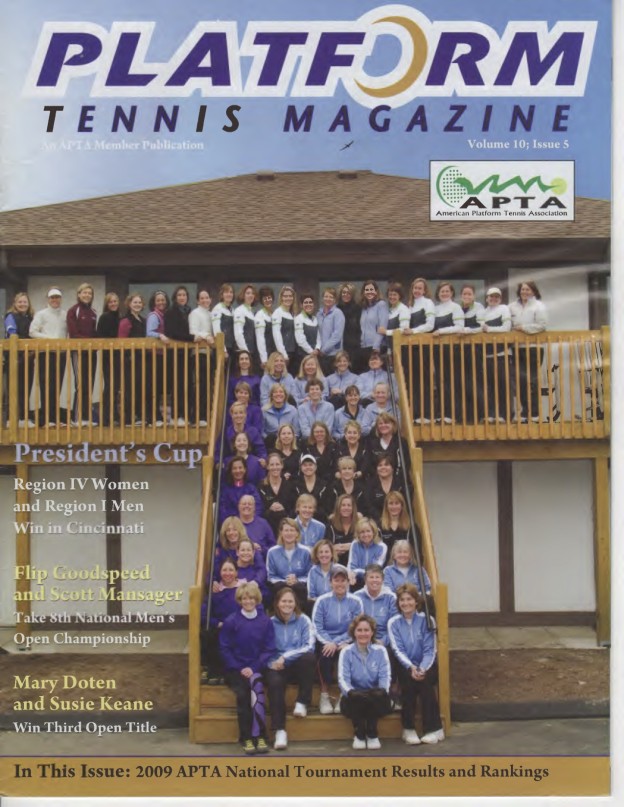
Results of National Championships and coverage of Men’s and Women’s Nationals

2009O&S
2009J

PTM reported from Cincinnati:

Mary Doten and Susie Keane Reach High to Capture Third National Title

In some ways, the Nationals is like any other tournament. There are draws, favors, reunions with friends, good lunches and the highs and lows of personal performance. But the Nationals is also something very different. There are temporary courts and a camera tower. Every hut has monitors and extra balls. There’s a merchandise tent, lots of sponsor banners and multiple parties. A masseuse works tired muscles. The finals play to big crowds. And at the Nationals the “thrill of victory” and the “agony of defeat” are just that much more intense.

The bulk of the women’s tournament was played Friday. Play started at 8 a.m. and ran reasonably on time, with the last quarters finishing up just before 6 p.m. The weather was warm and windy like Thursday, with overcast skies.

All the seeds passed through to the quarter-finals and the growing audience was treated to exceptional paddle on all sides. On the permanent courts, spectators watched the Delmonico-Main/Prop-Schneebeck match as well as the Ohlmuller-Sheldon/Delaney-Mangan match, sitting on chairs and benches on the wide platform around the fire pit.

At the back side of the hut, where there is large covered porch, the Dardis-Shay/Prendergast-Zink and Budde-Welscher/Doten-Keane matches were played on the temporary courts installed over Kenwood’s tennis courts. The play was inspiring, and was a fascinating show of the different skills and styles of the players.

One spectator was overheard saying, ‘Why would you want to be playing when there’s paddle like this to watch?” while another was asking, “Doesn’t watching this make you want to go play?” It’s likely that more regular players would answer “yes” to the second question.

Late Friday, Cincinnati locals Heather Prop & Lynn Schneebeck (#5 seed) defeated Delmonico-Main (#3 seed) in a three-set quarter-final, giving fans a chance to root for the home team in the semis on Saturday. The #7 seed Prendergast-Zink, #4 seed Delaney-Mangan, Prop- Schneebeck and #2 seed Doten-Keane also advanced to Saturday’s semi-finals.

On Saturday morning, the Cincinnati fans pulled for their team, but in the end opponents Doten & Keane were the ones to move to the finals. The other semi was an east coast battle between long time partners Bobo Delaney & Tonia Mangan and defending champs Prendergast & Zink. With overpowering returns and wall-like volleys, Zink and Prendergast bested Delaney and Mangan.

The crowds grew throughout the day as the men joined the women. By the time the women’s final went on at 3 p.m. the hut at Kenwood was impossibly loud and boisterous. Spectators filled all available seating. Fans got what they had come for in an exciting final.

Enjoying the gorgeous but windy 70 degree weather, the spectators were treated to an amazing display of athleticism and power.

The first set was an evenly matched and aggressive spectacle. All four ladies brought their best games. Doten & Keane won in a tie-break.

In the second set, Prendergast & Zink pulled out to a wide early lead of 5-0 and ended up bringing it home 6-3. Then, as often happens in this sport, the tide turned and 4-time champs Mary Doten of Hinsdale, IL and Susie Keane of Grosse Pointe, MI overcame defending champions Cindy Prendergast of Wilmington, DE and Lauren Zink of Lititz, PA, 6-1.

Flip Goodspeed and Scott Mansager Earn Eighth National Title
The men spent Saturday working their way through the draws, looking for the coveted finals slots. Of the 16 seeded teams, 14 made it to the round of 16. English-Heil (6) and Albrikes-Jonason (1s) lost in the round of 32, with English-Heil going on to win the 32 Consolation.

In the round-of-16, unseeded Mark Parsons and Brian O’Connor, who had won over Albrikes-Jonason, defeated #2 seeds Mike Cochrane and Scott Estes in three sets. They lost to Marino-Stulac in the semis but went on to win the quarter-reprieve.

The other quarter-finals saw Bancila-Easterbrook over Dave Keevins and Brian Uihlein, Steve DeRose-Jon Lubow over Ben McKnight-Peter Rose and Flip Goodspeed-Scott Mansager over John Schmitt-Dan Rothschild.

The final day of the APTA National Men’s and Women’s Championships was focused on the late rounds of the men’s draw. In contrast to the beautiful sunny Saturday, the Men’s semi finals and final matches on Sunday were played under threatening skies and wind gusts that made every lob a bit of guesswork.

The highlights were the main draw events at Kenwood Country Club, tournament central. In the semi-finals #4 seeds Alex Bancila and Brad Easterbrook defeated #7 seeds Mike Marino and Mike Stulac, and #1 seeds Flip Goodspeed and Scott Mansager defeated #3 seeds Steve DeRose and Jon Lubow.

In the finals, Goodspeed and Mansager played carefully, waiting for their chance to attack. Soft overheads, were mixed with slashes and spins. Booming drives were countered by soft hands again and again. As in the women’s final, the first set went to a tie-break, won by Bancila and Easterbrook.

What would be a good way to finish up the season after being inducted into the Platform Tennis Hall of Fame, winning the Men’s Senior 45+ title, and securing the number one position in national rankings? How about an 8th National Championship title. That’s exactly what Flip Goodspeed of Grand Rapids, MI and Scott Mansager of Chicago, IL did by taking the next two sets 6-3, 6-4, grabbing yet another APTA Men’s Open National Championship title.

Source: Platform Tennis Magazine, Vol. 10, Issue 5, 2009