2011 Junior Nationals

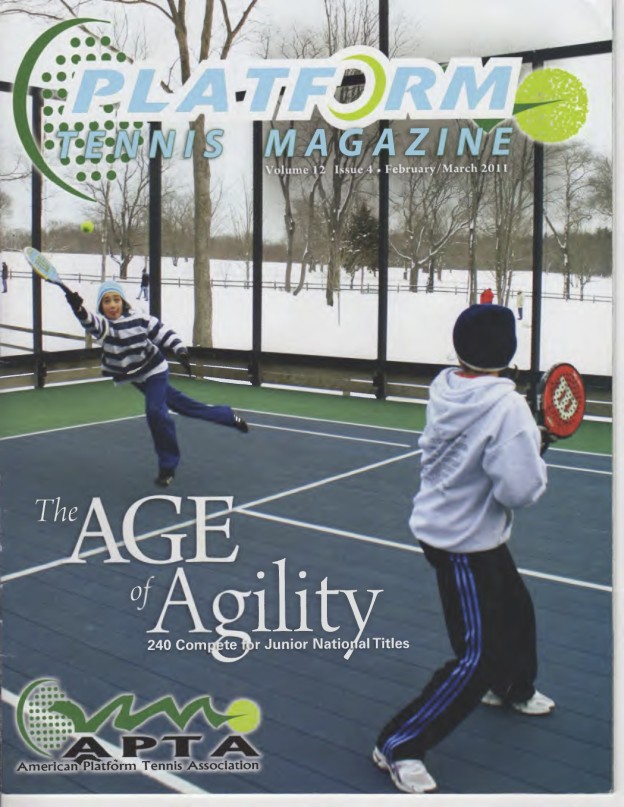
It was almost as if God smiled on New Canaan, Ct., for the 2011 APTA Junior National Tournament. Falling between record-breaking snowfall leading up to the event, and the threat of severe winter storms immediately following the day’s play, it would seem that a window of clear skies and cleared roads would be unlikely for the weekend.

But, as cars pulled in, bumper to snow bank, to Waveny Lodge, to unload young players from as far away as Chicago and Pittsburgh, it became as clear as the skies above that some serious platform tennis was about to be played.

The Junior Nationals, organized by Steve Caccam, Hooey Wilks, Tish Tregellas, Amy Burger, and Thea Ross took among others, took place in one day at 12 locations around New Canaan, all within a 15-mile radius of Waveny, and included 224 players. Finals were brought back to central Waveny Lodge to play in front of one of the finest paddle huts offered in a public facility.

Caccam viewed this tournament as a statement to the world of platform tennis on the strides the sport has made in recent years.

“This game’s been around since 1928. Virtually every tournament has been hosted is a growth in municipal paddle. I’ve played at a lot of places across the country, mostly private. This is a unique example of the renaissance of the game, the robustness of the program and the town leagues. We’re pretty proud of that. It’s impressive.”

Spread out among 12 court sites surrounding New Canaan, Connecticut, the Junior Nationals also proves the strength of the sport in Region I. Within a 15-mile radius, approximately 40 courts are available for paddle players.

Most of those courts are newer courts. Caccam said the main courts at Waveny Park were built in October of 2004.

Shortly thereafter, in the fall of 2005 community momentum inspired a public/private capital campaign to make further site renovations, completely updating Waveny Lodge, which used to be a caretaker’s cottage. The campaign was able to raise $485,000 for the project in just 18 months.

That availability and willingness to cooperate from the participating clubs and the community at large is something not lost on organizers.

“Without their reciprocity, it would be impossible to do something like this in one day. We’ve got over 100 teams. That’s a lot to do in a 7 hour tournament” Caccam said. “Unlike other tournaments, where you fill up the draw, the challenge here is running eight concurrent tournaments. You’re not playing Boys 18s with the Girls 10s. When you run an adult tournament, you have one big spread. Here, it’s all spread out. It’s geography, timing and volunteers that make the day.”

Last year, when Caccam and volunteers were finished with tournament play, it dawned on them that despite the hectic hustle and bustle with putting on a tournament, they all had learned some valuable information about the tournament sites themselves. Keeping the tournament in the same location allowed them to capitalize on that knowledge and make improvements for this year’s play.

“The moment it was over, and we were cleaning it up, letting out a collective “whew,” we all looked at each other and said, ‘What a shame, next year it will be held somewhere else,— he said. “We knew what we could improve upon. When it came back around, and we were asked to do it again this year, we said, ‘Sure. No problem We knew that we could make it an even better tournament than the year before.”

Caccam said thanks should go to Scott Gress, Chairman of the New Canaan Park & Recreation Commission and Stephen Benko, Director of the New Canaan Recreation Department, for supporting the effort to host this national championship at their town site; and sponsors: Orthopaedic & Neurosurgery Specialists, Karl Chevrolet, Bank of New Canaan, and the Fairfield County Platform Tennis League.

Source: Mike Berton, Platform Tennis Magazine, Vol. 12. Issue 4, March, 2011

2011 APTA Board Nominees – Courtia Worth, John Noble, George Douaire and Rich Green

Courtia is currently the Director of Tennis and Platform Tennis at the Hartford Golf Club where she has grown the platform tennis programs in particular over the past six years. She is partial to her Senior Racquets group of over a dozen men who show up with paddle or tennis racquet in hand three times a week throughout the year ready to play either sport! With an average age of 79, how great is that? She was pleased to be tapped to go The Villages and work with over 100 seniors in that stellar Orlando community.

Courtia learned how to be a teaching pro from some of the best. Bob Callaway gave her guidance at the Reilly Platform camps in Jackson Hole, Patty Hogan was her PPTA Coach and she started her teaching career teaching juniors with Marie Minnick. Her sister, the one and only Hall of Famer Winnie Hatch, brought her into the game. Winnie was forever wondering why Courtia was never in the right the place, at the right time, questioning, “Well, where did you think they were going to hit it?” Courtia never knew, but Winnie always did.

Courtia has won two National Championships, one with Karen Cashmen for Women’s 50 and another with Doug Barrow in National 60’s and has twice been a runner up. Although senior to some degree, she still represents Region II for the President’s Cup and is captaining the team for 2011 in Chicago.

Courtia was raised on the tennis courts in Houston, Texas, and she spent a few decades in marketing and advertising and dealing in photographic art in Manhattan. She now lives in the Hudson Valley, and has returned to her athletic roots!

John was introduced to platform tennis in 1999 and quickly became addicted and began to participate whenever and wherever he could. It didn’t taken very long for his participation to move to a new level and since 2002 he has been the tournament director of the Chicago Charities and Director of Tournaments for the Chicago Platform Tennis Charities League (CPTC). Additionally, John serves on the APTA Men’s Ranking Committee (since 2004) as the Region S representative and is helping chair the 2011 Men’s & Woman’s APTA Platform Tennis Nationals and 2012 Mixed APTA Nationals in Chicago.

A native of Lake Forest, Illinois John is a graduate of Ball State University and a member of its Athletic Hall of Fame. He currently lives in Lake Forest and has two beautiful daughters and wonderful wife, Susan, who has been and continues to be of great support. John works with a unique healthcare company that focuses on engaging and supporting the health of employees.

George, a resident of Northfield, IL, was bitten by the paddle bug about 10 years ago – a sub was needed for his club team, he was available and has played ever since. Since then he has been a team captain and participated in a many tournaments as possible. According to George, there is nothing better than a competitive match followed by a cold beer.

Early on George and his partners were cannon fodder in the first round of tournaments but he looked at the experiences as lessons in the game. Since then the goal has been to make it to Sunday in the back-draw.

George has a tremendous amount of respect for the game and the people who play it. He is in awe of the dedication of the volunteers who run the tournaments and shepherd the sport. He looks forward to helping the APTA grow the sport so that others can enjoy this fantastic game.

He has an MBA in Finance and is currently providing management consulting and M&A services while working on behalf of several charitable organizations. Formerly George was Chief Operating Officer at Think Partnership, an Internet marketing company and VP of Marketing and General Manager of eBusiness for Eastman Kodak Company.

Rich grew up on Long Island mostly playing tennis. He ventured onto a paddle court once but it was with a tennis racquet. Twenty something years later he was hooked playing with his Long Island team out of the Huntington YMCA. Upon later moving to Chapel Hill, North Carolina, for two years he continued to travel many Thursdays to represent that YMCA league team.

It took Rich almost three years to bring paddle courts to Chapel Hill at the Chapel Hill Tennis Club with the help of Region VII founder Taylor Bowen, an APTA grant, and local supporters. He organized the 2007 court opening that at that time was the largest APTA exhibition/ clinic with well over 200 attending. At that clinic, Marty Pomerantz, of the University of North Carolina campus recreation decided to add paddle courts to his planned on-campus complex across from the famed Dean Smith Center.

Rich continues to organize local league play and serves as current APTA Region VII President. For the past three years he has been President’s Cup Captain and has served on several APTA committees. He also built the APTA’s spreadsheet application for estimating platform tennis revenues and expenses to help grow the sport.

Outside of paddle Rich works for a convertible hedge fund, enjoys cycling, and is probably one of the few paddle players on the yogic path.

The Women’s Players Committee: APTA Board Member Aila Main explains

The Women’s Players Committee… What is that you ask? I didn’t know we had one of those, you say. Well, you do. The Women’s Players Committee is comprised of several female representatives from around the country. Currently serving are yours truly, Ma Main, along with Sally Cottingham, Charlotte Gilet, Christi Hays, Sandra Odenbach, and Cindy Prendergast. The Committee has a few purposes.

One of the Committee’s goals is to pass along any observations, ideas and, recognizing our sport can always improve, criticisms players may have. Another is to give recommendations on how to handle any issues that may come up during the course of the year. While most issues that arise are tournament related, they can also be about etiquette, rules or protocol.

It is also the Players Committee’s role to present any suggested material changes of the status quo to the APTA Board. For example, should a player feel National Ranking Tournaments should play off for 3rd and 4th place (they currently do not), the board would need to approve this change.

The head of the Players Committee would first check with the entire Committee on whether they felt it was a valid idea. If the feeling was yes, then the idea would be presented to the board at the Annual Meeting, discussed, and voted on. If the vote passed, then the change would take effect the following year. This particular idea did not take, but a more recent one about awarding more points deeper into the draw at Nationals may. Stay tuned.

APTA Board Member: Tina Kelly

Tina Kelly

Residence: Savannah, GA (since Dec. 2010), previously Sleepy Hollow, New York
APTA Board of Directors: May 2006 – present
Family: Husband, Bill, two stepdaughters, six grandchildren, and one Boston Terrier.

How long have you been playing platform tennis? I started playing when I was about 10. My father, Art Houlihan, was very active in platform tennis and on the APTA board during the 1970s, so paddle has always been a big part of my family. My older brother, Tom, played as a junior (and continues to play in Boulder, Colorado), and won three junior nationals, so I was always trying to keep up with him.

Have you ever won any major tournaments? I hate to admit it, but I think I hit my peak when I was 18. My partner and I won the 15-and-Under and 18-and-Under Nationals. Of course my husband might argue that our recent husband-wife club title is the most important tournament of all.

We know “Passing Shots: A Pictorial History of Platform Tennis” was just published. How did that project start? Rich Lombard and Bob Brown [from the Hall of Fame Foundation] approached me almost two years ago to create the sport’s first coffee table book. I thought it was a great idea. Since the HOFF had been unearthing so many terrific old photographs, draw sheets, and other historic material, it was the perfect time to pull it all together. A coffee table book is a tangible way for players to feel an excitement and connection to the sport. I’m hopeful that people unfamiliar with platform tennis will see the book and say, “Hey, this looks like fun. I should try it.”

What do you feel is your contribution to the APTA Board? I’ve been active in several arenas. My professional background is in writing, editing, and marketing, so I get to use those skills. I’ve been involved with branding, website development, writing articles, designing brochures and ads, producing an informational “Newcomer’s Guide,” marketing, working on material for tournament support, editing, and helping with whatever needs to be communicated to the membership.

What has been your favorite thing about being on the APTA Board? The teamwork that is involved. I guess it’s a given that if you love paddle, you love teamwork. I’m amazed about the amount of time that people volunteer and working under both Mark Fischl and Tim McAvoy has been terrific. It’s a pleasure to try to communicate my excitement about the sport to others.

Results of National Championships and coverage of Men’s and Women’s Nationals

2011O&S
2011J

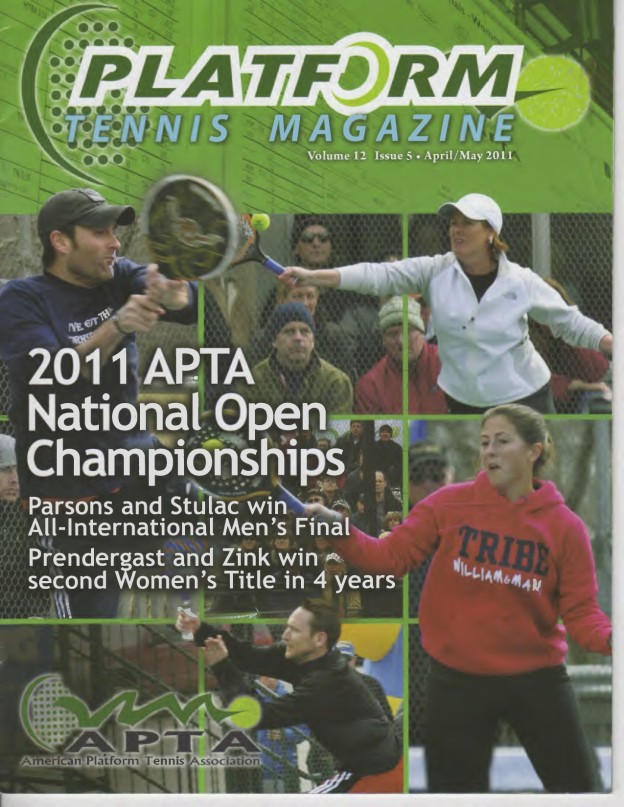
Being charged with putting on the biggest tournament of the season is no small thing, and, in the case of the 2011 Chicago Nationals it was an outright miracle of organization and coordination.

John Noble, Matt Garavaglia and Shannon Vinson, coordinators of the event, had to arrange for 84 courts of play at 22 sites all within a 25-minute radius of Chicago’s North Shore Corridor for 452 competitors.

The trio had to coordinate everything from ensuring the bleachers were delivered and installed on time, to putting together the program and merchandising for the event. Thankfully, there were 175 volunteers who were organized by Walter and Ann Fyk.

“They are a wonderful couple and they organized it by day, by club, by time slot. They ran with it,” Vinson said. “We needed many volunteers to execute the weekend. The level of excitement for the event to return to Chicago was high and many were eager to help. They wanted to help out more, which was really nice!’

While at the time of writing, the organizers of the Chicago Nationals have not had an opportunity to perform a full event post-mortem, their overall impression of the event was overwhelmingly positive.

“It went very well,” Noble said. “The only thing difficult is planning for the number of attendees, not players but actual spectators. On Saturday night we had so many attending that we had to use satellite parking and shuttle buses. We had more of an audience than we’ve had in the past. There was a lot of enthusiasm and attention surrounding the event, so handling the volume of spectators was our biggest limitation. But it still went well:’

Vinson said that while she’s run other events, she’s done nothing the size of the Nationals.

“Overall, I thought it was a wonderful weekend. The participants had a great time. The spectators had _a great time. There were a couple hiccups, but they were mostly things behind the scenes and nobody noticed,”she said. “No matter how much planning you do, the last 72 hours are the most important. Everything has to come together at the right time for it to work. That, to me, was our biggest team effort. Checking off what we needed to do so that we could be ready to welcome people Wednesday night.”

Vinson said the hosting venue, the Glen View Club, did everything the committe members asked to help ensure the event went off without a hitch. “They were outstanding,” she said. “Their management was so easy to work with. Anything within reason, they’d help us accommodate it.”

“We shared responsibilities and tackled the event,” Noble said. “Together we had the right people heading the right committees; all working together to execute the event.”

With a full Men’s draw of 128 teams, and a draw of 98 Women’s teams, Vinson said she had the opportunity to be both an organizer and a player.

I “I was a member of the President’s Cup team from Region Five and the main draw. Saturday and Sunday I watched a lot of amazing paddle,” Vinson said. “I had the best of all worlds. The game is changing. It’s very aggressive. The men’s final was the most unbelievable thing I’ve seen. The gets, the speed of the players, and the longevity of the points are all amazing:’ she said. “All in all, it was unbelievable paddle.”

The trio will be organizing the Mixed Nationals in the near future, and seems to be quickly becoming the go-to group for large-scale tournament events. “We’ve received an outpouring of support and gratitude from the players and those who came to watch,” Vinson said.

Source: Platform Tennis Magazine, Vol. 12, Issue 5, April, 2011