APTA Eliminates Tiebreakers

APTA sought reaction from players to this innovation by the United States Lawn Tennis Association (USLTA1)

Note 1: The USTA was previously known as the United States National Lawn Tennis Association that was established in 1881. In 1920 the word “National” was dropped and in 1975 the word “Lawn” was dropped

Newsletter announced the advantages for the aluminum deck. Deck was manufactured exclusively for Richard J. Reilly Jr., Inc. by Maark Corp, Cranbury, NJ

Aluminum decks at two courts

Kim Kimberly and Tad Bowen installed the new aluminum decks pioneered by Richard Reilly of R. J. Reilly, Inc. that were the first installations of what has become the modern standard. They were built in the Wilton & New Canaan, CT area.

The Evans Backstop Design

Screens are perfected – the games future is assured

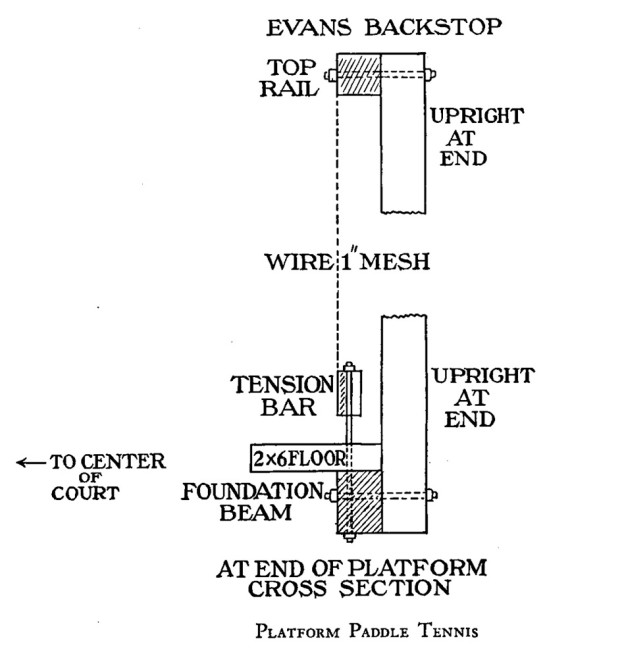
Donald K. Evans of Fox Meadow solved the game’s biggest problem, the unpredictable bounces off the backstops. Without a good solution the game had limited growth potential.

Evans devised a method to stretch a one-inch wire mesh from top to bottom inside, but not touching, the uprights surrounding the court. With adjustable tension bars, the Evans Backstop yielded a uniform bounce when a ball hit any of the four screens, and it became standard on all new courts. The future of the game was assured.

This new backstop was first erected—with the aid of John G. MacKenty—during the winter of 1934-35 on the second Cogswell court.

Don Evans was inducted into the Hall of Fame in 1966

Source: Adapted from Fessenden S. Blanchard, Paddle Tennis, 1944, and Platform Paddle Tennis, 1959

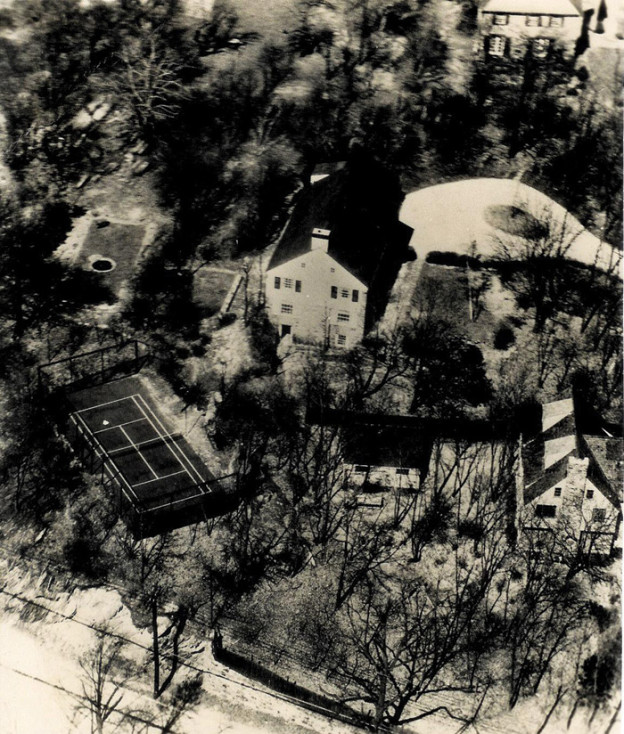
Caption: Aerial view of the second court near Old Army Road in Scarsdale, New York (Oct. 1932). Ardsley Road is shown at bottom. The Cogswell house is at center. The Blanchard house is out of sight at upper left. As shown, only three sides of the original court were screened.

Cogswell builds second court

With the help of a rock wall and some fill, the original platform morphed to the current size of 60’ x 30’.

Even with the larger platform and uneven bounces from the wire, the players continued the practice of playing the balls from the wiring. By this time, the wiring height had reached 12’ and used a smaller one-inch mesh.

The Cogswell’s held a party right before the demolition of the first court that included dancing on the “doomed” old platform.

Source: Adapted from Fessenden S. Blanchard, Platform Paddle Tennis, 1959

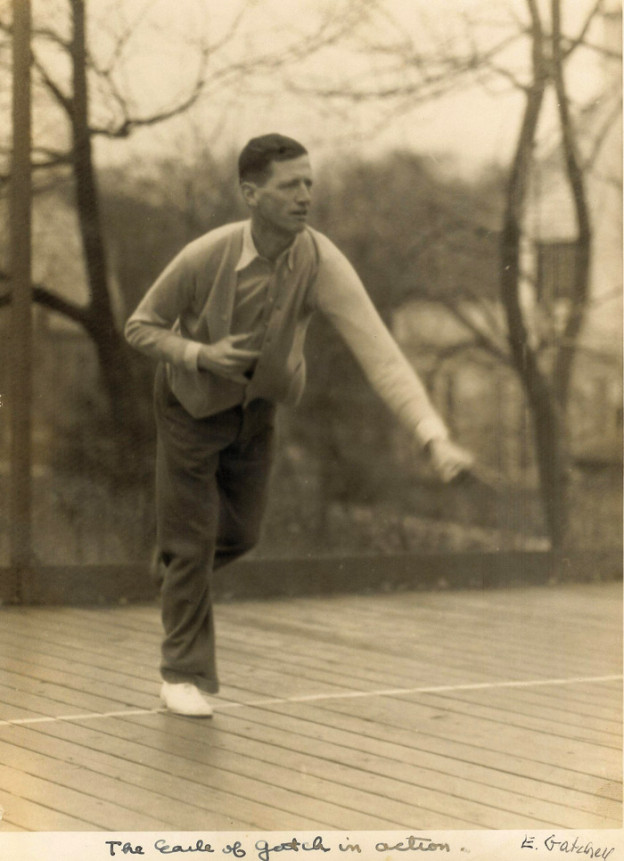
Earle Gatchell on first court.

Lighting the court to extend the game

Early on, lighting was added to courts so play could continue during short winter days.

Blanchard’s description of the first lighting system:

“The best procedure is to set up 4 individual poles made of pipe, 2 along each side of the platform at distances of 8 to 14 feet from each corner (opinions vary as to the better of these distances). The pipes should have reflectors at the top with either 750 or 1000 watt bulbs on each, raised about 20 feet above the surface and suspended over the platform on a short arm at the top of the pipe.

The lighting cost is not high and can be kept at a very low figure if you have a good amateur plumber and handy man among your friends.

Jimmy Cogswell put up the lights at his court and we only needed expert help on the electrical switchboard.”

Source: Fessenden S. Blanchard, Paddle Tennis, 1944

Court size and dimensions set

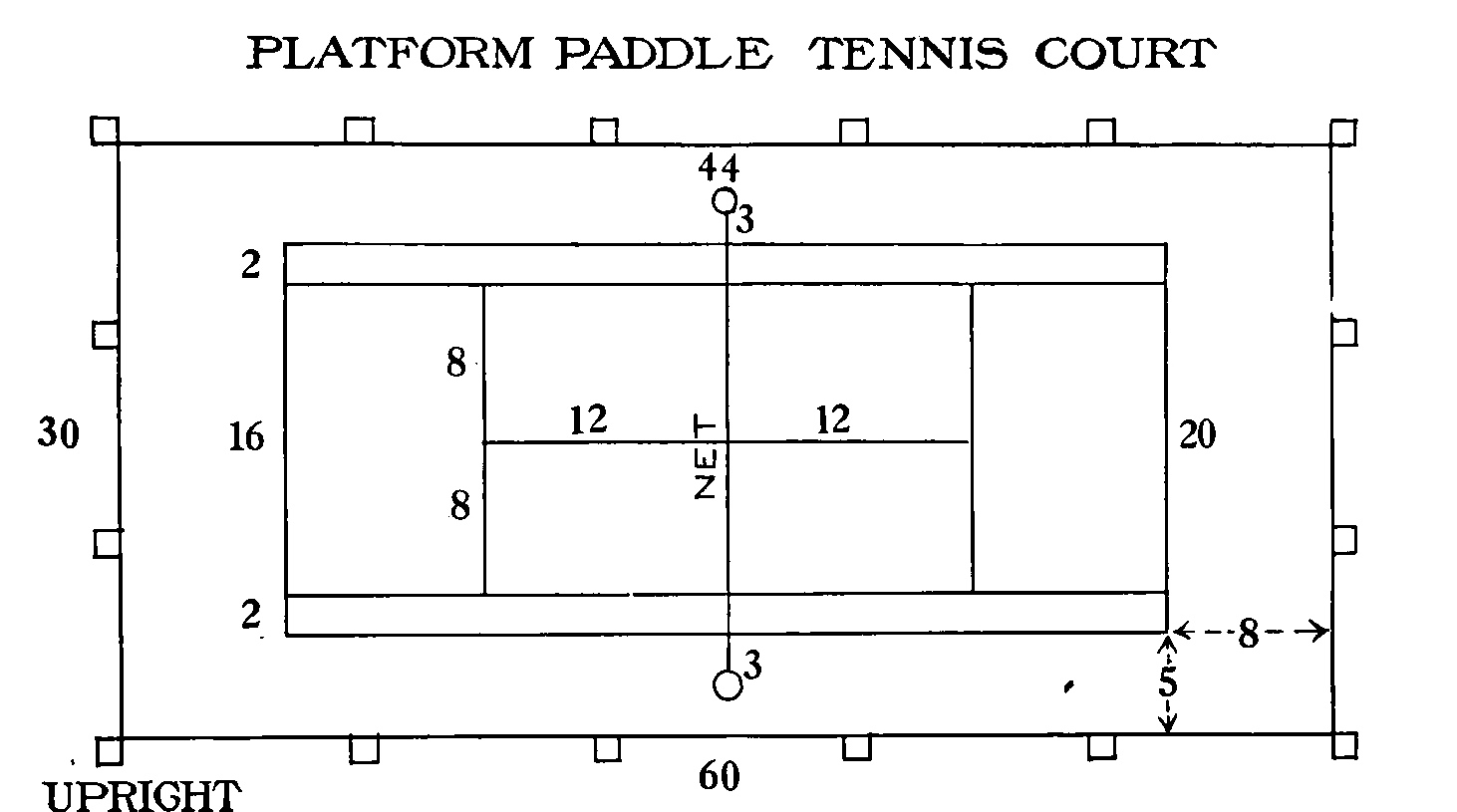
The dimensions from Cogswell’s original court, including service and single court measurements, have stood the test of time.

There have been a number of experiments at changing them, including an APTA sponsored experiment at Fox Meadow Tennis Club in 1956 where the court length was extended 2 feet on either end to 48 feet.

The platform size was increased to the present day dimensions of 60 x 30 feet in 1932 when Cogswell built a second court with a larger platform. This made the playing area one quarter the size prescribed for a tennis court.

Era 1 Early Years - 023 - Version 2 copy

Source: Adapted from Fessenden S. Blanchard, Platform Paddle Tennis, 1944.

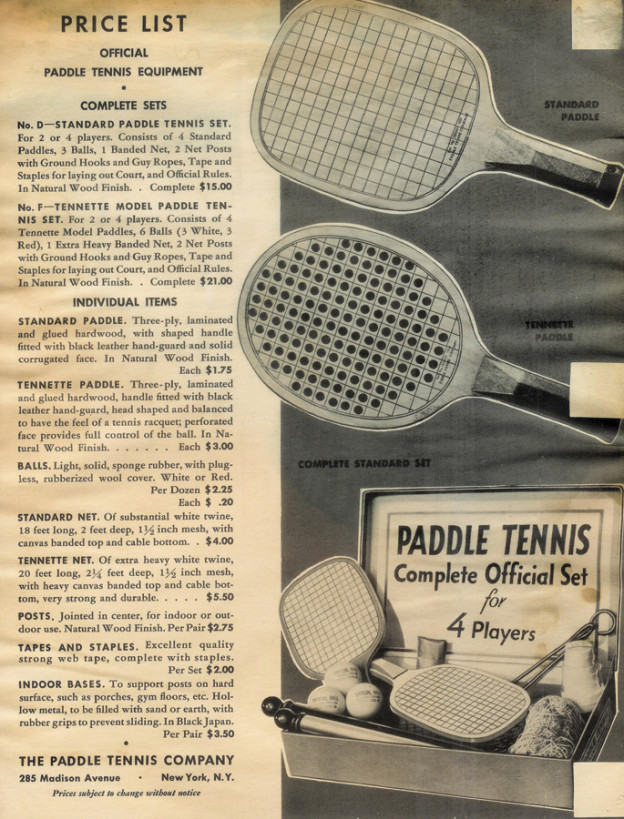
Price list for paddle tennis equipment, late 1930s

One-serve rule introduced

The net height was lowered and court dimensions altered from the original Paddle Tennis standards. These changes and the adoption of the one serve rule allowed for a nice balance of advantage between server and receiver.

The one serve rule was adopted at the beginning and has never been seriously challenged

A cold winter day in 1930. Earle Gatchell (left) and Fessenden S. Blanchard on the first platform tennis court.

The move from Paddle Tennis to Platform Paddle Tennis begins and the wires come into play with a “ground rule”

While deck tennis rings and badminton birds were easy to keep in bounds, paddle tennis balls were a challenge. To keep the balls from running down the surrounding landscape, the court needed back and side wiring. Before long two-inch mesh chicken wires were stapled to eight feet high upright two by fours that surrounded the court. Gradually the court was completely surrounded by wires. The screens rose to 12 feet by 1932 as play evolved.

Source: Adapted from Fessenden S. Blanchard, Paddle Tennis, 1944, and Platform Paddle Tennis, 1959

Blanchard and Cogswell soon decided that the badminton 44′ x 20′ measurements were much better than the 39′ x 18′ measurements used in the original form of paddle tennis. By using the outer lines of badminton doubles, only two feet separated each back line and the chicken wire. This didn’t give them enough room to swing their paddles.

This led to the decision, which in the opinion of all present-day players, has “made the game.” They decided to allow players to take the ball off the back or side wiring: that is, as it bounced off the wire after having first hit inside the proper court, and before it had hit the platform a second time.

They called this a “ground rule” after the ground rules in baseball that are special rules particular to each baseball park1&2

If the landscape had allowed the court to be lengthened, it would never have been discovered how much this new rule added to the fun of the game. The rule prolonged rallies and took the advantage away from the net players. Irregular bounces and balls sticking in the mesh plagued the early days. Reducing the mesh size to one-inch solved the ball sticking problem but eliminating irregular bounces had to wait until the development of the Evans backstop in 1934-35.

Source: Adapted from Fessenden S. Blanchard Paddle Tennis, 1944

Note 1: Some secondary sources cite the following incident recounted in Blanchard’s book Platform Paddle Tennis as the beginnings of what was called the “ground rule”. “And sometimes the balls stuck in the two-inch mesh, which we used at first. I remember once when that happened on our side of the net I ran around behind the back net and gave the ball a hefty swat. To everyone’s surprise it went over the net into the other court. My partner kept the ball in play until I got back and we finally won the point.”. This is incorrect as both Blanchard books explicitly state that the “ground rule” was adopted at the very beginning. He called this Lucky Incident Number 2. Lucky Incident Number 1 was the decision on the court sized based on the geographical constraints.

Note 2: At a presentation to Fox Meadow members in March of 1997, Molly Ware, Blanchard’s daughter, confirmed the apocryphal nature of the story. “As has often been reported, it is not true that my father dashed around the back and whacked a bail that was stuck in the screen across the net, shouting, ‘it’s in play.’ A terrific story, but sheer fiction.” She explained that the insufficient area from the baseline to the screen did not allow for a full back swing and created a condition where play off the screens became a necessity.


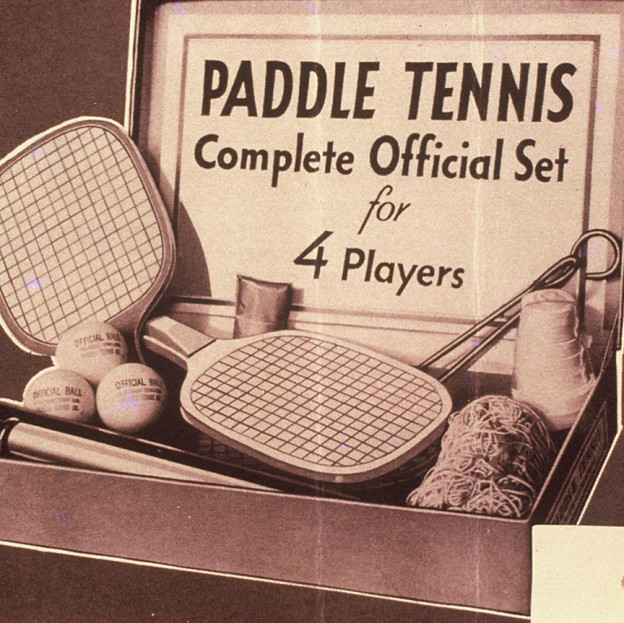
A late-1920s boxed set of paddle tennis equipment, similar to the one James Cogswell brought home

Perfect equipment already exists

One day, Cogswell turned up with some short rectangular-shaped paddles and spongy balls, which he discovered in a sporting goods store.

The equipment was used for paddle tennis, a game invented several years earlier by Reverend Frank Beal for cramped urban playgrounds. Beal and Frank Contessa had established the American Paddle Tennis association in 1922 to promote the game and market equipment – see Frank B. Contessa

Blanchard and Cogswell tried them out on their platform. After lowering the deck tennis net and a few bats back and forth, they knew they had made a discovery.

Source: Adapted from Fessenden S. Blanchard, Paddle Tennis, 1944 and Platform Paddle Tennis, 1959