APTA develops policy on platform tennis court builders

The September 15th Newsletter carried the following basic policy:

• It is the intent of the APTA that the game of Platform Tennis be played under uniform court conditions wherever it is played.

• The APTA considers it appropriate to provide advice and guidance, where needed, to ensure quality and uniformity in court construction while recognizing the desirability of encouraging innovations in the use of materials and methods of construction so long as the basic nature of the play of the game is not affected.

• The APTA will offer guidance to those seeking information on plans, specifications, and builders of platform tennis courts. Such guidance is offered within the framework of this policy, the implementation of which is outlined below; while it is based upon the best information available, the APTA cannot accept responsibility for quality of construction, delays, or failure of any sort in contractual arrangements between builder and customer.

The APTA implementation Plan had the following elements:

(1) A list of builders will be maintained, divided into two sections; Section I, “Builders of Wooden Courts to APTA Specifications” and Section II, “Builders of
Courts to APTA Dimensions but Using Materials other than Wood or other Construction Design.”
(2) Any builder who wishes to be included on the list may apply in writing. If he is a new builder constructing courts to APTA specifications, a completed court (or courts) will be inspected by the APTA and, if considered satisfactory, the builder will be included on the list with a footnote indicating:

“New builder constructing courts to APTA specifications which have been inspected and are considered satisfactory by the APTA but which have not been in use for two full playing seasons.”

If he is either a new builder or an established builder constructing courts with different construction materials or construction design, he should outline in his written application specific deviations from APTA plans and specifications. A completed court (or courts) will be inspected by the APTA and, if considered satisfactory, the builder will be included on the list with a footnote indicating:

“Builder constructing courts with different construction materials or construction design which have been inspected and are considered satisfactory by the APTA but which have not been in use for two full playing seasons.”

In each of the above cases, after two playing seasons of use and a satisfactory
second inspection, the applicable footnote will be removed from the builder’s listing.

In the event that a builder who has been in the business for more than two seasons applies for listing, both a recently constructed court (or courts) as well as a court (or courts) which have been in use for two or more seasons of play will be inspected and, if considered satisfactory by the APTA, the builder will be included on the list as applicable without footnote.

(3) Inspections will be made by APTA officials, including regional Vice Presidents, or others specifically designated. No expense may be incurred by the Association for
such inspections. If in the judgment of the inspecting officials, including actual play on the court, the bounce of the ball on the deck and off the screens and the feel of the deck are similar, and provided court dimensions are according to APTA regulations, then recognition as applicable will be granted.

(4) The APTA reserves the right to remove any builder from the list at any time if, in the judgment of the APTA, the quality of courts being constructed by that builder and/or the construction performance of that builder are considered to be below normally acceptable standards.

Source: The APTA Newsletter, Vol. 3 No. 4

The Etiquette of Platform Tennis

“The Etiquette of Platform Tennis” published

The Annual Meeting minutes included the following report by Secretary Robert A. Brown.

“The rapid growth of the game is attributable to the increasing number of ‘newcomers’ who are exposed to and are taken up by the game. With this in mind and in order to maintain the high level of sportsmanship and good conduct that is such an important part of ‘paddle,’ the APTA recently published a new booklet entitled “The Etiquette of Platform Paddle Tennis.”

The author of the booklet was Robert A. Brown. It has been reprinted a number of times and is still available.

The APTA mailed the booklet to all members, and it was well received. Subsequently, the APTA received requests for over 3,000 additional copies of the booklet. Although intended for the newcomer, a number of old-timers requested copies for their close friends who played.

Source: The APTA Paddle Newsletter, Vol. 3 No. 4

R.J. Reilly, Inc. pioneers the aluminum court deck

Richard J. Reilly, Jr. had been building wooden courts since the mid 1960’s and had made numerous innovations over time. But, it was Wilson Sporting Goods that ultimately gave Reilly his best idea.

Wilson had come out with a metal tennis racquet and their major rival, Head, was anxious to catch up and had some consultants working on an aluminum racquet as a competitive response. It so happened that Reilly had built a wooden court for Peter Fisher in Katonah, NY and Fisher suggested he visit George Vaughn and Dick Hargrave who, along with an engineer with a PhD in the aluminum field, were the principal consultants for Head. This Princeton, NJ based team helped Reilly develop all the technology (specifications, extrusion dyes and techniques), required to manufacture an aluminum deck.

As a woodworking purist, he hated the idea of using aluminum, but saw it as providing the longevity that wood didn’t have, as well as the capability for conducting heat, which would help with snow removal. He was right, and by the mid 1970’s, 85% of his courts were aluminum.

There were many obstacles to overcome. The first aluminum boards had just two stiffening ribs and the boards sagged and bent at the edges. Adding a third rib solved this issue and became the standard ever since.

The other challenge was paint adherence but using wood floor sanders helped roughen the surface enough to obtain excellent adhesion. Reilly also experimented with paint formulations the best of which was a two-part epoxy paint but it dried so quickly on a hot day that spreading the aggregate that was used to create the rough texture on the deck had to be done very fast using a high pressure spray. This was tricky and on windy days more than one car parked nearby was accidentally painted.

Reilly had originally used sand as the aggregate (as pioneered by the Tremont Place Paddle Tennis Club in the mid 1930s) but then switched to walnut shells (too soft) and then aluminum oxide, the present day standard.

The epoxy paint was a big improvement over the deck enamel used previously as with deck enamel courts had to be painted every one to two years and the heavy paint build-up tended to chipped and became very uneven creating a poor playing surface. A well-painted epoxy deck on the other hand would last 7-8 years.

Source: Adapted from Off The Wire, Vol. 6 No. 3 and personal communication from Richard J. Reilly

The modern ball makes its debut

Move to yellow ball begins

On the recommendation of Eagle Rubber Company, the APTA introduced a yellow ball (the “night ball”) in 1972.

Other ball manufacturers soon followed their lead. Vittert produced the V-29 ball while Marcraft introduced both a red and yellow ball named “Big M.” Other manufacturers, like Barr, Puma and Bullet began producing orange and red balls as the game took off through the 1970’s.

Source: Christina Kelly,Passing Shots: A Pictorial History of Platform Tennis, 2010 and Robert A. Brown,personal communication.

Two serves or not two serves? That is the question

The APTA offered players an opportunity to use January and February as a 60-day trial period to test a two-serve option at different playing levels in various club events. Feedback via Platform Tennis News was requested.

The May-June issue of the magazine carried the results. There were 19 yes votes to change to two-serves, and 141 voting no, indicating strongly that the change was not favored.

Some of the reasons were:
…..it would ruin the game. We don’t want it like tennis

…..leave the game alone, it is an amateur’s game enjoyed as is

…..how about two returns?

Source: Platform Tennis News, November 1981 and May-June 1982

The pros and cons of aluminum decks

Although R.J. Reilly introduced the aluminum deck in the early 1970s, many of the courts built prior to the 1980s had wood decks. These decks were relatively inexpensive to install, yet became difficult to maintain as active play and the elements took their toll. Aluminum decking not only extended the life of a platform tennis court, but builders now had the ability to install heaters beneath the courts that would warm the decks and eliminate thin layers of snow or ice that would prohibit play.

Aluminum decking revolutionized the court-building industry, yet it had an unforeseen impact on the accessibility of courts outside the more privileged country club scene. Wooden courts around the country that had been decommissioned, particularly in communities, municipalities, and schools, were simply not replaced because, though aluminum courts are less expensive to maintain, they were much more expensive to install.

The boom in court building during the 1970s slowed considerably with the trend toward aluminum courts in the 1980s, and by the 1990s most activity was firmly back in the private club arena.

Hi-bounce or Low-bounce ball?

Many players liked a more bouncy ball, especially when it became very cold. To accommodate them, Vittert made both a lo-bounce (V-30) and a hi-bounce ball. The APTA had approved the V-30 for all National ranking tournaments and the hi-bounce ball only for singles. The January edition of Platform Tennis explained the APTA position and provided guidance for using the V-30 ball in cold.

When it’s really cold, the standard V-30 needs a respectable warm-up, or it will just dribble when you expect a bounce. Nevertheless, cold is part of life on the platform. So, what do you do about ball selection? Well, the “book on bounces” says:

• For virtually all doubles tournaments or matches, use the standard, low-bouncing V-30.

• Always warm up with two balls. When you start to play, put the second ball in the warming hut, a warm car, a ball-warmer, or perhaps a down jacket — but never on the court.

• For the kind of tournament that sometimes coincides with a bitter cold spell (Chicago had one with wind chill of minus-22° and the players in ski masks or protective Vaseline), the National Tournament Committee may okay the use of Hi-Bounce. The local committee has to have this option
on its list of “things to do.” If the forecast reads “below-zero temperatures expected,” then someone will have to put in a fast order for the Hi-Bounce.

• In very cold conditions, for play among beginners, or at any social get together, or even in local tournaments (not on the APTA-sanctioned list), use the Hi-Bounce. Why not? It means longer rallies, a livelier ball, and more enjoyment all the way.

• For teaching in the winter, Hi-Bounce is recommended. It’s easier for the new player to reach. And he or she may not be able to keep a standard V-30 in play long enough to warm it up and thus make it more active.

Source: Platform Tennis, January 1981

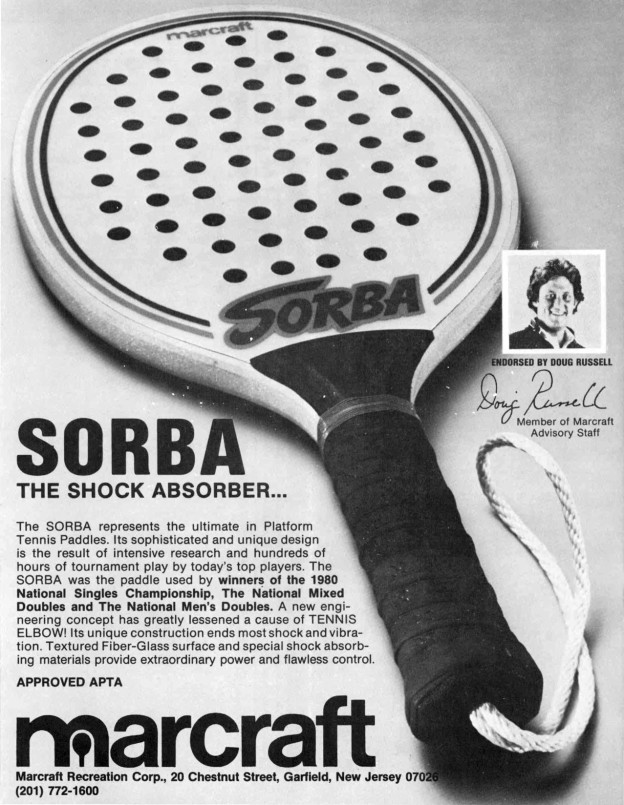
Advertisment for the Marcraft Sorba paddle

New sneaker endorsed by APTA

The APTA endorsed the Swift River “Reflex” court shoe following tests by a Board-appointed players committee.

The Swift River “Reflex” court shoe was made in New Hampshire.

The sneakers had bottoms made of a gum-colored compound of high-abrasion rubber to assure maximum mobility in any weather, as well as resistance to abrasion.

APTA works on improving the ball

From the APTA Annual Minutes:

“Robert Frothingham reported on efforts with Barr Rubber Company to improve the ball and asked Stan Greene of Marcraft to report on their efforts to enter this activity. Mr. Greene stated that they have a source for balls but are still working on the flocking problem. They hope to have limited quantities available this season.”

Personal Business, November 1971  

Courts in New York City

The September APTA Paddle Newsletter reported:

“Starting this winter, paddle in New York City is a reality.

The place is the Town Tennis Club. Sports Marketing Associates Corporation1 has joined with the exclusive Town Tennis Club in a joint platform tennis venture. They have three lighted courts available for lunchtime or after work play or all the time if you live in New York or don’t want to go home.

Also, complete clubhouse services from cocktails to meals to locker rooms with saunas. Sounds pretty plush.

By membership only and same covers the paddle facility only from November I thru March 31.”

Note 1: SMAC was owned by “Mr. Paddle”, the future Hall of Fame inductee Dick Squires

Source: The APTA Paddle Newsletter, Vol. 2 No. 3