Frank B. Contessa – the link between paddle and platform tennis

An article on Contessa by Vicky Cosstick appeared in in Paddle World, Vol. 1 No. 5, Fall 1976

In the article John Ware, Blanchard’s son-in-law, referred to him as the ‘missing link” between paddle tennis and platform tennis as Contessa who developed, manufactured and promoted the paddle tennis racket, net and balls which Blanchard and Cogswell bought in a New York store.

Through his church activities, Contessa met the Rev Frank Beal whose boys were playing street paddle with crude saw-cut bats, and in 1922 Contessa left his Wall Street career to form with Beal, the American Paddle Tennis Assoc. with the aim of marketing the game and equipment specifically for under-privileged youth.

Contessa began with the financial backing of Wall Street colleagues, and space donated by his brother Joseph in the basement of a yarn warehouse at 131 Spring St. (in what is now called SoHo, Manhattan). The first equipment consisted of a carrying case, nets, stanchions, paddles and balls for two or four players: ” A Complete Outfit at the Cost of One Standard Tennis Racquet: $10.00 “. A later version included tape and staples to mark out the court. In designing the equipment,

Contessa gave primary consideration to cost, portability, and flexibility. The stanchions for net-posts were made especially to be collapsible and the ” airball” (sponge rubber) was designed to bounce on an irregular surface, large enough so that a child would see it coming over the net easily. The paddles were made of plywood.

Over the period between 1922 and 1926, Contessa set about marketing the game in a systematic fashion. ” I thought it would take two years,” he says, ” but it took four.”

In 1926, the G. Lynn Sumner Co. , a Madison Avenue advertising company, offered to buy the Paddle Tennis Co., and the directors, including Doc Beal, agreed. Frank Contessa was outvoted. His concern was that the new owners would up the price of the equipment and redirect it to the more wealthy set.

He left the world of paddle tennis and went onto other ventures. But his predictions were correct. Not only did the equipment become more and more costly, but the game was taken up by two Scarsdale players named Blanchard and Cogswell,who, not satisfied with playing the game just anywhere, and with the resources to develop a more sophisticated game, built a platform and had the idea of playing the ball off the wires.

Viking plans a warm weather ball

Viking has recently announced plans to introduce a new ball which will extend the normal platform tennis playing season worldwide into a year-round sport. The new Viking Low Bounce platform tennis balls are set to arrive in March 2012, just as the platform season usually comes to an end.

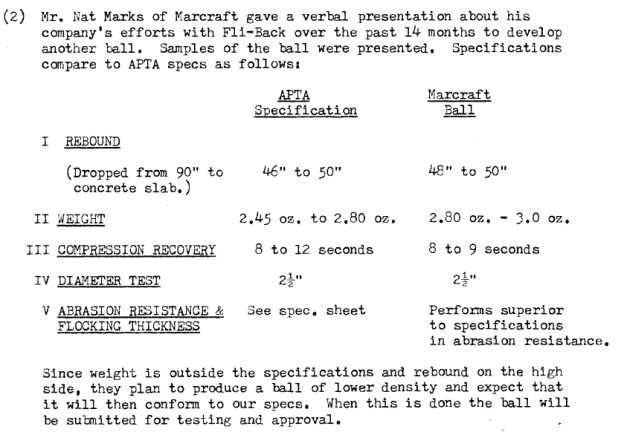
Platform tennis is a sport played primarily in the northeastern and midwestern United States. Due to the solid rubber core construction of a normal platform ball, which produces a lively bounce during the cold winter months, this same ball becomes too fast and hard to control when the weather gets warm or in high-altitude conditions. Viking has just announced the introduction of a new formula that combines the current construction of the Extra Duty ball with the feel and performance athletes expect from a normal platform tennis ball.

Viking has been the Official Ball of all American Platform Tennis Association (APTA) National Championships since 1999. [enlarge image to read more]

Paddle technology keeps improving – Viking promotes lightweight paddles

Viking Athletics is proud to officially announce the arrival of its 2011-2012 product line – complete with 3 new lite weight paddles, the re-introduction of the most popular paddle ever made and yet another addition to Viking’s technology portfolio – all added to the existing line of proven paddles and the Viking ball.

Viking has done it again! Introducing a new paddle technology application called Carbon Mesh. Carbon Mesh material consists of braided graphite strips of material which are bonded together for extra strength and stiffness. This material will be featured at the 12 o’clock position on two new paddles this season adding extra stiffness and strength to the rim area. Viking continues to be clearly focused on raising the bar on platform paddle innovation again this year as Carbon Mesh follows SpinTex and Triple Threat technologies which were both introduced during the past two years. SpinTex adds an extra layer of texture to the paddle surface to significantly improve ball bite and spin for unparalleled control and placement and can be found on the entire line of adult Viking paddles. In addition, Triple Threat technology, a special woven graphite composite material located at 10, 2 and 6 o’clock on the paddle frame provides extra stiffness and perimeter weighting in key locations on the TT Pro Elite paddle series improving power and stability on off center hits. [enlarge image to read full article]

Wilson launches new paddle technology; some even have bottle openers in the butt cap

Wilson has taken the paddle tennis world by storm and introduced a new paddle racquet technology to enhance every player’s game. Wilson understands that in the game of platform tennis achieving maximum spin on the ball is critical to the outcome of the match. With the revolutionary Gator Grit technology, Wilson has tripled the amount of grit on the paddle surface on every racquet for extra bite to provide increased spin and feel of the ball. Gator Grit is now available on all of Wilson’s new paddles.

With maximum grit must come maximum protection, so with every Gator Grit paddle the player will receive a free cover. The cover will not only protect the paddle but also a player’s additional belongings carried in the bag from the coarse Gator Grit. [enlarge image to read full article]

Stadium Lighting comes to Platform Tennis

While most technological advances in platform tennis take place on the racquet side, David Dodge, president of Premier Platform Tennis, said that lighting advances are becoming increasingly more affordable and preferable for platform tennis courts nationwide.

“The big thing right now is the new stadium-style lighting,” Dodge said. “Lighting has made a lot of advances. Some places are still using 1,500-watt court lights, and these new lights are
typically 400-watt metal alloys. They reflect light differently, and by reflecting differently, they can put a lot more light on the court.”

Dodge said the lights can be retrofitted and installed into most existing light standards, and average six lights per court. “The cost is right around $4,000 per court for six. If you install eight, it’s $5,200 per court,” Dodge said. “On the East and West coasts, we’ll do six-light installations. In Chicago, we do eight.”

However, Dodge said the prices are still coming down, and the eco-friendly wattage will mean increased savings on the utility bill. And while there are better lights out there that may throw off more light with less energy consumed, the price point is vastly higher, resulting in prohibitive usage in a platform tennis environment.

“No other lighting is there yet,” Dodge said. “But they are making vast improvements. They’re 75 percent more efficient today than with previous standard fixtures.”

Dick Reilly- legendary court builder and innovator

Platform tennis legend and Hall of Fame inductee, Dick Reilly has been a staple of the game for more than four decades. Growing up with the sport in Scarsdale, New York, Reilly remembers his father playing recreational platform tennis. Reilly took up the sport in college. After college, he entered the world of academia as a teacher, but worked on a construction crew, building houses in the off-months to supplement his income. It was during these summer vacations that Reilly got the idea that building platform tennis courts to a higher standard could do both him and the sport a service.

How did the idea to build platform tennis courts come to you?
“While playing on some courts in Scarsdale, I was shocked at how poorly the courts were made. In 1961, the wooden joints and butts of the platform were raised, causing many bad bounces. I thought that if I built a court, I would make the joints meet under the net. To do that, 30-foot boards would be required, but at that time, only 20- to 24- foot boards were made. Contracting a western lumber mill, I ordered a boxcar full of 2″x6″ x 30-foot boards, and that’s how we started. In my first year, I built two courts. At that time, there were no professional court builders and screens were pretty much nonexistent they were pretty much just a wire fence fastened to a 2×4-inch board. They were not taut. I increased the bottom boards to 3×4- inches, making them much stronger and able to hold much greater tension. In those days, the screens were still held together with staples. I can recall times when people would bump into the screens and actually fall through them. My solution was to interweave a lacing material, making the screens stronger and more playable.”

How did you come up with the concept to build platform tennis courts out of aluminum?
“Phil Osbourne was an engineer for Alcoa in New Jersey. Phil and I had a friend who just built the first aluminum tennis racquets at that time. He asked me to go to Princeton to build the first platform tennis court made of aluminum for George Vaughn and Dick Hardgrave, but I didn’t want to do it because I loved working with wood. That week, Phil and I designed the aluminum deck boards on a napkin at a local restaurant. He moved to Pittsburgh in the early ’60s, and along with Jenny Scott, built the Fox Chapel Racquet Club. He asked me again to build the first aluminum courts, using architectural blueprints which he helped create. We built the first aluminum court in November of 1963. We used a wooden superstructure to support the screens.”

Over the the years, how many courts did you build of wood and aluminum? And in what countries did you them?
“I built about 3,500 courts or so. Probably the first 100 were wood; the rest were all aluminum. It’s been a blessing that I’ve been able to travel the world putting in these courts. Many of the courts we’ve put in were in U.S. Embassies, such as those in Belgium, Moscow, Germany, Poland, England, France and Japan.”

“There must be close to 4,000 courts in existence today. The aluminum courts last forever. The old wooden decks would only last 7-8 years.”

When did your children get involved with the business? Are they involved full-time, part-time?
“Two of my four kids have been involved with the business, Jim and Kathy. They both graduated college in 1985, and I solicited them to get into the business. Kathy had a degree from Dartmouth and she was the perfect person to run the office. Jim had a degree in forestry, but I encouraged him to get into building the courts. At one time, Jim ran seven, two-man teams. Our business divided itself between building and maintenance. The wooden decks required tremendous maintenance, so we would hire college kids for summer resurfacing.”

You were an APTA board member in the 1980s. Can you contrast dynamics of the sport and Board at that time, with today?
“I recall when I was a Board Member in the ’80s, Mike North was the president of the APTA. The function of the APTA was primarily to set up tournaments, the Nationals being, of course, the biggest. Men’s and Women’s tournaments were divided by age and adolescent play began to grow.”

What are the greatest achievements of the APTA Board?
“I think the greatest achievements have been in branching the sport out to a national audience. Back in the ’70s and `80s, everything was at Fox Meadow and based along the East Coast. The first distant courts we built were at the Cincinnati Country Club. Phil Osbourne then helped us branch into Pittsburgh. Chicago came a bit later when we built Winnetka. John Embree was a big organizer for the sport in Chicago. The APTA has done so much for the sport.”

Did you ever meet the founders, James Cogswell or Fessenden Blanchard?
“Fessenden’s daughter, Ruth Walker, was our next door neighbor growing up. I was her yard man as a teenager. However, I never met Fessenden Blanchard. Over the years, I did meet James Cogswell several times, but he was not alive when we created the first aluminum courts. I think he would have been pleased with them.”

Source: Platform Tennis Magazine, Vol. 11, Issue 3, January, 2010

Coming off a tough 2008, Wilson and Viking improve ball offerings

Last season was a nightmare for the platform tennis ball industry. Wilson was criticized for two reasons: their balls came out late and the ball wasn’t as bright as their Viking competition. On the other hand, the Wilson ball’s flocking held up much better in competition than Viking’s and it seemed that there were fewer Wilson “wobblers” (balls that were not properly balanced) than Viking wobblers.

Players will also notice changes to both the Viking and Wilson balls this season.

New equipment technology

Platform tennis technology continues to evolve, making the sport more enjoyable and easier to play. The key components to determine a paddle’s playability are: weight, density and composite materials, surface area, grit, hole sharpness, rim style and grip length.

Most of today’s paddles come standard with grit and sharp holes. It is the other things that will ultimately define an end-user’s preference in equipment.

With the introduction of EVA Foam paddles and the record sales of the Viking OZ back in the 90’s, manufacturers have committed to altering foam paddle core densities for new paddles.

Eleven of the 17 paddles comprising the 2009 lines are 2008 remakes. Three more are remakes with minor alterations.

While Viking comes out with major innovations every few years, Wilson’s new [K] line is the year’s greatest innovative change in 2009. Not necessarily better or worse than Viking’s line… just technologically new. The end users will determine which product they like best. [enlarge image to read full report]

Scott Mansager has thoughts on lobs

I’ve had a lot of discussions over the past couple of seasons with a number of players about the lob “bounce out” loss of point rule. I think this rule should definitely be changed for the following reasons:

1. Lobbing effectively in platform tennis requires a lot of skill in a 22 feet deep court (note: a tennis service box is 21 feet deep). Any lob hit high/deep enough to bounce
out of the court would give the net team enough time to get under the ball and decide whether or not to play it out of the air. It is difficult to get your opponent much behind the service line with low trajectory lobs even if they would land deep untouched and the good overhead hitters handle the high/medium depth lobs pretty well. A higher trajectory lob would come down steeper and if hit deep enough would force the overhead hitter to take an additional step back thus creating more potential offensive opportunities for the backcourt team.

2. The old Vittert ball would rarely bounce out unless you hit a “sky lob”, but in warmer weather (above 45 degrees or so) the newer Viking and Wilson balls are bouncing out with some lobs that are hit just a little higher than the height of the lights. The risk/reward for the lobber trying to hit that high/deep lob in warmer weather is not worth it.

3. At the inaugural Premier Cup in 2005, the players voted to override this rule. I didn’t notice much of a difference in play. I saw two lobs bounce out for winners, and that was because one of the players was late for the pre-match instructions and didn’t know about it, and the other did it on purpose at match point (down 0-5). Based on my experience playing at this event I think the fears are overblown that changing
this rule would damage the game — for two reasons:

• Any lobber trying to get too “greedy” with hitting high/deep lobs is going to miss more
and they will learn to tone it down.
• The net team will adapt to well-hit high/deep lobs by playing them out of the air if
they think it will land in and bounce out.

4. You can’t compare the “spike” overhead that bounces out of the court since almost anyone could do that off of a short lob to a skillful high/deep lob that has a certain degree of risk to it.

I guess the bottom line for me and some of the players that I talked to is that we don’t think it is right to penalize a skillful shot — especially a high/deep lob in a 22 feet deep court where the net team has the option to play it out of the air. At the very least it shouldn’t be a loss of point.