Courts in the U.S. ca. 1939

This is a partial listing as there were “platforms too many to mention in the suburban area of New York City,” and there were also courts in Los Angeles and Nova Scotia.

Source:”Growth of the Game,” Report to members of the American Paddle Tennis Association”, as cited in Paddle Tennis, Blanchard 1944

R. J. Reilly courts as of Summer 1997

Each dot on the map is the five digit zip code of a customer but some have more than one court. Court costs at the time could be as much as $40,000 and most were installations at private clubs and schools.

Source: R. J. Reilly Co. Brewster NY

It may have been “The Year of the Ball” but there was plenty of paddle innovation for such a small sport, and four suppliers

Platform tennis players have it made.

What sport our size has four major manufacturers competing so heavily for the equipment market?

Since the mid 1990’s, Viking and Wilson have been going head-to-head in the ball market.

Due to a heavy, individualized marketing effort by owner David Kjeldsen, Viking was able to secure a substantial market majority through the 1990’s.

In April of 1999, Kjeldsen bought out Wilson’s ball market share for an undisclosed figure and term limit. Since then, Wilson’s former promotional Director John Embree began to focus on the paddle market, particularly in the Midwest and amongst women. Two years ago, Jim Burda replaced Embree to direct the platform tennis program. His duties included detailing paddle specification, testing equipment and then marketing to players and instructors across the northeastern states.

Burda’s success was evident last year when Wilson sold out their entire new paddle line less than one month into the season. With the success of last season in hand, Wilson has kept their top four 2006 models and launched two new (K)Factor paddles, based on their tennis racquet products. The paddles are an exciting addition to a sport filled with amazing technological advances for a sport so small.

The K-Factor paddles feature: a large hitting surface, (K)ore Foam that Wilson says provides a more stable hitting surface, and (K)ontour Rim – an enhanced stiffness for improved stability and (K)ontrol.

Platform Tennis Magazine tested the (K)Tour and (K)Surge and found them to be incredible new products- living up to the hype generated by Wilson.

Viking Athletics has been busy over the past couple years planning and testing their latest technological releases. Billed as paddles with precision, power and passion, the new line features Viking’s new VASTT” technology system.
Some of the technology is “under-the-hood”, and some is “visible technology”.

Variable Tempered Rims match rim temper to core densities that Viking says will optimize power and control. Surtar2TM and Tempered ImpactTM bonding technology match bonding levels to core densities.

Viking’s Core Impact TechnologyTM matches paddle “skins” to paddle “cores”. You won’t see them but Viking swears that players will notice the performance differences.

What does all this mean? It means that Viking has matched up variations of foam cores, rims and surface materials to create paddles with great variances in power, feel and flexibility. On two of Viking’s paddles, the Ignite and the Pro V-1, you will see a Shock Absorbing Ring billed to provide extra shock protection while not limiting power.

Over the past couple years, two additional vendors have been making waves in the industry.

Harrow Sports entered the platform tennis market last season with a high quality line of paddles. Harrow will continue to expand their reach into platform tennis by sales and distribution through teaching professionals.

At the same time, The Paddle Company has continued to expand their market share with their “body friendly” equipment (i.e. Soft, one-piece paddles with reduced shock).

Harrow Sports and The Paddle Company remain heavily invested in platform tennis; but, due to the launch of several new paddles in 2006 (and a new ball from the Paddle Company this summer), no new products have been released this season from these two manufacturers.

2007 – The Year of the Ball. The Paddle Company introduced new balls and Wilson Racquet Sports re-entered the market

Although there were some incredible new paddle technologies being released, 2007 may very well be membered as “The Year of the Ball”

A problem for our sport from the manufacturer’s standpoint – the ball has always been a loser. Not economical from any standpoint, the situation has come to a head in the last couple of years as the APTA asked, “What are our alternatives to the conventional platform tennis ball?”

Our ball has to endure up to 100-degree variations in heat, increasing amounts of grit applied to paddles, and the ability to be seen at night under the lights. Is it time we ask ourselves “Are we asking too much from this yellow piece of rubber?”

The volume of balls manufactured yearly (less than 200,000) is minuscule compared to balls for other sports.

The health concerns alone for the workers who apply the flocking to the ball are enough to make your hair stand on end.

Consistency in bounce, right amount of bounce, right color, and getting the flocking to stay on the ball are all factors contributing to the reluctance in manufacturers to even attempt to make a ball in the first place, given the small amount of numbers that need to be produced every year compared to tennis balls.

Is our unwillingness to change the ball inhibiting our sport’s ability to grow? Do we absolutely have to have this ball? What are our alternatives?

The Paddle Company, Wilson and Viking Athletics can tell you how hard it is to manufacture a ball. However, no ball, no sport. Someone has to take on the job to enable platform tennis to thrive.

The Paddle Company has surprised the manufacturing market by producing its first new batch of balls in years.

In March, 2007, CEOs Jerry Brown and Clark Reed sent out three different ball samples to platform tennis teaching professionals and top-ranked players. The balls were tested and compared to the existing Viking ball. The result is a new, brighter Paddle Company ball with a consistent bounce.

Wilson Racquet Sports also has just officially launched their reentry into the platform tennis ball market. Having bowed out of the market in April of 19991, an equipment sales surge has convinced the powers that be that the time to invest is now.

With Viking’s estimated 95 percent hold on the ball market share, Wilson felt that it was important to their overall platform tennis strategy to guarantee a stable environment by investing in their own product.

Terri Graham, Wilson’s Business Director of Indoor Racquet Sports said, “Jim Burda spearheaded our pursuit back into the ball market. We agreed that in having only one major ball manufacturer, we were posed with the question, ‘How would the sport suffer in the event something happens to them?”

Graham added, “We have taken a very aggressive forecast in our ball market re-entry. We have a long-term, better yet, call it a life-time agreement with the factory to produce balls.”

How will the new APTA Approved balls be different that those of Viking and The Paddle Company? Graham answered, “Our flocking is extra thick for added durability and spin.” She added, “This is a game of spin, and our ball will fit in perfectly.”

The three new balls are all excellent. They are very similar, yet subtly different in color, bounce and flocking. The manufacturer that succeeds in the best marketing approach will gain the upper hand in the ball market.

NOTE 1: Viking had acquired the Wilson ball business in 2000 but the five year non-compete restriction had elapsed

Source: Platform Tennis Magazine, Vol. 9, Issue 1, October 2007

Draw procedure for seeded players in tournaments reviewed; APTA updates “How to Conduct a Tournament Draw”

The Rules and Equipment Committee had been working on an update of the booklet on “How to Conduct a Tournament Draw”, and had reached the point of a final draft.

However, before going to press, Bob Brown had become aware of a difference of opinion among some Directors and members of Players Committees regarding the procedure for placing the seeds in the draw.

Ultimately the extant procedure was maintained

Screen Shot 2014-01-26 at 11.04.34 AM
How to Conduct a Tournament Draw

Is there an advantage to service?

During his tenure as the chair of the APTA Rules and Equipment Committee Robert A Brown had conducted a number of surveys of service holds and breaks, in part because of the no-let decision in the late 1990s. In 2003 he updated his earlier work with and analysis on the 20003 Senior Men’s 50+, 60+ and 70+ championships and filed the following report with PTM.

In discussions with players about the “pros” and “cons” of the no-Jet on net cord serve rule, the conversation usually progresses to a question as to whether the server In platform tennis has an advantage in serving. The “con” proponent will generally comment that this is the case and that the no-let rule further favors the server. While there Is a modicum of truth to the latter comment, It is not a significant factor, since most of the net-cord serves are returnable and the Incidence of the “dribbler” occurs on less than one-half of one percent of the serves delivered.

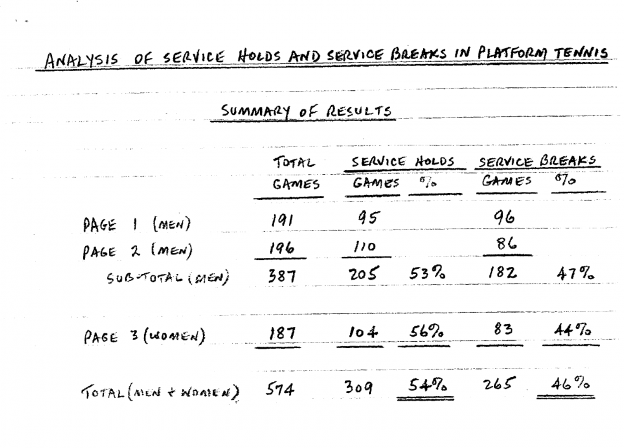
Regarding the question as to whether the no-let rule does, or should, help the server, maybe a case can be made that such help Is needed. Research has shown that service holds and service breaks In platform tennis are roughly 50/50, with some variation for men and women. The usual reaction to this fact: “That’s hard to believe!” That is a natural reaction from players· whose exposure to tennis over the years reflects the known dominance of the server In tennis – the result of having two serves, improved equipment and no wires. In platform tennis, with one serve and friendly wires, it’s a different story.

In a (limited) update of prior research, the chair umpire’s score cards for the championship matches in the 2003 Senior Men’s 50+; 60+ and 70+ tournaments were analyzed and yielded the following results:

In the 50+ final, Jean Kempner / Jim McNitt vs Steve Nycum / John Stefanik, a total of 30 games were played In three sets. There were 13 service holds and 17 service breaks.

In the 60+ final, Alan Graham / Stu Opdycke vs. Roy Anderson / Joe Holmes,a total of 17 games were played in two sets. There were 8 service holds and 9 service breaks.

In the 70+ final, Bob Brown / Dave Childs vs. Herb Bascome / Blair LeRoy, a total of 34 games were played in three sets. There were 17 holds and 17 breaks of service.

Grand total for the three matches: 81 total games (a pretty good sample), 38 service holds, 43 service breaks. (47% holds, 53% breaks)

These results seem to be typical of results in prior research for the men. Prior studies on the women indicated a higher percentage of service holds (56%) and a lower percentage of breaks (44%) which may be a reflection of a generally less offensive serve returns (?).

What about the average players, or players of lesser ability? While their performance has not been studied, It Is likely that we would find similar results or possibly an even lower percentage of service holds, since serves are weaker, providing as added advantage to the returner, and faults are more frequent.

So, aside from the matter of consistency between the net-cord on service and the net-cord during a rally, considering the generally poor service-hold performance, what’s wrong with giving the server a little help?

APTA changes to a twelve-point tie breaker

It didn’t take long before a committee consisting of tournament level players and headed by APTA President Bob Brown re-visited the nine-point tie-breaker adopted in early 1974.

The nine-point tie-breaker rule stated that if two teams reached 4-all the next point decided the set. This was considered unfair.

The APTA subsequently adopted a 12-point tie-breaker of its own, one in which the first team winning 7 points takes the set. If the teams reach 6-all then it takes a margin of two points to win (e.g. 8-6 or 12-10)

The sequence in the APTA 12-point tiebreaker is as follows:

Assume the last point of the set has ended, and the game score is 6-all. The players stay on the same side of the net and the next player in the regular service rotation serves once from the ad court.

When that point is over, the players change sides and the normal serving rotation continues with each player serving twice from the deuce court first and then the ad court.

After two players have served and the four points are over the teams change sides again and the other two competitors serve twice apiece in the normal service rotation.

This pattern is maintained through-out the remainder of the tie-breaker.

In this system, each player serves on the same side as he had been doing from the start of the set and do not have to contend with a new orientation to the winter sun.

This approach to the 12-point tie-breaker is unlike tennis where the first serve is from the deuce court and then each player serves from the ad court and then the deuce court. The teams also remain on one side for six consecutive points

Source: Platform Tennis Feb/Mar 1981