Ball rebound specification modified

The Rules and Equipment Committee submitted a review of the ball specifications and test results from the U.S. Testing Laboratory.

Recognizing that many questions about the liveliness of the ball were a result of unusually warm weather during the prior season, the Board approved a change in the rebound specification, increasing that number from 48.0″ to 51.0″.

No-Let rule trial period to continue

At the Annual Meeting in May, the Board of Directors of the APTA voted to continue the rule established at the 1996 meeting, which eliminated the let on a net cord service.

The motion agreed upon left the door open for a further review in May 1998; however, the Directors were much stronger in support of the rule change than they were when they first instituted it.

Part of the reason for their change in approach was due to the fact that tennis was also moving ahead with abolishing the let. The USTA Senior Father and Son circuit would be experimenting with the “no let” service on a trial basis in its 1997 national championships, and the men’s and women’s senior divisions of the U.S. Open instituted the change in 1996. The APTA Board was not as “far out” in making this change as some players thought.

Source: Platform Tennis News, Summer 1997

Balls used in National Championships – Viking, Wilson and Marox

For the first time in the history of the game, more than one brand of ball was approved for use in the different National Championships.

Three manufacturers were allocated a portion of the designation “Official APTA National Championship Ball” by a vote of the APTA Board.

The ball to be used in the Men’s and Women’s National Championships was awarded to Viking Athletics. The Senior Championship would be played with the ball made by Wilson Sporting Goods. The Mixed National and the Mixed Masters would use the Marox ball.

Source: Platform Tennis News, Winter 1997

Eleventh edition of the Official Rules issued

All the talk as the paddle season opened was about the change in the Official Rules under which play would continue on a net cord service.

Some changes in wording were necessary to emphasize that, although many paddle tennis rules were derived from tennis, there were situations where they were different in certain respects.However, there were a few substantive changes in the Eleventh Edition of the Official Rules.

The Rules Committee, under direction from the Board of Directors, had been asked to make the calling of lines by players in an un-officiated match, less “hard and fast” and more “forgiving.” This was accomplished by expanding the comment following Rule 10 by incorporating most of the wording from the “The Etiquette of Platform Tennis.”

The “Continuous Play” regulation found in Rule 24 had a new paragraph (c) inserted which read: “During a service game, the server is permitted a maximum of 20 seconds between the finish of play on a point and the delivery of the next service.” While rarely an issue, it was determined that, on some occasions, players may be exceedingly deliberate or talkative between points, to the extent that play was slowed and the delay was sometimes used as a tactic to upset opponents.

Finally, in Appendix B, a new diagram was added to illustrate the new standards for racquets with wrap-around rims. This enabled new manufacturing techniques to be used in the production of (possibly better) paddles for the game.

Source: Platform Tennis News, Fall 1996

Foot-Fault awareness

Foot-fault 1996

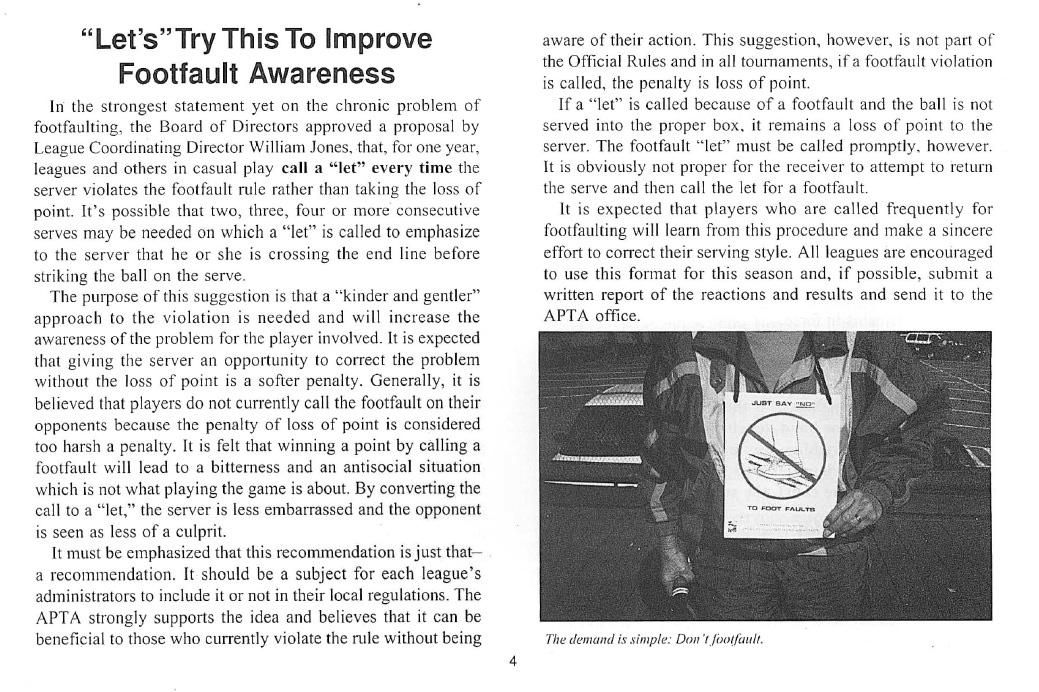
In the strongest statement yet on the chronic problem of foot-faulting, the Board of Directors approved a proposal by League Coordinating Director William Jones, that, for one year, leagues and others in casual play may call a “let” every time the server violated the foot-fault rule rather than taking the loss of point.

The purpose of the suggestion was that a “kinder and gentler” approach to the violation was needed and would increase the awareness of the problem for the player involved.

Source: Platform Tennis News, Summer 1996

Platform Tennis News, Summer 1996

No-Let serve started – two year trial period to assess player reaction

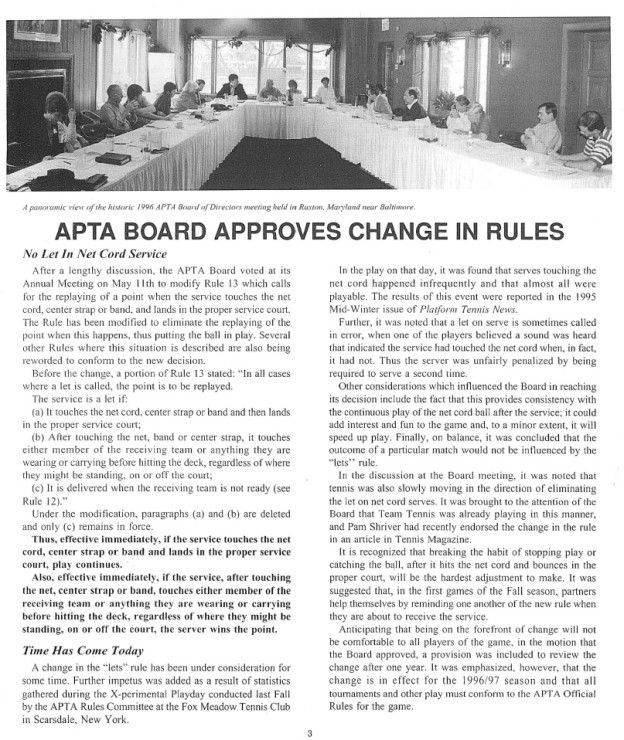
After a lengthy discussion and extensive presentation by Bob Brown at the Annual Meeting on May 11, 1996, the APTA Board voted to modify Rule 13, which called for the replaying of a point when the service touched the net cord, center strap or band, and landed in the proper service court. The rule was modified to eliminate the replaying of the point when this happens, thus putting the ball in play.

Several other rules where this situation could be described were also reworded to conform to the new decision.

Before the change, a portion of Rule 13 stated:

“In all cases where a let is called, the point is to be replayed. The service is a let if:
(a) It touches the net cord, center strap or band and then lands in the proper
service court;
(b) After touching the net, band or center strap, it touches either member of
the receiving team or anything they are wearing or carrying before
hitting the deck, regardless of where they might be standing, on or off the
court;
(c) It is delivered when the receiving team is not ready (see Rule 12).”

Under the modification, paragraphs (a) and (b) were deleted and only (c) remained in force. Thus, if the service touched the net cord, center strap or band and landed in the proper service court, play continued. Also, if the service, after touching the net, center strap or band, touched either member of the receiving team or anything they are wearing or carrying before hitting the deck, regardless of where they might be standing, on or off the court, the server won the point.

This decision in 1996 was enacted as a two-year trial period, after which player reactions would be surveyed, and permanency considered by the Board.

Source: Platform Tennis News, Summer 1996

Ball used in tournaments

With the exception of National Championship Events, where the APTA Board makes the determination as to which ball will be used, Tournament Chairs of APTA Sanctioned Events could choose any APTA-approved ball, though only one brand was to be used throughout the tournament. Any player or players substituting another ball would be disqualified.

In addition, in National Ranking and Regional Ranking tournaments, no points would be awarded to those players who are disqualified.

It was reported that, whenever possible, the choice of ball should be indicated on the tournament entry form.

Source: Platform Tennis News, Winter 1996

Wilson enters the Platform Tennis market

The announcement by Wilson Sporting Goods Company that it was entering the platform tennis market with a line of paddles and paddle accessories was made at a press conference at the U.S. Open tennis tournament.

In a separate news release, it was indicated that development of the new platform tennis paddles stemmed from the technology used in Wilson’s tennis racquets. All four paddles would be constructed of molded graphite. The new models were designated Hammer 9, Hammer 8, Pro Staff 6, and Pro Staff 5. The numbers assigned to each paddle corresponded to a specific “Power Series” rating that fit a certain style of play.

Source: Platform Tennis News, Summer & Fall 1995

Separately, Wilson had acquired the Vittert V30 ball business from Hedstrom so they now could supply both balls and paddles. This development became an issue for A2Z/Viking Athletics as Wilson no longer would supply them with balls as they were a competitor in the paddle business. This forced Viking to enter the ball manufacturing business – see also A2Z Acquires Marcraft’s Platform Tennis Business

“Code of Conduct For Platform Tennis Players” established

Responding to the occasional “bad apple in the bushel,” the APTA released a statement that describes the expected conduct of competitors in its tournaments and the penalties that may be enforced against violators.

The “Code of Conduct for Platform Tennis Players” below appeared in the Tournament Schedule as “a constant reminder to participants of what is expected of them when they enter sanctioned events.”

Players shall not engage in unsportsmanlike conduct. At no time, but especially during the course of a match, shall a player engage in:

a) verbal or physical abuse of any persons connected with the game or spectators;

b) use of visible or audible profanity;

c) mistreatment of the equipment, the court or its fixtures;

d) behavior that reflects a failure to accept the decisions of officials and/or disregard for the rules and spirit of the game.

Any official or player may report conduct considered improper on the part of a player to the Tournament Director and/or the office of the American Platform Tennis Association for investigation by its Conduct Review Committee. The Committee shall report its findings to the Board of Directors of the Association, which will assess penalties as it deems appropriate.

The penalties may range from refusal to accept an individual’s or team entry in a future tournament at the same venue, to suspension from sanctioned tournaments for 12 months.

Source: Platform Tennis News, Summer 1995

The new specifications

New equipment specifications

As the result of new manufacturing techniques, the Equipment Committee, headed by former APTA President Robert A. Brown, was asked to review the APTA paddle specifications.

The Board approved a recommended change to make the total maximum length of the paddle 18″, and eliminate the separate handle/play length designation.

It also approved a change in the edge (or rim) that will allow a 1/8″ height wraparound of a maximum 1/2″, in addition to the flush-with-face surface that was previously the only one allowed.

Source: Platform Tennis News, Summer 1995