Dave Kjeldsen, founder of A2Z (later renamed Viking Athletics), with his familiar horned hat and cigar

A2Z acquires the assets of Marcraft Recreation Corporation

There was a new/old “player” in the manufacturing ranks of the platform world. A2Z, headed by President David Kjeldsen, had transformed itself from Marcraft ‘s largest retail distributor into a manufacturer/wholesaler of platform equipment, by purchasing the assets of Marcraft Recreation Corporation’s domestic platform tennis division in April 1995.

At the time Marcraft was just a paddle manufacturer. They had been a ball manufacturer for a while in the 1970s (Big M yellow and red balls) but had stopped production and had become a reseller of the game’s dominant ball, Hedstom’s Vittert V30.

When Hedstrom sold their ball manufacturing business to Wilson – see Wilson Acquires Hedstrom Ball Business – this created an issue for A2Z (renamed Viking Athletics in 1996) as Wilson refused to allow them to continue selling the V30 ball as they were now a competitor in the paddle market. This forced A2Z to develop their own ball

APTA Board again struggles to address foot-faults

In the continuing struggle to contend with the foot-fault violation, and possibly clarify the foot-fault rule, the APTA Board again considered the matter.

The discussion focused on two questions: (1) What could be done to control/reduce the incidence of foot-faulting among players? and (2) Should there be any change or changes in the foot-fault rules?

It was decided that, starting with the 1995 season, all National Championships should have a foot-fault judge in all matches from the quarterfinals on, unless there was a chair umpire. While it was recognized by the APTA that this would be a difficult chore for both the committee and the appointee, it was felt that it can and should be done in order to further curb the incidence of foot-faulting.

With regard to the second question, the discussion focused on the current wording of the foot-fault rule (Rule II) in the Rules Book. The rule states that the server, throughout the delivery of the service. may not “change position by walking or running,” but the rule goes on to state that the server is not deemed to be walking or running as a result of “slight movements of the feet which do not materially affect the location originally taken by the server.” In focusing on what is a “slight movement,” the Board considered changing the rule to be more specific, but decided to defer this decision and think further about it during the season.

The APTA had also received suggestions that the rule specify that the forward foot must maintain its original position, thus disallowing any movement, although “pivoting” of the forward foot would be allowed. It was deemed that such a regulation would be even more difficult to enforce than the current violation of simply stepping on the line, so the Board also deferred consideration of this suggestion.

Source: Platform Tennis News, Winter 1995

Experimental clinic report recommends “no-let” be implemented

The committee (Robert A. Brown, Walter Peckinpaugh, Charles J. Stevens and Charles E. Vasoll) recommended that the APTA Board consider implementing the “no-let” rule in the 1996-1997 season; that the diagonal corner screens were not a practical innovation the Board should consider further; and, that the no-ad rule, which had been favorably received, should be given further consideration.

A full report on the experimental clinic was included in the Mid-Winter edition of Platform Tennis News.

Source: Platform Tennis News, Mid-Winter 1995

APTA Board approves experimental clinic to explore changes to the game

Bob Brown, reporting for the Rules Committee, requested and obtained approval for an experimental rules clinic at the Fox Meadow Tennis Club in Scarsdale, NY.

The most intriguing proposal involved the modification of the court by placing diagonal screens in the four corners. The Board approved an expenditure of $1,000.00 for this program, which included the manufacture and installation of the temporary screens to experiment with this suggestion.

Other proposed rule change suggestions, including no-let on serve, and different scoring procedures, were also to be given an experimental test.

Source: Platform Tennis News, Mid-Winter 1995

APTA approves new Marox ball Vittert, Marcraft and Marox are now main suppliers

The APTA granted approval to a new platform tennis ball developed by Marox, Inc. of Carteret, New Jersey. The new ball debuted in the 1994-1995 season.

Under the auspices of the Rules and Equipment Committee, a sample supply of the new ball was tested in February. When all APTA specifications were met, the Board of Directors gave its approval to this new product in March. Random testing of balls taken from production was planned to assure that the specifications approved for the sample would be met.

Source: Platform Tennis News, Spring 1994 and APTA May 1994 BOD Minutes

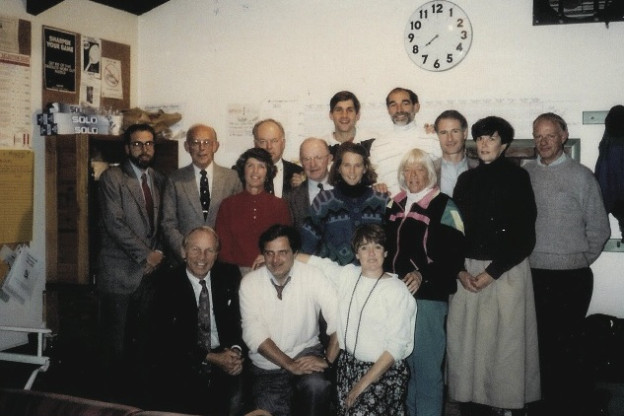
A 1993–94 APTA Board of Directors meeting at the Montclair Golf Club Paddle Hut. Standing back row: Reb Speare, Bob Brown, Chuck Vasoll, Peter Dodd, Walt Peckinpaugh, Pete McCormick, Carol York, and Bill Childs. Standing second row: Hope Kerr, Charley Stevens, Claudia Neal, and Nancy Mangan. Kneeling: Howard Sipe, Brian Zevnik, and Ginna Ohlmuller.

LETS Committee files a report

Despite a century-long period during which the inconsistent rules pertaining to let cord situations (serve or during play of point) had been perpetuated, the recently formed committee came out strongly in favor of consistent treatment – i.e., play should be continuous on all let cords which, after striking the net, land fairly in the opponent’s court, whether it be on service or during play after the service.

The committee’s rationale for this recommendation were:

1. The rules with regard to the play of all lets should be consistent.

2. The recommended change would speed up the game.

3. There would be no further disputes over whether a let on service was indeed a let (heard by one, but not by others).

4. One less official (the let cord judge) would be required in matches that are officiated.

5. Playing the let on service will add interest to the game.

6. Over the long run, points won or lost on lets on service will probably even out between server and receiver. The let service that just dribbles over the net into the receiver’s service court will usually be a winner for the server. On the other hand, the let cord service that pops up high and drops into the receiver’s service court will often result in an easy winning return for the receiver. The bulk of the let services that just graze the net cord will be routinely returned by the receiver.

The committee recommended a two-year trial period for the new rule, during which all matches had to be played using the new rule. This was a period long enough to permit players to adapt to, and become comfortable with the rule, thereby avoiding the natural human tendency to react negatively to change without giving it a try. This trial period recommendation was tabled by the APTA Board until 1996, when it was again considered and finally adopted. After the two-year trial period ended in 1998, the “no-let” rule was approved and became official in all play.

Source: Platform Tennis News, Summer & Fall 1993

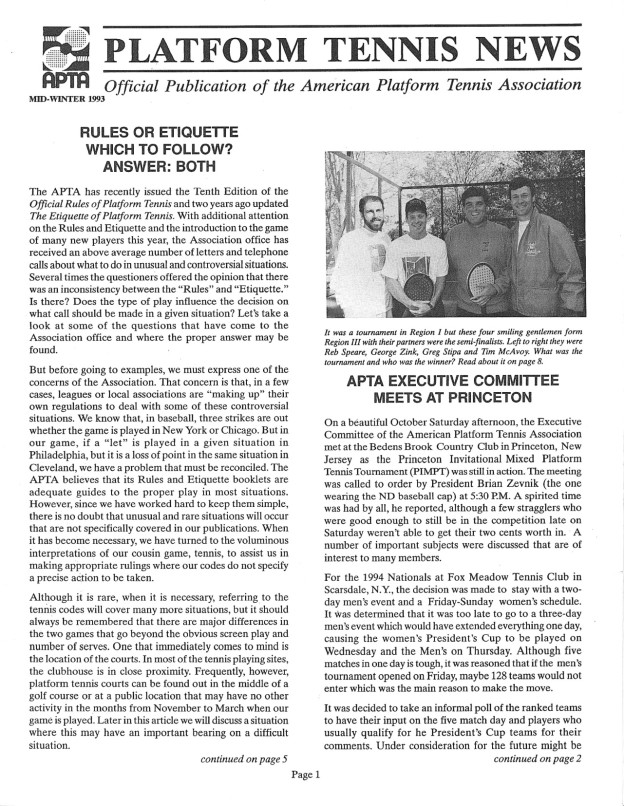
Mid-Winter edition of Platform Tennis News

Official Rules updated

The new edition was more than a reprint of existing text. With input from all the directors of the Association, and suggestions from members, Rules Committee, Director Bob Brown did a major rewriting of the text.

One of the seemingly simple, but really arduous tasks was to remove all the male pronouns (he, his, him) from the rules, in line with current practice.

The second major effort was to clarify rules for certain play situations that were not specified, but were understood to be accepted practice in actual court action. For example, the circumstances surrounding the ball hitting a net post were defined much more clearly than in the prior edition of the Official Rules.

Source: Platform Tennis News, Summer 1993

Hedstrom works on problems with ball quality

Hedstrom, the maker of the Vittert ball, stepped up communication to the paddle community about their program to address issues with ball quality and durability.
James Braeuing, VP Operations reported on progress:

A. Wobble/out of round – We have isolated the cause of this problem and currently have a program to update our press temperature and cooling water controls to increase the consistency. We feel these changes will eliminate the problem.

B. Bounce consistency – As you are aware, we recognized that our bounce adjustment at the beginning of last season was too severe and led to a squishy feeling as well. We adjusted the firmness and bounce in early September. Since that time, we feel we have isolated what we consider to be the most appropriate firmness and bounce. We are revising our producing equipment to target this specification and are also engineering and fabricating special equipment to insure a narrow band of compliance, eliminating the wider variations you may have encountered.

C. Flock adhesion – We have sent the samples many of you have returned which exhibited poor flock adhesion to our glue supplier. We also recognized that the flock adhesion problems were accelerated in a wet environment. Our glue supplier feels that it has identified the problem and has given us a solution to try.

D. Flock coverage consistency – We are evaluating a new flocking chamber, which we are told will allow a more consistent deposit of flock on all areas of the ball. Hopefully, that will solve the thick and thin condition.”

Source: Platform Tennis News, Spring 1992

Foot-Fault alert

Why doesn’t the APTA do something about “foot-faulting?”

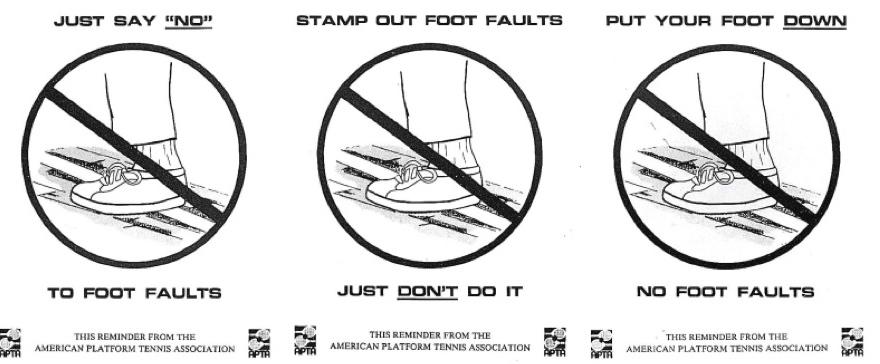
The APTA had heard it expressed verbally and in writing many, many, many times. Some complaints were quite loud, and some were very strong. They responded to this criticism in two ways. First, by taking up a suggestion that came from Mike Dougherty of Garden City, Long Island (NY), they attacked the problem from a light side. A series of three posters, illustrated below, had been sent to every member Club to display in their warm-up huts, bulletin boards, or locker rooms, to remind players of this violation of the rules.

Foot-faults

The second step was a directive given to the APTA Rules Committee, led by former President Bob Brown, to look into the problem and make some recommendations.

Source: Platform Tennis News, Fall 1991