National Championships

1952

It was a repeat performance for the 1951 winners in all three events.

For Elfie and Ronald Carroll this was their fourth straight win, a record only matched since by Hilary Hilton Marold and Doug Russell (1979-1982).

Source: Fessenden S. Blanchard, Platform Paddle Tennis, 1959

National Championships

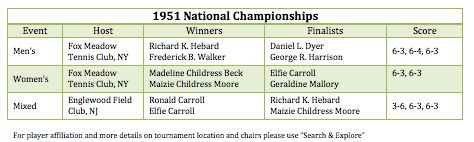
1951

Hebard and Walker won their second title and Madge Beck and Maizie Moore were again back in the winners circle after been the finalists the previous year.

The Mixed was won for the third straight year by future Hall of Famer Elfie Carroll and her husband, Ronald.

Source: Fessenden S. Blanchard, Platform Paddle Tennis, 1959

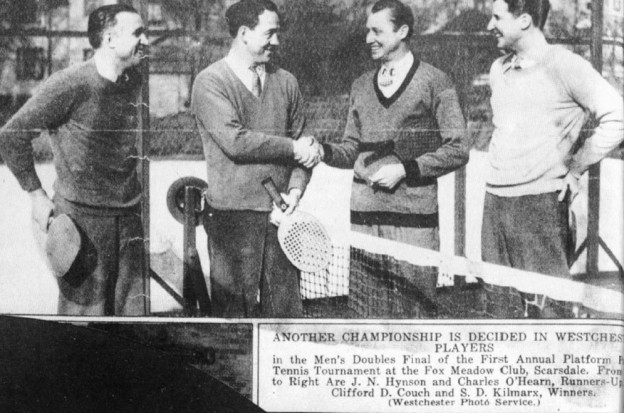
The 1935 Men’s Champions Clifford D. Couch and S. D. Kilmarx on the right and finalists J. N. Hynson and Charles O’Hearn.

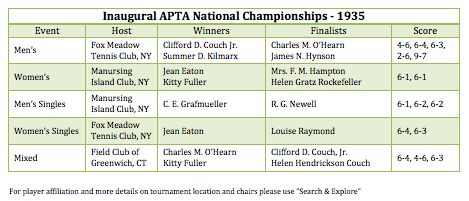
Inaugural National Championships held

1935

In 1935, the American Paddle Tennis Association started conducting a series of annual championship tournaments, held during January, February and March—the height of the season. Included for the first three years were Men’s and Women’s singles championships. But interest waned and singles were dropped in 1938. Blanchard claimed early on that paddle really was just a doubles game.

Source: Fessenden S. Blanchard, Paddle Tennis, 1944

For the first five years, with one exception, teams from the Fox Meadow Tennis Club of Scarsdale dominated these tournaments, occupying both the winning and runner-up positions. By 1940, there were 17 member clubs in the APTA, most of which entered teams in the men’s doubles. However, the experience and a large number of quality teams from the Scarsdale contingent kept them at the top of the heap. The one exception came in 1936 when a strong team from Orange, NJ, Harold D. Holmes and Richard G. Newell took the championship.

Source: Fessenden S. Blanchard, Paddle Tennis, 1944

Screen Shot 2013-11-13 at 7.35.19 AM

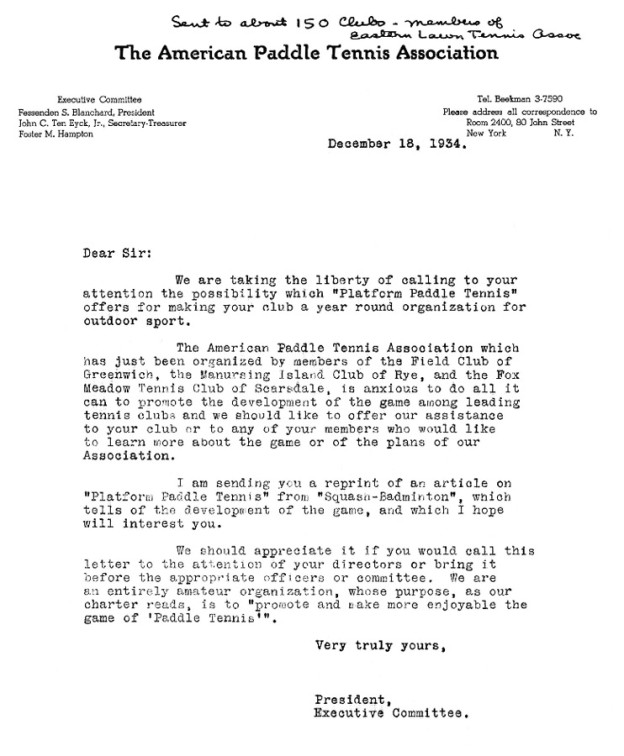
APTA letter to members of the Eastern Lawn Tennis Association explaining the benefits of the game

Fessenden S. Blanchard becomes first APTA President (1934-1938)

Blanchard, a co-inventor of the game along with James Cogswell, and one of the five co-founders of the American Paddle Tennis Association became the first President. Although Jack Ten Eyck Jr. had been the driver behind starting the APTA, it seemed sensible to have Blanchard take the lead, as he was a tireless promoter of the game he loved. Ten Eyck served as the APTA’s first Secretary. During his tenure on the APTA Board Blanchard also acted as Secretary (1935-1941), chief correspondent and publicist for the game. He authored two books on the game – Paddle Tennis (1944) and Platform Paddle Tennis (1959).

Source: Adapted from Fessenden S. Blanchard, Paddle Tennis, 1944, and Platform Paddle Tennis, 1959

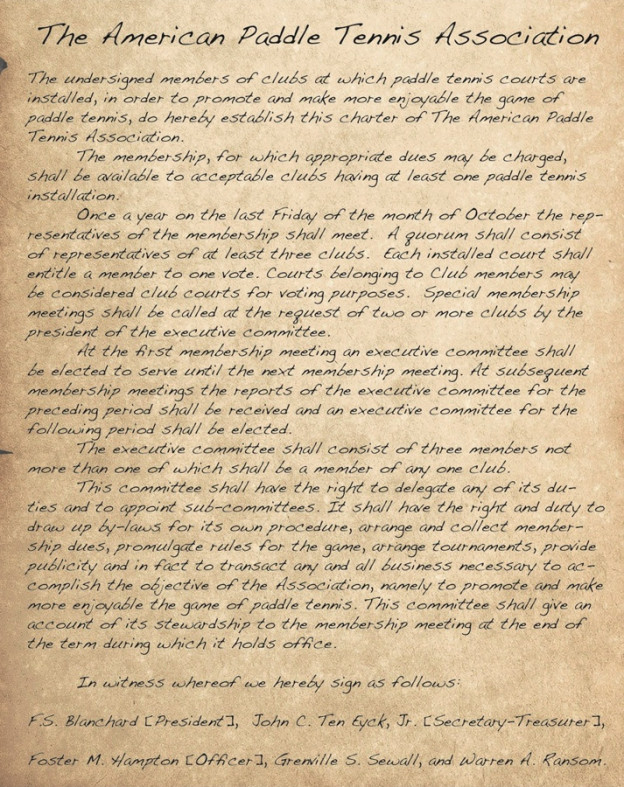
Text from the original charter of the American Paddle Tennis Association. The charter was signed in November 1934.

Founding of the APTA

Manursing Island Club of Rye, New York, was an early adopter of the game after a somewhat skeptical committee of two came to Scarsdale to try out the sport at the court on Old Army Road. After trying out the game, the discussion changed from whether to put in a court to how many. They made a decision to install two courts and two additional ones shortly after. Not long after, Manursing member John C. (Jack) Ten Eyck Jr., took the initiative in founding the American Platform Tennis Association (APTA)— first called the American Paddle Tennis Association. Initial members came from Fox Meadow, Manursing and Greenwich Field Clubs.

Source: Adapted from Fessenden S. Blanchard, Platform Paddle Tennis, 1959

In November 1934, Ten Eyck called the inaugural meeting of the APTA in his office in New York City. Representatives of three clubs that had been pioneers in the establishment of platform tennis courts were invited: Fox Meadow Tennis Club of Scarsdale, New York, the Manursing Island Club of Rye, New York, and the Field Club of Greenwich, Connecticut. Warren A. Ransom, and Grenville S. Sewall represented Manursing; Foster M. Hampton represented the Field Club; and Fessenden S. Blanchard represented Fox Meadow. All five signed the original charter.

The charter provided that meetings of member clubs were to be held at least once a year on the last Friday in October. Each installed platform entitled a member to one vote. However, there was a special provision stating that “courts belonging to club members may be considered club courts for voting purposes.” This was suggested because of the fact that in some communities, as in Scarsdale and Greenwich, many privately owned courts had been made available for Association championships and play by club members. At the time the Association was organized, the Fox Meadow Tennis Club and the Field Club at Greenwich each had only two courts compared to six at Manursing Island. However, the total number of platforms belonging to club members in the two former places was relatively large. The Manursing men generously made the proposal for this clause in the interests of fairness.

Source: Adapted from Fessenden S. Blanchard, Paddle Tennis, 1944

Within two years, the original three clubs grew to eight with the addition of Tremont Place Paddle Tennis Club (Orange, New Jersey), Ardsley Country Club (Ardsley-on-Hudson, New York), Bronxville Field Club (Bronxville, New York), American Yacht Club (Rye, New York), and Amackassin Tennis Club (Yonkers, New York).

Source: Fessenden S. Blanchard, Platform Paddle Tennis, 1959

One of the earliest steps to grow the game, was to send a reprint of an article in Squash-Badminton about platform tennis, and an announcement about the formation of the APTA to clubs belonging to the Eastern Lawn Tennis Association

Letters were also sent to forty platform owners asking these five questions:

1.     How can we improve the type of back net to get a larger percentage of accurate bounces off it? [This was sent a short time prior to the development of the Evans backstop on the Cogswell platform.]
2.     Do you favor the present practice of allowing one serve only? [All replies but one favored one serve.]
3.     Are the present court measurements about right? For instance, would a 2.5-foot alley, instead of the present 2 feet, improve the game, without changing the service or singles court? [No change was suggested at the time.]
4.     We are attempting to standardize the height of the net, which is now 3 feet at the posts with no regular height at the center. What do you think of 2’10” at the center—or do you prefer some other height? Many nets now sag to 2’8″ or 2’9″ at center. [The 2’10” was decided on, with, not over 3’1″ at the posts. This still remains the standard.]
5.     Have you any other suggestion of any kind on rules or equipment, or on any other matter?

Source: Fessenden S. Blanchard, Platform Paddle Tennis, 1959

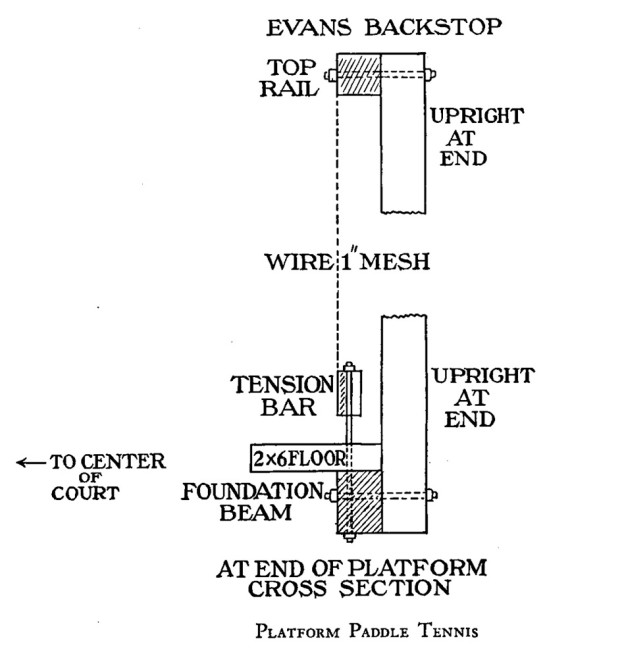
The Evans Backstop Design

Screens are perfected – the games future is assured

Donald K. Evans of Fox Meadow solved the game’s biggest problem, the unpredictable bounces off the backstops. Without a good solution the game had limited growth potential.

Evans devised a method to stretch a one-inch wire mesh from top to bottom inside, but not touching, the uprights surrounding the court. With adjustable tension bars, the Evans Backstop yielded a uniform bounce when a ball hit any of the four screens, and it became standard on all new courts. The future of the game was assured.

This new backstop was first erected—with the aid of John G. MacKenty—during the winter of 1934-35 on the second Cogswell court.

Don Evans was inducted into the Hall of Fame in 1966

Source: Adapted from Fessenden S. Blanchard, Paddle Tennis, 1944, and Platform Paddle Tennis, 1959
First club court built at Fox Meadow Tennis Club in Scarsdale, NY

Of the twenty-five or more families comprising the Old Army Athletes (O.A.A.) in 1928, five were members of Fox Meadow Tennis Club and one of them had built their own court. They urged the club to put in a paddle court so Fox Meadow could become a year round sports rendezvous.

Source: Adapted from Fessenden S. Blanchard, Paddle Tennis, 1944

Expanding into an untried sport in the midst of a national economic depression was risky. Gradually worn down by the arguments of its O.A.A. members, the Board of Directors of the Fox Meadow Tennis Club had a meeting on April 15, 1931, to make a crucial decision. Should they or should they not put up a platform tennis court? They represented a tennis club and some of the avid tennis-playing members didn’t warm up a bit. Finally, a happy compromise was proposed on which the conservatives and the enthusiasts could agree. The club would put up a platform with a boarded end, marked suitably for practicing tennis strokes. It would also be marked for platform tennis with an easily removable net at the center.

On motion “duly made, seconded and carried [as the minutes of that meeting read] the Board authorized the construction of a Practice Tennis Court.” On November 1, 1931, the grand opening of the new platform, no longer called a “practice tennis court,” was featured by matches between teams from “both sides of the tracks.”

Source: Adapted from Fessenden S. Blanchard, Paddle Tennis, 1944, and Platform Paddle Tennis, 1958

Also see The game starts to catch on

Scarsdale neighbors found Platform (Paddle) Tennis

In the fall of 1928, Scarsdale, NY neighbors James (Jimmy) Cogswell and Fessenden (Fess) Blanchard were on a hunt for an outdoors winter sport close to home. This led them to build a multi-purpose wooden platform on a small strip of land on Cogswell’s property for deck tennis, badminton or volleyball. The size and shape of that strip of land had a significant effect on the whole future of Platform Paddle Tennis.

The job was completed by the end of November 1928. The result was a 48′ x 20′ green platform marked out for both badminton and deck tennis. The landscape proved a challenge. The platform couldn’t be wider than 20 feet without raising it over a rock. The ground fell off so sharply at 48 feet in length that a major operation would be required to increase it. Volleyball was no longer an option.

They quickly realized that the unsheltered spot also was not ideal for badminton, so the platform was largely used for deck tennis.

Source: Adapted from Fessenden S. Blanchard Paddle Tennis, 1944

Historical Factoid: Henry B. Eaton, an executive with a lumber business in NYC and a friend of Blanchard and Cogswell, was helpful in supplying material for the first court and was instrumental in getting his company to support the building of many of the early courts, including the first non-privately owned court in 1931 (Fox Meadow). Eaton was President of Fox Meadow Tennis Club in 1936. His wife, Jean Eaton, was the winner of the Women’s Doubles and Singles Nationals in 1935 (the inaugural tournaments) and the Women’s Doubles in 1936. See also – Portables Deck and Gates Sports Platform Company

Source: Joan Eaton Mauk, daughter of the Eatons