Umpires Committee established

Prompted by increasing concern about line calls and foot-faulting, APTA President Robert Brown formed a committee to advise and recommend steps to cope with these matters. The committee recommended the establishment of an Umpires Committee, whose function would be to post line judges to make out calls and any foot-fault calls.

The APTA concurred with the recommendation. Paul Malloy, Paul Sullivan and Brook Kindred, from Fox Meadow formed the nucleus, along with renowned tennis umpires Jack Stahr and Mike Dunne.

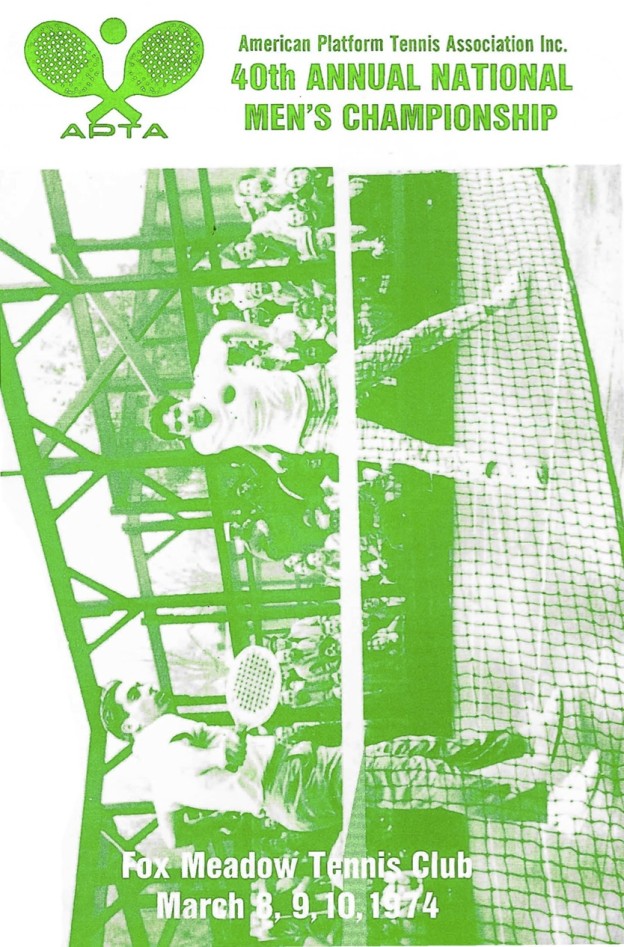
1974 Men's Nationals Program Brochure

National Championships – Inaugural Junior Girls (under 20)

1974- Rev1

Men’s Doubles returned to FMTC and, with 127 teams entered, it was like old times.

Half the defending championship team of Kingsbury-Mangan belonged to Fox Meadow, and half the team that won, John Beck and Herb Fitz Gibbon, grew up there. Big John Beck played for the Bedford Golf Club, but around Fox Meadow, he was still Madge and Ted Beck’s boy, a local kid who made good. The five-set final lasted more than two and a half hours before Beck and Fitz Gibbon overwhelmed Keith Jennings and Chauncey Steele. It was not a complete Fox Meadow victory, but it felt terrific regardless.

In the Senior events, Charles Baird and Ed Swanberg completed their hat-trick in the 50+ and Baird teamed with Roger Lankenau to win the 45+.

In the 60+, Walter Frese and Ken LaVine won their second title.

See APTA Newsletters listed as sources for drawsheets

Source: Off The Wire, Vol. 5. No. 3, & Mid-summer; Diana Reische, Fox Meadow Tennis Club – The First Hundred Years, 1983

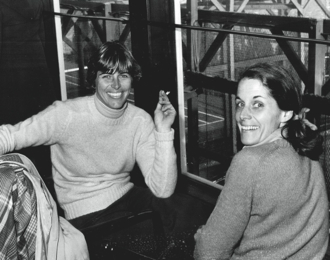
Shirley Babington and Marti Cavanaugh. The sisters won the 1974 Women's and were finalists in 1973, 1975 and 1977.
Shirley Babington and Marti Cavanaugh. The sisters won the 1974 Women’s and were finalists in 1973, 1975 and 1977

Robert A. Brown. Photograph taken at Fox Meadow Tennis club on January 22, 1978 at gathering of APTA's "President's Council"

Robert A. Brown elected APTA President (1973-1975)

Platform tennis came of age while Brown was President, and he had a major influence on the APTA’s policies and plans as both an Officer and Director.

During his term, the APTA published its first official “Rules of Platform Tennis” booklet, under the lead of Bill Ballard.

He hired the association’s first full-time Executive Director, got the APTA on sound financial footing, and instituted detailed record-keeping of National Championship results.

He also engineered the transition during 1973-1974 from orange to yellow ball, which was used for the first time in the Nationals in 1975, and authored the booklets “The Etiquette of Platform Tennis” and “How to Conduct a Tournament Draw.”

APTA President Mike North noted, when thanking Brown for his service to the organization at the end of his tenure as President, “Brown has just begun his contribution to platform tennis.”

That was prophetic as Bob became very active in chairing, as well as competing, in Senior Tournaments, and as chairman of the Hall of Fame.

He also served again on the APTA Board in the 1990s as Region I president and as Rules and Equipment chairman, resulting in a total of 22 years of service on the APTA Board, a record that is not likely to be broken.

Brown was a major force behind the Board approval, in 1998, of the no-let rule on service.

Source: Paddle Talk, No. 2, November 1975

As game expands Fox Meadow players lose dominance at tournaments but the “spirit” of the game remains an essential part of the club

By the mid-1970’s, platform tennis was a national game, attracting an estimated 500,000 competitors. The game was no longer exclusively played by Eastern clubs. The tournaments were often commercially sponsored. As the game widened, Fox Meadow lost its dominance of the Nationals, but the Club’s impact in other areas remained strong.

Cecil J. (Mike) North, Jr.(APTA President 1975-1977) of Bedford Golf and Tennis Club wrote in the program for an earlier Nationals:

“As platform tennis attracts greater numbers of players, expands geographically, and becomes increasingly money-oriented, I think it is important to remember why people played it in the first place: because it is informal, because it is fun. Fox Meadow is a reminder of these qualities.”

Source: Diana Reische, Fox Meadow Tennis Club – The First Hundred Years, 1983

Bill Pearce, VP of Coca-Cola Bottling Company of New York, presents past president Bob Kingsbury and the APTA with the Robert Sticker platform tennis painting

Robert Sticker painting presented to the APTA

A highlight of the Annual Meeting, held in New York City in June, was a special presentation by William Pearce of a platform tennis painting by artist Robert Sticker.

Pearce, Vice-President of Coca-Cola Bottling Company of New York (CCBNY), explained that in 1976 CCBNY’s President and avid platform tennis enthusiast, Charles Millard had commissioned Sticker to paint a platform tennis scene at Fox Meadow Club. Prints of that oil painting were then given to winners of the tour, which was sponsored by the CCBNY subsidiary Tribuno Wines. Through the generosity of CCBNY, the APTA was able to offer a limited number of these color prints to its members.

Source: Platform Tennis, September 1980

The Nationals move from Fox Meadow

The Fox Meadow Club had been a great and historic site for the Nationals over the years, hosting all but the 1936, 1939 and 1973 Men’s championships. But platform tennis’ continued growth all around the country had been an impetus to move the sport’s key event to a new site. The size of the Championships and the logistics involved were a challenge for the club.

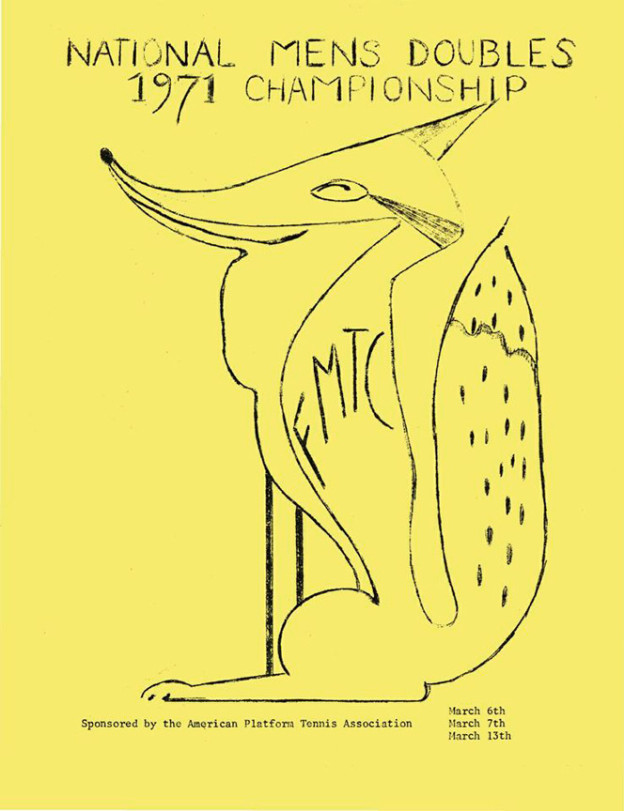
1971 Men's Nationals Program Brochure

National Championships – now the Women had a Senior event

1971 - Rev 1

The 1971 Nationals included the inaugural Women’s 50+.

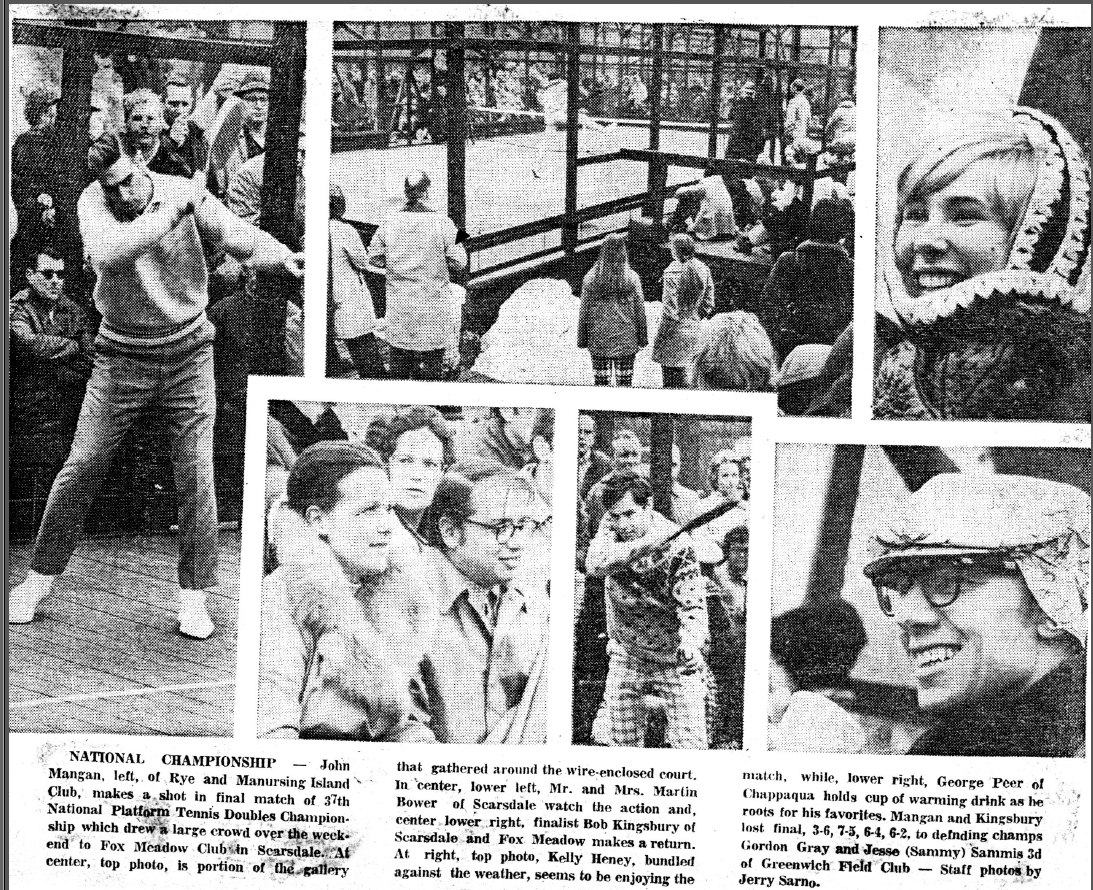
The men had a 128 team draw, and the final was a repeat of the previous years. This win made it a hat-trick for Gray and Sammis, the second hat-trick in the game’s history (Hebard and Carver had won in 1961-1963).

The new and up and coming team of Gloria Dillenbeck and B.J. DeBree won their first title, defeating the winners of the last four events, Charlotte Lee and Peggy Stanton.

Tad Bowen and Sidney Sweet, Jr. repeated as finalists in the Men’s 50+, losing to Robert Baldwin and George Schmid. William Miller and Gregory Prince won the Men’s 60+, while Charlotte Lee and partner Clair Hesseltine won the inaugural Women’s 50+.

In the Junior’s, Charles (Chip) Baird Jr. won his third straight and future Hall of Fame member, Rich Maier, was a finalist.

Source: The APTA Paddle Newsletter, Vol. 2, No.  2 & 3

Screen Shot 2013-11-11 at 11.54.14 AM

APTA Honor Award: Carroll, Carver and Maizie Moore

Elfie Carroll, a New York State tennis champion in singles and doubles, won three National Women’s (1950, 1955 and 1958) and four straight Mixed (1949-1952) with her husband, a record that stood until 1982 when it was tied by Hilary Hilton Marold and Doug Russell. Her Women’s wins in 1955 and 1958 were all the more remarkable since she and her husband moved to eastern Long Island in 1952 where she had few opportunities to play. (Seminole Club, Forest Hills, NY).

Alexander (Zan) H. Carver, Jr. played on the amateur tennis circuit and was ranked as high as number eleven in 1944. He won the Men’s Nationals three straight times (1961-1963), the Mixed nationals in 1964 and the Men’s 45+ in 1963 and the Men’s 50+ in 1970. He was skilled at the half-volley and brought the center court theory of tennis doubles to the game. (Fox Meadow Tennis Club).

Mary A. (Maizie) Moore was part of the Childress dynasty at Fox Meadow Tennis Club and was a fine tennis player, competing successfully at state and national levels. She won six Women’s Nationals – five of them with sister Madge Beck – once the Women’s event was reinstituted in 1949 after a six-year hiatus. She also won the Mixed Nationals in 1946. (Fox Meadow Tennis Club).

Source: The APTA Paddle Newsletter – Annual Meeting, November 1970

National Championships

1970- Rev 1

The 1970’s Nationals were the largest draws in history, with 128 men’s teams and 72 in the women’s.

Gordon Gray and Jesse Sammis III won their second consecutive title over the rising team of Bob Kingsbury and John Mangan.

Charlotte Lee and Peggy Stanton won their fourth straight title.

John Mangan sweetened his loss in the Men’s by partnering with Susie Harris to beat the previous year’s champions, Charlotte Lee and Bradley Drowne.

Dick Hebard and Zan Carver defeated the previous year’s champions, Tad Bowen and Sidney Sweet, Jr. in the 50+ (Hebard had won the event in 1965 with Sweet). John Cookman and Mansfield Sprague won the Men’s 60+ (also called the Veteran’s).

In September 1970, the second APTA Paddle Newsletter printed the draw sheets and results – see link above.

Source: The APTA Paddle Newsletter, September 1970