Old courts at FMTC replaced

As part of Killy Kilmarx’s (1900–1996) long-range plan, developed in 1948 for moving and refurbishing the Club’s seven courts and adding two more, all the old paddle courts east of the clubhouse had been dismantled. By 1953 and in the 1953-54 season, the Club built two new courts for $6,000.

Source: Diana Reische, Fox Meadow Tennis Club – The First Hundred Years, 1983

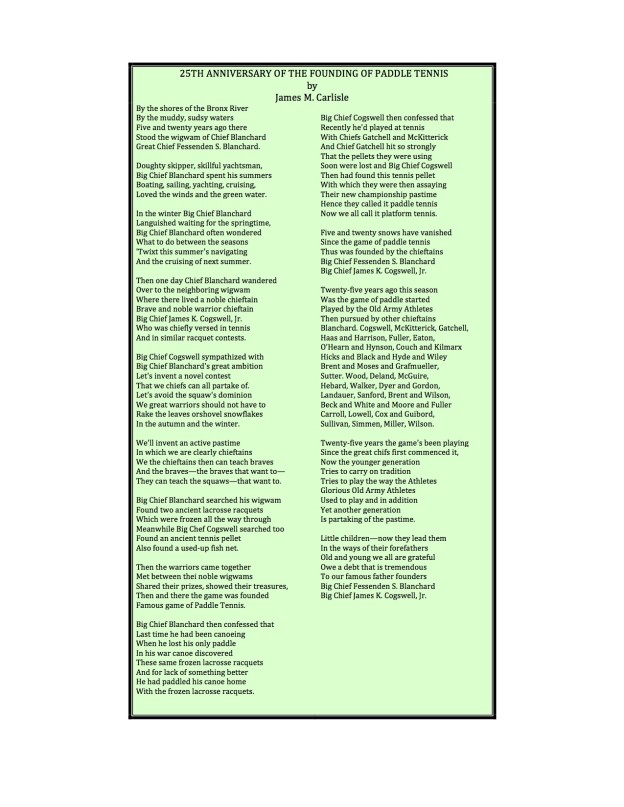
James Carlisle's "Hiawatha" poem, with due apologies to Henry Wadsworth Longfellow. The poem was read at the celebration of the 25th anniversary of the game held at Fox Meadow on February 21, 1953.

James Carlisle’s “Hiawatha” poem

The Old Army Athletes (OAA) had a long tradition of enlivening celebrations with poetry about the game and the people involved starting with Frederick Lewis Allen, editor of Harper’s magazine, and his wife. The Allens were neighbors of the Cogswells and regulars at OAA gatherings. This tradition carried over to Fox Meadow when many OAA joined after the construction of the first paddle court. On February 21, 1953 another poet laureate for platform tennis came to the fore at the twenty-fifth anniversary of the founding of the game at Fox Meadow. The poet laureate was James M. Carlisle, a worthy successor to the Allens and one of the games best players, even though he served underhanded!

Source: Fessenden S. Blanchard, Platform Paddle Tennis, 1959

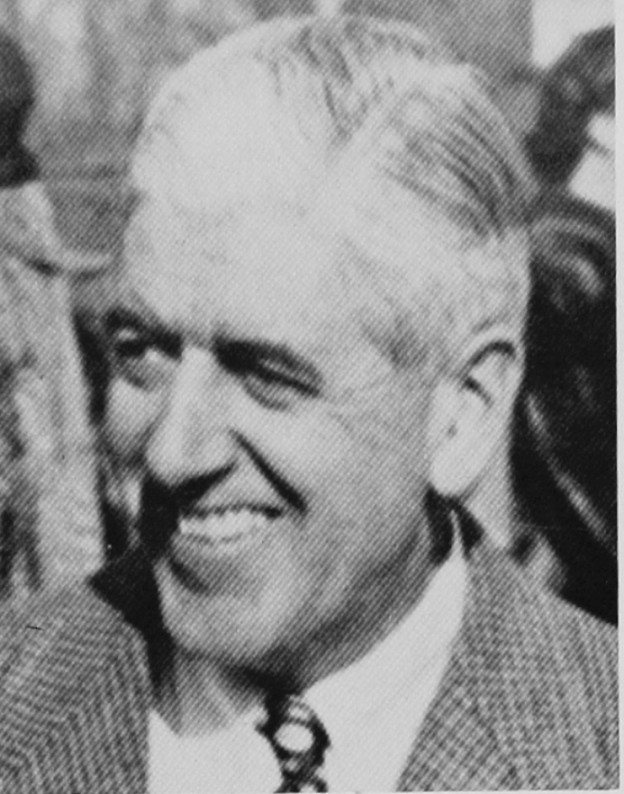
Richard K. Hebard, 1983. Photograph taken at FMTC Centennial

Richard K. Hebard elected APTA President (1953-1955) and FMTC President (1953-1955)

Hebard (1914-2007) graduated in 1933 from the Hill school in Pottstown, PA where he had an outstanding athletic record (see side-bar) and in 1937 from Springfield College. MA. He returned to the Hill School as a faculty member for a number of years and later during WWII he served as a lieutenant commander with the Navy.

After the war he joined his father’s business the R. W. Hebard Company Inc., an engineering and contracting company (had been involved in the Panama canal construction) and R. W. Hebard Associates, agents for Brazilian mining interests (Hebard had South American lineage through his mother’s side).

He was the National Boys tennis champion in 1928 at the age of 14 and continued to have great success on the tennis courts over his playing days.

Hebard married Lois Fuller the daughter of Percival and Kitty Fuller in 1948 and they were long-time members of Fox Meadow where Dick, following in his mother-in-law’s footsteps, amassed many platform tennis titles and became recognized as one of the finest players in the games history.

In tennis Hebard won the Men’s singles five times – 1947-1949 and 1961-1962; the men’s doubles nine times – 1946, 1948, 1951-1953, 1955-1957 and 1960; and the mixed doubles five times – 1949-1950, 1954, 1957, 1963, four of which were with his wife and the other with his mother-in-law.

In platform tennis he won the Men’s nine times – 1947-1948, 1951-1952, 1955-1957, 1963 and 1965 and the Mixed three times – 1953-1955, twice with his mother-in-law and once with his wife.

Both Hebard (1914-2007) and Kitty Fuller were among the first group of ten individuals1 inducted into the Platform Tennis Hall of Fame in 1965 for their contributions to the game (nine of the ten where Fox meadow members).

Historical Factoid: Note 1: Nine of the ten were Fox Meadow members

W. Putnam Livingston, FMTC President (1949-1950)

W. Putnam Livingston elected FMTC President (1949-1950)

Livingston (1905-1987) grew up in CT and ME and attended Williams College. He retired from Bankers Trust as a vice president after a long career where he focused on using technology to improve efficiency and customer services. He was recognized as a leader in this field. He retired to NH where he died after a long battle with Alzheimer’s.

Long-range plan for courts developed

In 1948, when there were seven courts, Killy Kilmarx prepared a long-range plan for moving and refurbishing these courts and adding two others.

Source: Diana Reische, Fox Meadow Tennis Club – The First Hundred Years, 1983

Parent-Child Tournament

In 1947, sixty-four teams entered the Parent-Child tournament, with Charlie O’Hearn and his son Michael defeating Lamar Fearing and his son John to take the crown. The newspaper reported on the event that children come in all sizes, from pint-size to towering specimens and that referring to the latter as “children” somehow didn’t seem right.

Source: Diana Reische, Fox Meadow Tennis Club – The First Hundred Years, 1983

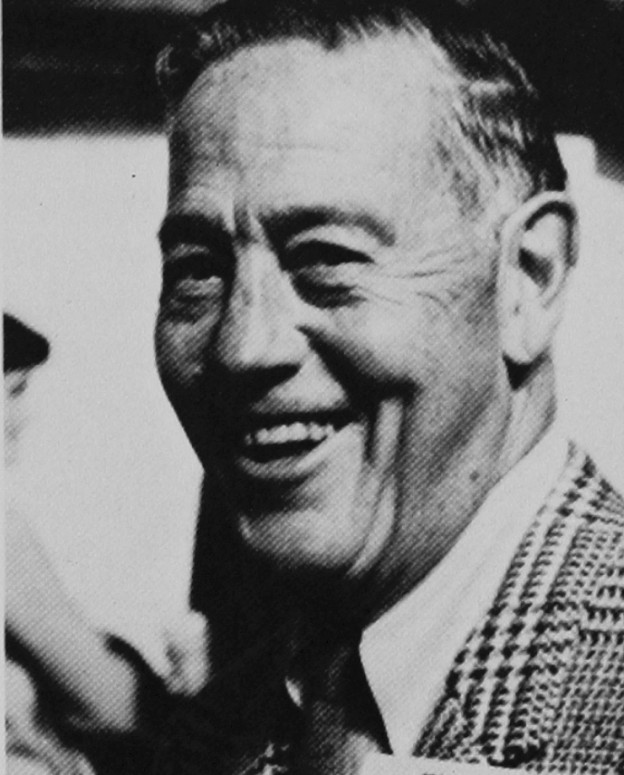
Charles M. O’Hearn, FMTC President (1947-1949)

Charles M. O’Hearn elected FMTC President (1947-1949)

Charley O’Hearn (1901-2001) turned down an offer to be the Red Sox’s GM. Both FMTC and paddle benefitted from this decision.

Charles O’Hearn dominated the game from 1935 through to 1950 and won ten National Championships—four times in Men’s, five times in Mixed, partnering with his wife Ginnie for four of them, and the last Singles Championship. When he moved to New Haven, CT, in 1951, his involvement in the game declined, although he remained an excellent player.

His son Michael O’Hearn was also an active FMTC member and a Club and National Champion.

Innovations to Parent-Child Tournament

In 1946, Tournament Chairman Lamar Fearing introduced an innovation to the Club’s popular Parent-Child tournaments: any member who lacked a child of playing age could borrow one from another member.

At Fox Meadow, paddle meant not just championship competition but an aspect of the game fostered by the Old Army Athletes, the inclusion of young and old, good and mediocre.

Source: Diana Reische, Fox Meadow Tennis Club – The First Hundred Years, 1983