FMTC Membership continues to grow

Despite having so many members away for the War effort, and raising the membership limit to 140, the waiting list still grew as Fox Meadow’s popularity increased, driven by the strong platform tennis social and tournament activities.

Source: Diana Reische, Fox Meadow Tennis Club – The First Hundred Years, 1983

Fox Meadow list WW II Honor Roll

Club minutes refer to a 1944 Honor Roll of eighty-seven members and sons and daughters of members who were in the services, but the list has vanished in the intervening years.

Source: Diana Reische, Fox Meadow Tennis Club – The First Hundred Years, 1983

Fox Meadow expands to seven courts

With the exception of Manursing Island Club in Rye, NY, no other club even came close to affording its members such ample opportunities to play “The Game.”

With seven courts Fox Meadow was the premier club for the game and its “home.”

Source: Diana Reische, Fox Meadow Tennis Club – The First Hundred Years, 1983

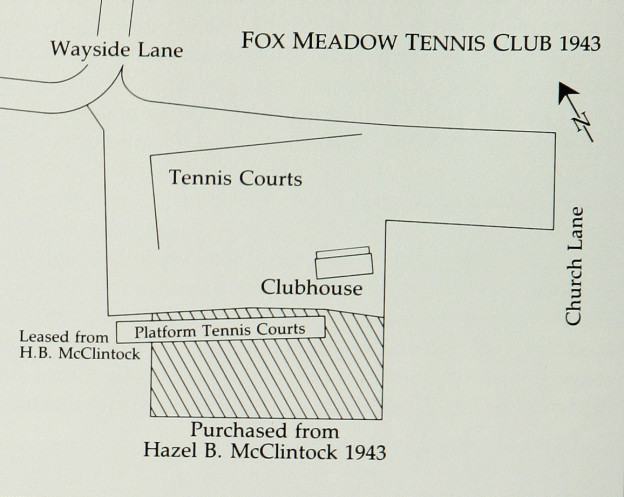
Land leased and purchased from Hazel B. McClintock in 1943

Fox Meadow final able to acquire the land leased from the Crane’s in 1938 in order to build additional courts

In 1943, Hazel Barton McClintock bought a twenty-five acre parcel from the Crane heirs, and she agreed to sell the Club nearly all the land on which it already had paddle courts, approximately three-fourths of an acre, for $4,200.

One paddle court still lapped over onto McClintock’s property, but she permitted the Club to leave it in place.

A few years later the McClintocks joined the Club.

Source: Diana Reische, Fox Meadow Tennis Club – The First Hundred Years, 1983

Oscar F. Moore, FMTC President (1943-1945)

Oscar F. Moore elected FMTC President (1943-1945)

Moore also served as President of the APTA from 1946-1948, which proved to be important growth years. He was credited with developing the mixed Scrambles or Jamboree, a format that gave the game much of its social overtones and proved to be very popular. Few people gave so much of their time and energy, or were so dedicated to platform tennis.

Robert Gordon, FMTC President (1942-1943)

Robert S. Gordon elected FMTC President (1942-1943)

Robert S Gordon (1898-1979) was long time civic leader in Scarsdale. He practiced law at Sullivan & Cromwell before becoming general counsel at National Dairy Products Corp. (now Kraftco Corp.).

One of his sons, James P Gordon, (1928-2013) was credited with the development of the fore-runner to the laser and narrowly missed being awarded a Nobel Prize in Physics for his work; he also was a multiple APTA National Champion.

The other son Dr. Robert S Gordon, Jr. coordinated AIDS research at NIH and died in 1985

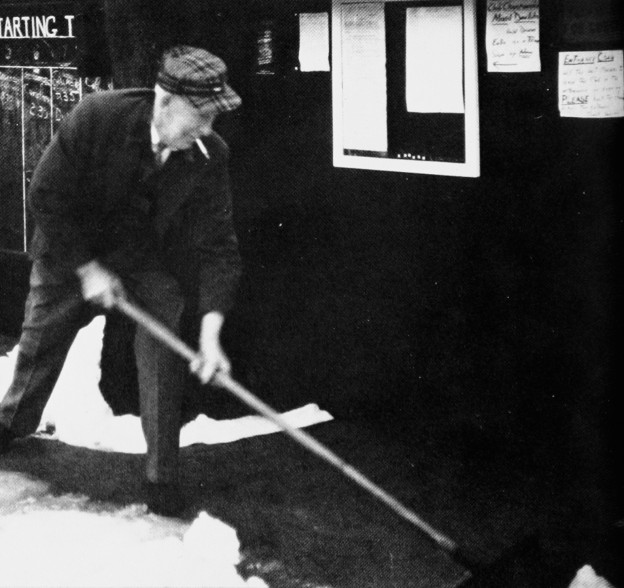
Before the days of court heaters there was Felix McCrea, Groundskeeper Extraordinaire

Felix McCrea become FMTC caretaker

A few years after Felix joined the Club in 1941, Charlie O’Hearn said in his president’s message that he honestly didn’t know what Fox Meadow would do without Felix. “He is wonderful with the kids, he is wonderful with the grownups, he is wonderful with a hammer and saw, and more than once he has fixed our coal burner single-handed. And the tennis and paddle courts speak for themselves. He is an institution around this Club.”

“Fox Meadow is a kind of institution,” said Brook Kindred, “and in the old days the institution was Felix McCrea, who was probably the most renowned court builder in the metropolitan area.”

Felix served full-time until 1960 when he started to work on a part-time basis overseeing the courts. He died in 1972 and a bronze plaque was placed outside the clubhouse to honor “a thorough gentleman and dedicated custodian of the Fox Meadow Tennis Club for forty years.”

Source: Adapted from Diana Reische, Fox Meadow Tennis Club – The First Hundred Years, 1983

FMTC property in 1943, showing land purchased and also leased from Hazel B. McClintock

Fox Meadow adds more courts

The Club built additional courts on land it leased from the Crane heirs in 1938 for $150 a year. The site was a 40′ x 250′ strip of land running along the Club’s southern boundary. Although the Cranes had begun to sell parts of the estate, efforts to buy the property outright stalled.

(Note: In 1943, Hazel Barton McClintock bought a twenty-five acre parcel from the Crane heirs, and she agreed to sell the Club nearly all the land on which it already had paddle courts, approximately three-fourths of an acre, for $4,200. One paddle court still lapped over onto McClintock’s property, but she permitted the Club to leave it in place.)

Source: Diana Reische, Fox Meadow Tennis Club – The First Hundred Years, 1983

Paddle Benefits Wimbledon

The United States was not yet at war, but for months waves of German bombers had pounded England almost daily, causing terror and destruction in towns and cities. Among those hardest hit was the world’s tennis Mecca, Wimbledon, whose citizens issued a plea for help from America’s tennis players.

The Fox Meadow Tournament Committee responded promptly:
“In response to an appeal on behalf of the heavily bombed citizens of Wimbledon, England, we are having a Wimbledon Paddle Tennis Tournament . . . a scrambled mixed doubles event with Tea and Crumpets afterward. The entry fee is $1.00.”

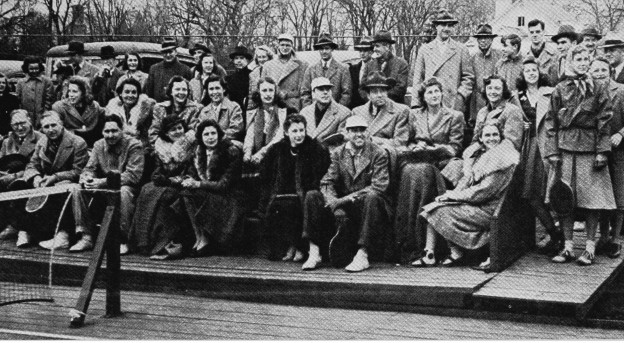
The 1941 benefit was typically Fox Meadow: well bred, in the precise spirit of the times, intergenerational, and centered on platform tennis. The Wimbledon tournament drew ninety-five players, many of them young people home from prep schools or colleges for Easter. Oz Moore handled the complicated seeding and drawing necessary for a successful Scramble, and many of his pairings matched a vacationing junior high or prep school student with a top-ranked national player.

National women’s champion Madge Beck drew thirteen-year old Billy Riegel, and they made it to the semifinals. The final round, however, went to Maizie Moore and William Spindler, who defeated Mrs. John Fowler and Charlie O’Hearn, 6 4, 4-6, 9-7. Said Club President Keith Eaton of the event, “The Wimbledon Benefit showed us that paddle tennis is not only a fast and exciting sport for play by experts, but it is a grand family game, and it also proved to the satisfaction of everybody that the Fox Meadow Club will not lack championship material for future national tournaments.”

Source: Diana Reische, Fox Meadow Tennis Club – The First Hundred Years, 1983

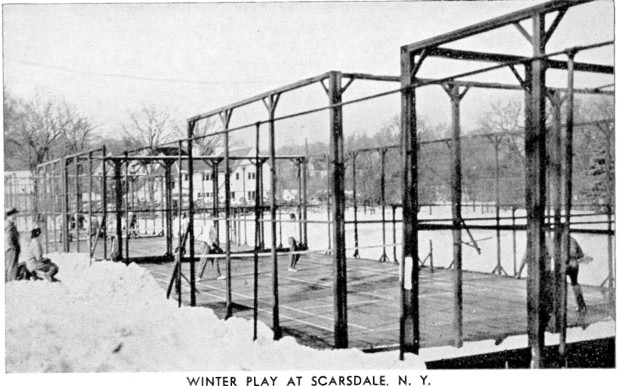
Winter play at Fox Meadow in late 1930s

Paddle so popular at FMTC that there now is a waiting list

By 1940, more than a dozen people were on the waiting list for membership. World War II, however, put most Club activities on hold. Because gas rationing made tournaments all but impossible, most were suspended for the duration of the war. By the dozens, members and their offspring left for the war. Dues for those on active duty were cut to $25.

Source: Diana Reische, Fox Meadow Tennis Club – The First Hundred Years, 1983