


Paddle under the influence…..of Tennis

David Caldwell & Blake Cordish had thoughts on the subject:

Over the last five to seven years a fresh crop of experienced tennis players has dramatically influenced the way the modern game of paddle is being played. Tennis players have helped to make paddle a faster, more aggressive game characterized by new shots, spins and strategies.

New Shots
Tennis players have brought their ground strokes to paddle and the effect has been increased pace, spins and additional offensive firepower off both sides from the baseline and the net.

On the forehand side, many tennis players utilize a semi-western grip that allows for more topspin so the ball can be struck harder and still come down in the court. This has also allowed for new offensive strategies such as using an off-pace, topspin groundstroke to dip the ball to a net person’s feet so the player can then “blitz” and volley the next shot, effectively ending the point or taking over the net position.

Interestingly, the semi-western grip has also introduced a new offensive shot for the net person with the full swinging forehand volley. Generally hit off of a short lob, this swinging volley is actually a forehand groundstroke hit with tremendous velocity targeting the feet of the baseliner. The goal is to aim at the backcourt player’s feet so he has to take a half-step back to avoid being hit, thus making it harder for his team to track down the next ball after it comes off the back wire. This, coupled with increased side spin on the overheads, has provided a way for the net team to more effectively control the point by keeping the backcourt team off balance and making it harder for them to get a clean ball to drive or lob.

On the backhand side, the most noticeable shift is the number of tennis players that have brought aggressive, two-handed backhands to paddle that obviously leads to more offense and takes away “safe” zones for net players to hit to. One interesting result, as traditional in tennis, more and more two-handed backhanded players are standing in a “neutral” position to return serve versus the traditional paddle stance that opens up the forehand. This provides for a more varied and therefore more effective return strategy.

Faster Points
One of the more subtle but substantive changes introduced by tennis players is the speeding up of the game, not only in terms of pace of shot, but also in the tempo of points (i.e. less time between balls being struck and quicker points with fewer lobs). Tennis players, without the benefit of wires, are obviously conditioned to take the balls off the deck. As a result, fewer balls are being left to the back wire.
Interestingly, tennis players are much more likely to “control” a point from the baseline with drives than they are lobs. It is certainly not clear that this strategy is necessarily the most effective, but it does make for a faster paced, more dynamic game, especially with four tennis players on the court.

New Technology
Along with the players, major tennis equipment suppliers like Wilson, have played a more pronounced role in paddle and brought over existing tennis technology. For example, when we took up paddle eight years ago, we naturally gravitated to Wilson because the grips were shaped like tennis grips versus the traditional smaller, rounder paddle grip. Wilson has retained the tennis grip trait but, reacting to the feedback of players, has introduced improved paddles that are firmer and provide more feel and grit that has allowed for more effective spins. Today’s paddles are more conducive to an aggressive style of play that was not possible even as recently as five years ago.

New Strategies
All of the above tennis influences have contributed to evolving strategies in paddle. In addition, it is important to note that while errors play an important role in tennis, winners do as well. Tennis players bring to paddle an instinctive desire to figure out a way to end points. In some ways, it is the Achilles heel of tennis players when they first take up the game, but this mindset has also helped to evolve and improve the game as tennis players creatively look for ways to win points versus avoiding losing them.

Perhaps, the most pronounced and most exciting trend is the growing importance of “blitzing” or opportunistically charging the net to volley an opposing team’s volley. The basic goal is take advantage of a dipping or hard hit groundstroke to make the opposing team volley up. The best volleys from the blitzing team are generally aimed right back at the first volleyer’s forehand hip. A tennis background which focuses on increased topspin, an instinctive preference to take the ball off the deck and court positioning closer to the baseline, all make this offensive strategy a natural for tennis players.

Even with all the exciting offensive influences tennis players are bringing to paddle, it is critical to remember that with its small court and the lively nature of the present day ball, that paddle is ultimately not a game of winners but of errors. For tennis players, coming to terms with that mindset is critical. This year’s Men’s National Champions, Flip Goodspeed and Scott Mansager, are a great reminder that whether you have a tennis background or not, ultimately sound fundamentals are essential to success on the paddle court.
Hall of Fame Inductees: Sharon Hummers, Winnie Hatch. Plus 2008 Inductees Scott Mansager and Flip Goodspeed who made the ceremony this time!

In a celebration held at the Women’s 40/60 National Championships on February 11, 2009, Winnie Hatch and Sharon Hummers were inducted into the Platform Tennis Hall of Fame, in recognition of their outstanding achievements both on and off the court over many years.

The induction presentations were delivered by Steve Baird for Edwina “Winnie” Worth Hatch and by Bob Brown for Sharon K. Hummers, before a large, enthusiastic, and appreciative audience at the Canoe Brook Country Club in Summit, New Jersey. Each honoree acknowledged the election with thanks, and other comments of adoration followed by several relatives and friends.

The induction of Mansager and Goodspeed, the 2008 Hall of Fame Inductees, took place on January 17, 2009 at the Cincinnati Midwesterns. Todd Ward explained why:

The Cincinnati Midwesterns played out the way most Midwesterns have gone for the last several years. What differed this year was that at the Saturday night party at the Ridge Club, 120 people witnessed a little platform tennis history.

Cincinnati benefitted from the lengthy quarter-final match that Flip and Scott played at previous year’s 2008 Nationals in Rochester. As a result they didn’t make it to ceremony of their induction to The Platform Tennis Hall of Fame until after 10:30 p.m. which required rescheduling the ceremony until the 2009 Cincinnati Midwestern’s.

Hall of Fame representatives Steve Baird, Walt Peckinpaugh, and Fritz Odenbach were all on hand to dedicate the honor to the sport’s greatest team to ever play the game. All talked of the amazing feats the duo accomplished on the court – not to mention off the court as well. Both players addressed the crowd with some light-hearted barbs at each other but humbly accepted the honor with the same ease and grace they displayed on the court for 16 years together.

The induction speech for Goodspeed and Mansager was delivered by Steve Baird.

And by the way, Goodspeed and Mansager defeated Estes and Cochrane 6-4, 7-5 in the Midwesterns final. Flip and Scott hope to continue their mastery of Cincinnati this March as they will return and go for their 8th National Title in March.

Source: Platform Tennis Magazine, Vol. 10, Issue 4, February, 2009

LIPTA hosts Viking Junior Tour event

On Saturday, December 13, 2008, the Long Island Platform Tennis Association (“LIPTA”) hosted its 6th Annual Viking Junior Tour tournament at the Garden City Country Club, the Cherry Valley Club and the Garden City Community Park.

With Christmas less than two weeks away, the children received a surprise early morning visit from that jolly old Nordic man with rosy cheeks and a little round belly – that’s right, David Kjeldsen, founder of Viking Athletics, was there to provide his support, wearing his trademark “horns”! LIPTA is grateful to Viking Athletics for its sponsorship of the Viking Junior Tour, and for providing the children with a memorable platform tennis experience (and great favors).

Among the four age divisions, thirty-two (32) teams participated, and countless parents and grandparents cheered. The level of paddle was extraordinary, the good sportsmanship was commendable, and the smiles were constant!

John Cerga and Alex Bancila, the Directors of Racquet Sports at the Garden City Country Club and the Cherry Valley Club, respectively, and Taylor Stanton, Racquet Sports Professional at the Cherry Valley Club, volunteered their time and helped make it a memorable day for the players. Additional thanks to Mike Sparacino for his behind the scenes work with the program and drawsheets.

Source: Mark J. Brosnan, Platform Tennis Magazine, Vol. 10, Issue 4, February, 2009

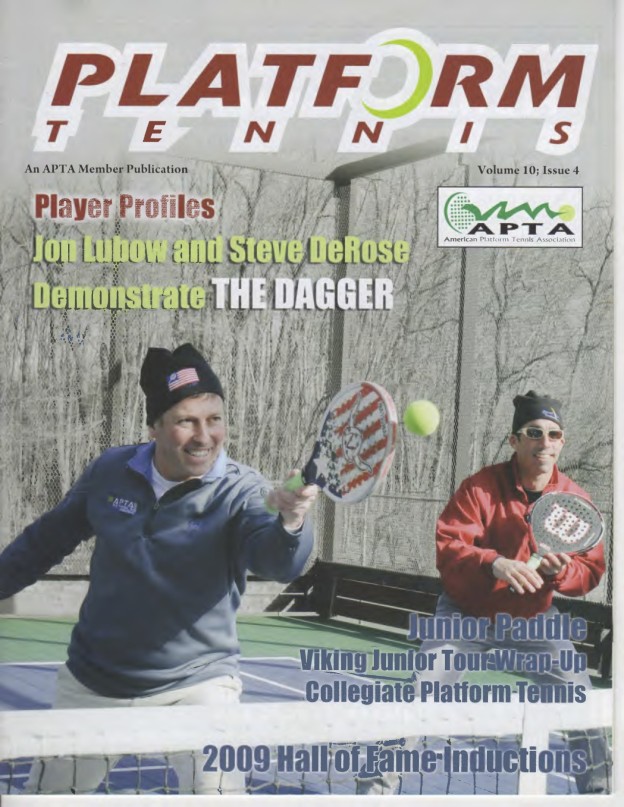
Paddle’s newest weapon – The Dagger

Deception can be an effective weapon in any paddle player’s arsenal. Throwing up an offensive lob when your opponents are on top of the net or hitting a drop shot off a hard drive will keep them off balance and lead to a lot of free points. Here you will learn how and when to attempt a Dagger, an extremely low percentage shot that, if executed successfully, could win the point outright and get some laughs in the process.

The Dagger is a shot off the end of the paddle that should only be tried under certain circumstances.

The Set-up
A good spin overhead from an offensive position backs one of your opponents deep into his corner and puts him on the defensive. All he can do now is hope to dig the ball out and keep the point going. A weak floater towards the middle of the court is the perfect setup for a Dagger attempt.

The Reaction
The other team sees that they have hit a weak shot and prepare to suffer the consequences. They will be expecting you either to hit a slash back into the corner or maybe a drop shot that will force them to lunge forward in a desperate attempt to stay in the point.

The Execution
To set up for the Dagger, point your paddle directly at the net. If the opponents see this they will think you are setting up for a drop shot into one of the alleys.

As they lunge forward, you execute the shot by hitting the ball off the end of the paddle.
Do not thrust forward too much as this will make the shot more difficult. Just allow the ball to come to you and let it bump off the end of your paddle.

A perfectly executed Dagger should bounce for the first time near the service line at the T. At this point your deflated opponents should be completely out of position as the ball heads right up the middle between them. (Note: An off-center dagger hit could spin off the edge of the paddle and become a drop shot winner so hit the shot from very close to the net)

Once you have mastered the Dagger, or become bored with it, and you need to add even more variety and arrogance to your game, it is time to try a Bagger (The Butt Dagger is shown below). Here you just simply flip your paddle over so the tip is pointing behind you and hit the ball with the butt of the paddle. Then duck!

Player Profiles: “The Dagger” Men – Jonathan Lubow and Steve DeRose

Jonathan Lubow

Hometown: Randolph, NJ
Spouse and Kids: Wife: Jessica. Daughters: Caroline (8), Katie (5)
Hobbies: Gardening, Golf, Skiing
Personal Note: Wrote Options on Futures: New Trading Strategies
Paddle used: The National
Favorite shot: The “Dagger”
Sports experience: Played tennis in high school
Team accomplishments: 2006 and 2009 NJ State champs, 2008 Chicago Charities champions

Platform tennis partner history: “I used to play with Chip Dyer. He moved to Colorado four years ago and I hooked up with Steve.”

How do you train for the season: “I do not train. I try to play all year round. Night paddle in summer is great.”

Nutritional regimen, vitamins, stretching, etc.: “I drink Gatorade and I never stretch.”

When did you start playing platform tennis? “After College. Charlie Stevens (Paddle Legend) got me into the game.”

What do you like most about platform tennis? “Fun, exercise, and camaraderie.”

How did you partner with Steve DeRose? “Steve is the tennis pro at our club (Morristown Field Club). He just took up the game five years ago. I was captain of our team and played the first doubles court. He was playing the 4th court. When my partner moved away, I pulled Steve up to be my partner.”

How would you like to do in the 2009 Nationals: “In the 2008 Nationals, we lost badly to Caldwell and Cordish in the round-of-16. In the future, we would like to do better.”

Future goals: “Be a good husband and father.”

Steve DeRose

Hometown: Morristown, NJ
Hobbies: Golf, Reading, Skiing, Gym, Thinking, and Photography
Paddle used: Wilson K Boom
Favorite shot: Any shot that ends the point
Started playing paddle: After lunch one day with Drew Broderick
Paddle partner history: Paul Marshall, Bill Maxwell, Sean Flanigan, Carol Kimmelman, Jonathan Lubowmirsky
Sports accomplishments and experience: MHHS one-on-one basketball tournament winner, Rutgers Keller Cup, Men’s B National Finalist, A-10 All-Conference Men’s Tennis

How do you train for the season? “By doing the opposite of what Jon does… eating right, Beekram yoga, Pilates, boxing, weight training. I am also into Vapor, athletesperformance.com routines in which you prehab the body before stretching.”

Why do you play paddle? “It is an incredible community of fun, exceptional, competitive people playing an equally remarkable humbling game.”

How did you meet up with Jon? ” Jon’s partner Chip Dyer happened to be moving the year after I started playing.”

How would you like to do in the 2009 National? I would be really happy with any result that came out of playing consistently tough, aggressive paddle.

Future goals: ” I would like to continue to enjoy the challenge of playing our best in the biggest moments. As an instructor, I would like to continue making the most challenging parts of the game accessible to those who want to learn it.”

Paul G. Sullivan (1927-2009)

Hall of Fame inductee, Paul G. Sullivan, died on February 4, 2009 in Vero Beach, Florida, at the age of 82.

He was born in Brooklyn, lived most of his life in Scarsdale, New York, and in recent years, Vero Beach. He attended Princeton University, and served in the Navy as a radioman in Annapolis. His work career spanned over 50 years, first with Hayden Stone and then with Smith Barney.

Paul served for many years on the Board of the American Platform Tennis Association, and was APTA President from 1963-1965. He was also President of the Fox Meadow Tennis Club from 1967-1969.

During the 50’s and 60’s, he was a major contributor to the activities of the APTA serving, among other things, as Chairman of many National Championships and as Chairman of the APTA Umpires Committee. He was also a USTA umpire, and served in that capacity at the U.S. Open and at Wimbledon.

He was instrumental in the APTA’s establishing of the Honor Award in 1965, to recognize individuals of distinction in platform tennis, which designation was changed in 1998 to the Platform Tennis Hall of Fame.

In recognition of his long-term service and outstanding contributions to the game, he was inducted into the Hall of Fame in 2002.

Source: Robert A. Brown, Platform Tennis Magazine, Vol. 10, Issue 4, January, 2009

Player Profile: Scott Bondurant

Scott Bondurant

Age: 49
Residence: Chicago, Ill.
Family: Wife: Susan; Daughters: Brooke, 13; Cara, 11
Occupation: Asset Management
Hobbies: Tennis, Golf, Travel

Do you have an awareness of the fact that you’re playing guys that could be 30 years your junior?
I’d be lying to say that it isn’t fun to be able to compete with players that are a lot younger. It’s still fun to be out there playing in the open division. The other thing is platform is very conducive to continuing to be able to play, to compete at older ages simply because it’s a smaller court and it’s all doubles. If you can find a partner that can cover a large part of the court, you can hang in there.

Do you prepare differently mentally than you have in the past?
Not really. I would just say that I probably don’t get as nervous about matches as I used to. I just go out there and take them as they come.

Has your training regimen changed over the years?
My warm up runs used to be a lot longer than they are now. I’m more likely to get tired if I run very long.

How long do you see yourself competing in the open levels of competition?
It’s a really good question. As long as I can truly compete, and feel like, on any given day, that when I’m playing with a top-notch partner that we can beat anybody.

How long have you been playing platform tennis?
I started playing basically 20 years ago and love the sport.

What about the sport keeps your interest?
The game is just a ton of fun. I guess three things, first and foremost it’s wonderful to be able to get outside in the winter athletically. Two, it’s hugely social. It’s a great group of people who play the game. It’s a tight knit community. Three, the fact that I can still compete at a high level keeps my interest as well.

What other athletic activities do you pursue?
I played very competitive junior tennis and college tennis and professionally for a period of time. It was a fairly natural transition to take on platform tennis. When I was very young, I lived in the Scarsdale, New York area, and my parents played. My mom’s sister Lucy McAvoy is a platform tennis hall of famer, and my cousin Tim has been one of the top players in the Philadelphia area for 25 years.[Note: Scott’s mother, Helen Barnes, was a very accomplished tennis player. See The Barnes Sisters]

Does your family share your passion for the sport?
My wife plays, and plays Series 2 in the Chicago women’s leagues. Both kids also play a little bit.

Do you play as a family and give each other pointers?
The kids are starting to get old enough where we can begin to have a little competition, but they have been too young to play at any serious level yet. Because my wife plays, she’s been very supportive.

Do you have any role models or players who have inspired you during your playing career?
Rich Mayer stands out, along with Steve Baird, as giants of the game to me. They were the best team by far when I first started playing

Do you have any tips or advice for those just starting out in the sport?
The only comment that I would have would be that you can continue to improve for a much longer period of time than you might think. Your first 10 years of the game – if you’re 25, will continue to improve, and you’ll stay at a pretty high level for a period of time. The other thing is hey, in the end it’s all about having fun and nobody takes paddle too seriously.

Where do you find yourself learning new techniques or styles to add to your game?
I’m a big beneficiary of all the top-notch players in the Chicago area. The more you play with people with different styles and shots, that will just help your game. Getting out there and playing with real strong players is far and away the most important thing.

Any final thoughts on the sport?
I’d say that I would expect the kind of generation of players that are in their late 30s early 40s to continue to be competitive for quite a while. It’s nice that I am it’s one of things that I wouldn’t be surprised if there are more guys that end up playing well into their 40s. I’ll play in the 50s and over this year, but still think that my partner Mark Johnson and I will be competitive in the open.

Source: Platform Tennis Magazine, Vol. 10, Issue 3, January, 2009

Platform Tennis websites worth a peek according to David Kjeldsen

Our sport is growing, and growing quickly. This is evidenced by the number of websites devoted to league play and area play across the country. While I am sure I am missing quite a few, below is list of sites that I recently compiled. (If you know of others, please let me know.)

Clearly some of the sites are updated almost daily. Sadly, others haven’t been updated in over a year. Some are hokey; some are professional to the max. Some are purely data driven; others are all about the story. But the bottom line is they seem to work for the groups they serve.

If you have a half hour or so, spend some time visiting each of the sites. You may get ideas to share with your league webmaster to make your site better.

Please let me know your favorite. Mine is the Western Pennsylvania Platform Tennis Association. [enlarge image to read more]

My Serve – David Kjeldsen opines on the good and the bad

FAULT – Roving Foot Fault Judges. Where were they at the first large APTA tournament of the season? I watched over 15 hours of matches at the Chicago Charities, and I didn’t hear one foot-fault called – although I saw a lot. I thought the new APTA rule was roving foot fault judges were to be used at all national ranking tournaments. Maybe I was in the wrong place at the wrong time when I was watching? Funny, I didn’t see any at the Sound Shore Invitational either. Surely I will see them next weekend in the APTA Presidents back yard for the Long Island Invitational.

ACE – Peachtree Paddle, Atlanta, Georgia. Gotta love any platform group that gives out great car window decals to their members. The three-color design really stands out. Contact them and maybe you too can get one.

ACE – Videographers. With the technology available today, there is a lot of great information regarding platform tennis on the web. Thanks to all the camera guys who make this possible. Have some fun. Search “platform tennis” on YouTube and you’ll learn a lot and smile a lot.

FAULT – Member Lookup. One of the best features of the old APTA website was the “Member Lookup.” It is still not back on line.

DEUCE – Member Lookup. The Long Island Platform Tennis Association is one of several leagues across the country that have their entire membership directory online in a password protected format that alleviates some of the privacy concerns that open association lists have had in the past. Once LIPTA and others figure out how to automatically generate responses by E-mail for requests for forgotten passwords and or membership numbers all will be “aces.”

DEUCE – APTA Board Members. I am not sure how much conversation about platform was generated, but kudos to all the board members who sported their APTA vests at the Chicago Charities. For players with gripes or grapes, the board members were clearly visible to and available to all. Sadly, no board members I saw at the Sound Shore Invitational were identifying themselves.

ACE – PPTA. 100+ current and future players came out to see top PPTA pros and national, champions, all from Chicago, play an exhibition at the Cherokee Town and Country Club in Atlanta on November 1. Special thanks to Peter Lauer, the driving force behind the event.

“I’ve traveled all the way across the country for you to show me how to hit more winners.” Hank Irvine had a suggestion!

Rod Workman, PPTA Professional Director of Racquets at the Onwentsia Club in Lake Forest, IL, recounted the experience in a column on intermediate and advanced instruction in PTM:

Sixteen years ago, I was teaching a paddle camp in Eureka, Montana with the “Godfather of Paddle,” Hank Irvine, when my ideas on the winning shot began to take shape.

A gentleman from Long Island arrived at the camp and said to Hank, “I’ve traveled all the way across the country for you to show me how to hit more winners when I play.”

Hank’s blood pressure spiked and he swiftly responded, “Sir, my suggestion is that you get on the next available plane back to New York because we won’t be teaching winners at this camp. The game is not about hitting winners but never making errors!”

With that, I adopted Hank’s style of teaching and playing, which I still use today.

Source: Platform Tennis Magazine, Vol. 10, Issue 2, December, 2008