


UNC Platform Tennis – clinics and exhibitions

Marty Pomerantz, Director, Campus Recreation, University of North Carolina-Chapel Hill filed this report with PTM:

It took about five years of cajoling, collaborating, and construction, but this author’s vision for a multi-purpose recreational facility finally evolved from a paper napkin at Bruegger’s Bagels to a successful grand opening on Saturday, October 17. The new South Campus Recreation Complex (SCRC) sits atop what once was an eight court tennis center and home of the Carolina Varsity Tennis Team. Today, it consists of three sand volleyball courts, three tennis courts, two full length basketball/inline hockey courts, and the piece de resistance, three brand new ground level platform tennis courts.

The grand opening event included sand volleyball and tennis tournaments, which attracted a number of student teams. But the highlights of the day’s festivities included a professional platform tennis exhibition, a Pro-Am exhibition, and some outstanding clinics run by the visiting professionals who flew in from New York and Chicago.

In the main event, Mike Cochrane and Jean Kempner teamed up against Mike Rahaley and Mark Fischl. What was noticed by the group of impressed university and community spectators was the impressive high skill level of the four pros, the intensity and appeal of this relatively unknown game on tobacco road, and the good natured trash talk of “Mikey” Cochrane.

The Pro-Am portion featured Cochrane teaming up with Rebecca Dirksen Paul, former player at Dartmouth College and former Assistant Coach of the Carolina Women’s Varsity Tennis Team. On the other side of the net, Jean Kempner teamed up with Brian Kalbas, currently in his sixth year as the Carolina Women’s Varsity Tennis Coach and avid platform player himself. Clearly, it took a few games for Paul and Kalbas to “embrace” the wires, but once they did, the play was crisp, skillful, and entertaining.

Asked how platform tennis compared to traditional tennis, Kalbas commented that platform is much more fun to play. “The game is so fast-paced and keeps you moving all
the time. You don’t have far to retrieve balls or walk to the other side of the court.” Platform tennis maximizes the space and, compared to tennis, is easier for novice players to reach a level at which they can play and thoroughly enjoy the game.

The student participants are excited about forming a recognized student organization, becoming a sponsored team, and traveling to DC where George Washington and Georgetown already claim teams. And with Duke just 10 minutes away, the first annual UNC-Duke Paddle Tennis Challenge is just around the corner. Mackenzie Thomas, Class 2013, from Huntington, Long Island, is leading the effort to promote the sport. Having played the game for several years Mackenzie was very excited to see the courts installed.
Courts inaugurated in Atlanta

Melanie Oudin helps inaugurate courts in Atlanta

On Friday, October 9, The Peachtree Paddle League (PPL) kicked off the new season in fine style with its annual gala and exhibition at the newest platform tennis venue in Atlanta, the Racquet Club of the South (RCS).

Made famous recently by the charmed success of US Open quarter finalist, 17-year-old Melanie Oudin, RCS unveiled their brand new courts and viewing deck to a crowd of some 125 people, including many enthusiastic kids.

Topping off the night was an appearance by Melanie in person, who picked up a paddle and played her first set of platform tennis, paired with Philadelphia native and Atlanta transplant, Ali Tross Cole.

Behind the RCS story was a grant from the American Platform Tennis Association to help with the cost of construction of their two courts.

Mark Fischl, then President of the APTA, was instrumental in enabling this project to go forward.

Current APTA President Tim McAvoy has embraced the grant program and accelerated it through the formation of a Growth Committee, chaired by PPL founder and Region VII President Peter Lauer, to help local organizers of paddle programs with both grant money and other resources that can help them to succeed in building paddle in their area.

With the new courts at RCS, the Peachtree Invitational, played across several venues, can now accommodate a bigger draw and a women’s tournament.

Premier Cup – Berka and Eberly collect the cash

The 5th Annual Premier Cup took place this year at Sunset Ridge Country Club in Chicago on October 10th & 11th. This year’s field featured the strongest veteran teams in the sport as well as many of the top up and coming teams. Sunset Ridge boasts six courts and is under the direction of Peter Berka. This year’s field had representation from states of Illinois, Ohio, New York, and New Jersey for the two-day event that had a total purse ofS5,000.

The first day of competition started at 10 a.m. on Saturday and lasted through dark as each team played a round robin competition within their own group (three matches).

Format:
• Two out of three sets; regular scoring

• Super tie-breaker for 3rd set (Sat. only)

• Top two teams from each group advanced to semi-finals on Sunday

Rules for Advancement:
• Best overall record from round robin play

• 1st tie-breaker used is head-to-head, followed by sets won (then % of games won)

Premier Platform Tennis & Wilson Racquet Sports provided personalized apparel for the players. The club itself came through in a much appreciated and professional way by providing drinks and food for all players and spectators throughout the weekend as a thank you to all who carne out to enjoy what many call the “Super Bowl” of platform!

The first day of competition ended with both groups having to go the tie breaker method to decide who would advance and play for the money on Sunday. In the end, the teams of Scott Bondurant and Mark Johnson (1st) and Steve Derose/Jon Lubow (2nd) advanced from the Green group along w/ Chris Gambino/Scott Mansager (1st) and Peter Berka/Drew Eberly (2nd) from the Purple Group.

By Sunday, the word had got out that Sunset Ridge’s own Peter Berka was playing in the Semi’s. The home club members, along with many of Chicago’s finest, came out to watch the best battle for early season supremacy!

The match started at 10 a.m. with the top team from each group facing the 2nd place team from the opposite group for a place in the finals. Both matches were tightly contested and those who witnessed saw some incredible performances.

The finals saw a rematch from Saturday’s round robin play as the top seeds Chris Gambino/Scott Mansager squared off against the local favorite & hosts Peter Berka/and Eberly. In a match that was clearly closer than the score indicated, Peter Berka/Drew Eberly avenged their only loss on Saturday to take the title 6-3, 6-0 and be crowned 2009 Premier Cup Champions!

“Each year the players, tournament and sponsor support continues to go to a greater level, making this event one of a kind,” said Jason Gray, tournament director.

Congratulations to Sunset Ridge and Peter Berka for putting on a fantastic and professional weekend of platform on and off the court. The event would not be made possible without the efforts of the tournament sponsors Premier Platform Tennis, the Chicago Platform Tennis Association and Wilson Racquet Sports.

A team to watch: Brian O’Connor and Mark Parsons

Brian O’Connor

Age: 25.75
Hometown: Larchmont, NY
Marital Status/Kids: “I am not sure what marital status means. If that is the same as martial arts status, yes, I have a yellow belt with two black stripes. Kids… no, I do not fight kids, although some in my class are pretty tough”
Hobbies: Tennis, beaches, bodybuilding, and Gossip Girl
Achievements in Tennis:
• Hold record at Binghamton University for most singles victories
• Team advanced to NCAA’s 3 times
• Two-Time National Grandfather/ Grandson Champion

How and When You Got Into Platform: ” I fell in love with paddle when I was a young bang-baller. I spent most of my childhood following women’s paddle, as my mother (Joanmarie) would bring me to all her local events and league matches.”

What You Like About the Sport: “The various styles of play provide for interesting matchups. Among the top teams strategies including: hard drives, heavy spin, frequent blitzing, drop shots, FYM’s, baggers and daggers, etc. Off the court, I enjoy the camaraderie, custom tee shirts and sneakers.”

What Paddle Do You Use and Why: “I use Mark’s old paddle (Wilson Slash) because he gave it to me.”

How Did You Pair With Your Partner: “I was in the right spot at the right time, and somehow he convinces me that it’s always my turn to sign us up for tournaments and write the check.”

Mark Parsons

Age: 30
Hometown: Norwalk, CT
Marital Status: Married to Dana
Children: Maddox, McKenzie and my man-child partner Brian
Team Affiliation: Proud Member of the “Jontourage”
Hobbies: “Posting on Paddlepro.com and working on my calves.”
Achievements in Tennis:
• University of Tennessee 1997-2001
• All American Singles Selection
• 8-Time All Sec Selection
• 2000 NCAA Final Four Team
• 2001 NCAA Finalist Team
• Career High College Singles #8
• Career High College Doubles #2
• ATP Career High 700

How and When You Got Into Platform: “Tennis in the snow wasn’t fun. I couldn’t see the lines. Platform legend Steve Baird introduced me to the sport.”

What You Like About the Sport: ” I love the strategy side of the game. It’s way more involved then tennis. The camaraderie off the court is comparable to no other sport I have played.”

What Paddle Do You Use and Why: ” I use the Viking Re-Ignite because Mike Cochrane told me to.”

How Did You Pair With Your Partner: “Community service of 50 hours. Need I say more.”

Team Tournament Results:
• 2008/’09: Semis in Long Island
• Quarterfinals in Philadelphia
• 5th at 2009 National Championships
• Singles Champion in 2008 and 2009 (Mark)

Team Goals:
To beat Mike Stulac in anything: checkers, darts, backgammon, curling … and avoid him like the plague in paddle tournaments.

O’Connor and Parsons on how they got together as a team.

Brian: “I was in the right spot at the right time, and somehow he convinces me that it’s always my turn to sign us up for tournaments and write the check.”

Mark:”Community service of 50 hours. Need I say more.”

Winnie Hatch (1942-2009)

November 9, 2009 – The platform tennis world lost a great champion. Hall of Fame inductee, Edwina (Winnie) Worth Hatch, passed away after a courageous battle with cancer. Winnie, a 14-time National Senior Champion was inducted into the Platform Tennis Hall of Fame in 2008.

Winnie introduced hundreds to the game of platform tennis and ran scores of tournaments, from the Nationals to local events.

Source: Platform Tennis Magazine, Vol. 11, Issue 2, 2009

PTM Publisher Wayne Dollard opines on the state of the game in Chicago

It seems that Chicago has been getting more and more attention lately in the platform tennis world. No disrespect to the East or West coasts, but I would say this is rightfully so.

Although only 2-3% of the known platform tennis courts are in the Chicago area, their’s is the largest organized league in the country with approximately 3,000 players.

Also, over the past seven years, seven Chicago men and women have captured ten of the 14 National Men’s and Women’s Nationals( Susie Keane, Mary Doten, Scott Mansager, David Keevins, Brian Uihlein, David Ohlmuller and Chris Gambino). [enlarge image to read more]

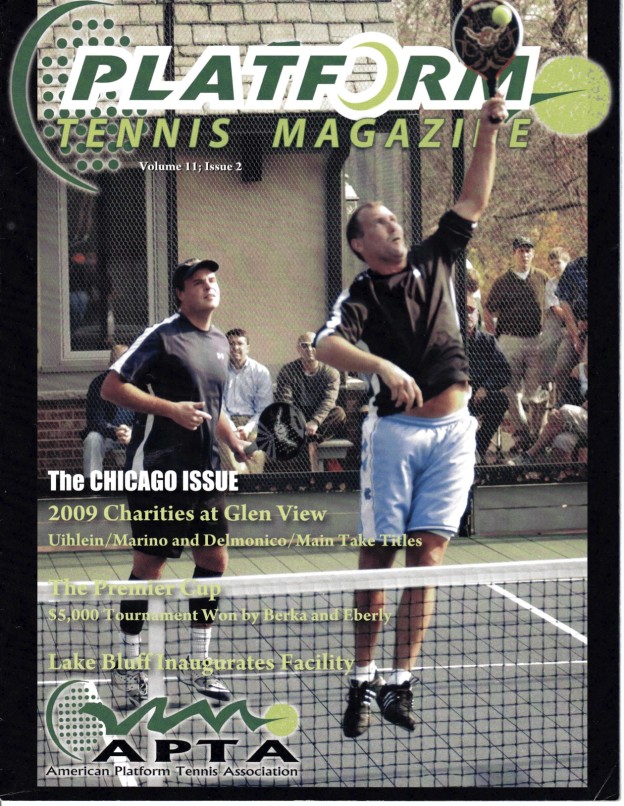
Chicago Charities coverage – Uihlein and Marino take the Men’s and Delmonico and Main the Women’s

Uihlein and Marino Team Up to Take Men’s Title…..Delmonico and Main Win Women’s Charities………

It was a beautiful platform tennis day and the play was outstanding when the women took to the courts at the Chicago Charities.

The 2009 women’s draw was missing many of the big-name players such as Lauren Zink, Cindy Prendergast, Laura Parsons and Susie Keane; however, the talent level was still exceptional compared to most other ranking tournaments.

Kerri Delmonico and Aila Main worked their way through the draw defeating Sally Cottingham and Liz Hayward in the quarter-finals and then Bobo Delaney and Tonia Mangan in the semi-finals on their way to the final.
http://youtu.be/HiPJbZWsHUA

Quarter Final Prop-Schneebeck & Doten-Schwartz.3rd set tie break – Prop-Schneebeck are up in the breaker 6-1. Ad-hoc commentary provided by energized viewers in the hut

Heather Prop and Lynne Schneebeck clinched the other half of the draw with wins over Doten and Schwartz in the quarter-finals and then OhlmuUer and Sheldon in the semi-finals. The finals was patient yet fast-paced. After a tough battle, Kerri Delmonico and Aila Main earned the top spot over Heather Prop and Lynne Schneebeck in the Chicago Charities Women’s Open.

http://youtu.be/UWqmTAqug4g
A typical point in Men’s Final – this being Chicago, gun shots can be heard but they were from nearby skeet range!

Congratultions to Mike Marino and Brian Uihlein for their victory over Mike Cochrane and Scott Estes in the finals of the 2009 Chicago Charities. The play, under a cloudless and unusually warm sky, was lively and spring-like as all the men’s draws-were played out at the Glen View Club. The final was an intense three-set match played to a large crowd of spectators.

The depth of talent at the 2009 Charities was impressive. Missing only a few familiar names, the seeded teams at this year’s tournament covered two complete generations of paddle and an array of styles. There were masters of zen-like patience, big swinging drivers, loud ones, quiet ones, and one court amusing itself with how many times the guys could tag each other.

Fifteen of the sixteen men’s seeded teams made it to the round of 16. Full of past national champions and finalists, those eight matches were among the most exciting of the tournament.

The semis saw Peter Berka and Drew Eberle lose to Mike Cochrane and Scott Estes, and Mike Marino and Brian Uihlein defeating Scott Bondurant and Mark Johnson. This set up three-set final won by Marino and Uihlein over Estes and Cochrane.

Source: Platform Tennis Magazine, Vol. 11, Issue 2, 2009

Premier Cup goes to Canada

The Fonthill Platform Tennis Club, just 25 minutes north of Niagara Falls, offers two platform tennis courts, a comfortable warming hut, players that welcome you with open arms, and a fridge full of beer. Basically a platform tennis player’s dream!

James Aldred, President of the club and event organizer, along with long-time friend and club member, Rich Humphries, put together the winter’s most anticipated event.

On March 28th 2009, the top Canadian platform tennis players came out to compete for the first prize money tournament ever in Canada. Club members all pitched in with home made food and baked goods, Lorenzo’s Fine Foods was on the grill, and Embroidery Plus donated jackets. The local Tribune newspaper touted articles and camera crews showed up to give the event television coverage.

David Dodge of Premier Platform tennis put up the prize money which was divided between winners of Division A and Division B (each division had 8 players) The results were Derek Thomas and Jay Smith being the winners of Division A and Neil Burke and Rich Allen winning Division B, with each player receiving $250 prize money. Each player also received a prize from the Fonthill Club. Prizes included, Bosch job site radios, 12 volt Bosch power tools, and gift certificates.

The event provided for great promotional weekend for all involved, loads of fun, and an even more anticipated event next March. David Dodge stated, “It is sometimes overwhelming to see how clubs’, their members, and local patrons can step up and pull together to make these events and our sport such a great success. I thank you for pulling together to keep our sport alive and growing!”

Source: Platform Tennis Magazine, Vol. 11, Issue 1, 2009

Peggy Stanton

Peggy Stanton (1924-2009)

Hall of Fame inductee, Margaret G. (“Peggy”) Stanton, died peacefully in her home in Quogue, New York, on June 17, 2009, at the age of 85.

Peggy was a major contributor to the advancement of women’s platform tennis and was also a distinguished player. She won the Women’s Nationals in 1967, 1968, 1969, and 1970, and was a finalist in 1971. She was also a finalist in the Mixed Nationals in 1969, and went on to win two Senior Women’s Nationals in 1974 and 1977 and was a finalist in 1976.

Peggy was an active promoter of platform tennis, an enthusiastic worker for the advancement of women’s platform tennis, a well known instructor, and played in many exhibitions. She was the first female Director on the APTA Board, in 1971, and served for three years as the women’s tournament director.

In recognition of her achievements, Peggy Stanton was inducted into the Platform Tennis Hall of Fame in 1979.

Source: Robert A. Brown, Platform Tennis Magazine, Vol. 11, Issue 1,

Are today’s top players the best ever?

Mark Holtschneider opined.

At this year’s National 45s/55s/65s Championship, a tape of the 1976 Men’s Nationals was playing in the paddle hut. The play was dominated by lobs and soft overheads to the corners. There was an occasional flat forehand drive. There were no Mansager-like crushing forehands, no Goodspeed-like two-handed backhand drives, and no Uihlein super cut overheads. Contemporary players look much quicker and more athletic. A few players in the hut said that today’s top players are definitely better than the best players of the ’70s. Others agreed that athletes in all sports are better today than they were 30 years ago – track times are faster, pole vaults are higher, basketball players are taller, and football players are bigger.

I disagree. I think the late 1970s champs could compete with the best of today’s players.

First, the rackets and balls in the ’70s were very different from today. The rackets were wooden and much heavier. The balls were denser and much less bouncy. As a result, many of today’s shots could not be hit with the old equipment. Just because today’s players hit harder and with more spin does not mean that the former champs could not have done the same things with today’s paddles and balls.

Second, the “Tennis Boom” was in full swing in the 1970s. More Americans played tennis in that decade than today. Nearly every top platform tennis player was first an accomplished tennis player. If there were more tennis players in the ’70s, then it stands to reason that there would be more good platform tennis players.

Finally, there was the money. In the 1978-79 platform tennis season, Passport Scotch offered over $100,000 in prize money. The year-end tournament alone was $50,000. In inflation adjusted dollars, that’s $160,000 for just the last tournament! Not surprisingly, that kind of money attracts top players. For example, the 1977 and 1978 Men’s Nationals were won by Herb Fitzgibbon and Hank Irvine. Fitzgibbon played on the U.S. Davis Cup team and won a gold medal in tennis at the 1968 Mexico City Olympic Games. Irvine played Davis Cup for Rhodesia and was a semi-finalist at Wimbledon in Mixed Doubles. In 1979, Clark Graebner and Doug Russell won the Men’s Nationals.

Graebner was a member of a winning U.S. Davis Cup team, a Wimbledon singles semifinalist, a U.S. Open finalist, and a French Open doubles champion. These players competed at the highest international level and had incredible racket skills. Those skills easily transfer to platform tennis. And, these players were only in their mid-thirties when they won their platform tennis National Championships. (As a point of comparison, if three similarly accomplished tennis players, ten years off their prime, entered platform tennis today, we’d see the likes of 1998 Davis Cuppers Todd Martin, Justin Gimelstob and Jan-Michael Gambril.) Could the late ’70s champs compete well today? I sure think so.