The New York Times, March 14, 1955

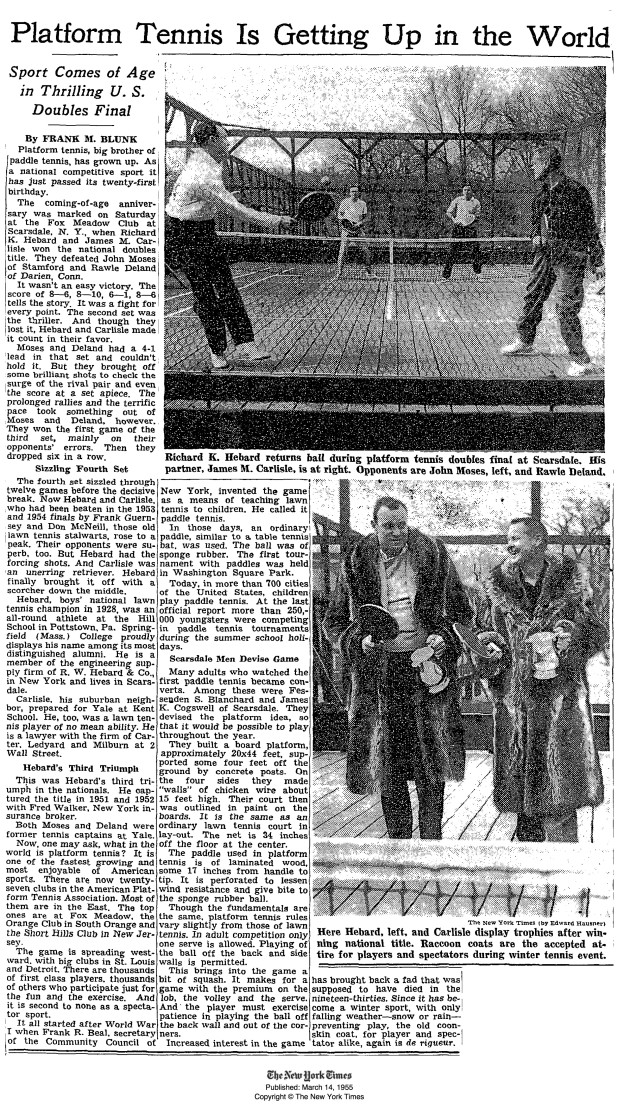
New York Times covers Men’s Nationals

The article covered the coming of age of the game when the APTA’s 21st birthday was marked by the Men’s Nationals at Fox Meadow, and described the hard-fought finals between Hebard and Carlisle, the winners, and Moses and Deland.

Source: The New York Times, March 14, 1955

Number of courts continues to grow despite losses to disrepair and Hurricane Carol

In the early days, courts often fell into disrepair as the original construction techniques and choice of materials were poor.

Often these courts were torn down, but the court at Riverside Yacht Club in Riverside, CT, was the first to be lost to an “Act of God.”

Despite the fact that courts were being lost, many more were being built and the number of operational courts was expanding rapidly.

Interest in the game from north of the border

The APTA had an inquiry from Department of Agriculture, in Quebec, Canada.

“Having been in charge of this district for the Province of Quebec Lawn Tennis Association,” said the letter, “I am convinced that paddle tennis will be popular but the older members are skeptic about the whole thing.”

Blanchard recalled how similar this was to Fox Meadow’s initial take on the game.

Source: Fessenden S. Blanchard Platform Paddle Tennis, 1959

Lob becomes new weapon in the sport

In 1941, a powerful new type of play carried a new star to three championships. Clifford S. Sutter, former third ranking tennis player of the United States and twice intercollegiate champion, supported by his partner, J. B. Maguire, developed the exciting possibilities of the lobbing game.

With almost unbelievable accuracy in their deep lobs and exceptional skill in taking the ball off the back and side wiring, Sutter and Maguire were able to keep the ball in play, even though their opponents were constantly smashing for the corners. For a time, at least, it seemed they had found the answer to the net game.

Source: Fessenden S. Blanchard, Paddle Tennis, 1944

New York Times, 1941

The appeal of the game

The number of men who seem to enjoy playing with their children, as well as their wives, is evidence of the great appeal of paddle tennis as a family game. Children start batting the ball around at about seven years of age, and begin acquiring the rudiments of tennis.

Platform Tennis in Life Magazine

Kenneth Ward arranged for a piece to run in Life Magazine, and he appeared in several of the pictures that ran with it. In one of the shots, his expression was so contorted that Life felt impelled to caption it: “Up the wire, like a monkey, goes Ken Ward, President of the American Paddle Tennis Association. In spite of his strange antics, Ward is a good-looking New York broker.”

(Note: The pictures were taken by the Albanian-American photographer Gjon Mili who, along with Harold Edgerton of MIT, was a pioneer in the use of stroboscopic instruments to capture a sequence of actions in one photograph)

The Life article brought some amusing reactions.

One was a letter from a man who objected to calling O’Hearn the “game’s greatest player.” He said O’Hearn had never played against him.

Another man’s letter made the revolutionary idea of taking balls off the backstop seem tame:

“Your article on paddle tennis as played by a group in New York State is most interesting to us here in New Jersey, but I would like to tell you about our game. We play in a garage, about 30 by 60 feet in Morristown, using the ceiling as a play surface. This, of course, eliminates any advantage in playing the net position, as the ball can be struck against the ceiling making it strike the opponent. Along the center of the ceiling runs a beam the full length of the court and balls played off this introduce strange angle shots. No walls offer any hazards but one rear wall, and that is a trickster’s delight. Here is an old hot air furnace with its pipes reaching out like arms to change the direction of the ball or destroy it for one attempting its return. In a match last week the ball struck against the ceiling, bounced up from the floor into the maze of pipes and has not been found yet. For all I know it has now been shoveled out with the ashes. On winter weekends it is a toss-up whether this game or hockey prevails, but we old men have a preference for our game of paddle tennis.”

Source: Adapted from Fessenden S. Blanchard, Platform Paddle Tennis, 1959

Number of courts skyrockets

The APTA Annual Report of October 25th estimated 500 courts to be in use.

They based the estimate on a list of 229 platforms built by the Gates Company and a partial list of plans distributed by James K. Cogswell.

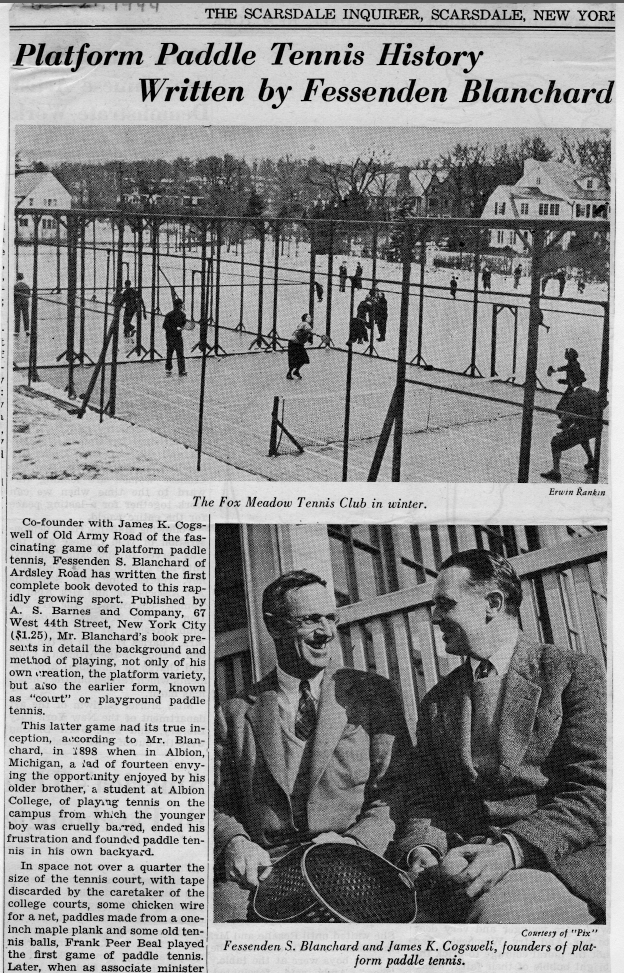
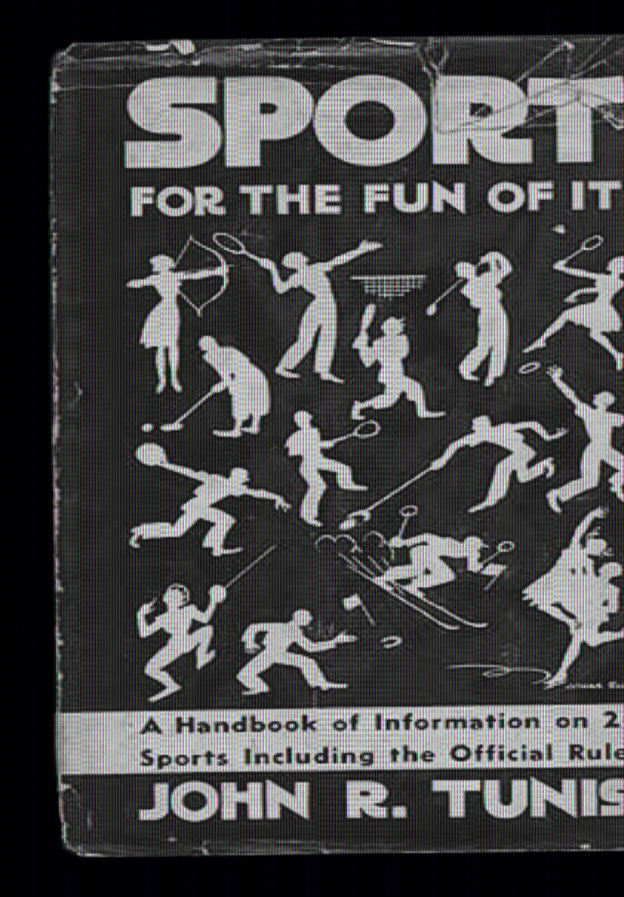
First book covering Platform Tennis published

The book was published by A. S. Barnes. John Roberts Tunis (December 7, 1889 – February 4, 1975), was an American writer and broadcaster and “the ‘inventor’ of the modern sports story.” Known for his juvenile sports novels, Tunis also wrote short stories and non-fiction, including a weekly sports column for the The New Yorker magazine. As a commentator Tunis was part of the first trans-Atlantic sports cast and the first broadcast of the Wimbledon Tennis Tournament to the United States.