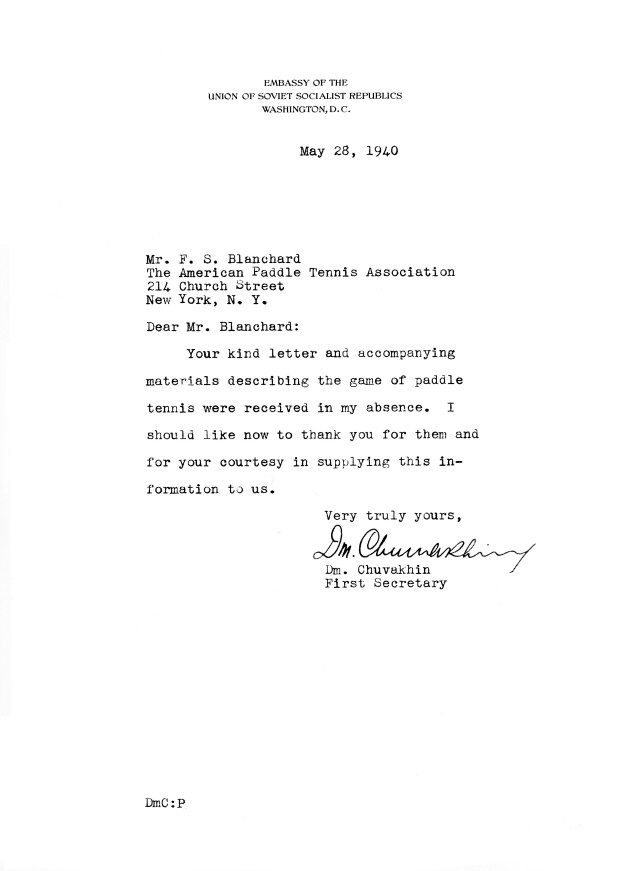
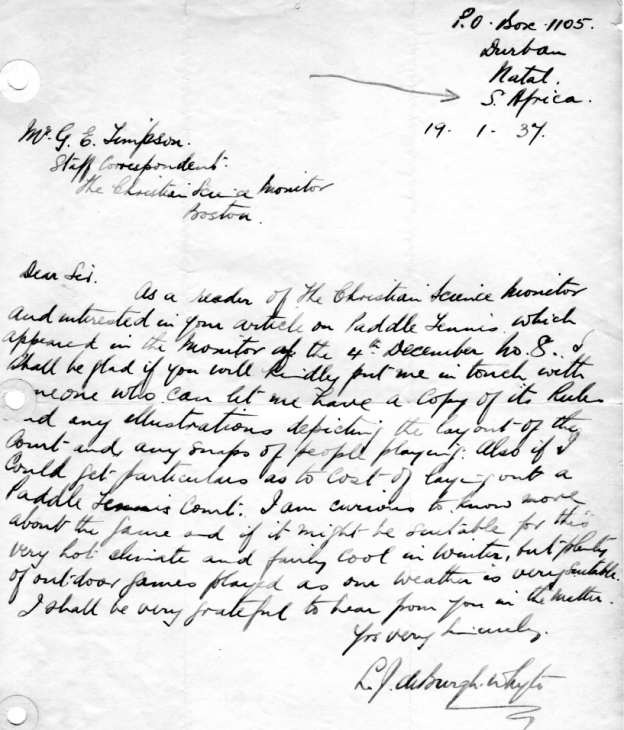
Letter from Chuvakhin to Blanchard thanking him for sending details on court construction and playing the game.

Paddle in Russia

In the spring of 1940, the APTA received a request for information on the sport from the “Embassy of the Union of Soviet Socialist Republics” in Washington, D.C. The Russian Commissar of Sports, Mr. Dm. Chuvakhin, wanted to learn more about platform tennis.

Fox Meadow players dominate the game through the 1930s and 1940s

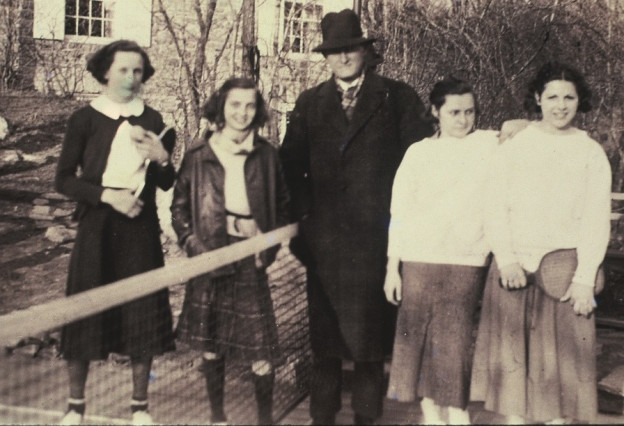
Through the 1930s and 1940s, Fox Meadow players dominated the new sport, and their styles and strategies became the standards for championship play. The Club’s pre-eminence was partly attributable to members’ wholehearted adoption of the game and partly to the fact that Fox Meadow had far more courts than any other club, with the exception of Manursing Island Club in Rye, NY.

APTA asks Fox Meadow Tennis Club to host inter-club Scrambles

The Fox Meadow Tennis Club had been holding tennis Scrambles for several years when Ken Ward of Manursing suggested in 1938 that the recently formed American Paddle Tennis Association (APTA) hold an inter-club Scrambles. In paddle, this event came to be called the Jamboree and later the Jambles. Play was held at Fox Meadow, the only club with enough courts.

“Scrambles” tournaments established

Considered by Blanchard as “one of the greatest steps forward in the history of platform tennis,” Ken Ward created the scrambles format and conducted them at Manursing Island Club. These scrambles tournaments were keys in increasing participation by balancing talents and introducing tournament play without the championship tensions and rivalries.

Ken Ward and John Stephenson presided over the draw. The entries were secretly classified into A and B players, and the names of each group put in a separate hat. No two players from the same hat or the same club could play together.

Ken Ward and Oz Moore discussed the draw. “I have the worst luck in these scrambles tournaments,” said Ken. “I never seem to draw anybody who is any good. Why, sometimes my partners haven’t ever seen a paddle. Of course, if I did get anyone that was any good, they’d all be suspicious.” “I’m the same way,” replied Oz. “I never get a good partner either. I’m always out of luck, too.” “Let’s compare notes,” suggested Ken. “Who did you draw last year?” “You!” said Oz.

Unless a player drew Charlie O’Hearn, Paul Hicks, or Cliff Sutter for a partner, he would not know for sure that he rated as a B player—and if he did draw one of those men, he was so pleased that he forgot the insult. The scramble format proved to be an excellent way to develop hidden talent and grow the game.

In the first scrambles tournament, Sidney B. Wood, Jr., a former Wimbledon champion, who had never played platform tennis until he entered that tournament, drew Donald White as a partner, one of the best players of the time. Sid picked up the game quickly. He and his partner were able to win against some of the stronger scrambled teams. This illustrated the affinity between the two sports.

Source: Adapted from Fessenden S. Blanchard, Platform Paddle Tennis, 1959

Media interest in the game grows

Newsweek featured platform tennis in a March 21, 1937 article and on March 23, 1937, J.P. Allen proclaimed in the New York Sun:

Davis Cup Panacea Offered.

Blanchard Proposes Paddle Tennis to Balance California Supremacy in East

New York Sun, 1936

Profile of the game rises

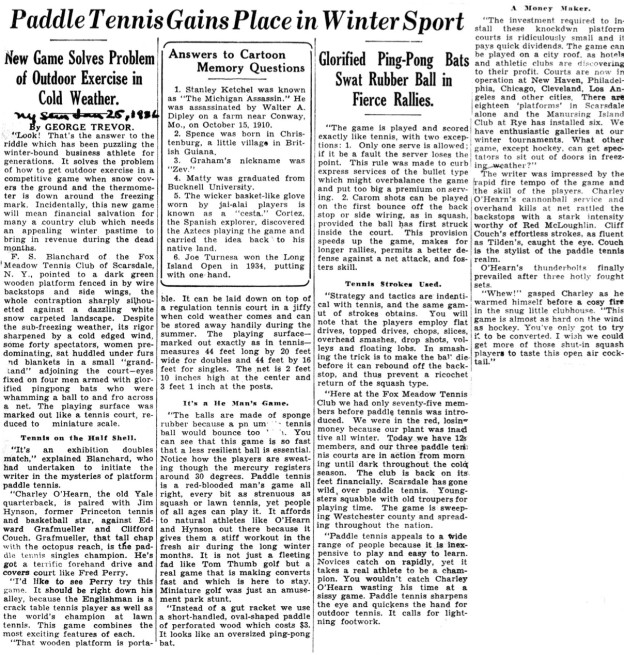
On January 25th, 1936 George Trevor (1892-1951), remembered as one of the best sports writers in the business, began an article on Platform Tennis as follows:

Paddle Tennis Gains Place as Winter Sport

Look! That’s the answer to the riddle that has been puzzling the winter-bound business athlete for generations. It solves the problem of how to get outdoor exercise in a competitive game when snow covers the ground and the thermometer is down around the freezing mark. Incidentally, this new game will mean financial salvation for many a country club that needs an appealing winter pastime to bring in revenue during the dead months.

Trevor gave his impressions of the exhibition match he had watched (Charley O’Hearn and Jim Hynson vs. Kip Couch and Ed Grafmueller):

The writer was impressed by the rapid-fire tempo of the game and the skill of the players. Charley O’Hearn’s cannon ball service and overhead kills at the net rattled the backstops with a stark intensity worthy of a Red McLoughlin. Kip Couch’s effortless strokes, as fluent as Tilden’s, caught my eye. Couch is the stylist of the paddle tennis realm. O’Hearn’s thunderbolts finally prevailed after three hotly fought sets. “Whew!” gasped Charley as he warmed himself before a cozy fire in the snug little clubhouse. “This game is almost as hard on the wind as hockey. You’ve only got to try it to be converted. I wish we could get more of those shut-in squash players to taste this open-air cocktail.”

Source: Fessenden S. Blanchard, Platform Paddle Tennis, 1959; The New York Sun, January 25, 1936

The appeal of the game

“It is a splendid means of entertainment for all of those who have places large enough for a court and who are sociably inclined. But don’t put up a platform if you are a social isolationist or want to enjoy complete peace and quiet, uninterrupted by the sounds of laughter and exclamations in many keys. For once you have a court and have invited your friends, you’ll find it hard to keep them away. “

Source: Fessenden S. Blanchard, Paddle Tennis, 1944