Vassar builds first college court

Vassar President Henry MacCraken dropped by the Blanchard’s unexpectedly in late 1931 “to find out about paddle tennis.” It was a necessary visit since an alumna had donated a court.

The article headline in the New York Sun on October 24, 1931 read: “Paddle Tennis to Be Tried Out at Vassar.”

At the end of a brief article about the game the Sun added, “Vassar is the first college to experiment with the new form of sport.” Unfortunately, the experiment was a failure, likely due to poor choices of court location and backstops, and the fact that there was only one court.

Source: Adapted from Fessenden S. Blanchard, Platform Paddle Tennis, 1959

Also see The game starts to catch on

First club court built at Fox Meadow Tennis Club in Scarsdale, NY

Of the twenty-five or more families comprising the Old Army Athletes (O.A.A.) in 1928, five were members of Fox Meadow Tennis Club and one of them had built their own court. They urged the club to put in a paddle court so Fox Meadow could become a year round sports rendezvous.

Source: Adapted from Fessenden S. Blanchard, Paddle Tennis, 1944

Expanding into an untried sport in the midst of a national economic depression was risky. Gradually worn down by the arguments of its O.A.A. members, the Board of Directors of the Fox Meadow Tennis Club had a meeting on April 15, 1931, to make a crucial decision. Should they or should they not put up a platform tennis court? They represented a tennis club and some of the avid tennis-playing members didn’t warm up a bit. Finally, a happy compromise was proposed on which the conservatives and the enthusiasts could agree. The club would put up a platform with a boarded end, marked suitably for practicing tennis strokes. It would also be marked for platform tennis with an easily removable net at the center.

On motion “duly made, seconded and carried [as the minutes of that meeting read] the Board authorized the construction of a Practice Tennis Court.” On November 1, 1931, the grand opening of the new platform, no longer called a “practice tennis court,” was featured by matches between teams from “both sides of the tracks.”

Source: Adapted from Fessenden S. Blanchard, Paddle Tennis, 1944, and Platform Paddle Tennis, 1958

Also see The game starts to catch on

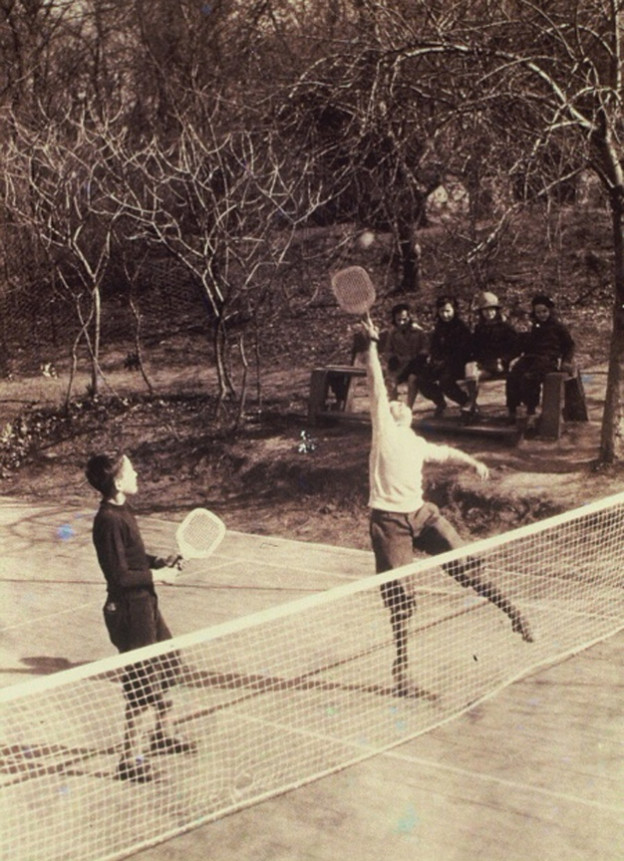
Horton Heath (left) and a friend practice at the original Cogswell court.

 Surviving The Great Depression

The Great Depression also influenced the formative years of paddle. Money was short, and even those who were not suffering were reluctant to spend it.

In paddle, gear was cheap, no particular clothes were needed, and a court could be built for as little as $400.

It was a perfect game for lean times.

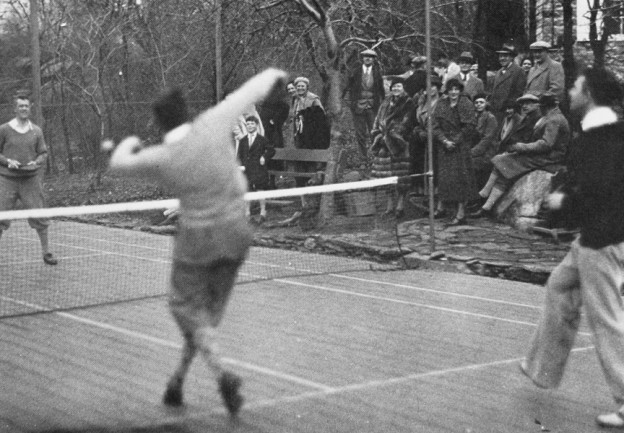
Old Army Athletes spectators at the Cogswell court, 1933. The matches were followed by tea with Francesca (Teck) Cogswell in the Cogswell's living room.

Social aspect grows with the game

old-army-athletes

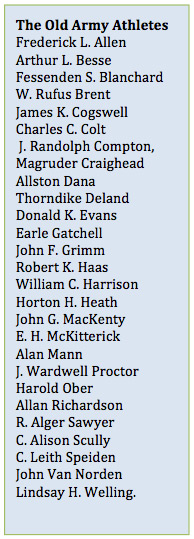
From the first game, Jimmy and Fess knew they were onto something promising. The court became a gathering place for their families and friends to socialize, play and fine-tune the game. The expanding circle of founders dubbed themselves the Old Army Athletes, for Old Army Road on which the Cogswell’s house stood.

During the winters of 1928, 1929, and 1930, the Old Army Athletes shaped the rules and character of platform tennis. They made it a family game, a sport that players of disparate abilities and ages could play together happily. This enthusiastic group of 25-30 families infused the game with the camaraderie and informality that has become its hallmark.

The Old Army Athletes even started a ”marital championship” with sixteen teams of husband-wife pairs only. There was a penalty of one point for each time a husband criticized the play of his wife, and vice versa. The judges had to listen carefully to detect any faint signs of sarcasm when sweet remarks seemed somewhat overdone.

Molly Blanchard Ware in a 1985 New York Times article recalled “Sagas were composed about the Titanic struggles on that Cogswell court. Pretty good sagas, as a matter of fact, because a Blanchard neighbor, Frederick Lewis Allen , author of Only Yesterday, a history of America in the 1920’s, was an ardent Old Army Athlete. Lives were changed and friendships cemented, because something new and fun and worth saving a weekend for had been invented.”

Source: Adapted from Fessenden S. Blanchard, Paddle Tennis, 1944, Fessenden S. Blanchard, Platform Paddle Tennis, 1959, Diana Reische, Fox Meadow Tennis Club – The First Hundred Years, 1983, and Platform Tennis – Back Where it all Began, New York Times, March 10, 1985

On December 28, 1929, there was a gathering of the Old Army Athletes at Alger Sawyer’s house in Scarsdale. Frederick Lewis Allen (Editor of Harper’s Magazine at the time) and his wife staggered in and serenaded the guests. The song they sang was to the tune of Kipling’s “Gentlemen Rankers:”

Screen shot 2013-01-22 at 12.16.09 AM

Source: Fessenden S. Blanchard, Platform Paddle Tennis, 1959

Fessenden S. Blanchard (left) and James K. Cogswell

The Founders

As innovators of a new sport, the duo made a balanced team.

Jimmy Cogswell was a trained engineer with a job in sales. “He was fascinated with the question of how to build the court, the technical side of it,” said his daughter, Do Cogswell Deland.

By contrast, Fess Blanchard “was so un-mechanical he couldn’t change a light bulb,” according to his daughter Molly Ware. He was the game’s pied piper, publicist, and chief promoter.

These complementary skills provided a great impetus to the development of the game.

The biggest stroke of luck was that these displaced Bostonians had ended up being neighbors in the first place. Blanchard had moved to New York to pursue a textile career in New York City, but Cogswell had set his sights on using his engineering training in a mining career in Canada. Fortunately, his wife would have none of that and he re-invented himself as a textile salesman. He moved his family to Scarsdale where Blanchard was his back-yard neighbor and was employed in the same industry.

Blanchard and Cogswell were among the first inductees into the Platform Tennis Hall of Fame in 1965

Blanchard promoted the sport in countless articles and letters in the 1930s and ‘40s. He did radio interviews and published the first book about the sport in 1944.

Both Blanchard and Cogswell had a keen sense of fun, according to Do Deland. Molly Ware agreed, “One thing they had in common was their enthusiasm. They were like kids, never blasé. Neither of them minded being thought an idiot.”

 Source: Diana Reische, Fox Meadow Tennis Club – The First Hundred Years, 1983