Doug Russell

Singles grows up – APTA approves Men’s and Women’s National Singles

Men’s and Women’s singles championships had been held from 1935-1937 but were discontinued in 1938 due to lack of interest.

In the mid 1970s when paddle was expanding rapidly singles made a comeback.Doug Russell, then the head paddle professional at the Manhattan Platform Tennis Club was looking for ways to increase participation by players and fans and began experimenting with experimenting with singles play, including varying certain rules to see how they might impact the game. It was concluded that allowing just one serve was too much of an advantage to the receiver, so two serves were allowed. In addition, no-add scoring was adopted.

Manhattan Platform Tennis Club began hosting singles tournaments in 1977 and Apple Platform Tennis Club, also in Manhattan followed suit.

Doug Russell finally persuaded the APTA Board to reactivate singles and they authorized a National Men’s and Women’s Singles Championship for the 1979-80 season to be held at the Apple Club with Doug Russell as chair.

Russell went on to win the event four years in a row (1980-1983) and again in 1987.

The APTA approved format called for the use of just the singles court. Players had one serve, and the “no ad” formula, in which the first point after deuce decides the game, was followed in scoring.

At Doug Russell’s urging the hi-bounce ball was used. His confidence in it was justified: players showed they could control it, and they benefitted from its liveliness in chasing after passing shots that reached their own back wires.

In the March 29, 1984 New York Times article The Subtle Charms of Platform Tennis by Ira Berkow, Russell was quoted “… singles is considerably more exciting [than doubles] to play and to watch. It’s-head to-head in a relatively small area, and it’s very quick. There’s a lot of net play and to be good you have to have excellent reflexes and a lot of nerve”

Source: Platform Tennis News, October 1980 and Christina Kelly, Passing Shots: A pictorial History of Platform Tennis, 2010, APTA Executive Committee Minutes August 22 and 23, 1979
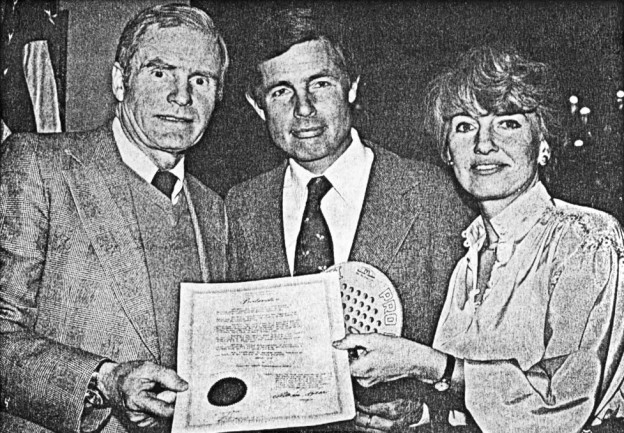
New Jersey Govenor declares March “Platform Tennis Month.” Governor Brendan T. Byrne (left) with APTA President Robert Kingsbury and Executive Director Gloria Dillenbeck

March is Platform Tennis Month in New Jersey

Governor Brendan T. Byrne, a stalwart supporter and player of platform tennis, signed a proclamation on February 28 designating March as “Platform Tennis Month in New Jersey.” Present at the ceremony, which took place at the State House in Trenton, were APTA president Robert Kingsbury and executive director Gloria Dillenbeck. Below is the text of the proclamation.

PROCLAMATION

WHEREAS, the sport of platform tennis is gaining marked popularity as a source
of intense competition, fast action and excitement; and . .

WHEREAS, several thousand New Jerseyans are among the thousands across the
country being drawn to this new exciting game; and

WHEREAS, New Jersey has been selected for the first time as the site of the American Platform Tennis National Men’s and Women’s Platform Tennis Championships, the 1980 Passport event, to be held at the Montclair Golf Club in West Orange on March 28-30, 1980; and

WHEREAS, the Garden State has also been selected as the site of the National
Junior Platform Tennis Championships to be held at the Orange Lawn Tennis Club,
on March 8 & 9, 1980; and

WHEREAS, active participation in sports of all types substantially heIps in building
and maintaining a healthy body and clear mental outlook; .

NOW, THEREFORE, I, BRENDAN BYRNE, Governor of the State of New
Jersey, do hereby proclaim March, 1980 as PLATFORM TENNIS CHAMPIONSHIP
MONTH in New Jersey.

Source: Platform Tennis, March 1980

Honor Awards suspended

From 1980 to 1991, the APTA Board stopped appointing the Honor Award Committee. In 1992, under the leadership of then APTA President Charles Vasoll, and with the urging of Bob Brown, the Board re-activated the program.

Historical Factoid: It is a matter of conjecture as to why the APTA suspended the Honor Award which had been a successful program.

New millennium, new levels of play

As with many sports, the turn of the calendar to a new century produced a new generation of platform tennis players who infused the game with a heightened level of athleticism and rapidly changing skill sets. Elbow-bending slices turned routine overheads into unplayable winners. Vicious spin serves caromed off two and even three screens to make aces part of the game. Two-fisted backhand blasts became the norm rather than the exception. An influx of converts from the tennis community was at the forefront of the new emphasis on physical play and new-honed skills.

Source: Christina Kelly, Passing Shots: A Pictorial History of Platform Tennis, 2010

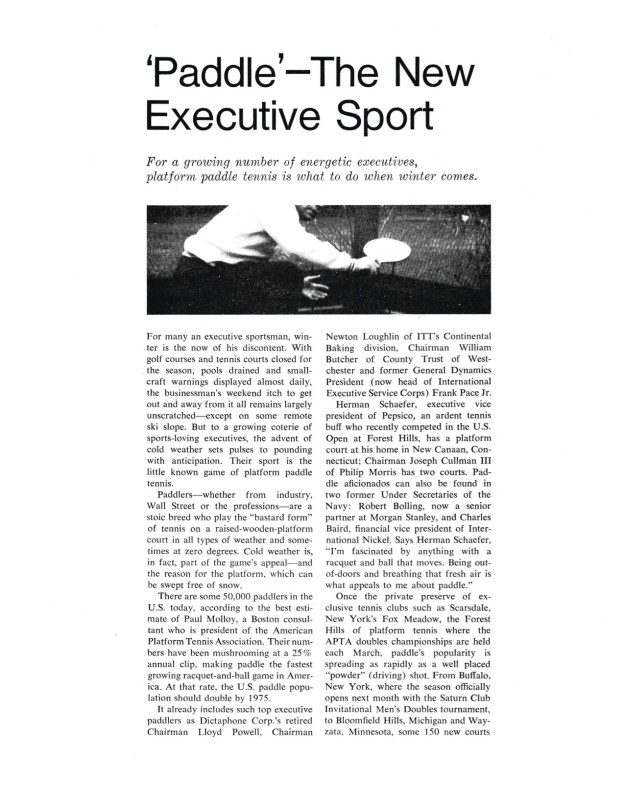
Dun & Bradstreet, October 1971

Rapid growth in the 70’s

By 1970, there were an estimated 150,000 people playing platform tennis. Based on a survey of court builders and ball and racquet manufacturers, the growth during the next five years ranged from 15 to 25 percent per year.

"Platform Tennis New Sport," Washington Post, March 31, 1950

Washington Post reports on “New Sport”

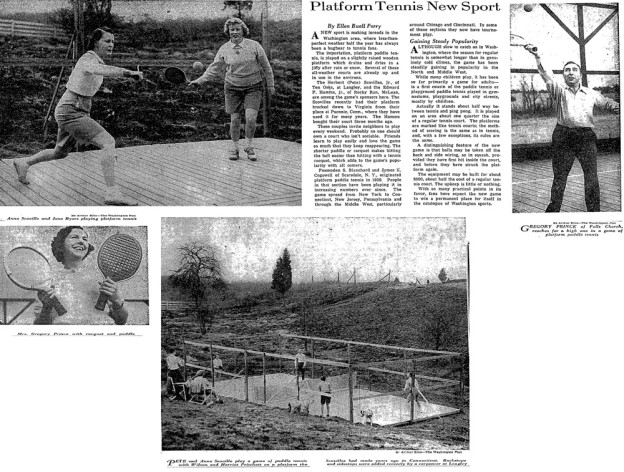
“A new sport is making inroads in the Washington area, where less-than-perfect weather half the year has always been a bugbear to tennis fans. The importation, platform paddle tennis, is played on a slightly raised wooden platform that drains and dries in a jiffy after rain or snow.

Several of these all-weather courts are already up and in use in the environs. The Herbert (Pete) Scovilles, Jr., of Ten Oaks, at Langley, and the Edward F. Hamms, Jr. of Rocky Run, McLean, are among the sponsors here. The Scovilles recently had their platform trucked down to Virginia from their place at Taconic, Connecticut, where they have used it for many years. The Hamms brought their court three months ago.* These couples invite neighbors to play every weekend. Probably no one should own a court who isn’t sociable. Friends learn to play easily and love the game so much that they keep reappearing. The shorter paddle or racquet makes hitting the ball easier than hitting with a tennis racquet, which adds to the game’s popularity with all comers.”

Source: Washington Post, March 31, 1950

Court construction plans help the game to expand

Both clubs and private estate owners usually built the first courts in accordance with plans and specifications provided by Cogswell and Blanchard—at first for nothing and later for a nominal fee.

Professor Eliot Dunlap Smith of Yale University assisted in early court improvements with Cogswell and Blanchard. Along with his personal experience playing, he consulted the Yale Department of Forestry for advice. In later years, Scarsdale architect Richard H. Tatlow also served as an advisor and worked in the American Paddle Tennis Association, the forerunner of the present day American Platform Tennis Association (APTA).

Source: Adapted from Fessenden S. Blanchard, Paddle Tennis, 1944, and Platform Paddle Tennis, 1959

Competitive paddle tennis begins

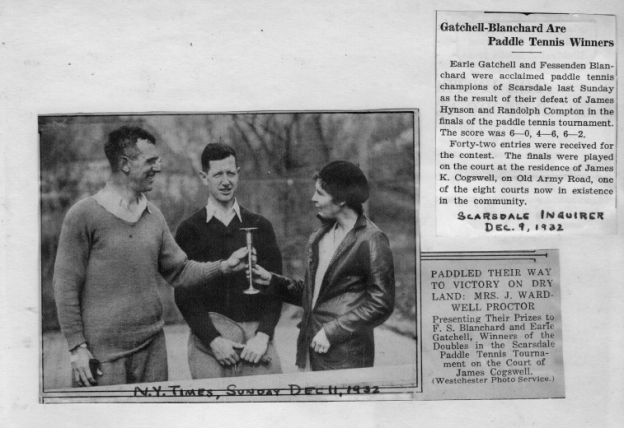
By December, there were eight platforms in Scarsdale alone and the first open tournament took place, with forty-two entries. The new, larger Cogswell platform and court were the venue for the finals. Earle Gatchell and Fessenden Blanchard, representing the Old Army Athletes, won an exciting final match, 6-0, 4-6, 6-2, from Randolph Compton and James N. Hynson. “Paddled their way to victory on dry land,” said The New York Times.

By the end of the year, more than twenty courts had been constructed in Massachusetts, Connecticut, and New York. These $500-$600 courts were initially popular on private estates. Later on, leading tennis clubs constructed their own courts.

Source: Adapted from Fessenden S. Blanchard, Paddle Tennis, 1944, and Platform Paddle Tennis, 1959

Historical Factoid: Lois Proctor – shown above presenting the trophy to Blanchard and Gatchell – had taken quite a “shine” to Blanchard (see note at left)

Source: Blanchard Scrapbook 1929-1963

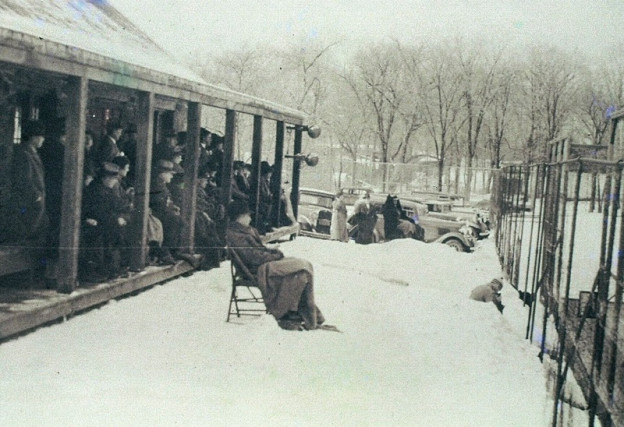
A snowy day didn’t discourage the crowd of spectators at Fox Meadow Tennis Club.

The appeal of the game

Frederick Lewis Allen, Editor of Harper’s Magazine, wrote the following letter on February 19, 1932 to a lady who had asked him what he thought of the game. The letter was written before the Evans invention had made taking balls off the backstop an assured success, before the sanding technique had practically eliminated slipping during a rain, and when the game was still largely confined to those who learned it on the Cogswell court.

“I know of no other active game which can so readily be played outdoors at all seasons and in virtually all weathers. In Scarsdale we play it every week-end from October to May (and sometimes on week-day evenings by artificial light). Golf links and tennis courts may be out of commission; skating ponds may not be frozen over; there may be no skiing or coasting—yet Paddle Tennis goes right on. We play it when the thermometer is below freezing and the snow has to be shoveled off the court. We play it on rainy days, for the wet doesn’t hurt the wooden paddles, and if the court gets a little slippery that is not fatal. I cannot exactly recommend playing in a really heavy rainstorm or a driving snow storm’, but I have played in both and enjoyed it—stopping every few minutes to shovel the fresh snow or standing rainwater off the court with a strange instrument known as a squeegee. To be able to count on the exercise and the sport all year round is an immense boon.

Another advantage is that the court is so small that many people whose grounds are not large enough to include a tennis court can easily find space for a Paddle Tennis platform; and that the platform is relatively inexpensive to build and the cost of upkeep is negligible. But these advantages would count for little if the game itself were inferior. I consider it one of the best games ever invented

Anybody who has ever played lawn tennis finds it absurdly easy to learn: I have seen men take a respectable part in a doubles match with seasoned players after only an hour’s practice. It is one of those games in which the relatively poor player is not completely outclassed and humiliated; even the duffer can return enough drives to feel that he is something more than a helpless bystander. One reason is that the paddle is so short that the ball is easy to hit quickly and with fair accuracy. You can pick any four players out of a group and be sure that they will be able to work up a pretty good match.

Yet I must not give the impression that because the game is easy to learn it is mild and innocuous. Although Paddle Tennis is less tiring than lawn tennis because the court being smaller there is less running, on the other hand the ball goes back and forth much more quickly than in lawn tennis; the rallies are usually longer, the pauses between them are shorter, and the players are on the move every second. They can (and do) hit the ball just as hard as they please; and there are plenty of opportunities for strategic placing, for outguessing one’s opponent, for alternating smashes with lobs or deep drives with cross-court pokes at the net. Most of the play, by the way, is near the net—in doubles, at least—and that means quick and exciting action. If anybody thinks Paddle Tennis is merely a children’s game or a sort of overgrown ping-pong, the sight of a fast set of men’s doubles will soon remove the idea from his mind.

If the fun that thirty or forty of us have had in Scarsdale is any criterion, it offers first-class sport—to say nothing of exercise—to anybody who can hit a sponge-rubber ball with a wooden paddle and move faster than a walk.”

Source: Adapted from Fessenden S. Blanchard, Paddle Tennis, 1944