Platform Tennis in Life Magazine

Kenneth Ward arranged for a piece to run in Life Magazine, and he appeared in several of the pictures that ran with it. In one of the shots, his expression was so contorted that Life felt impelled to caption it: “Up the wire, like a monkey, goes Ken Ward, President of the American Paddle Tennis Association. In spite of his strange antics, Ward is a good-looking New York broker.”

(Note: The pictures were taken by the Albanian-American photographer Gjon Mili who, along with Harold Edgerton of MIT, was a pioneer in the use of stroboscopic instruments to capture a sequence of actions in one photograph)

The Life article brought some amusing reactions.

One was a letter from a man who objected to calling O’Hearn the “game’s greatest player.” He said O’Hearn had never played against him.

Another man’s letter made the revolutionary idea of taking balls off the backstop seem tame:

“Your article on paddle tennis as played by a group in New York State is most interesting to us here in New Jersey, but I would like to tell you about our game. We play in a garage, about 30 by 60 feet in Morristown, using the ceiling as a play surface. This, of course, eliminates any advantage in playing the net position, as the ball can be struck against the ceiling making it strike the opponent. Along the center of the ceiling runs a beam the full length of the court and balls played off this introduce strange angle shots. No walls offer any hazards but one rear wall, and that is a trickster’s delight. Here is an old hot air furnace with its pipes reaching out like arms to change the direction of the ball or destroy it for one attempting its return. In a match last week the ball struck against the ceiling, bounced up from the floor into the maze of pipes and has not been found yet. For all I know it has now been shoveled out with the ashes. On winter weekends it is a toss-up whether this game or hockey prevails, but we old men have a preference for our game of paddle tennis.”

Source: Adapted from Fessenden S. Blanchard, Platform Paddle Tennis, 1959
Number of courts skyrockets

The APTA Annual Report of October 25th estimated 500 courts to be in use.

They based the estimate on a list of 229 platforms built by the Gates Company and a partial list of plans distributed by James K. Cogswell.

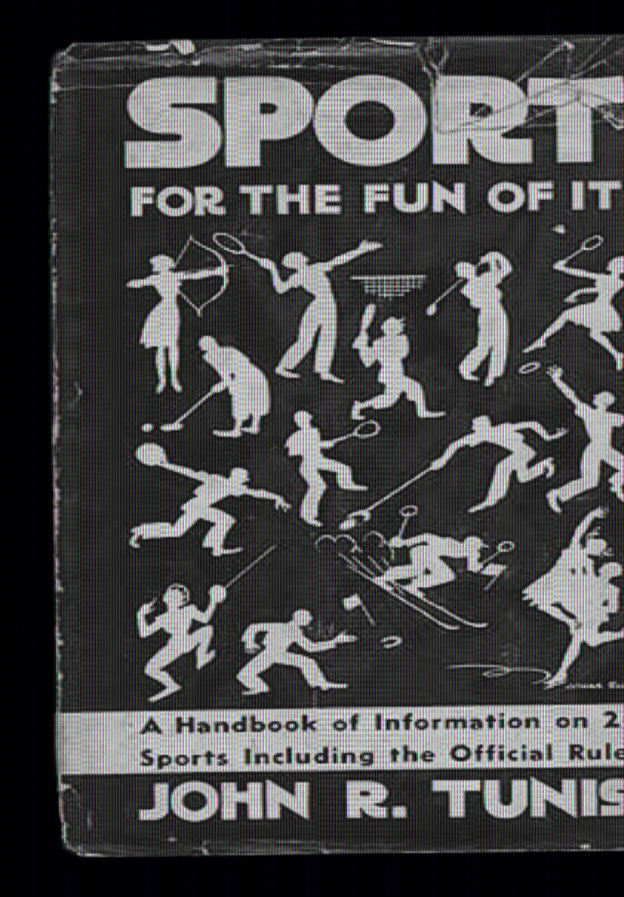
First book covering Platform Tennis published

The book was published by A. S. Barnes. John Roberts Tunis (December 7, 1889 – February 4, 1975), was an American writer and broadcaster and “the ‘inventor’ of the modern sports story.” Known for his juvenile sports novels, Tunis also wrote short stories and non-fiction, including a weekly sports column for the The New Yorker magazine. As a commentator Tunis was part of the first trans-Atlantic sports cast and the first broadcast of the Wimbledon Tennis Tournament to the United States.

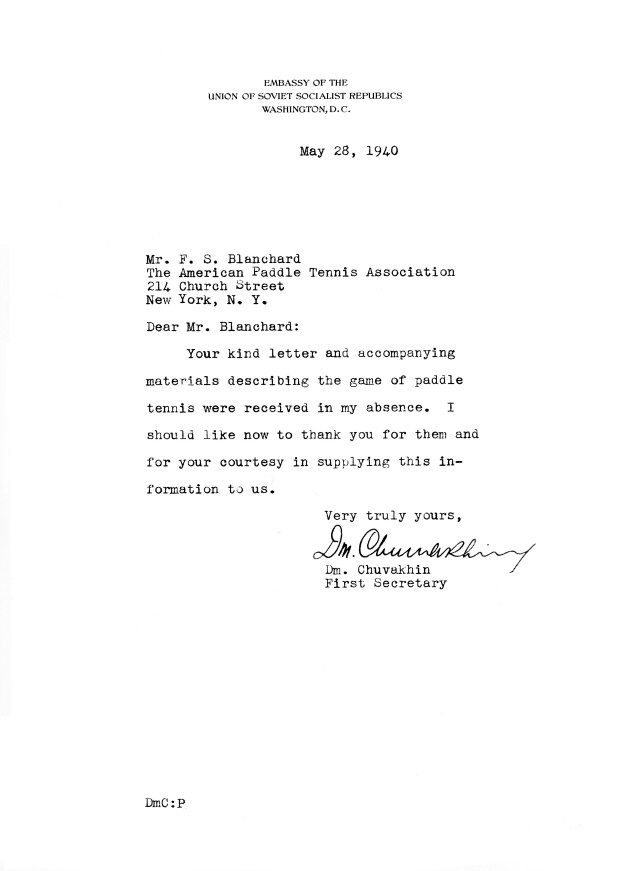
Letter from Chuvakhin to Blanchard thanking him for sending details on court construction and playing the game.

Paddle in Russia

In the spring of 1940, the APTA received a request for information on the sport from the “Embassy of the Union of Soviet Socialist Republics” in Washington, D.C. The Russian Commissar of Sports, Mr. Dm. Chuvakhin, wanted to learn more about platform tennis.

Fox Meadow players dominate the game through the 1930s and 1940s

Through the 1930s and 1940s, Fox Meadow players dominated the new sport, and their styles and strategies became the standards for championship play. The Club’s pre-eminence was partly attributable to members’ wholehearted adoption of the game and partly to the fact that Fox Meadow had far more courts than any other club, with the exception of Manursing Island Club in Rye, NY.

James K. Cogswell, FMTC President (1939-1940)

James K. Cogswell elected FMTC President (1939-1940)

Jimmy Cogswell (1893-1959) was a founder of the game of platform tennis along with Fess Blanchard.

Cogswell grew up in Portsmouth, ME and Blanchard in Boston, MA and both had different educational backgrounds and interests, but through an extraordinary lucky set of events they ended up as neighbors in Scarsdale, worked in the same business area, and had similar interests in finding something to do in the winter months.

The first court was built on the Cogswell property on Old Army Road and became a gathering point for a bunch of friends that called themselves the Old Army Athletes.

The story of how the game grew from this court, rescued FMTC from bankruptcy and now is played by over 40,000 enthusiasts throughout the county is rich with the seminal contributions of many FMTC members over many decades.

National Championships

1939

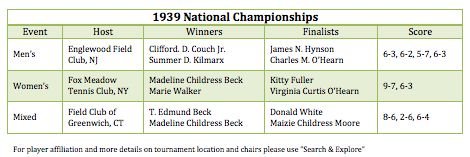
Fox Meadow Teams again dominated the tournaments and were winners and finalists in the three events.

Couch and Kilmarx repeated their 1935 win by defeating Hyson and O’Hearn who had won the previous two years and Madge Beck and Marie Walker successfully defended their 1938 title and were on their way to five straight wins until the war years when the event was discontinued from 1943-1948.

Source: Fessenden S. Blanchard, Paddle Tennis, 1944

APTA membership continues to grow

In October, 1939, five years after the organization of the APTA, President Harold D. Holmes reported a membership of 15 clubs, all of them still only in the New York suburbs.

“As paddle tennis veterans may remember, our form of the game began in Scarsdale in November, 1928. For several years its growth was slow. In the last few years the game has gone rapidly ahead with Scarsdale still leading in the number of courts (now twenty-eight), Greenwich, CT, second, and Englewood, NJ, which has come forward rapidly, third. It is impossible now for the Association to keep an account of all of the courts that go up during each year. Some of the more recent ones include platforms for Saint Mary’s School of Peekskill, the Round Hill Club of Greenwich, the Bedford Golf and Tennis Club, the Knollwood Club of White Plains, the Saddle and Cycle Club of Chicago, the Woodway Country Club of Stamford, CT., the Knickerbocker Country Club of Tenafly, NJ, the Indian Harbor Yacht Club of Greenwich, the Stamford Yacht Club, the Devon Yacht Club of East Hampton, Long Island, the Orange Lawn Tennis Club and many others. Dr. George Gallup is expected shortly to take a poll of the growth of paddle tennis sentiment, for he has recently built a platform. Arthur Murray is probably complaining about the sanding of his paddle tennis court, which ruins it for dancing purposes. Thomas W. Lamont and John M. Hancock are among other well known men who have erected courts.

Besides platforms too many to mention in the suburban area of New York City, the game has spread to such widely scattered places as Atlantic City; Milwaukee, Wisconsin; Danville, Virginia; Ottawa, Illinois; Danboro, Pa; Paoli, Pa; Narragansett, Rhode Island; Martha’s Vineyard, Mass; Bennington, Vermont; South Portland, Maine; Perrysburg, Ohio; Los Angeles, Cal.; and so on. England is reported to have one or two platforms at least. Plans have even been sent to Natal, South Africa, in response to an inquiry to the Association.”

Source: Fessenden S. Blanchard, Platform Paddle Tennis, 1959
Kenneth Ward elected APTA President (1939-1942)

Blanchard gave Ward much credit for his enthusiasm and organizing ability as chairman of the Publicity Committee that he had run prior to taking over as President. He threw the same energy into the new position and the Association continued to flourish, By November 1941, the APTA had 21 member clubs. Blanchard considered him one of the best presidents the APTA had during the first two decades.

Source: Adapted from Fessenden S. Blanchard, Platform Paddle Tennis, 1959

APTA asks Fox Meadow Tennis Club to host inter-club Scrambles

The Fox Meadow Tennis Club had been holding tennis Scrambles for several years when Ken Ward of Manursing suggested in 1938 that the recently formed American Paddle Tennis Association (APTA) hold an inter-club Scrambles. In paddle, this event came to be called the Jamboree and later the Jambles. Play was held at Fox Meadow, the only club with enough courts.