1938 Memorial Day Carnival at Fox Meadow

Strong social aspect at Fox Meadow

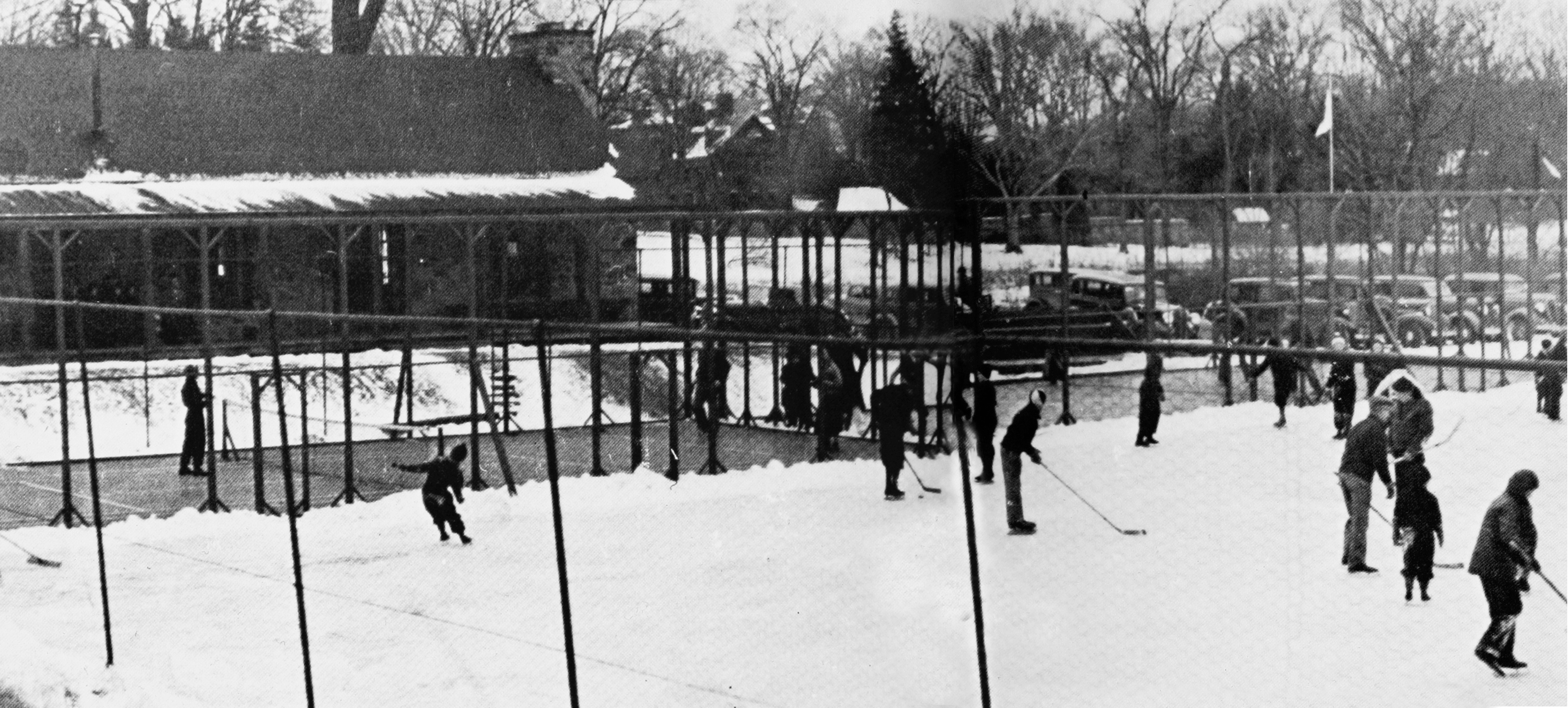
A busy day at Fox Meadow in the early 1940s. Platform tennis, hockey and skating keep members out of mischief. A busy day at Fox Meadow in the early 1940s. Platform tennis, hockey and skating keep members out of mischief.

In 1938, FMTC held a Memorial Day Carnival, complete with a Fox Meadow orchestra directed by Woodruff Johnson and made up of members: on piano, Johnson; on saxophone, Putnam Livingston; on guitar, Earle Gatchell; on banjo, Allison Scully; and on violin, Wardwell Proctor.

Two reasons were given for staging the carnival: to provide a good time for families and to raise money for a Club Improvement Fund. The carnival raised $333. That was Fox Meadow Tennis Club: fun, practical, and frugal. When something needed to be done, more often than not, members would do it themselves. Dues remained low because of members’ willingness to pitch in.

The master of ceremonies was Thorndike Deland, Sr. For a ten-cent admission charge one could also watch him perform magic tricks. The gypsy cranking a rented hurdy-gurdy was Club President John Van Norden. His tunes enlivened all the attractions a carnival should have: a fortune-teller, games of chance, a marionette show, and a shooting gallery where Jim Hynson proved deadly accurate with water pistols, dousing candles as fast as volunteers could relight them.

Source: Diana Reische, Fox Meadow Tennis Club – The First Hundred Years, 1983
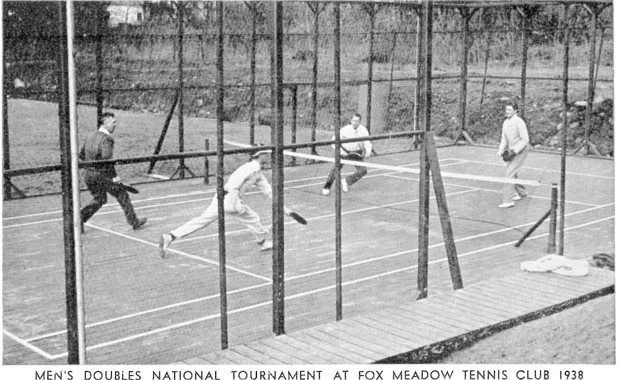
Men's National Championship 1938, Fox Meadow Tennis Club, Scarsdale, NY

National Championships

1938

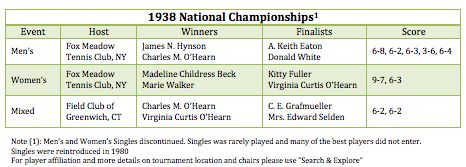
Singles now had been discontinued. Blanchard had always maintained doubles suited the game of platform tennis best. The APTA confirmed this and found a low level of interest in both men’s and women’s singles and decided to discontinue these events in 1938. Men’s singles was reinstated in 1980.

Fox Meadow teams swept the remaining three National events and Charley and Virginia O’Hearn won their third straight Mixed title and the fourth in a row for Charley. Only two other team have won more than three consecutive Mixed Nationals – Ronald and Elfie Carroll (1949-1952) and Hilary Hilton Marold and Doug Russell (1979-1982).

Source: Fessenden S. Blanchard, Paddle Tennis, 1944

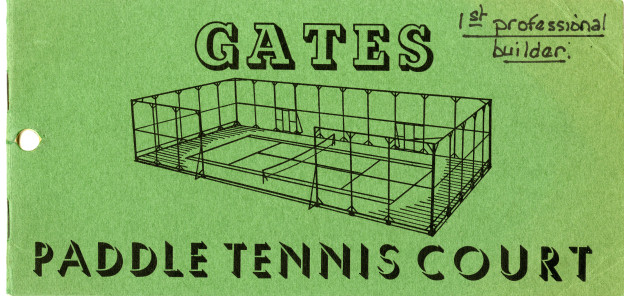
Gates Sports Platform Company begins operations

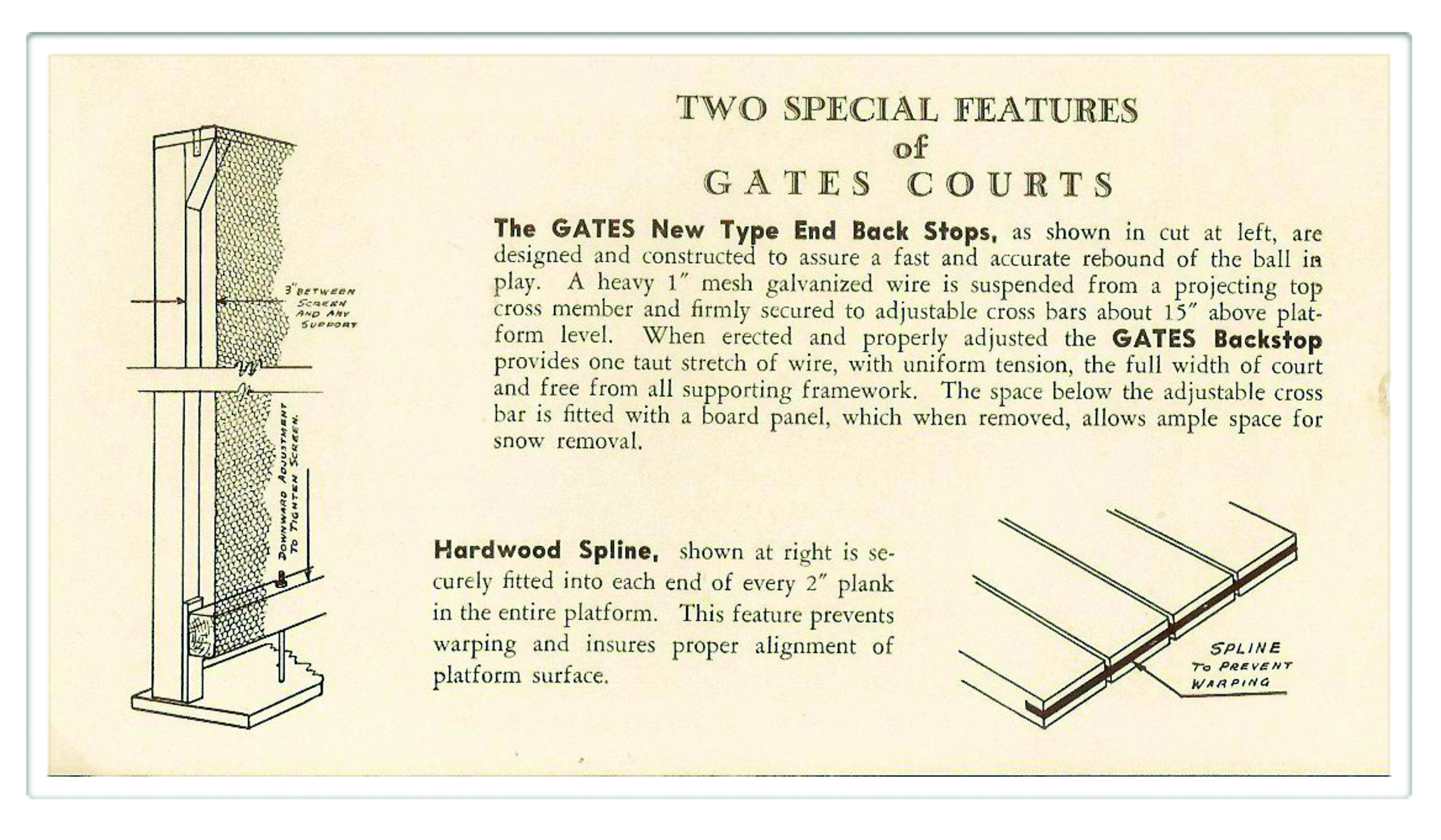
Gates Court innovations

The early court construction had been greatly helped by the efforts of Henry B Eaton who was working for a lumber company in NYC. In the late 1930’s, the lumber company was liquidated, but fortunately the work Eaton had done in providing an easy and convenient way for clubs and individuals to obtain platforms inspired one of the company’s employees, Joseph Russhon, to take over its platform tennis business and he continued operations as the Gates Sports Platform Company.

Thanks to Eaton and Russhon, the early development of the game received a considerable boost, and many platforms were set up. Some of these platforms were erected on top of tennis courts in the fall, and then taken down and stored in the spring. Later, clubs began to find it too expensive and hard on the platforms to put them down and take them up each year and permanent courts came to be the accepted practice.

Source: Adapted from Fessenden S. Blanchard, Platform Paddle Tennis, 1959

Historical Factoid: Eaton was President of Fox Meadow Tennis Club in 1936. His wife, Jean Eaton, was the winner of the Women’s Doubles and Singles Nationals in 1935 (the inaugural tournaments) and the Women’s Doubles in 1936.

“Scrambles” tournaments established

Considered by Blanchard as “one of the greatest steps forward in the history of platform tennis,” Ken Ward created the scrambles format and conducted them at Manursing Island Club. These scrambles tournaments were keys in increasing participation by balancing talents and introducing tournament play without the championship tensions and rivalries.

Ken Ward and John Stephenson presided over the draw. The entries were secretly classified into A and B players, and the names of each group put in a separate hat. No two players from the same hat or the same club could play together.

Ken Ward and Oz Moore discussed the draw. “I have the worst luck in these scrambles tournaments,” said Ken. “I never seem to draw anybody who is any good. Why, sometimes my partners haven’t ever seen a paddle. Of course, if I did get anyone that was any good, they’d all be suspicious.” “I’m the same way,” replied Oz. “I never get a good partner either. I’m always out of luck, too.” “Let’s compare notes,” suggested Ken. “Who did you draw last year?” “You!” said Oz.

Unless a player drew Charlie O’Hearn, Paul Hicks, or Cliff Sutter for a partner, he would not know for sure that he rated as a B player—and if he did draw one of those men, he was so pleased that he forgot the insult. The scramble format proved to be an excellent way to develop hidden talent and grow the game.

In the first scrambles tournament, Sidney B. Wood, Jr., a former Wimbledon champion, who had never played platform tennis until he entered that tournament, drew Donald White as a partner, one of the best players of the time. Sid picked up the game quickly. He and his partner were able to win against some of the stronger scrambled teams. This illustrated the affinity between the two sports.

Source: Adapted from Fessenden S. Blanchard, Platform Paddle Tennis, 1959

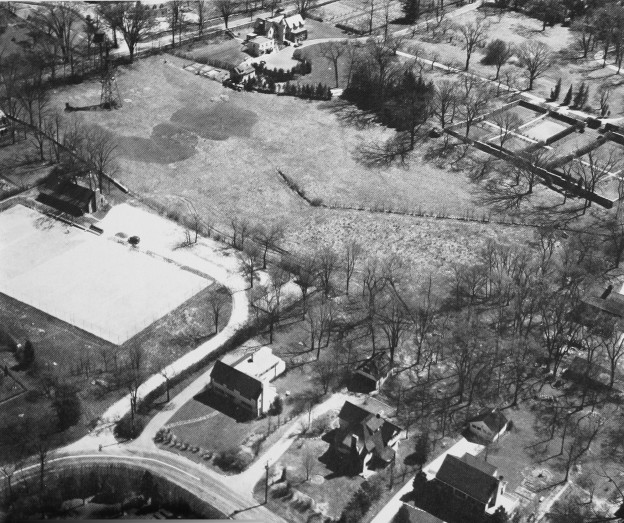
Aerial view of FMTC in 1937. At the left stands the windmill in Crane Meadow, just below Church Lane. The first paddle court can be seen at the curve of the driveway.

Effort to gain control over the Tennis Realty Corporation

Before Fox Meadow could make any substantial changes—buy or sell property, expand the clubhouse—it first had to gain operating control of the old Tennis Realty Corporation, which owned the Club’s grounds and facilities. This wearisome task took more than a decade.

By the early 1930s, so many former members (and therefore stockholders) had resigned, moved, or died that Club members owned a shrinking percentage of the Realty Corporation’s stock. It had become impossible to assemble a quorum for the annual meeting of the Realty Corporation, a situation that left its directors in a legally untenable situation.

In 1937, during John Van Norden’s presidency, the Club board began an all-out effort to collect enough stock through donation, purchase, or affidavits stating that the shares were lost, to gain control of the Realty Corporation and then liquidate it. After years of persistent effort, the Realty Corporation was dissolved in 1941. Fox Meadow Tennis Club assumed its property and its mortgages. Since then the management of the Club has rested solely with the Board of Governors.

Source: Diana Reische, Fox Meadow Tennis Club – The First Hundred Years, 1983
National Championships

1937

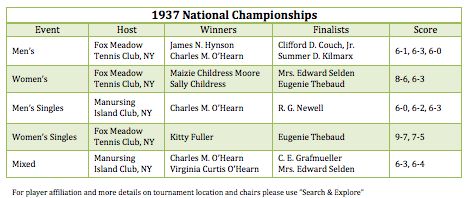
Fox Meadow Tennis Club teams dominated the Nationals, winning all five events and Charley O’Hearn completed a hat-trick in the Mixed (with Kitty Fuller in 1935 and then with his wife, Virginia, in 1936 and 1937). This was the last year the singles was played until Men’s singles was reintroduced in 1980.