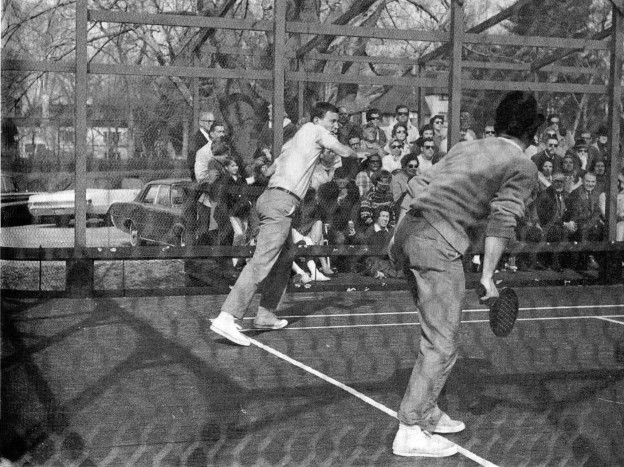
Kimberly and Jennings defeated Richardson and Swanberg in the finals in four sets

National Championships

1967 - Rev 1

APTA President Ned Swanberg and his partner Tom Richardson lost to the 1964 Champions David Jennings and Oliver Kimberly, Jr. in four sets.

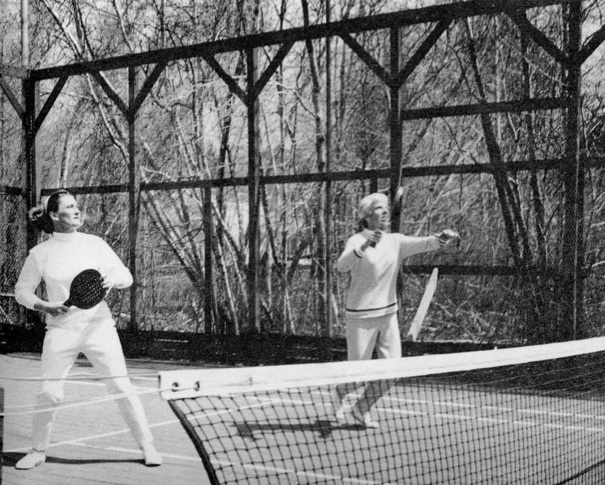
Charlotte Lee and Peggy Stanton won the first of their four straight Women’s titles, defeating two time champions Do Deland (Cogswell’s daughter) and Susan Wasch.

Gordon Gray and Anne Symmers won their second straight Mixed.

George Lowman and Bill Pardoe won their second straight Men’s 50+.

Gogswell’s grandson won the Junior Boy’s with John Lowman; they had been finalists in 1965 and 1966.

Source: Oliver H. Durrell The Official Guide to Platform Tennis, 1967; and APTA Platform Paddle Tennis 1963-1973: Rules and Records, 1973

Women's Nationals 1967: Peggy Stanton and Charlotte Lee
Women’s Nationals 1967: Peggy Stanton and Charlotte Lee

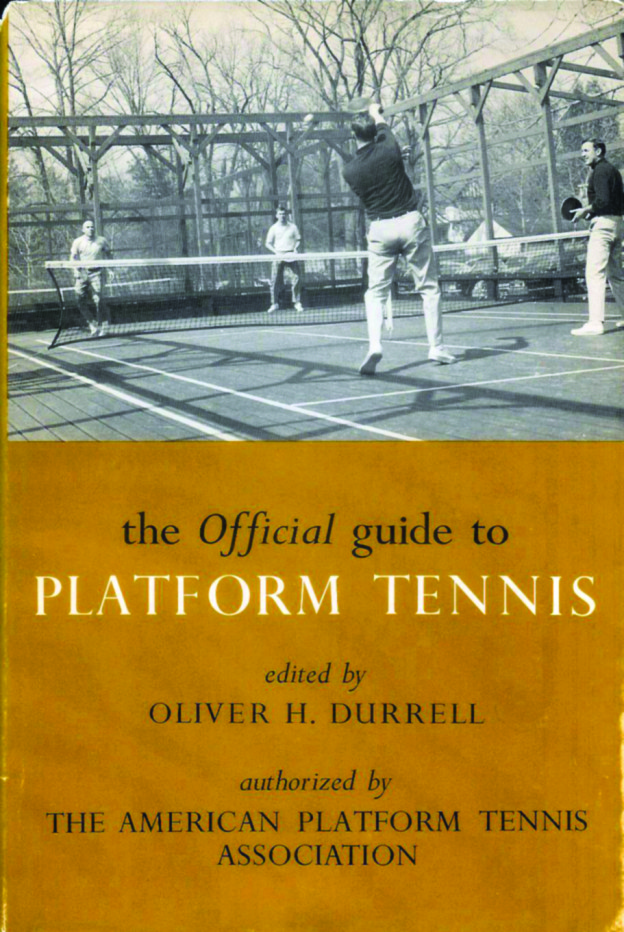
Durrell’s “Official Guide to Platform Tennis” published

The book was authorized by the APTA and the dust-jacket explained the book’s goals:

“This book has been prepared to answer every conceivable question about platform tennis. It tells the story of the origin and development of the game, describes the strategy and tactics of play, how to go about constructing a platform, where to purchase paddles, balls, and net, the official rules, and how to run a tournament. It also explains the activities of the American Platform Tennis Association, and lists its past officials, as well as the records of every major tournament ever played under the auspices of the Association.”

One of the useful tips from the chapter on “How to Run a Tournament”

“The Chairman can host the semi-finals for luncheon at his home, thus allowing the finalists a chance for a shower and change of clothes. Bull shots (vodka and beef broth) are traditional on this occasion. Be sure to invite the Finals Umpire to lunch. This is a good time for him to get to know the finalists and the clubs they represent. He can be a member of a regional Tennis Umpires Association or a capable member of the club.”

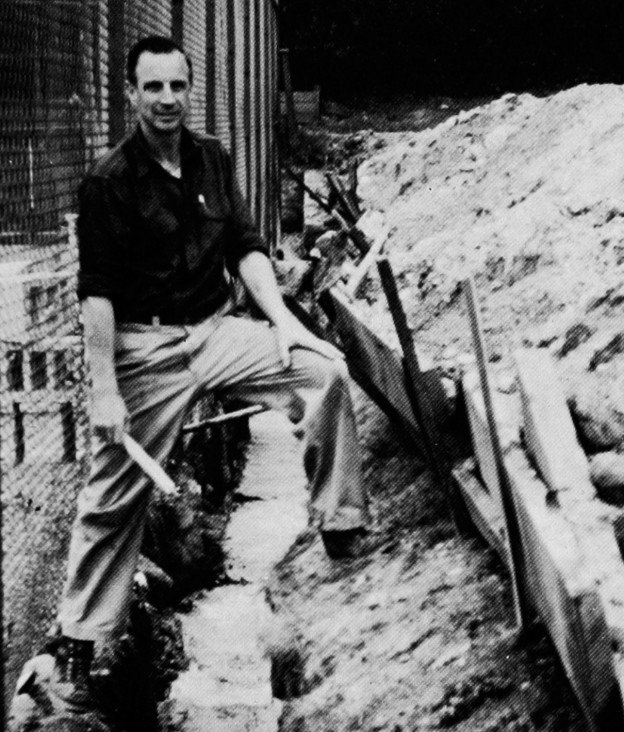
Walter Close (1916-1991) was know as a "doer" at the APTA as well as at Fox Meadow. The retaining wall he built between the club porch and the tennis courts still stands.

APTA Honor Award: Close, Stephenson, Sutter

Walter H. Close, Jr.: Walter Close started his platform tennis career in the early 1950’s and soon became known as a “worker” who gravitated to the important jobs. He teamed with Dick Hebard to win the National Men’s 45+ in 1960 and again in 1961. But, his accomplishments stretched beyond the court. He served as APTA Tournament Chairman from 1958-1959, after which he served as association President from 1960-1961. These were busy and successful years for the game and, during his regime, the APTA membership increased from 24 to 38 membership clubs. (Fox Meadow Tennis Club).

John A. Stephenson: John Stephenson served as Vice President of the APTA from 1941 to 1946, and as its President from 1948-49. An avid player and tough competitor, he won many local tournaments, and was very active in promoting paddle at the Manursing Island Club, and organized some of the first night play under lights. (Manursing Island Club, Rye, NY).

Clifford S. Sutter: Sutter won four National Men’s, two Mixed and one Men’s 45+. He was one of the canniest and most consistent players of the game, a student of placement and control of the ball who was at his best in the return of serve, where he altered both speed and direction. Sutter introduced many tennis skills to the game of platform tennis, and was a master of a prime offensive and defensive tool of the game, the lob. He introduced deeper lobs to the game than was common at that time and they were, in a word, devastating (Field Club of Greenwich).

Click on hyperlinks to go to Hall of Fame biographies

Edmund Swanberg elected APTA President (1967-1969)

Swanberg enjoyed many years as an active player and enthusiast of the game. He fondly recalled the well-attended annual meetings of the APTA at the Princeton Club in New York City and, at one of these meetings during his tenure, he reported that it appeared that the game was growing at a rate of 20-25% annually, based on metrics of court construction and APTA membership rolls.

Swanberg was instrumental in getting ranking players to put on exhibitions at clubs where new courts had been built.

Men's Nationals, 1966: Richard Squires and Edward l. Winpenny, Jr

National Championships

1966 - Rev 1

The previous year’s finalists, Dick Squires and Ted Winnpenny, Jr., prevailed over the new and rising team of Gordon Gray and Jesse Sammis.

Charlotte Lee won her fourth Women’s title with yet another partner, Carolyn Nelson, and Gordon Gray and Anne Symmers won the first of their three straight Mixed titles.

The dominance by Fox Meadow teams had begun to wane.

Cogswell’s grandson, Rawle Deland, Jr., was a finalist in the Junior Boy’s for the second year in a row.

Source: Oliver H. Durrell The Official Guide to Platform Tennis, 1967; and APTA Platform Paddle Tennis 1963-1973: Rules and Records, 1973

Don Evans accepting the Honor Award form Brook Kindred. Evans solved the problem of inconsistent bounces of the wires, an innovation that spurred the growth of the game.

APTA Honor Award: 7 more pioneers honored

James M. Carlisle: Carlisle served as APTA Secretary from 1955-1957, and as President from 1957-1959. A winner in as many different kinds of tournaments as anyone else in the early years of the game, he won the Men’s Nationals in 1955 and 1958 with Richard K. Hebard. He also won the first and second annual National Men’s 45+, in 1957 and 1958, a tournament that he is generally considered to have founded. (Fox Meadow Tennis Club).

Donald K. Evans: Among his many accomplishments, Donald K. Evans is best known for the backstop that shares his name. In designing and producing the Evan Backstop, he solved the major impediment to the enjoyment and expansion of the game—the inconsistent bounces of the ball off the wires. He designed and built the freestanding taut wiring that is officially used today. The first installation was on Jimmy Cogswell’s court in Scarsdale, NY, during the winter of 1934-1935. (Fox Meadow Tennis Club).

Harold D. Holmes: Harold Holmes was affectionately known as “Mr. Paddle of New Jersey” for his tireless efforts on behalf of the game in that state. A member of the Tremont Place Paddle Tennis Club in Orange, NJ, he also served as APTA’s second President from 1938-1939. (Englewood Field Club, NJ).

Barbara Bixler Koegel: Barbara Koegel was an accomplished tennis player who started playing platform tennis when she was in her mid-thirties in 1955, and won the National Women’s the following year and the National Mixed with A. H. (Zan) Carver, Jr. in 1964. She retired from competitive play in 1965 for health reasons. At her home club, Fox Meadow, she devoted time and talent to developing the skills of new players, which helped raise the level of women’s play. (Fox Meadow Tennis Club).

Charlotte McNeill Lee: Charlotte Lee made a mark in tennis before becoming an outstanding platform tennis champion, despite only starting to play the game in her early forties. Playing with a variety of partners, she won three straight National Mixed (1961-1963), and then again in 1965, and five National Women’s (1961, 1963, 1964, 1966, and 1967). She was a master tactician of the game. (Short Hills Country Club, NJ).

Frederick B. Walker: Frederick Walker served as APTA Secretary-Treasurer from 1948-1950, and as President from 1951-1953. In partnership with Dick Hebard, he won three National Men’s in 1949, 1951, and 1952, and was considered a master of the “drop shot” in his day, with one of the hardest forehands (Fox Meadow Tennis Club). He was the son-in-law of Fessenden Blanchard and his wife, Ruthie, was a very accomplished player in her own right, and a finalist in the National Women’s in 1956 and 1959.(Fox Meadow Tennis Club).

Marie Walker: Walker won five straight Women’s Nationals with Madge Beck from 1938-1942. They likely would have won more but the Women’s Nationals was not played from 1943-1945 because of travel difficulties during World War II and then not reinstated until 1949. (Fox Meadow Tennis Club).

Oliver A. Kingsbury, 1983. Photograph taken at the celebration of Fox Meadow Tennis Club's centennial

Oliver A. Kingsbury elected FMTC President (1965-1967); new club house wing become a reality during his term

Kingsbury (1902-2005) was born in Clifton, NJ and graduated from Paterson High School. For many years he was an officer of the advertising firm Donahue & Coe, Inc. in New York City where he handled one of the key accounts, Metro Goldwyn Mayer in the hay day of MGM musicals.

During Kingsbury’s tenure the board developed plans for a major addition to the clubhouse that would contain a new kitchen and clubroom.

The undertaking created much controversy with neighbors and the new wing only became a reality in 1967 because of the perseverance of Walter Close and Kingsbury who were feted by the club for their achievement, at which time the addition was unofficially dubbed the Kingsbury Wing.

FMTC Expansion 1967

National Championships

1965 - Rev 1

Holmes and O’Hearn (son of Hall of Fame member Charles O’Hearn), the previous year’s finalists won a five-setter over Dick Squires and Ted Winnpenny, Jr.1

Hebard won his first 50+ with partner Sidney Sweet and Charlotte Lee won her fourth Mixed title, this time with Bill Pardoe.

Do Cogswell Deland and Susan Beck Wasch won the Women’s; it was Wasch’s fourth Women’s title and the second one for the team.

Note 1: Charley O’Hearn was seen anxiously walking back and forth around the court where the final was being played like an expectant father. He was overjoyed at the outcome.

Source: Oliver H. Durrell The Official Guide to Platform Tennis, 1967; and APTA Platform Paddle Tennis 1963-1973: Rules and Records, 1973; Personal communication from Michael O’Hearn.

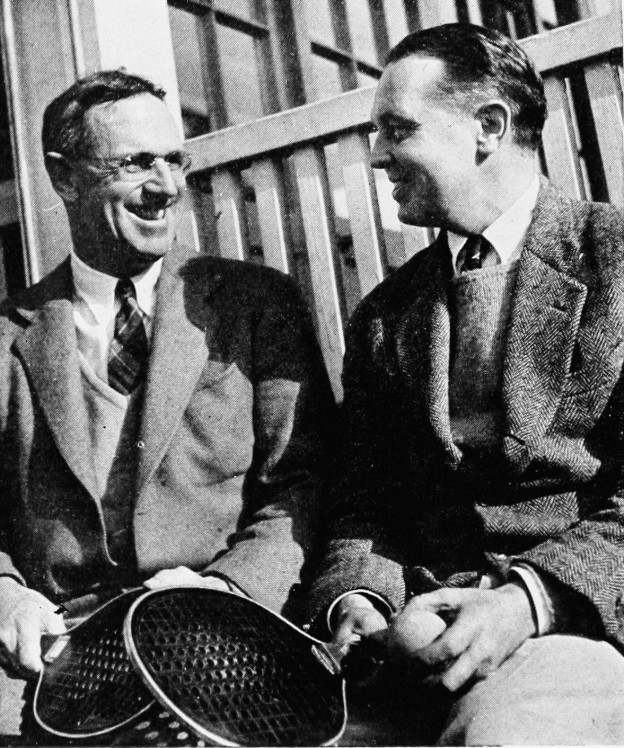
The Founders of the game. Fess Blanchard (left) and Jimmy Cogswell

The APTA Honor Award initiated: 10 pioneers honored

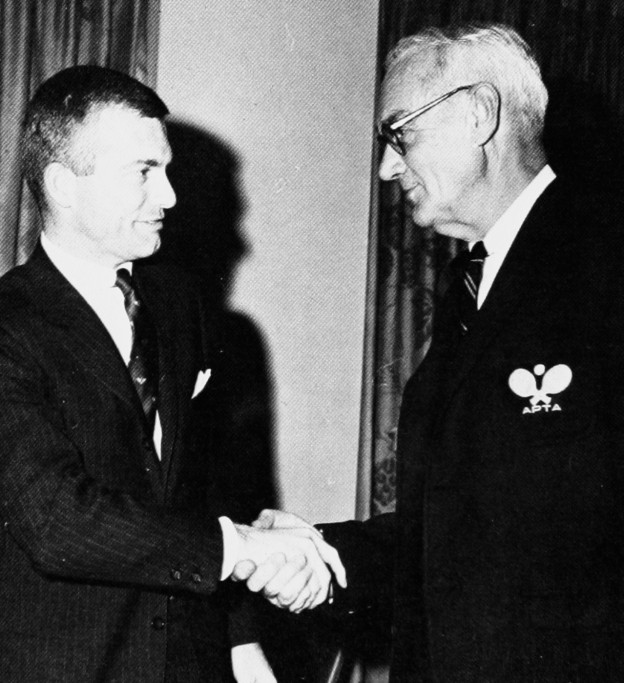
On February 18, 1965, the APTA gave out the inaugural Honor Awards to individuals who had made outstanding contributions to platform tennis. The awards were to be presented when the association’s Executive Committee felt that one or more individuals merited inclusion in the group of men and women who had created the game, nurtured it, or played it as champions.

The first APTA Honor Award Recipients were:

Madeline (Madge) Childress Beck: Considered one of the outstanding women players of the game, Madeline (Madge) Childress Beck won 17 National Championships—12 Women’s, 4 Mixed, and 1 Singles—from 1936 to 1960 and likely would have won more except that the Women’s Nationals were not held from 1943-1948, and the Mixed Nationals were not held from 1943-1945 and in 1948. (Fox Meadow Tennis Club) When it comes to discussing the leading women players developed since the game began, selecting the “leading lady” is easy. According to Fess Blanchard, “not only has this player won more national championships, by far, than any other woman but she has done it with a number of different partners.” (Fox Meadow Tennis Club).

Fessenden S. Blanchard: A co-founder of platform tennis and the game’s greatest supporter and promoter in the early days, Blanchard was also co-founder of the APTA, and its first president from 1934 to 1938. He was a tireless promoter of the game and acted as secretary, chief correspondent and publicist for paddle tennis during his tenure on the APTA Board. He authored two books on the game – Paddle Tennis (1944) and Platform Paddle Tennis (1959). (Fox Meadow Tennis Club).

James K. Cogswell, Jr.: Cogswell was a co-founder of platform tennis, and the first court was erected on his property on Old Army Road in Scarsdale, NY. He discovered the paddles and balls used in paddle tennis, which made the game we know today. With the Cogswell’s hospitality the court became a lively gathering place for enthusiasts. This social aspect has been a hallmark of the game ever since. As a trained engineer and an enthusiastic builder of things from fences to boats, he was responsible for many of the technical improvements in court construction, and developed the first set of construction drawings that were essential for the growth of the game. (Fox Meadow Tennis Club).

Clifford D. (“Kip”) Couch, Jr.: Couch was a three-time National Champion and top contender in National Tournaments from 1935 to 1949. He was considered the “stylist” of platform tennis. (Fox Meadow Tennis Club).

Katherine L. (Kitty) Fuller: Kitty Fuller was one of the pioneers of women’s platform tennis, a fine player and winner of the first mixed doubles championship, with Charley O’Hearn as a partner (1935). She also won the first two women’s doubles championships, with Jean Eaton (1935, 1936) and won the last women’s singles championship ever held (1937). (Fox Meadow Tennis Club).

Earle Gatchell: Gatchell was one of the original group of players on the first court and was credited by Blanchard for being an enthusiastic promoter of the game, “carrying the torch into dark places”.; He was an active player for over thirty years and was particularly interested in promoting the game with younger players. The Boys’ Trophy is dedicated to “Gatch.” (Fox Meadow Tennis Club).

Richard K. Hebard: Richard K. (“Dick”) Hebard was one of the outstanding players of the game, winning eight National Men’s Championships, and five National Mixed Doubles titles,. He continued to play competitively into his “senior” years, winning the National 50+. He was still winning National titles when he received the Honor Award. He served as APTA Secretary/Treasurer from 1950-1952, and President from 1953-1955, completing the latter term while also serving as President of Fox Meadow Tennis Club from 1954-55. (Fox Meadow Tennis Club).

James N. Hynson: Hyson, an excellent tennis player, won two consecutive National Championships (1937-1938), and was instrumental in the construction of the first court at a club—Fox Meadow Tennis Club in 1931. Serving as FMTC President from 1933-35, he helped oversee the addition of courts, and the building of a vibrant paddle community that lead to the club becoming known as “the home of platform tennis.” (Fox Meadow Tennis Club).

Charles M. O’Hearn: Charley O’Hearn dominated the game from 1935 through to 1950 and won ten National Championships—four times in Men’s , five times in Mixed, partnering with his wife Ginnie for four of them, and the last Singles Championship. When he moved to New Haven, CT, in 1951, his involvement in the game declined, although he remained an excellent player. (Fox Meadow Tennis Club).

Kenneth Ward: Kenneth Ward, the father of Scrambles Tournaments, which Blanchard viewed as “one of the greatest steps forward for the game,” served as the third APTA President from 1939-1942. Prior to taking over as president, he served as chairman of the association’s Publicity Committee, and his enthusiasm, combined with sales and promotional ability, brought considerable success to the game, and, by November 1941, the association had 21 member clubs. Blanchard considered him one of the best presidents the APTA had during the first two decades.(Manursing Island Club, Rye, NY).

The Awards continued until 1980, when there was a hiatus in activity. In the early 1990s, under the leadership of then President Chuck Vasoll, the APTA reactivated the Honor Award. In 1996, the APTA Board decided to replace the award and establish a Hall of Fame at the recommendation of President Charley Stevens. The Hall of Fame inducted all former Honor Awardees.

Source: Adapted from Diana Reische, Fox Meadow Tennis Club – The First Hundred Years, 1983, and Christina Kelly, Passing Shots: A Pictorial History of Platform Tennis, 2010


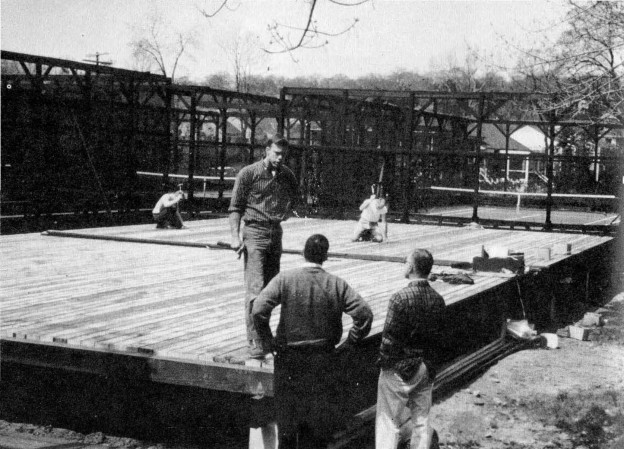
Reilly at work on a court

Richard J. Reilly, Jr. starts building courts

Dick Reilly had started building courts in 1965 and, by 1967, had built over sixty around the country. An enthusiastic player, Reilly developed many improvements in court construction that greatly enhanced durability and playability.

In the early 1970s, he pioneered the aluminum deck, which has become the standard.

Among the many improvements he made to court construction are:

• The use of thirty-foot, kiln-dried deck members, joining under the net, making the playing surface as technically perfect as is possible.

• A two-toned, green and red deck surface on which the white lines were two inches in width. This aided the players’ vision and promoted greater accuracy in a fast-paced rally.

• Hinged snow-boards which facilitated rapid clearing of the court.

• Quartz-iodine lighting for night play.

• The use of one-inch, hexangular, galvanized mesh with a gauge of sixteen, producing a truer rebound from the wire.

• Two-inch pipes in two-and-one-half-inch collars for the net posts, making them removable so that the court could be put to other use.

Source: Oliver H. Durrell, The Official Guide to Platform Tennis, 1967