




National Championships – Inaugural Junior Boy’s (under 20) and Men’s 50+ replaces Men’s 45+

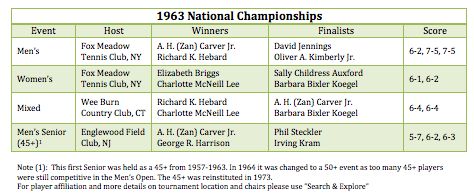
The Men’s 45+ was discontinued and was later reinstated in 19721.
A Men’s Senior 50+ event was added as the new Senior Men’s event.
In the Men’s, David Jennings and Oliver Kimberly, the previous year’s finalists, emerged as the winners over Thomas Holmes and Michael O’Hearn.
Charlotte Lee and Buffy Briggs won their second straight Women’s.
The Fox Meadow pair of Zan Carver and Barbara Koegel won the Mixed (Zan had wanted to take a cigarette break after they had split two long sets, as was his way, but Bobbie would not let him, as was her way!).
Germain Glidden and William Park won the inaugural 50+.
William deSaussure IV and Geoffrey Nixon won the inaugural Boy’s Junior event [Also see APTA 1963 Annual Meeting Minutes], the first of three straight titles for the team.
Note 1: The reason for this was that the APTA concluded that their initial decision to use age 45 for the “senior” category was too young, since four men over 45 years of age had won the 45+senior event as well as the Men’s National Championship between 1964 and 1972. In 1964 the “senior” age became 50+. [Also see APTA 1963 Annual Meeting Minutes]
Source: Oliver H. Durrell The Official Guide to Platform Tennis, 1967; and APTA Platform Paddle Tennis 1963-1973: Rules and Records, 1973; Personal communication from William F. Koegel.
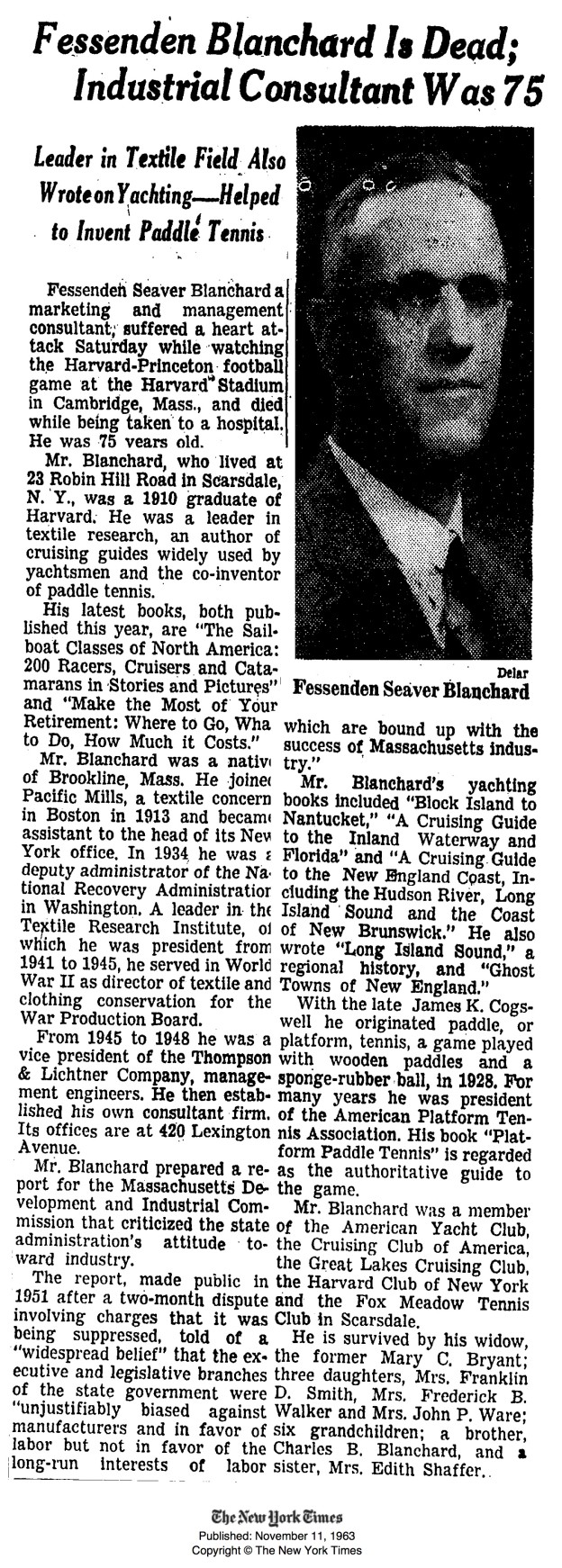
Death of Fessenden S. Blanchard (1888-1963)
Blanchard, a co-founder of the game, suffered a heart attack at the Harvard-Princeton football game at Harvard stadium. A 1910 graduate of Harvard, he was a leader in textile research, a past president of the Textile Research Institute (1941-1945) and, for many years, head of his own industrial relations firm, which he founded in 1948. He served as the first President of the APTA, from 1934-1938, and was a tireless promoter of the game in the early years. He was among the first group of individuals inducted into the Platform Tennis Hall of Fame in 1965. In addition to authoring two books on the game, he also wrote widely on yachting.
One of Blanchard’s reports, prepared for the Massachusetts Development and Industrial Commission and made public in 1951 after a two-month dispute involving charges it was being suppressed, told of a “widespread belief” that the executive and legislative branches of the state government were “unjustifiably biased against manufacturers and in favor of labor but not the long-run interests of labor which are bound up with the success of Massachusetts industry.”
Source: New York Times, November 11, 1963
APTA raises Juniors’ profile – Gatchell Bowl established for National Junior Boy’s
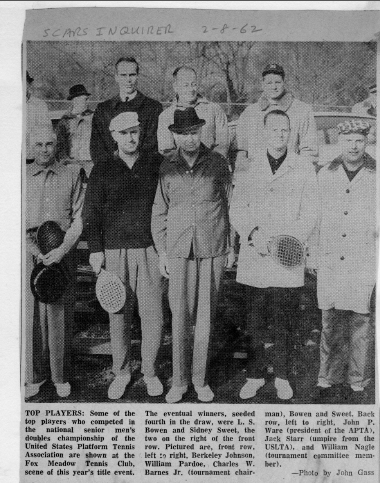
During his tenure on the APTA Board in the early 1960s, John Ware began looking at clubs with dedicated junior programs. In an effort to learn how to encourage other clubs to strengthen their programs, he visited the Englewood Field Club in New Jersey to observe its program. Ware found it to be so impressive that he suggested the APTA sponsor a tournament for boys.
In 19631 Fox Meadow hosted the first National Boys’ Doubles, chaired by Rawle Deland and John Ware (both, appropriately enough, sons-in-law of the game’s founders).
The APTA named the Championship trophy for the recently deceased Hall of Fame inductee Earle Gatchell, a player who had done much to help young players.
His wife, Bertha, presented the first Gatchell Bowl to the winners who, predictably enough, came from Englewood, which had the most active junior program at the time.
Note 1: The Junior Nationals were usually in December, so this event was part of the 1964 tournament season

Paul G. Sullivan elected APTA President (1963-1965)
Sullivan was President of the APTA in 1964 and 1965, and was on the Board for many years prior to that, serving as secretary, treasurer, vice-president, and chairman of the nominating committee.
During his tenure, the association improved its communication with the membership, and set the sport on a more professional footing by demanding quality umpiring and giving APTA more control over tournament draws.

APTA changes ball color specification
In the winter of 1963, an equipment innovation pioneered at Fox Meadow brought new color to the game. Because paddle in the north is often played in snow, the traditional white ball was difficult to see.
John Ware decided that coloring the balls might solve this problem. “I got a can of fluorescent paint, orangey-red, and started spraying paddle balls. These crusty orange balls worked pretty well until they dried out and cracked, and you got paint all over your clothes. But they were the precursors of the present yellow ball.”
The APTA 1963 Annual Meeting Minutes included the following recommendation of Rules and Equipment Chairman George Harrison:
“The committee has spent the past year in an unsuccessful attempt to inveigle the ball manufacturers to produce a regulation ball spray painted with a fluorescent yellow-orange paint. . . . We suggest the member clubs purchase balls in quantity and spray-paint [balls] themselves with Krylon No. 234.”
The changes didn’t officially take place until after the APTA had studied them thoroughly and worked with manufacturers.
Source: Adapted from Diana Reische, Fox Meadow Tennis Club – The First Hundred Years, 1983
Ultimately, of course, the manufacturers came around and produced the colored balls now in common use.
National Championships
Hebard and Carver won their third straight Men’s title, and Charlotte Lee won her second Women’s title with a new partner, Buffy Briggs, and her third straight Mixed, but this time with Dick Hebard, rather than James Gordon.
Zan Carver and George Harrison won the Men’s 45+.
Source: Oliver H. Durrell The Official Guide to Platform Tennis, 1967, APTA Platform Paddle Tennis 1963-1973: Rules and Records, 1973

Sports Illustrated – It’s Wintertime, So Let’s Play Tennis
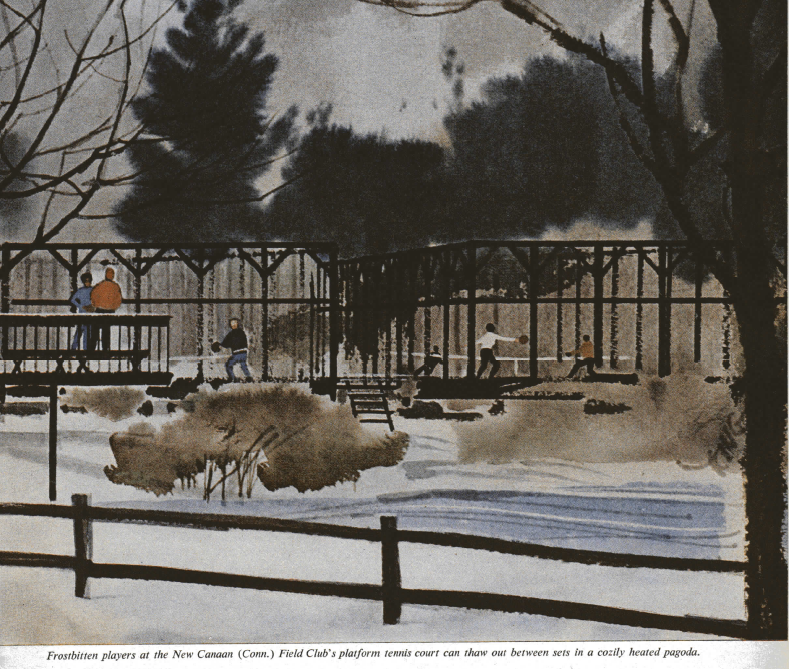
The article by Rex Lardner described the history of the game, where the game was being played, notable players and the casual sociability of the sport, including the “dress code.” The article began….
“The tennis fans of Connecticut and its neighboring states are a hardy lot—at least, a significant and growing number of them are. When winter winds begin to howl and snow blankets their courts, these intrepid racketeers neither give up their ball-banging nor take up squash; they deck themselves instead in a special kind of warm winter finery and move on to a structure of wood and wire to play a game called platform Tennis.”
National Championships – Men’s final filmed for TV
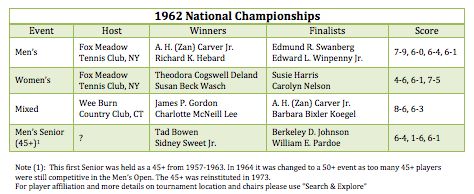
The Men’s final was a repeat of the previous year, although this time Hebard and Carver won in four sets, not five. The Men’s final was filmed for television.
James Gordon and Charlotte Lee repeated as Mixed Winners.
Susan Beck Wasch won her third Women’s title with Cogswell’s daughter, Theodora (Do) Deland.
Source: Oliver H. Durrell, The Official Guide to Platform Tennis, 1967

 © 2026 Platform Tennis Museum and Hall of Fame Foundation, All Rights Reserved.