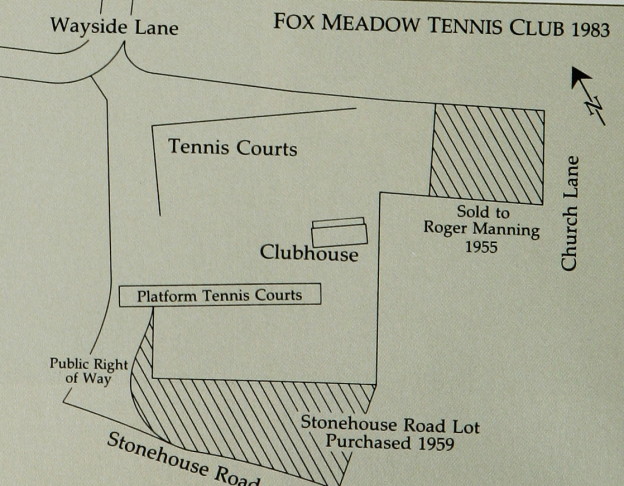
FMTC property showing land sold to Roger Manning in 1955 and parcel purchased in 1959

Fox Meadow acquires property abutting Stonehouse Road

This acquisition completed a plan dating from the late 1940s to sell the Club’s less usable higher land off Church Lane and to expand instead towards the more usable lower land behind the Club.

The higher ground of the Church Lane lot was sold in 1955. Many of the trees planted by the club, starting in 1959-60 under Walter Close, were added to the newly acquired Stonehouse parcel.

Source: Adapted from Diana Reische, Fox Meadow Tennis Club – The First Hundred Years, 1983

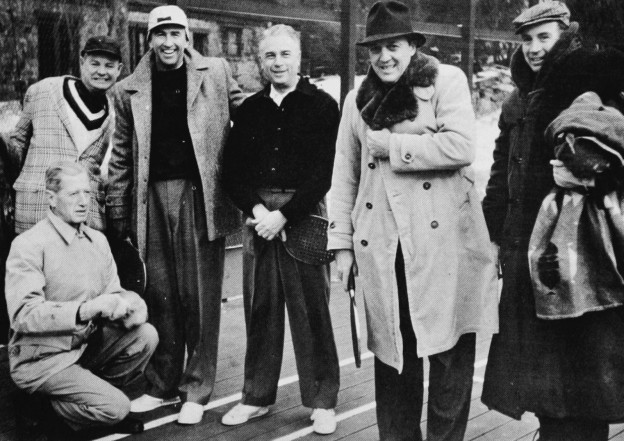
Finalists in Men's Senior Nationals 1958, with Earle Gatchell and Walter Close, who officiated. Left to Right: Earle Gatchell, Jim Carlisle, Frank Pace, Jr., (former Secretary of War), Berk Johnson, Cliff Sutter and Walter Close. Carlisle and Johnson won in 1958, Pace and Sutter in 1959

National Championships

1958

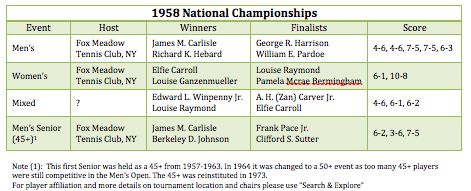
APTA President Carlisle and Johnson repeated in the 45+ and Carlisle also captured the Men’s with partner Hebard when they made a great comeback after being two sets down against the previous year’s winners.

Elfie Carroll and Louise Ganzenmueller, the previous year’s finalists, captured their third title. From 1950-1960 they won three and were finalists four times.

Source: Fessenden S. Blanchard, Platform Paddle Tennis, 1959

Formal foot-fault rules developed

The 1958 Men’s Championships saw the introduction of the formal Foot Fault Rules.

The server shall throughout his delivery (moment of impact of paddle and ball) of his service:

A. Not change his position by walking or running
(1) The server shall not by the following movements of his feet be deemed “to change his position by walking or running”
(a) Slight movements of the feet that do not materially affect the location originally taken by him
(b) An unrestricted movement of one foot so long as the other foot maintains continuously its original contact with the ground. The moving foot cannot touch the baseline or touch inside the court.

B. Maintain contact with the ground (platform)

C. Keep both feet in such a manner so as not to touch the baseline nor touch inside the court.

Source: Fessenden S. Blanchard, Platform Paddle Tennis, 1959

Kip Couch, 1935. Photograph taken a sam-finals of 1935 Men's Doubles

Clifford D. Couch, Jr. elected FMTC President (1957-1959)

Clifford (Kip) Couch was one of the best players in the early APTA championships and was among the first group of individuals inducted into the Platform Tennis Hall of Fame in 1965. The sports writer George Trevor of The Sun (New York) called him the “stylist of the paddle tennis realm.”

National Championships and inaugural Men’s Senior (45+). NBC broadcasted commentary on Men’s Nationals

1957

Don McNeill and Rob Carlisle taped an on-the-spot Men’s Nationals commentary from Fox Meadow Tennis Club which was later broadcast over NBC’s “Monitor” program

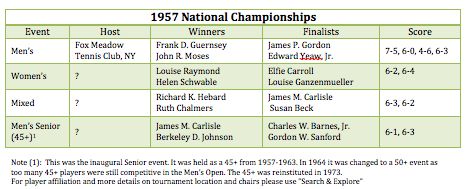
The Nationals now included a Men’s senior event, the 45 or over (this was changed to 50+ in 1965 as too many 45+ players were still very competitive in the Men’s).

Fittingly the new APTA President James Carlisle won the inaugural Men’s Senior with partner Berkeley Johnson, and was a finalist in the Mixed.

The Women’s final pitted two-time champion Louise Ganzenmueller against her sister-in-law Louise Raymond.

The sister-in-law won.

Source: Fessenden S. Blanchard, Platform Paddle Tennis, 1959, and Paddle World Feb/Mar 1979

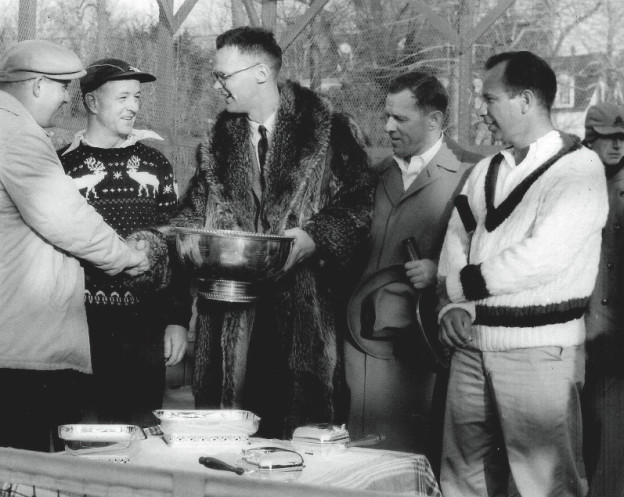
The awards presentation at the 1956 Men’s Nationals (from left): Bill Pardoe, George Harrison, Ted Cook (APTA president and tournament chair), Don McNeill, and Herman Schaefer

National Championships

1956

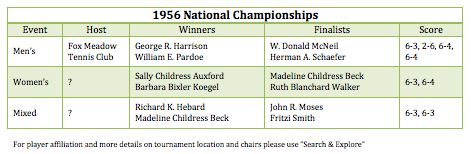
In the Men’s Harrison and Pardoe won their first of their two titles.

Sally Childress Auxford teamed up with Barbara Koegel and got the best of her sister, Madge Beck, and her partner, Blanchard’s daughter, Ruth Walker.

The Mixed was a repeat of the 1955 final but this time Hebard and Madge Beck won.

Source: Fessenden S. Blanchard, Platform Paddle Tennis, 1959

APTA experiments with court dimensions

There had been several suggestions that the length of the court (not the platform) should be increased in order to make it possible to lob more effectively over the heads of opponents and introduce a greater variety of offensive play. By lengthening the court, possibly two feet at each end, the idea was to make it easier to break up long rallies, where poor overheads and short lobs off the backstop were used. The APTA asked Fox Meadow Tennis Club and Orange Lawn Tennis Club to conduct some experiments.

Temporary lines were drawn on one court at each club, making the length of he court 48 feet instead of 44 feet, leaving 6 feet at each end past the backline. With reliable backstops, returning deep drives would not be extremely difficult.

A number of matches used the longer courts. The majority of the players preferred to leave the measurements as they were. Players felt that the longer courts placed too much of a burden on the server and made the game more tiring for older players. In addition, the extra two feet on each side did not make enough difference in lobbing to justify throwing “out of whack” the balance achieved with the existing measurements.

They believed, in general, that things were fine as they were and “why change such a good game?” In other words, most of them just did not like it, so the matter was dropped.

Source: Adapted from Fessenden S. Blanchard, Platform Paddle Tennis, 1959

“Although I believe that, if we had started with the longer measurements, they would have been accepted without complaint and the game might have been slightly better, I was pleased in another way that most of the players liked platform tennis as it was.”

Source: Fessenden S. Blanchard, Platform Paddle Tennis, 1959

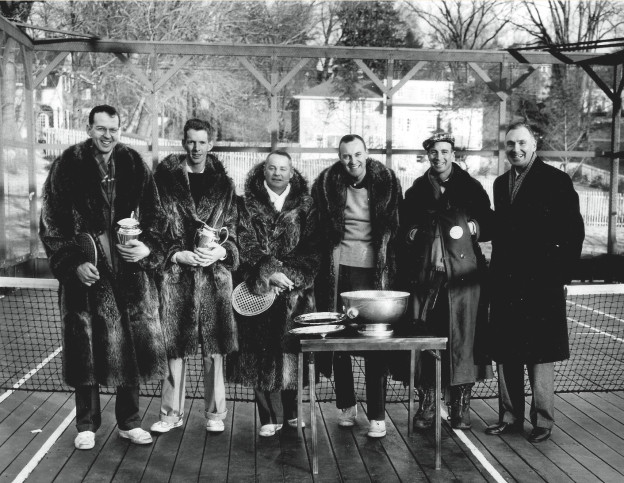
Coonskin coats are the “unofficial” uniform

Paddle’s unofficial uniform

There was no standard or official uniform for paddle players, except maybe in overcoats. Coonskin coats seemed to be the mark of the well-dressed player, except when he was actually playing.

A few of the younger players began turning up with coonskin coats, for which they paid $25 to downtown furriers. When Blanchard went to one of the furriers to get a coat for himself, he was greeted with these remarks: “I have been storing these coonskin coats for years but never had a nibble. But now I am almost sold out. Some people out in Westchester have a game that they play outdoors all winter. They’ve been coming in here and have gobbled up almost all I have”

Source: Fessenden S. Blanchard, Platform Paddle Tennis, 1959